Algorithmic stablecoins are one of the most ambitious experiments in decentralized finance - and one of the most misunderstood. At their core, an algorithmic stablecoin is a cryptocurrency designed to hold a stable value (typically $1 USD) not by holding dollar bills in a bank, but by using smart contracts and onchain algorithms to continuously balance supply and demand. No custodian. No reserve audit. Pure code.
That design is either DeFi's most elegant achievement or its greatest unsolved problem - depending on which chapter of the story you're reading.
⚡ Key Takeaways
- An algorithmic stablecoin maintains its peg through smart contract-driven supply adjustments, not fiat reserves
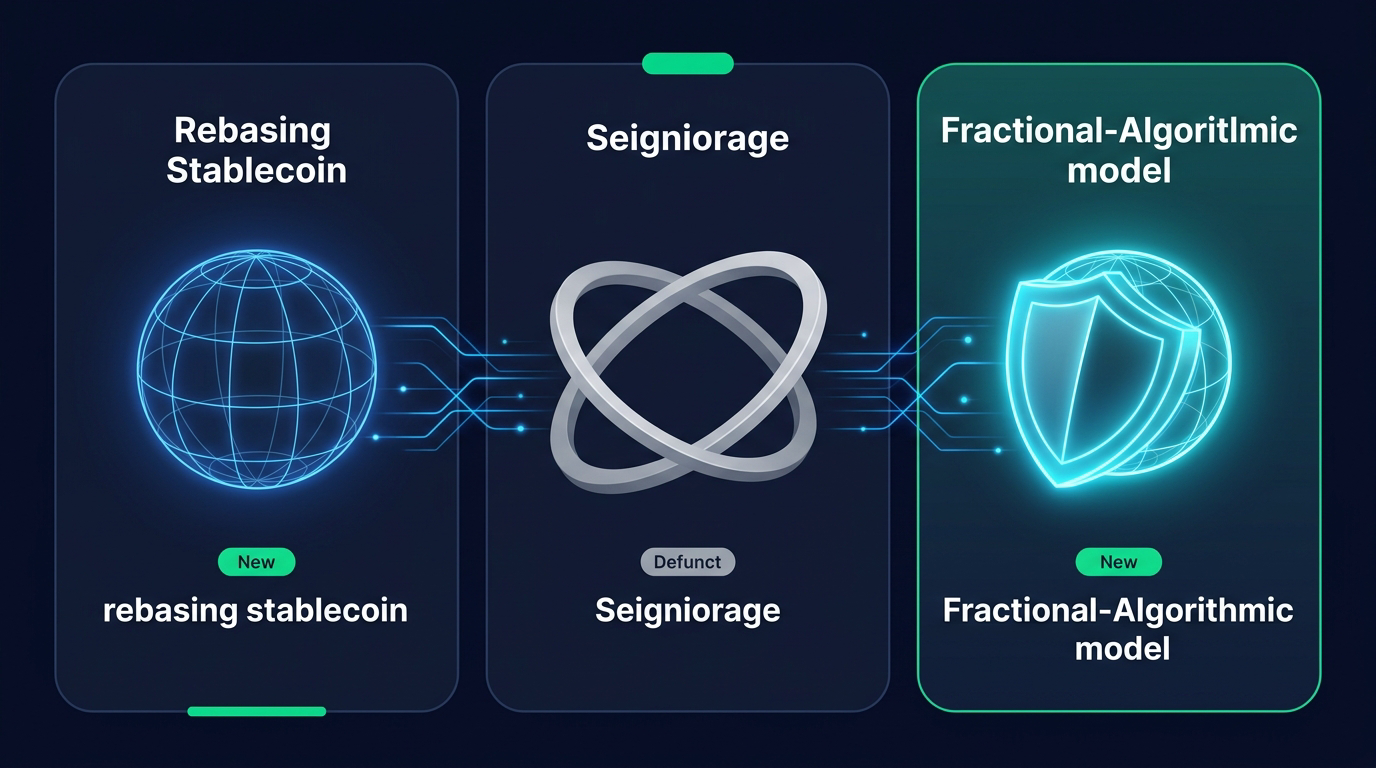
- Three core model types exist: rebasing, seigniorage, and fractional-algorithmic - each with distinct risk and efficiency profiles
- The 2022 collapse of TerraUSD (UST) wiped out over $40 billion and permanently reshaped how the industry designs these systems
- Fractional-algorithmic models (like Frax Finance) are the dominant surviving format in 2026 - and the closest thing to a proven design template
- EU MiCA regulation now effectively bans purely unbacked algorithmic stablecoins from operating as payment instruments within the EU
What Is an Algorithmic Stablecoin?
An algorithmic stablecoin is a digital asset that uses software rules - algorithms encoded into smart contracts - to balance its circulating supply with market demand, with the goal of keeping its price pegged to a target asset, almost always the U.S. dollar.
Contrast this with the familiar fiat-backed model. For every $1 of USDC in circulation, Circle holds $1 of cash or equivalents in a bank account. If you want to redeem, Circle sends you the dollar. Simple, centralized, audited.
Algorithmic stablecoins skip the custodian entirely. Instead, "monetary policy" is written directly into smart contracts: when demand rises and the price pushes above $1, the protocol mints new tokens to increase supply and drive the price back down. When demand falls and price slips below $1, the protocol contracts supply - usually by burning tokens or issuing bond instruments - to push the price back up.
This is essentially a central bank running on code. No board meetings, no discretionary judgment. Just deterministic execution at whatever speed the blockchain processes transactions. The appeal for anyone serious about decentralization is real. So is the complexity - and the risk that comes with it.
How the Peg Mechanism Works: Minting, Burning, and Rebalancing
Understanding how an algorithmic stablecoin actually maintains its peg comes down to two events: expansion and contraction. Here's how each plays out onchain.
Expansion Event (Price > $1):
- Market demand rises - more buyers than sellers push price above $1
- The price oracle feeds this market data to the smart contract
- The contract mints new stablecoin tokens, increasing circulating supply
- Additional supply creates selling pressure that returns price toward $1
Contraction Event (Price < $1):
- Demand drops - sellers outnumber buyers, price falls below $1
- The oracle confirms the price deviation to the smart contract
- The contract incentivizes users to burn stablecoins (often in exchange for bond tokens redeemable at a premium later)
- Reduced circulating supply removes selling pressure, allowing price recovery
A third force also operates in parallel: arbitrageurs. When the stablecoin trades below $1, arbitrageurs buy cheap tokens, burn them through the protocol for bond instruments, and pocket the difference when the peg recovers. This profit motive actively reinforces the algorithmic mechanism - in theory. When market confidence holds, arbitrage accelerates peg restoration. When confidence collapses, arbitrageurs flip to the other side and accelerate the fall.
One dependency is non-negotiable throughout this entire process: the oracle. Smart contracts can't check their own token's market price independently. They rely on external price feeds to know when to trigger minting or burning. If that data is delayed, inaccurate, or manipulated, the entire rebalancing mechanism misfires.
Types of Algorithmic Stablecoins
Not all algorithmic stablecoins use the same approach. Three distinct model types have emerged from years of experimentation - each with different mechanics, trade-offs, and survival rates.
Rebasing protocols (Ampleforth/AMPL) adjust the number of tokens in every holder's wallet directly. If AMPL trades above $1, everyone's balance increases proportionally. Below $1, everyone's balance shrinks. The price targets $1 by changing quantity, not by buying and selling on the open market.
Seigniorage models use two tokens: the stablecoin and a companion "share" or "bond" token that absorbs volatility. When the stablecoin falls below peg, users burn it for discounted companion tokens; when peg recovers, the protocol mints new stablecoins to redeem those bonds with profit. Terra/LUNA was the largest implementation - and its collapse in 2022 exposed the fundamental weakness of designs with no hard collateral floor.
Fractional-Algorithmic stablecoins combine partial hard collateral (like USDC) with algorithmic supply management. Frax Finance, which pioneered this model, manages a dynamic collateral ratio that shifts based on market conditions. This design has survived multiple crypto market cycles and remains the most credible surviving template in 2026.

Key Examples of Algorithmic Stablecoins (2026)
The algorithmic stablecoin space in 2026 is smaller, more cautious, and more collateralized than it was in 2021. Pure algorithmic designs have largely been discredited by the Terra collapse. What remains is a hybrid-dominant ecosystem where surviving projects have either adapted toward higher collateralization or occupy niche positions through their unique mechanism design.
According to CoinGecko, algorithmic stablecoins collectively represent less than 2% of the total stablecoin market. That small market share reflects the confidence damage from Terra - and the ongoing challenge of building algorithmic stability that survives adversarial market conditions.
Frax Finance (FRAX) - The Fractional-Algorithmic Pioneer
Frax Finance launched in late 2020 as the first fractional-algorithmic stablecoin and remains the clearest proof of concept that hybrid designs can sustain a peg through volatile conditions.
The core insight of Frax is simple: don't choose between pure algorithmic efficiency and full collateral security - let the market determine the right balance. The FXS governance token absorbs volatility on behalf of FRAX holders. When FRAX falls below peg, the mechanism burns FRAX in exchange for FXS, contracting stablecoin supply. When FRAX exceeds peg, it mints new FRAX while distributing FXS to liquidity providers.
After Terra's collapse in May 2022, Frax moved decisively toward higher collateralization - a pragmatic adaptation that reflected both market reality and regulatory direction. That willingness to evolve is part of what distinguishes it from failed purely algorithmic designs.
TerraUSD (UST) and LUNA - The Cautionary Tale
Every discussion of algorithmic stablecoins runs through May 2022. What happened to TerraUSD isn't a footnote - it's the defining event that restructured the entire space.
THE UST COLLAPSE: DAY BY DAY (MAY 2022)
Day 1 - May 7
Large UST withdrawals from Anchor Protocol destabilize the peg; UST slips to ~$0.98
Days 2-3
Panic redemptions accelerate; users redeem UST for LUNA at scale, flooding the LUNA market
Day 4 - Critical Point
LUNA hyperinflation begins - supply expands massively as redemptions continue; LUNA price crashes from ~$60 to below $1
Days 5-6 - Total Collapse
UST falls to ~$0.10; LUNA drops to fractions of a cent. Over $40 billion in combined market value destroyed within days
UST was a pure seigniorage stablecoin backed only by LUNA - a volatile companion token with no hard asset floor. The Anchor Protocol artificially inflated demand by offering ~20% annual yield on UST deposits. That yield was unsustainable by any rational analysis, but it kept money flowing in.
The specific failure mode: reflexive tokenomics with no hard collateral floor and no emergency mechanism to pause redemptions. Once the loop started, the algorithm executed exactly as designed - destroying both assets in the process.
Ampleforth (AMPL) and Ethena (USDe) - Alternative Approaches
Ampleforth (AMPL) takes rebasing to its logical extreme: no collateral, no companion token, just daily supply adjustments applied directly to every wallet. The protocol has operated since 2019 without a major collapse - partly because its niche positioning limits the scale of any potential bank run.
Ethena (USDe) represents a newer generation of thinking: maintain a delta-neutral position by holding staked ETH while simultaneously shorting ETH perpetuals. The staking yield and short funding fees generate real returns for USDe holders without token emissions. Circuit breakers can pause the system if collateral ratios fall out of bounds - exactly the direction the market has moved post-Terra.
Benefits of Algorithmic Stablecoins
Despite the high-profile failures, algorithmic stablecoins continue to attract developers and researchers. The reasons are structural - the genuine advantages of the model haven't disappeared, they've just been put in sharper relief against known risks.
📊 Core Advantages at a Glance
- Capital Efficiency - No need to lock $1 of real reserves per $1 issued; supply can scale without pre-existing collateral
- Decentralization - No corporate custodian, no freeze buttons, governed entirely by code and community
- Censorship Resistance - Unlike USDC (which carries issuer blacklisting capability), a well-designed algorithmic stablecoin can't be blocked by a single entity
- Transparency - All supply adjustments are visible onchain in real time; no opaque reserve reports
- DeFi Composability - Designed natively for smart contract environments, integrating directly with lending pools, DEXs, and yield protocols
Capital efficiency is the strongest argument. A fiat-backed stablecoin requires 100% collateral to back every token - meaning $1 billion of USDC demands $1 billion of dollars sitting idle in a bank. An algorithmic stablecoin can theoretically mint $1 billion of supply with a fraction of that capital locked as collateral. For a DeFi ecosystem trying to create a global, permissionless financial layer, that scalability matters enormously.
Censorship resistance is the other core value. USDC and USDT have both demonstrated willingness to freeze addresses at regulatory request - a feature from a compliance standpoint, and a failure mode from a decentralization standpoint. An algorithmic stablecoin running on immutable smart contracts with appropriate time-lock governance can't be frozen by its creators.
Each of these advantages comes with a corresponding trade-off. Capital efficiency means less safety margin. Decentralization means no rescue mechanism. Censorship resistance means no recourse if something goes wrong.
Risks and Challenges of Algorithmic Stablecoins
Here's the honest assessment: algorithmic stablecoins carry a uniquely complex risk profile because their stability is entirely confidence-dependent. Unlike a fiat-backed stablecoin that can be redeemed 1:1 for dollar reserves, an algorithmic stablecoin has no safety net of last resort. When the algorithm works, the peg holds. When confidence collapses, the algorithm itself becomes the weapon that destroys value.
De-Pegging Events and Death Spirals
The death spiral is the failure mode unique to algorithmic stablecoins - and understanding its mechanics is non-negotiable before engaging with any project in this space.
THE DEATH SPIRAL - FEEDBACK LOOP
Step 1
Price falls below $1 due to market sell pressure
Step 2
Users lose confidence → mass redemptions begin
Step 3 - Critical
Protocol burns stablecoins, mints companion tokens → companion token supply floods the market → companion token price crashes
Step 4 - Loop Accelerates
Lower companion token value reduces stablecoin backing further → more confidence lost → more redemptions → more companion tokens minted
End State
System becomes economically insolvent - algorithm executes faithfully while destroying all remaining value
In a seigniorage system with no hard collateral, there's no mechanism to break this loop. Newer designs address this directly. Frax maintains a hard collateral floor that can't be algorithmically eroded. The lesson from Terra wasn't that algorithmic stability is impossible - it's that algorithmic stability without a hard floor is not a stablecoin design, it's a confidence game.
Smart Contract Vulnerabilities and Oracle Manipulation
Two technical risk vectors operate independently of market conditions and deserve specific attention.
Smart contract risk is the risk of bugs in the code governing minting, burning, and collateral management. Even audited contracts have been exploited across DeFi - the attack surface is large, and algorithmic stablecoin contracts are high-value targets because they control supply directly.
Oracle manipulation is the more insidious risk. Flash loan attacks - where an attacker borrows massive capital within a single transaction to manipulate a DEX price - can feed false prices to single-source oracles. If the oracle tells the smart contract that a token trades at $0.50 when it actually trades at $0.99, the protocol triggers an unnecessary contraction event. Multi-source oracle aggregation and time-weighted average prices (TWAP) significantly reduce this attack surface. A protocol using a single DEX-based oracle in 2026 is running with an avoidable vulnerability.
Regulatory Risk - MiCA and the Global Landscape
Post-Terra, regulators moved fast. The algorithmic stablecoin sector now operates under a tightening global framework, as tracked by Messari's regulatory coverage.
EU MiCA regulation - fully effective since 2024 - classifies unbacked algorithmic stablecoins outside the permissible frameworks for "asset-referenced tokens" and "e-money tokens." Fractional-algorithmic models with adequate documented collateral have a clearer path to compliance. Pure algorithmic models don't. This isn't speculation - it's the current state of the most advanced crypto regulatory framework on the planet.

How to Evaluate an Algorithmic Stablecoin - Before You Engage
Most DeFi users interact with stablecoins without understanding the underlying risk architecture. That's fine when using USDC. With algorithmic stablecoins, it's how people lose money in events they describe as "sudden" - even though the warning signs were visible from the start.
Here's the evaluation framework I use before engaging with any algorithmic stablecoin project. You can also reference how liquidity pools work to better understand liquidity depth as a risk factor.
Key Evaluation Criteria: Collateral, Oracles, Governance, and Liquidity
Collateral ratio is the most important number. For any stablecoin claiming algorithmic mechanics, the first question is: what percentage of outstanding supply is backed by assets that would retain value independently? Below 50% without hard circuit breakers is high risk - the algorithm has more work to do and less safety margin when market stress hits.
Oracle provider quality determines whether the mechanism triggers on real data or manipulated inputs. Multi-source oracles that aggregate prices across multiple venues - with manipulation-resistant TWAP mechanisms - are the current standard. A project using a single liquidity pool as its price oracle in 2026 has either not prioritized security or doesn't understand the attack surface.
Governance model defines who can change the rules. Time-locked multi-signature setups with community voting and mandatory 48-hour+ delays create meaningful protection against admin key compromises. Instant admin upgrade capability - even from a well-intentioned team - represents a centralization risk that undermines the entire decentralization thesis.
Liquidity depth is a practical risk multiplier. During sell pressure, thin liquidity means even small redemptions create disproportionate price impact, accelerating any de-peg. Tracking liquidity depth across venues via DefiLlama is a practical first step in any due diligence process.
Algorithmic vs. Fiat-Backed vs. Crypto-Backed - Full Comparison
No model is universally "best" - the right choice depends entirely on use case and risk tolerance. Fiat-backed stablecoins remain dominant for a reason: they're simple, stable, and regulatorily legible. Algorithmic stablecoins, at their best (FRAX post-2022), offer genuine capital efficiency and decentralization at the cost of higher complexity and confidence-dependent stability.
How Algorithmic Stablecoins Are Used in DeFi
Theoretical peg mechanisms matter, but the reason algorithmic stablecoins continue to exist is that they have real utility within DeFi ecosystems - utility that fiat-backed stablecoins either can't replicate or replicate at higher cost. Understanding impermanent loss in liquidity pools is essential context for any participant deploying algorithmic stablecoins in yield strategies.
📊 Core DeFi Use Cases
- DEX Liquidity Pools - Algorithmic stablecoins provide trading pairs on DEXs like Curve and Uniswap with near-zero slippage. FRAX/USDC pools on Curve consistently rank among the highest-volume stable pairs
- Yield Farming - DeFi protocols offer enhanced yield for providing algorithmic stablecoin liquidity, creating passive return opportunities for experienced participants
- Lending and Borrowing - Protocols like Aave accept algorithmic stablecoins as borrowable assets and, in some configurations, collateral - subject to each protocol's individual risk parameters
- Cross-Border Value Transfer - Capital-efficient algorithmic stablecoins enable low-cost international transactions without requiring dollar reserves in each jurisdiction
One underappreciated risk: DeFi composability creates contagion pathways. When an algorithmic stablecoin de-pegs, every lending pool that holds it as collateral, every DEX that includes it in a trading pair, and every yield protocol with liquidity exposure gets affected in cascade. This is exactly what happened with protocols holding UST when Terra collapsed - protocols that had no direct exposure to Terra's algorithm got hit through composability.
The practical implication: when evaluating an algorithmic stablecoin's DeFi integration, the quality of the protocol matters as much as the quality of the stablecoin itself.
Red Flags and Warning Signs in Algorithmic Stablecoin Projects
Understanding algorithmic stablecoin mechanics is useful. Spotting the projects most likely to fail before they do is more useful.
Anchor Protocol's 20% APY is worth dwelling on because it perfectly illustrates how yield promises become liabilities. That rate was partially subsidized from Terra's treasury - not generated organically from protocol fees. It was a marketing cost disguised as yield. When the subsidy ended and confidence wavered, the artificial demand that yield had created collapsed simultaneously with the peg.
Any stablecoin offering yield significantly above prevailing DeFi market rates deserves immediate scrutiny of its yield source. Real yield - the kind generated by platform fees, lending spreads, or protocol revenue - is what sustainable DeFi protocols build around. Yield that exceeds what the protocol actually earns is a subsidy, and subsidies end.
The Future of Algorithmic Stablecoins - Trends and Outlook (2026 and Beyond)
The algorithmic stablecoin landscape has changed more in four years than in the preceding decade. Where the space goes from here depends on three forces operating simultaneously: design evolution, regulatory crystallization, and competitive pressure from adjacent products.
THE ROAD HERE AND AHEAD
2022
Terra/LUNA collapse - $40B+ wiped, pure algorithmic confidence permanently damaged
2024
EU MiCA enacted - unbacked algorithmic stablecoins effectively banned as EU payment instruments
2025-2026 - Current
Hybrid fractional-algorithmic models (Frax, Ethena) establish dominance as the survivable design standard
2026 Emerging
AI-assisted supply management systems begin pilot integration in newer protocol designs
2027+ - Expected
US stablecoin legislation expected to reach clarity - outcome will determine whether hybrid models gain institutional legitimacy or face further restriction
The shift toward hybrid models is not a trend - it's a settled outcome. Pure algorithmic stablecoins without meaningful collateral floors have no institutional adoption path, no regulatory compliance pathway under MiCA, and no credible defense against death spiral dynamics. What the market has selected for is fractional-algorithmic designs with documented collateral and circuit breakers.
AI-powered stability systems represent the genuinely new frontier. Several protocol teams are integrating AI models that monitor market conditions, liquidity flows, and onchain sentiment to pre-emptively adjust supply parameters before stress events escalate. Early implementations show promise in reducing reaction latency - but they also introduce model risk that adds a new layer to an already complex risk profile.
CBDC competition is real but not immediate. Central bank digital currencies operate on fundamentally different rails - permissioned, custodial, identity-linked - positioning them as substitutes for fiat-backed stablecoins far more than for algorithmic ones. The decentralized, censorship-resistant value proposition of a well-designed algorithmic stablecoin targets a different user than a CBDC ever will.

Conclusion - Is an Algorithmic Stablecoin Right for You?
Algorithmic stablecoins represent one of the most ambitious attempts to solve a genuinely hard problem: creating stable, decentralized money without the centralization and capital inefficiency of holding bank reserves. That ambition is real, and the best surviving designs - particularly the fractional-algorithmic hybrids - demonstrate that the problem is solvable with the right architecture.
But "solvable with the right architecture" is very different from "safe to use without understanding the design."
Whether algorithmic stablecoins succeed long-term depends on design innovation, regulatory clarity, and market trust - the same three factors that have shaped this space since 2018. The toolkit to evaluate them is now in your hands.
Platforms built on onchain verifiability and transparent mechanics - where every supply adjustment is auditable, every collateral ratio is visible in real time, and no single party controls the kill switch - reflect where DeFi is genuinely headed. The era of "trust us, the numbers work" is over. Verifiability is the baseline expectation now, and projects that embrace it from day one are the ones positioned to matter in 2027 and beyond.
Crypto trading and DeFi engagement involve substantial risk of loss. Algorithmic stablecoins carry unique risks including de-pegging, death spirals, smart contract vulnerabilities, and regulatory restrictions. This article is for informational purposes only and does not constitute financial advice. Conduct your own research before engaging with any protocol.
Last updated: March 2026.
Frequently Asked Questions
What is an algorithmic stablecoin?
An algorithmic stablecoin is a cryptocurrency designed to maintain a stable value - typically $1 USD - through smart contract-driven supply adjustments rather than by holding fiat reserves in a bank. When price rises above $1, the protocol mints new tokens to increase supply. When price falls below $1, it burns tokens or issues bond instruments to contract supply. The stability comes from code and market incentives, not from a custodian holding dollars on your behalf. All supply changes are visible onchain and verifiable by anyone.
Why did TerraUSD (UST) collapse?
TerraUSD (UST) collapsed in May 2022 because it was a pure seigniorage stablecoin with no hard collateral floor, backed only by LUNA - a volatile companion token. The Anchor Protocol had artificially inflated UST demand by offering approximately 20% annual yield, partially subsidized from Terra's treasury rather than from sustainable protocol revenue. When large withdrawals began and the peg broke, mass redemptions flooded the market with LUNA tokens, crashing LUNA's price, which further undermined UST's backing, triggering more redemptions. This self-reinforcing loop - a death spiral - wiped over $40 billion in combined value within approximately five days.
What are the main types of algorithmic stablecoins?
Three core model types have emerged. Rebasing stablecoins (like Ampleforth/AMPL) automatically adjust token balances in every holder's wallet to target $1 - if the price is high, your balance increases; if low, it decreases. Seigniorage stablecoins (like the now-defunct TerraUSD) use a dual-token system where a companion token absorbs volatility. Fractional-algorithmic stablecoins (like Frax Finance/FRAX) combine partial hard collateral with algorithmic supply management. In 2026, fractional-algorithmic designs dominate the surviving landscape, as pure models without hard collateral floors were largely discredited by the 2022 Terra collapse.
Are algorithmic stablecoins regulated?
Regulatory treatment varies by jurisdiction, but the trend is clear: increasing oversight with stricter requirements for algorithmic designs. EU MiCA (effective 2024) effectively bans unbacked algorithmic stablecoins from operating as payment instruments within the EU, requiring significant collateralization for qualifying stablecoins. US regulatory frameworks continue developing, with Congressional stablecoin legislation under active debate as of 2026. Singapore's MAS requires documented reserve disclosures. Fractional-algorithmic models with documented hard collateral have clearer compliance pathways than pure algorithmic designs in virtually every major jurisdiction.
How do I evaluate an algorithmic stablecoin before engaging?
Apply a six-point due diligence framework. First, check collateral ratio - is a meaningful percentage of the supply backed by hard assets, verifiable onchain? Second, evaluate oracle quality - does the protocol use multi-source aggregated oracles (Chainlink, Pyth) with TWAP, or a single manipulable DEX feed? Third, examine governance - are contract upgrades time-locked with community oversight? Fourth, assess liquidity depth across DEX and CEX venues. Fifth, review independent audit history - have two or more firms published public reports? Sixth, scrutinize yield promises - if the APY significantly exceeds prevailing market rates, identify precisely where that yield originates.
What is the future of algorithmic stablecoins?
Three trajectories are converging through 2027. Hybrid models with fractional collateral backing are consolidating as the industry standard - pure algorithmic designs without hard collateral floors have no viable path in a post-MiCA regulatory environment. AI-assisted supply management is emerging as a technical differentiator, with protocols integrating machine learning models to pre-empt stress events faster than static smart contract rules. US stablecoin legislation - expected to reach clarity by 2027 - will be decisive for whether compliant hybrid designs gain institutional adoption or face further restriction. CBDC competition is unlikely to displace algorithmic stablecoins, which target a decentralization-focused user base that CBDCs don't serve.
What is a death spiral in crypto?
A death spiral is a self-reinforcing feedback loop that destroys an algorithmic stablecoin when market confidence collapses. The sequence: the stablecoin's price falls below $1 → users redeem at scale → the protocol mints companion tokens to cover redemptions → companion token supply floods the market → companion token price crashes → backing for the stablecoin weakens → more confidence lost → more redemptions → the loop accelerates. Each iteration makes recovery harder. Without a hard collateral floor to break the cycle, the system reaches economic insolvency rapidly. TerraUSD/LUNA is the most documented example of this dynamic at scale.