Looking for the best GPU for mining cryptocurrency in 2026? With Ethereum's move to Proof-of-Stake and Bitcoin requiring specialized ASIC hardware, GPU mining has evolved significantly. Today, graphics cards remain profitable for mining altcoins like Kaspa, Ravencoin, Flux, and Ergo - but only with the right hardware and realistic expectations.
⚡ Quick Answer
The NVIDIA RTX 4070 is the best overall GPU for mining in 2026, offering excellent efficiency at 7-8 MH/s per watt. For raw power, the RTX 4090 delivers ~2.0 GH/s on Kaspa. Budget miners should consider the RTX 3070 Ti at $250-280 used. Important: You cannot mine Bitcoin with GPUs - BTC requires ASIC miners.
The GPU mining landscape has changed dramatically since 2021. While the days of mining Ethereum with consumer graphics cards are over, profitable opportunities still exist for miners who understand efficiency, power costs, and which coins to target.
This comprehensive guide covers the top mining GPUs for 2026, realistic profitability expectations, ROI calculations, and everything you need to know before investing in mining hardware.
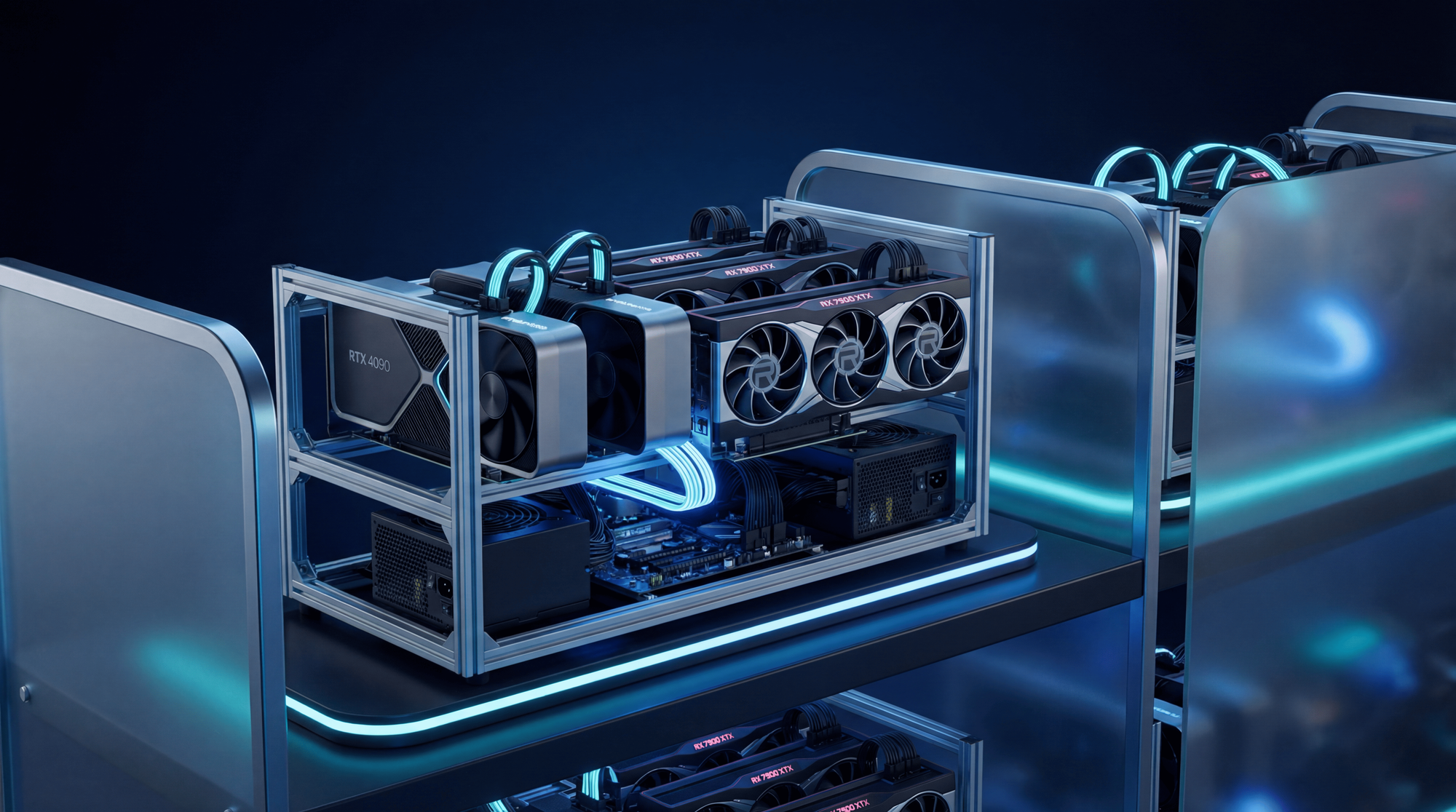
Can You Mine Bitcoin with a GPU in 2026?
Let's address the elephant in the room: No, you cannot profitably mine Bitcoin with a GPU in 2026.
Bitcoin mining requires Application-Specific Integrated Circuit (ASIC) miners. These specialized machines deliver terahashes per second (TH/s), while even the most powerful consumer GPU produces only megahashes (MH/s) on Bitcoin's SHA-256 algorithm - a million-fold difference.
⚠ Important Clarification
Bitcoin mining with GPUs became obsolete around 2015 when ASIC miners dominated the network. An Antminer S21 Pro produces 200 TH/s - more hashpower than thousands of RTX 4090s combined. If you want to mine Bitcoin, you need ASIC hardware costing $3,000-$15,000+.
What Cryptocurrencies Can You Mine with GPU in 2026?
While Bitcoin and Ethereum are off the table, several profitable altcoins remain GPU-mineable:
Kaspa (KAS) - Currently the most profitable GPU-mineable coin, using the kHeavyHash algorithm. Rewards raw throughput and efficiency.
Ravencoin (RVN) - Uses KawPoW algorithm requiring 6+ GB VRAM. Popular for miners with higher-end cards.
Flux (FLUX) - Uses ZelHash algorithm, rewards memory bandwidth. Requires 8+ GB VRAM for optimal performance.
Ergo (ERG) - ASIC-resistant Autolykos v2 algorithm. Memory-intensive, works well on cards with high bandwidth.
Ethereum Classic (ETC) - Still uses Ethash algorithm after Ethereum's Merge. Profitable with efficient cards.
Understanding which coins match your hardware is crucial for maximizing mining profitability. Learn more about what cryptocurrency mining involves before investing in hardware.
What to Look for When Choosing Mining GPUs
Before comparing specific cards, you need to understand the key metrics that determine mining profitability.
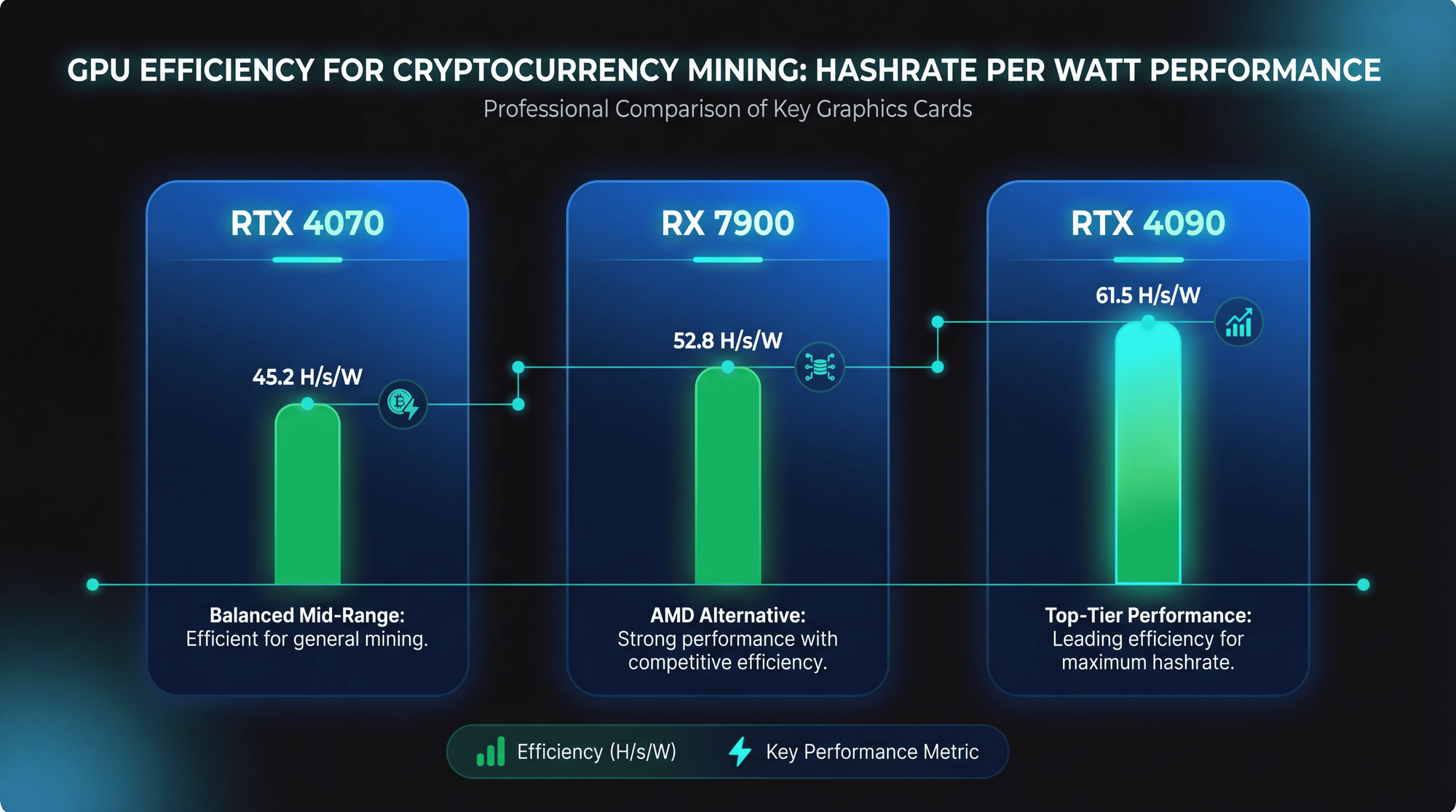
Efficiency (Hashrate per Watt)
Efficiency is the most important factor for mining profitability in 2026. It measures how much computational work your GPU performs relative to power consumed.
Formula: Efficiency = Hashrate ÷ Power (e.g., 860 MH/s ÷ 120W = 7.17 MH/s per watt)
Higher efficiency means lower electricity costs and better profitability. A card with moderate hashrate but excellent efficiency often beats a power-hungry beast.
VRAM Requirements
Different mining algorithms have different memory requirements:
| Coin | Algorithm | Minimum VRAM | Recommended |
|---|---|---|---|
| Kaspa | kHeavyHash | 4 GB | 8+ GB |
| Ravencoin | KawPoW | 6 GB | 8+ GB |
| Flux | ZelHash | 6 GB | 8+ GB |
| Ergo | Autolykos v2 | 4 GB | 6+ GB |
| ETC | Etchash | 5 GB | 8+ GB |
Power Consumption and Electricity Costs
Power consumption determines your ongoing operational costs. At $0.10/kWh, a 300W GPU costs $7.20/month in electricity alone.
Daily Power Cost Formula:
'''
Daily Cost = (Watts ÷ 1000) . 24 hours . $/kWh
Example: (120W ÷ 1000) . 24 . $0.10 = $0.29/day
'''
Most profitable GPU mining requires electricity rates under $0.10/kWh. At $0.20/kWh, many rigs operate at a loss.
ROI Calculation
Before buying any mining GPU, calculate your return on investment:
ROI Formula:
'''
ROI (days) = GPU Cost ÷ Daily Net Profit
Daily Net Profit = Daily Revenue - Power Cost - Pool Fees (1-2%)
'''
In 2026, typical ROI periods range from 2-5+ years for new GPUs. Used cards offer faster payback but may have reduced lifespan.
Best High-End GPUs for Mining (2026)
High-end GPUs deliver maximum hashrate for serious miners with access to cheap electricity. These cards excel for those prioritizing raw performance over efficiency.
NVIDIA GeForce RTX 4090 - The Hashrate King
The RTX 4090 remains the undisputed leader in raw mining performance for consumer GPUs. Built on NVIDIA's Ada Lovelace architecture with 16,384 CUDA cores and 24 GB GDDR6X memory, it dominates hashrate benchmarks across all GPU-mineable algorithms.
Mining Performance:
- Kaspa (kHeavyHash): ~2.0 GH/s @ 240W tuned
- Ravencoin (KawPoW): ~67 MH/s @ 330W
- Ergo (Autolykos): ~265 MH/s @ 250W
Profitability Reality:
At $0.10/kWh electricity, the RTX 4090 generates approximately $0.80-1.20 daily profit after power costs on Kaspa. With a $1,600+ price tag, ROI stretches to 4-5 years.
Best For: Miners with very cheap electricity ($0.05/kWh or less) or free solar power who prioritize maximum hashrate.
NVIDIA GeForce RTX 5090 - Next-Gen Powerhouse
NVIDIA's latest Blackwell architecture card features 32 GB GDDR7 VRAM and 21,760 CUDA cores. Early mining benchmarks show promising hashrates but extremely high power consumption (400-575W).
Profitability Reality:
The RTX 5090 is power-hungry even by high-end standards. Only viable for miners with near-free electricity. Most miners should wait for efficiency optimizations and driver updates before investing.
AMD Radeon RX 7900 XTX - Best AMD Option
AMD's flagship offers competitive performance at a lower price point than NVIDIA alternatives. The 24 GB GDDR6 memory handles memory-intensive algorithms well.
Mining Performance:
- Kaspa: ~1.2 GH/s @ 270W
- Ravencoin: ~58 MH/s @ 300W
- Ergo: ~180 MH/s @ 250W
Pros: Lower upfront cost, excellent VRAM capacity, strong on memory-bound algorithms
Cons: Less efficient than NVIDIA, runs hot, requires quality cooling
Understanding how blockchain networks validate transactions helps explain why mining hardware matters for network security.
Best Mid-Range GPUs for Mining (Efficiency Champions)
Mid-range GPUs offer the best balance of performance, efficiency, and ROI in 2026. These cards are recommended for most miners.
NVIDIA RTX 4070 / 4070 Super - Best Overall Choice ⭐
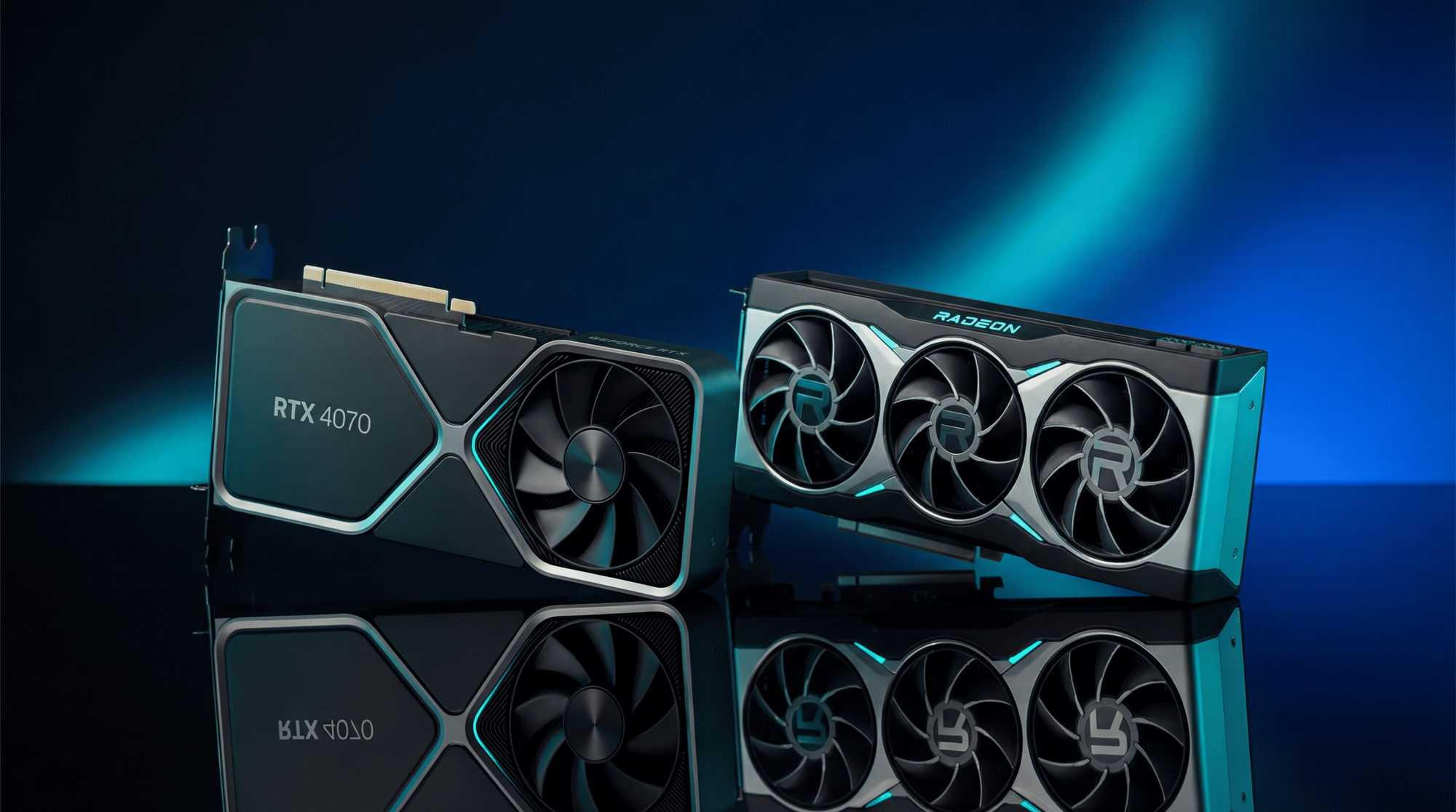
The RTX 4070 series represents the sweet spot for mining efficiency in 2026. With 12 GB GDDR6X memory and exceptional power efficiency, these cards deliver the best hashrate-per-watt ratio among consumer GPUs.
Mining Performance:
- Kaspa: 860-880 MH/s @ 120W (undervolted)
- Efficiency: 7-8 MH/s per watt - nearly matching the RTX 4090
- Ravencoin: ~30 MH/s @ 150W
- Ergo: ~150 MH/s @ 130W
Why It's Our Top Pick:
At $549-599, the RTX 4070 offers 2-3 year ROI with reasonable electricity costs. The 4070 Super provides slightly higher performance for $50 more.
🎯 Key Takeaways - Mid-Range GPUs
- RTX 4070/4070 Super - Best efficiency, recommended for most miners
- RTX 4080 - Higher hashrate but poor price-to-performance ratio
- RX 7900 XT - Good value, but less efficient than NVIDIA
- Focus on efficiency (MH/s per watt), not raw hashrate
Best Budget GPUs for Mining (Entry-Level & Used Market)
For miners starting out or operating on limited budgets, the used GPU market offers compelling options. Previous-generation cards can still generate profits with proper expectations.
RTX 3070 Ti & RTX 3070 - Best Budget Picks
The RTX 30 series remains popular among budget-conscious miners. The RTX 3070/3070 Ti offers excellent efficiency for Kaspa mining at a fraction of current-gen prices.
Why Buy Used:
- 40-60% lower cost vs new current-gen cards
- Strong resale value to gamers if mining becomes unprofitable
- Large community with optimized mining profiles
Considerations:
- Check for mining-related wear (VRAM temps, fan condition)
- Prefer cards with remaining warranty
- Avoid cards from intensive 24/7 mining operations
GPU Mining Profitability Calculator: Real Examples
Let's calculate actual profitability for popular mining scenarios in 2026.
Example 1: RTX 4070 Mining Kaspa
Setup:
- GPU: RTX 4070 ($549)
- Hashrate: 860 MH/s @ 120W
- Electricity: $0.10/kWh
- Pool Fee: 1%
Calculation:
'''
Daily Power Cost: (120W ÷ 1000) . 24 . $0.10 = $0.29
Daily Revenue (estimated): $0.65
Pool Fee: $0.65 . 1% = $0.0065
Daily Net Profit: $0.65 - $0.29 - $0.0065 = $0.35
ROI: $549 ÷ $0.35 = 1,569 days (~4.3 years)
'''
Example 2: RTX 3070 Ti (Used) Mining Kaspa
Setup:
- GPU: RTX 3070 Ti ($270 used)
- Hashrate: 595 MH/s @ 120W
- Electricity: $0.08/kWh
- Pool Fee: 1%
Calculation:
'''
Daily Power Cost: (120W ÷ 1000) . 24 . $0.08 = $0.23
Daily Revenue (estimated): $0.45
Daily Net Profit: $0.45 - $0.23 - $0.0045 = $0.22
ROI: $270 ÷ $0.22 = 1,227 days (~3.4 years)
'''
⚠ Profitability Warning
These calculations are estimates based on current network difficulty and coin prices. Mining profitability changes daily. Always verify with a live calculator like WhatToMine or minerstat before making purchase decisions. At $0.20/kWh electricity, most GPU mining becomes unprofitable.
Electricity Cost Sensitivity
| Electricity Rate | RTX 4070 Daily Profit | RTX 3070 Ti Daily Profit |
|---|---|---|
| $0.05/kWh | $0.50 | $0.33 |
| $0.08/kWh | $0.41 | $0.26 |
| $0.10/kWh | $0.35 | $0.22 |
| $0.15/kWh | $0.21 | $0.12 |
| $0.20/kWh | $0.07 | -$0.02 ❌ |
Power costs are the primary determinant of mining profitability. Consider solar or off-peak electricity rates.
Algorithm-Specific GPU Recommendations
Different cryptocurrencies use different mining algorithms, and some GPUs perform better on specific algorithms than others.
Kaspa (kHeavyHash) - Best for Efficiency
Kaspa rewards raw throughput and power efficiency. NVIDIA cards dominate due to superior efficiency.
Top Picks:
- RTX 4070 - Best efficiency (7.2 MH/W)
- RTX 4090 - Best hashrate (2.0 GH/s)
- RTX 3070 Ti - Best budget option
Ravencoin (KawPoW) - Memory Intensive
KawPoW is power-hungry and heat-intensive. Requires 6+ GB VRAM with DAG size ~5.1 GB and growing.
Top Picks:
- RTX 4090 - 67 MH/s @ 330W
- RTX 4080 - 45 MH/s @ 260W
- RX 7900 XTX - 58 MH/s @ 300W
Warning: KawPoW generates significant heat. Ensure adequate cooling and consider the extra power costs.
Flux (ZelHash) - Bandwidth Sensitive
Flux mining benefits from high memory bandwidth. Cards with 8+ GB VRAM perform best.
Top Picks:
- RTX 4080 - Strong Sol/s performance
- RX 7900 XTX - Excellent memory bandwidth
- RTX 3090 - 24 GB VRAM for future-proofing
Ergo (Autolykos v2) - ASIC Resistant
Ergo was designed to remain GPU-mineable with an ASIC-resistant algorithm.
Top Picks:
- RTX 4070 Super - Excellent efficiency
- RX 7900 XT - Strong memory performance
- RTX 3070 - Good budget option
🎯 Key Takeaways - Choosing by Algorithm
- Kaspa: Prioritize efficiency - RTX 4070 series wins
- Ravencoin: Expect high power and heat - plan cooling accordingly
- Flux/Ergo: Memory bandwidth matters - larger VRAM helps
- Use profitability calculators to compare algorithms for your specific hardware
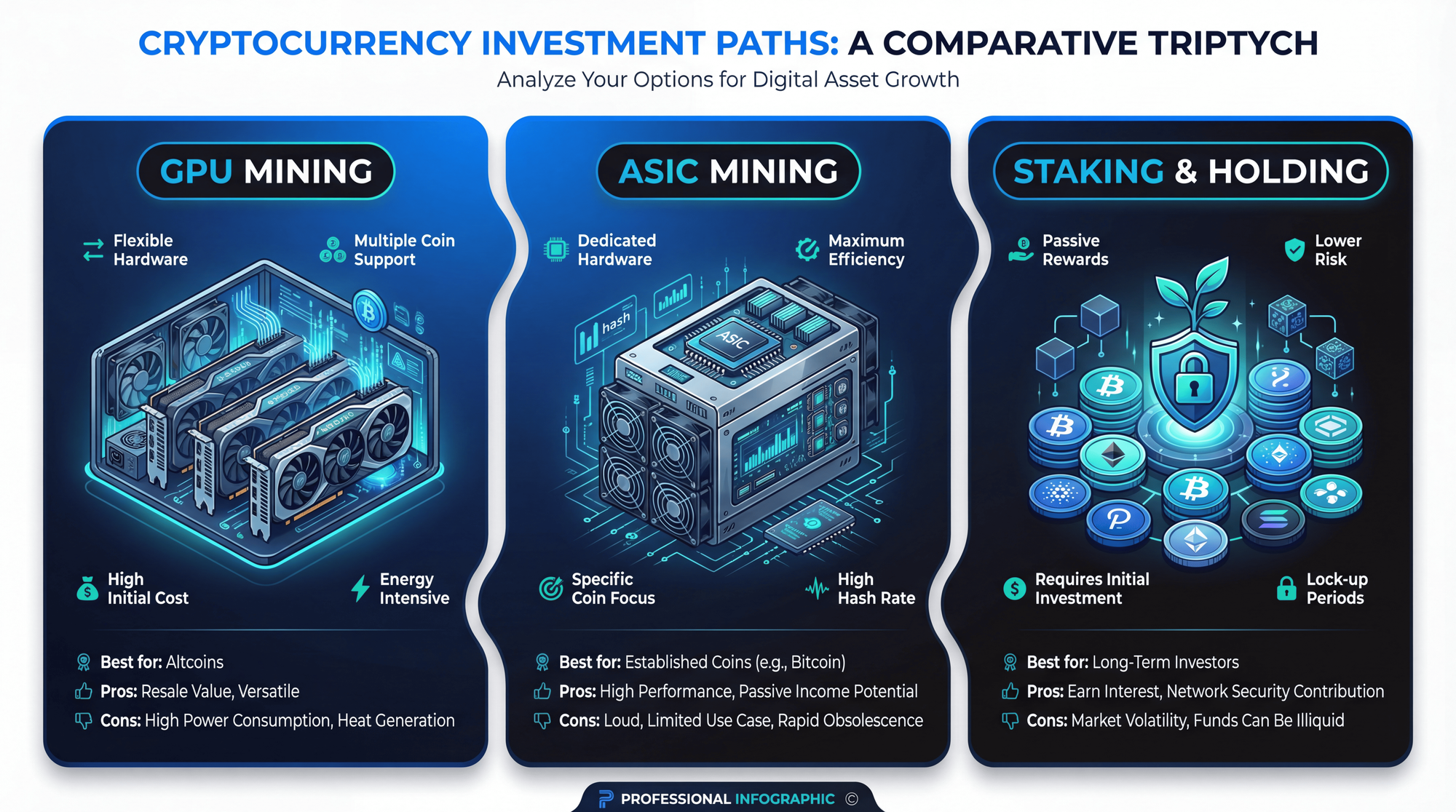
GPU Mining vs ASIC Mining vs Staking: Which is Better?
Understanding all your options helps make better investment decisions.
GPU Mining is best for hobbyists who want flexibility and an exit strategy (selling to gamers).
ASIC Mining is best for professional Bitcoin miners with cheap industrial electricity.
Staking is best for passive income without hardware management. Learn more about Proof of Work vs Proof of Stake consensus mechanisms.
Mining Rig Setup Considerations
Beyond the GPU, successful mining requires proper supporting hardware.
Power Supply (PSU)
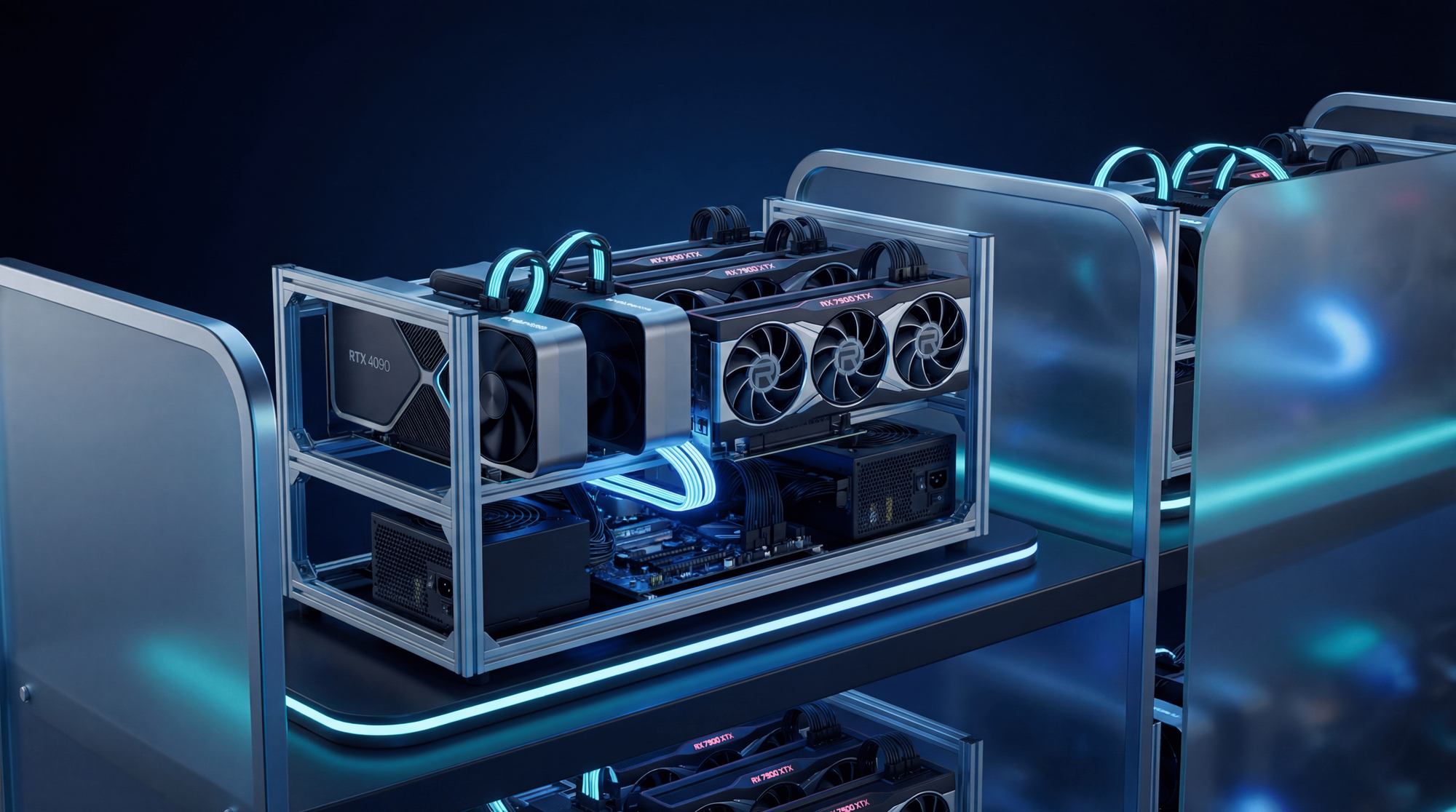
Calculate total power draw and add 20-30% headroom. A 6-GPU rig drawing 800W needs at least a 1000W PSU.
Recommendations:
- 80+ Gold or Platinum efficiency rating
- Quality brands: Corsair, EVGA, Seasonic
- Distribute power evenly across rails
Cooling
Mining GPUs run 24/7 and generate significant heat. Poor cooling reduces hashrate and shortens component life.
Tips:
- Open-frame rigs allow better airflow
- Consider replacing stock thermal pads on used GPUs
- Target GPU temps below 70°C, VRAM below 95°C
- Use high static-pressure fans
Motherboard & CPU
Mining doesn't require powerful CPUs. A basic dual-core processor with 8-16 GB RAM suffices. Choose motherboards with multiple PCIe slots or use risers.
Frequently Asked Questions
Can you mine Bitcoin with a GPU in 2026?
No. Bitcoin mining requires ASIC (Application-Specific Integrated Circuit) miners. GPUs cannot compete with the terahash-level performance of modern ASICs. Even the most powerful consumer GPU produces about a million times less hashpower than a single ASIC miner on Bitcoin's SHA-256 algorithm.
What is the most profitable GPU for mining in 2026?
The RTX 4070 offers the best balance of profitability and efficiency for most miners. It delivers 7-8 MH/s per watt on Kaspa — nearly matching the RTX 4090's efficiency at less than half the cost. For raw hashrate, the RTX 4090 leads, but its higher power consumption limits profitability at typical electricity rates.
How long does it take to ROI on a mining GPU?
At current difficulty and prices with $0.10/kWh electricity, expect 2-5+ years to recoup your investment. A used RTX 3070 Ti ($270) might ROI in 3 years, while a new RTX 4090 ($1,600) could take 4-5 years. Always calculate ROI with live profitability data before purchasing.
Is GPU mining still worth it in 2026?
GPU mining can be worthwhile as a hobby or supplementary income if you have access to cheap electricity (<$0.10/kWh), can repurpose hardware for gaming/AI, and have realistic expectations. Most miners should treat it as a learning experience rather than a primary income source.
What coins can you mine with GPU in 2026?
Popular GPU-mineable cryptocurrencies include Kaspa (KAS), Ravencoin (RVN), Flux (FLUX), Ergo (ERG), and Ethereum Classic (ETC). Each uses different algorithms with varying hardware requirements. Kaspa is currently the most profitable for most GPUs.
How much does a mining GPU earn per day?
Daily earnings vary significantly by GPU, algorithm, difficulty, and coin price. Typical ranges for January 2026:
- RTX 4090: $0.80-1.20/day (after power @ $0.10/kWh)
- RTX 4070: $0.30-0.45/day
- RTX 3070 Ti: $0.15-0.25/day
Always verify with live calculators as these numbers change daily.
Should I buy new or used GPUs for mining?
Used GPUs offer faster ROI due to lower upfront costs. The RTX 30 series (3070, 3070 Ti, 3080) are excellent used choices with strong resale value to gamers. When buying used, check for mining wear, request thermal pad replacement history, and test for 24+ hours before committing.
Conclusion: Choosing the Best Mining GPU in 2026
GPU mining in 2026 requires a strategic approach focused on efficiency over raw power. The days of easy profits are gone, but opportunities remain for miners who understand the economics.
✅ Our Recommendations
- Best Overall: RTX 4070 / 4070 Super — Excellent efficiency, reasonable ROI
- Best Performance: RTX 4090 — Maximum hashrate (only with cheap power)
- Best Budget: RTX 3070 Ti (used) — Proven performer at $250-280
- Best AMD: RX 7900 XTX — Competitive pricing, strong VRAM
Before You Buy:
- Calculate your actual electricity costs
- Use live profitability calculators (WhatToMine, minerstat)
- Factor in hardware lifespan and resale value
- Consider staking or buying crypto directly as alternatives
GPU mining is best suited for hobbyists, gamers with idle hardware, and those who can repurpose equipment for AI/creative workloads. For pure investment purposes, directly purchasing cryptocurrency may offer simpler returns.
Ready to Start Your Crypto Journey?
Whether you mine or trade, Zipmex makes it easy to buy, sell, and manage cryptocurrencies.
Start Trading Now →⚠️ Disclaimer: The information provided in this article is for educational purposes only and does not constitute investment or financial advice. Cryptocurrency mining involves significant financial risk including hardware costs, electricity expenses, and market volatility. Mining profitability varies based on network difficulty, coin prices, and electricity rates — all of which change frequently. Past performance does not guarantee future results. Always conduct your own research and consult financial professionals before making investment decisions.