Privacy is no longer optional in crypto - it's becoming essential. With MiCA regulations fully enforced since December 30, 2024 and on-chain surveillance tools growing more sophisticated, privacy-focused crypto projects are experiencing unprecedented growth in 2026. But here's what most guides won't tell you: several leading privacy protocols have recently launched tokens or are about to, creating potentially lucrative opportunities for early participants.
⚡ Quick Answer
The best privacy crypto projects for 2026 include Aztec Network (ZK L2 with $180M total funding, TGE possible Feb 2026), Zama (FHE protocol with $130M funding at $1B valuation), Penumbra (private DeFi on Cosmos), and Namada (multi-chain privacy with $60M funding). Privacy coins like Monero hit all-time highs in January 2026, signaling strong market demand.
This comprehensive guide breaks down the top privacy-focused crypto projects, explains their underlying technology (ZK-proofs, FHE, MASP), provides current market data, and analyzes regulatory risks. Whether you're a privacy advocate or looking for the next big opportunity, understanding these protocols now is essential.
Why Privacy Crypto Projects Matter in 2026
The privacy narrative has shifted dramatically. What was once associated with illicit activity is now recognized as a fundamental right and technological necessity. Three converging forces are driving this change.
First, institutional adoption requires confidentiality. Major financial institutions cannot conduct business on fully transparent blockchains where competitors can monitor every transaction. Privacy technology enables compliant, confidential transactions that meet both regulatory requirements and business needs.
Second, regulatory clarity is emerging - but with a twist. The EU's MiCA framework became fully enforceable in late 2024, creating clear rules but also pressuring privacy coins. Exchanges like Kraken have delisted Monero for European users due to compliance concerns, while Japan and South Korea maintain strict restrictions on privacy coins. Projects building "selective disclosure" and compliance-friendly privacy are positioned to thrive in this environment.
Third, the technology has matured significantly. Zero-knowledge proofs, Fully Homomorphic Encryption (FHE), and Multi-Asset Shielded Pools (MASP) have moved from academic papers to production-ready implementations. Aztec launched its Ignition Chain mainnet in November 2025, while Zama reached unicorn status with a $1B+ valuation.
Privacy Market Overview: Established Coins Rally
Before diving into emerging projects, it's worth noting the recent performance of established privacy coins. Monero (XMR) reached an all-time high of $799.89 on January 14, 2026, with market capitalization exceeding $8.5 billion. This rally signals strong market demand for privacy technology despite regulatory pressures.
📊 Privacy Coins Market Snapshot (January 2026)
Monero (XMR)
$8.5B+ Market Cap
XMR ATH
$799.89 (Jan 14, 2026)
CMC Rank
Privacy Tech
Ring Signatures
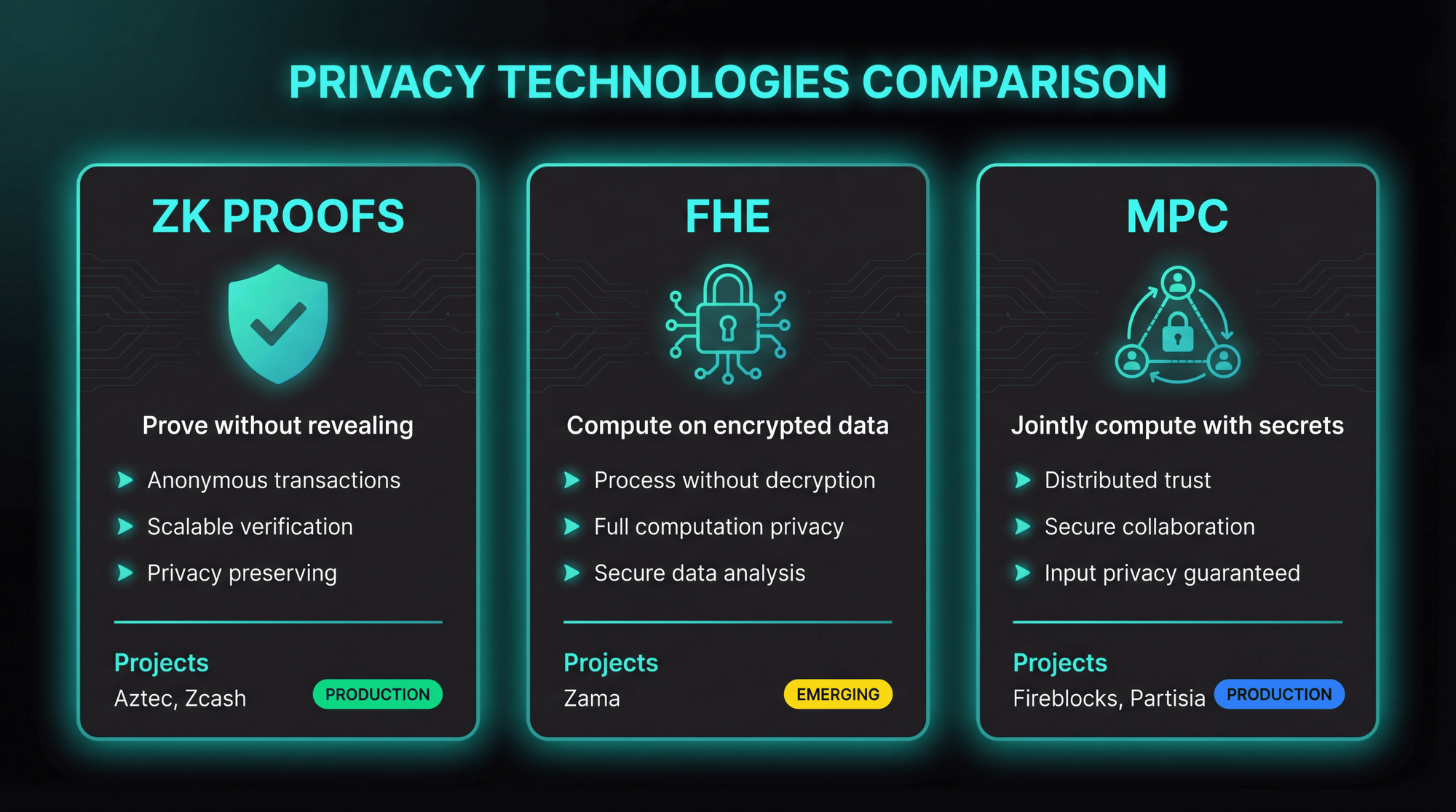
Understanding Privacy Technology: ZK vs FHE vs MASP
Before diving into specific projects, understanding the core technologies helps evaluate which protocols offer genuine innovation versus marketing hype.
Zero-Knowledge Proofs (ZK)
Zero-knowledge proofs allow one party to prove something is true without revealing the underlying data. In crypto, this means proving you have sufficient funds for a transaction without exposing your balance or transaction history. ZK-rollups like Aztec use this technology to create encrypted, verifiable transactions on Ethereum.
The main advantage of ZK technology is its maturity - it's been battle-tested in production for years. Projects like Zcash pioneered this approach, and modern implementations are significantly more efficient.
Fully Homomorphic Encryption (FHE)
FHE represents the holy grail of cryptography: performing computations on encrypted data without ever decrypting it. Imagine a smart contract that processes your financial data while the contract itself never sees the actual numbers - only encrypted versions.
Zama's fhEVM enables confidential smart contracts on Ethereum-compatible chains. While more computationally intensive than ZK, FHE offers stronger privacy guarantees for complex operations like confidential DeFi, private voting, and encrypted order books.
Multi-Asset Shielded Pool (MASP)
MASP technology, pioneered by Namada, allows users to shield any supported asset in a unified privacy pool. Rather than having separate privacy pools for each token, all shielded assets share one large anonymity set, dramatically improving privacy guarantees for everyone.
Top Privacy Crypto Projects for 2026
1. Aztec Network - The First Decentralized Privacy L2
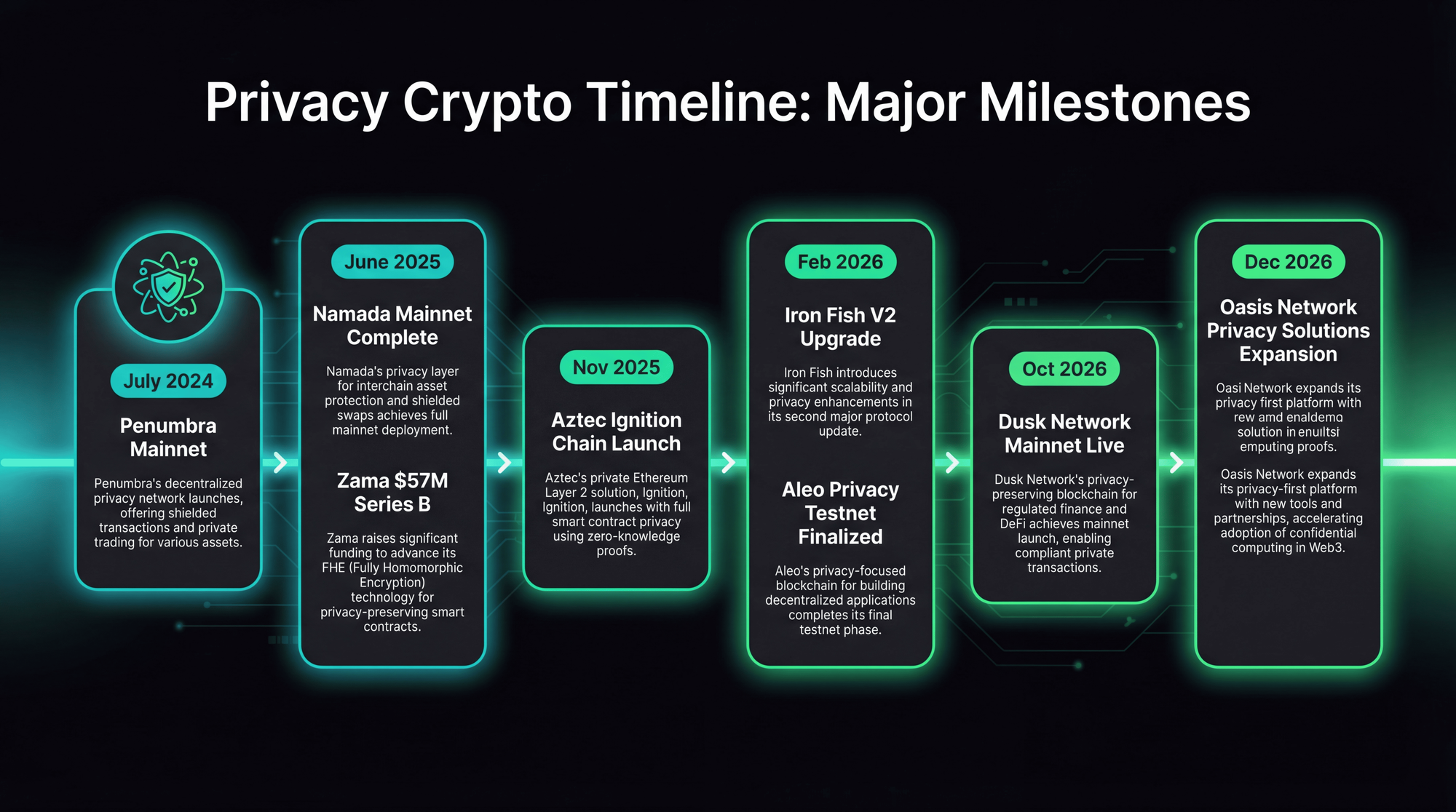
Aztec Network launched its Ignition Chain on Ethereum mainnet on November 20, 2025, becoming what the team calls "the first fully decentralized Layer-2 on Ethereum." This represents seven years of development culminating in a production-ready privacy infrastructure.
Technology: Aztec uses ZK-SNARKs to enable encrypted smart contracts on Ethereum. Developers can write contracts with both public and private functions, using zero-knowledge proofs for confidential DeFi, private payments, and institutional trading.
Why It Matters: Unlike other L2s that launched with centralized sequencers, Aztec started decentralized from day one with 500+ validators. This matters for privacy because centralized sequencers face government pressure to install backdoors.
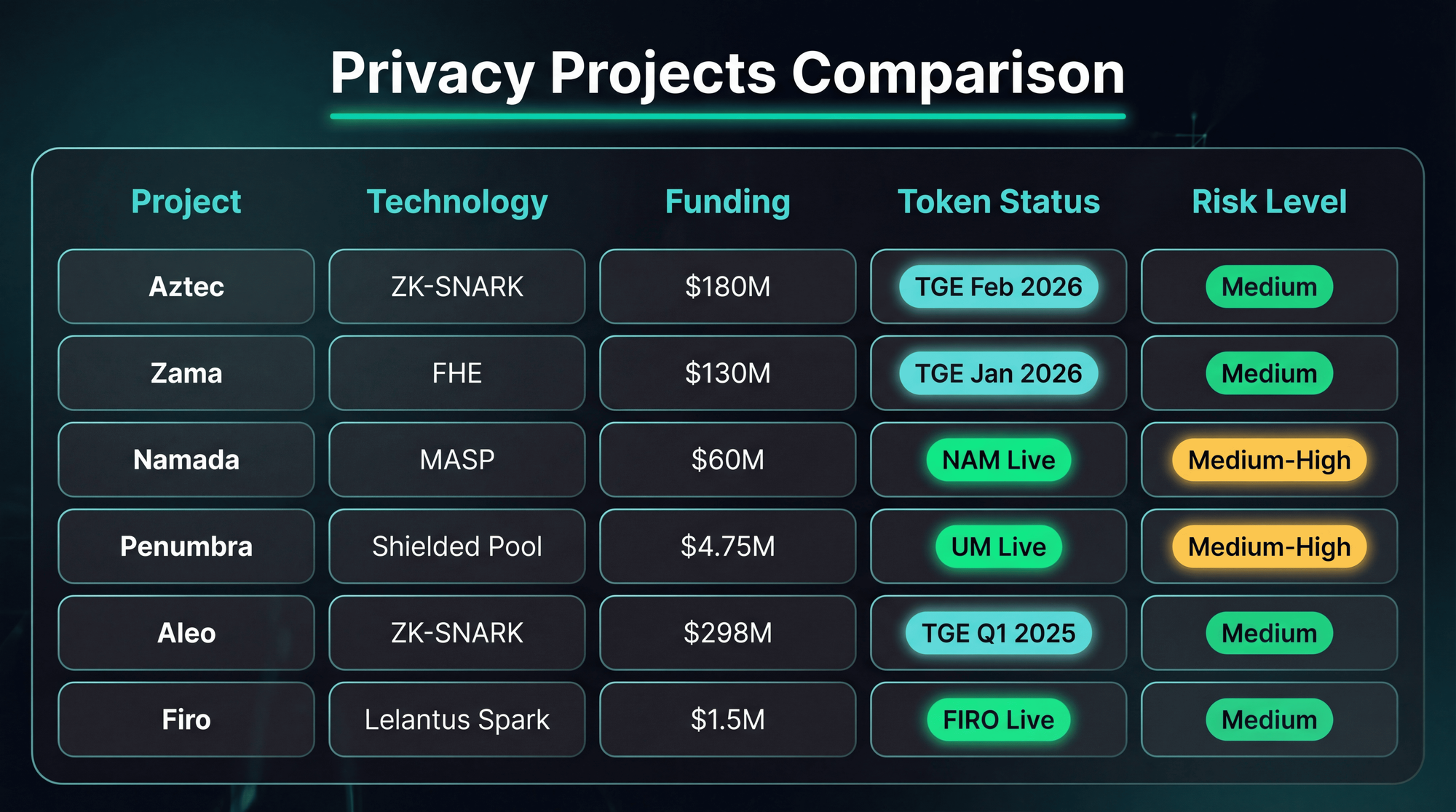
Token Status: $AZTEC token sale raised 19,476 ETH (~$61.3M) from 16,700+ participants in December 2025. TGE (Token Generation Event) can happen as early as February 11, 2026 through a governance vote. If the vote passes, tokens become tradeable on Uniswap V4.
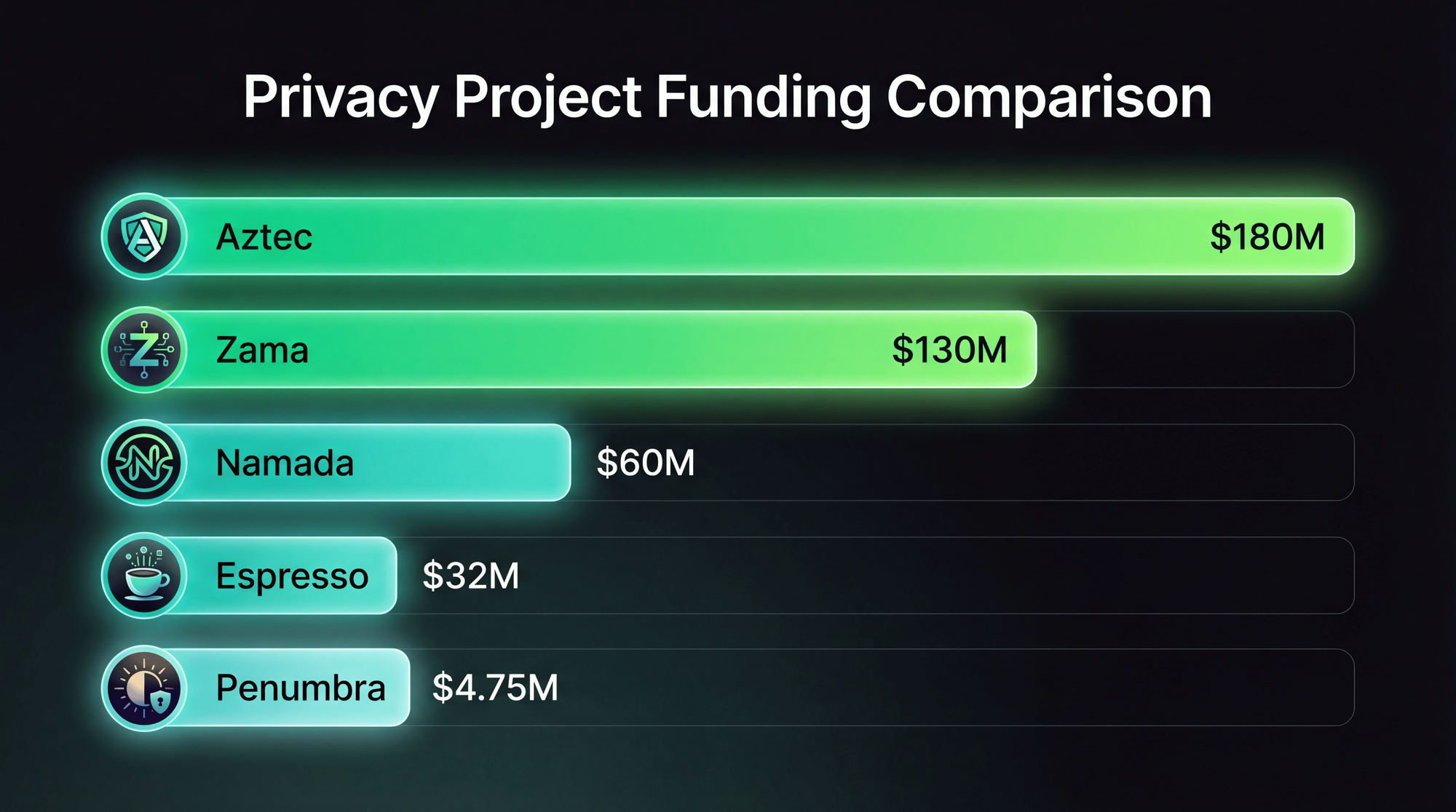
Total Funding: $119M in equity rounds (including $100M Series B led by a16z in 2022) plus $61M token sale = $180M total.
🔢 Aztec Network Overview
Total Funding
$180M
Privacy Tech
ZK-SNARK
Status
Mainnet Live (Nov 2025)
TGE Date
Feb 11-12, 2026
How to Participate in Aztec Ecosystem
Follow TGE Voting
If you participated in the token sale, create your Token Vault and participate in governance. TGE voting requires 100M+ AZTEC participation and 2/3 yes votes.
Prepare for Transaction Launch
Transactions go live in early 2026. Currently, Ignition runs with empty blocks while the team monitors for issues. Being an early mainnet user could qualify for future rewards.
Learn Noir Programming
Building on Aztec using their Noir language demonstrates serious engagement. Even simple projects can differentiate you. Join the Aztec developer community.
2. Zama - FHE Unicorn Bringing Encryption to Ethereum
Zama raised $57M in Series B funding in June 2025, bringing total funding to $130M and achieving unicorn status with a valuation north of $1 billion. This makes Zama the world's first FHE unicorn.
Technology: Zama's fhEVM allows developers to deploy confidential smart contracts where all data remains encrypted during computation. This enables use cases impossible with ZK alone: encrypted order books, confidential voting, private gaming, and sealed-bid auctions.
Why It Matters: FHE smart contracts represent a paradigm shift. While ZK proves something is true without revealing data, FHE enables actual computation on encrypted data. This opens possibilities for confidential DeFi, private voting, and encrypted order books that were previously impossible.
Token Status: Zama completed its Token Generation Event on January 9, 2026. The public auction runs January 21-24, 2026 through a sealed-bid mechanism where all winning bidders pay the same clearing price.
🔢 Zama Overview
Total Funding
$130M
Valuation
$1B+ (Unicorn)
Privacy Tech
FHE
Token Status
TGE Live (Jan 2026)
How to Participate in Zama Ecosystem
Join the Public Auction
Zama auction runs January 21-24 with claiming on February 2nd. Tokens are fully unlocked and immediately usable for fees, staking, or delegation.
Build on fhEVM
Developers can start building FHE applications on Zama's testnet. Projects building on Zama don't need extra licenses - commercial use is covered.
Use Ecosystem Apps
Apps preparing for mainnet include Zaiffer (confidential tokens), TokenOps (private distribution), Bron Wallet (encrypted custody), and Raycash (confidential stablecoins).
3. Penumbra - Private DeFi for Cosmos
Penumbra launched its mainnet in July 2024, becoming the first fully private proof-of-stake network for the Cosmos ecosystem. Unlike centralized privacy solutions, Penumbra is private by default - all transactions are fully shielded.
Technology: Penumbra uses ZK-SNARKs combined with a novel "shielded delegation" design that enables private staking. Its native DEX (ZSwap) enables private trading with on-chain routing, protecting users from MEV extraction and front-running.
Why It Matters: Penumbra is the first non-Cosmos-SDK chain to establish IBC connection with Cosmos Hub, enabling private transfers for any IBC-compatible asset. As the network of 50+ Cosmos chains grows, private cross-chain transactions become increasingly valuable.
Token Status: UM token is live and trading on Osmosis and other DEXs. Current price around $0.05 with approximately $2M market cap. Notably, Penumbra Labs shut down in late 2025, but the community continues development - a sign of true decentralization.
Funding: $4.75M seed round from Dragonfly Capital.
🔢 Penumbra Overview
How to Participate in Penumbra Ecosystem
Get UM on Osmosis
Trade UM through Osmosis DEX by bridging assets from other Cosmos chains. UM is needed for transaction fees and staking on Penumbra.
Stake for Shielded Returns
Penumbra enables fully private staking. Delegators earn staking rewards without revealing their holdings - a first in proof-of-stake networks.
Use ZSwap for Private Trading
Penumbra's native DEX enables private swaps between any IBC-compatible assets. No MEV extraction, no front-running, complete privacy.
4. Namada - Multi-Chain Privacy Layer
Namada completed its mainnet launch in June 2025, introducing Multi-Asset Shielded Pools (MASP) to provide privacy for assets bridged from Ethereum, Cosmos, and other chains.
Technology: Namada's MASP allows users to shield any supported asset in a unified privacy set. This means ETH, ATOM, OSMO, and other assets all share one large anonymity pool rather than having fragmented privacy sets per token.
Why It Matters: Most privacy solutions have fragmented anonymity sets - few users shield each specific token. Namada solves this by pooling all shielded assets together, dramatically improving privacy for everyone regardless of which asset they're shielding.
Token Status: NAM token is live and trading. The project completed a five-phase governance rollout culminating in full decentralization. Users can earn shielding rewards by keeping assets in the shielded set.
Total Funding: $60M across multiple rounds from investors including Polychain Capital. Currently ~$6M in Total Value Shielded (TVS).
🔢 Namada Overview
Total Funding
$60M
Privacy Tech
MASP
Token
NAM (Live)
TVS
~$6M
How to Participate in Namada Ecosystem
Shield Assets for Rewards
Namada pays users to keep assets shielded, strengthening privacy for everyone. The longer you keep assets in the shielded pool, the more rewards you earn.
Bridge Multi-Chain Assets
Bridge assets from Ethereum and Cosmos to add them to Namada's unified shielded pool. More assets = larger anonymity set = better privacy.
Participate in Governance
NAM holders can vote on protocol upgrades and parameter changes. Early governance participants often receive additional rewards in future distributions.
5. Espresso Systems - Shared Sequencer with Privacy
Espresso is building shared sequencer infrastructure for rollups with optional privacy features. Unlike projects focused solely on privacy, Espresso addresses the broader rollup coordination problem while enabling confidential transactions.
Technology: The Espresso Sequencer provides decentralized ordering for multiple rollups simultaneously, with optional privacy features for transactions. This matters because most rollups currently rely on centralized sequencers that can censor transactions or extract MEV.
Why It Matters: As L2s become the dominant execution layer, the sequencer becomes a critical centralization point. Espresso's shared sequencer enables both decentralization and optional privacy - rollups can choose to integrate privacy features without building them from scratch.
Token Status: No token yet. The project has raised $60M+ from investors including Electric Capital and Sequoia. Testnet participation may qualify for future airdrops.
Regulatory Landscape 2026
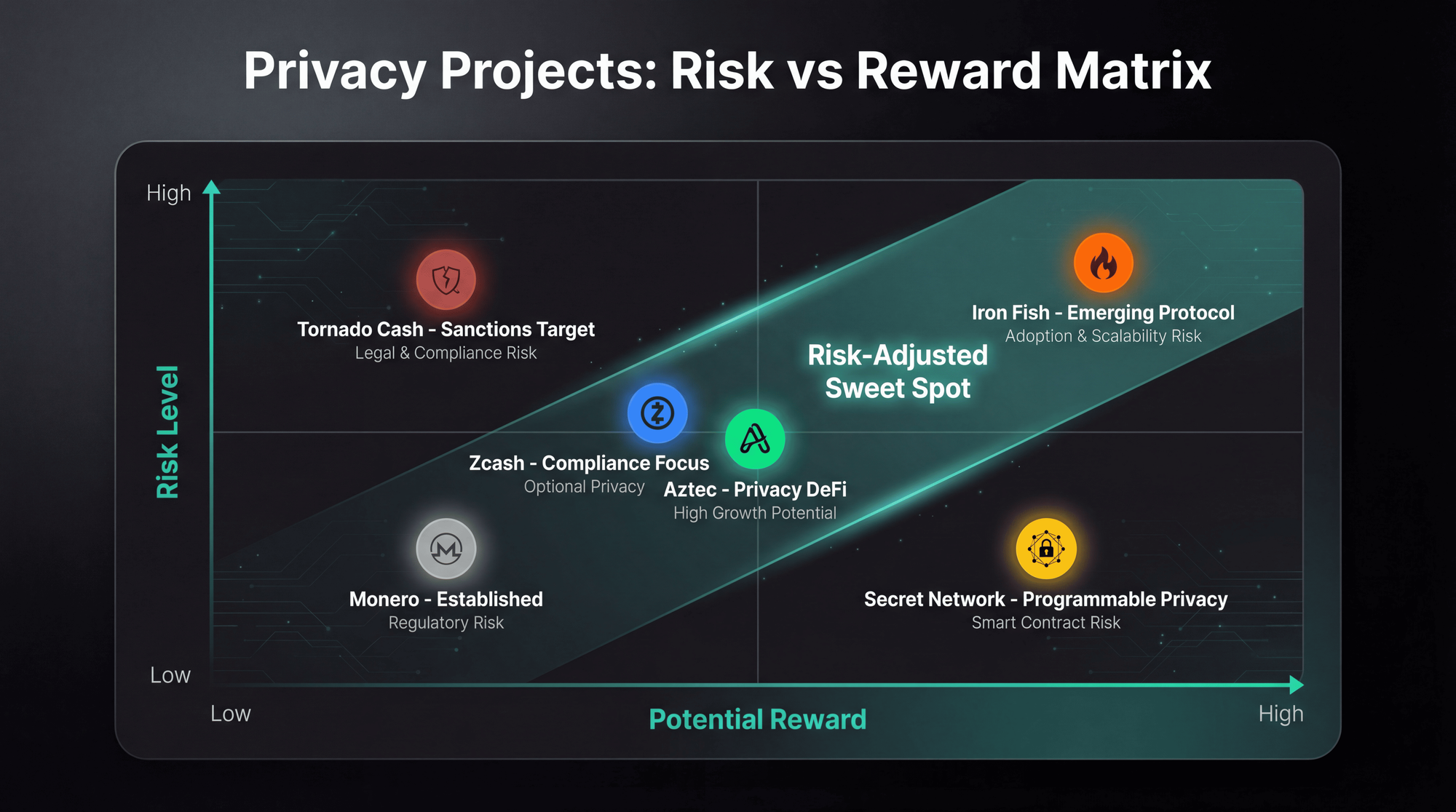
Privacy crypto faces a complex regulatory environment that varies significantly by jurisdiction. Understanding these dynamics is crucial for risk assessment.
Europe: MiCA and Privacy Coins
The EU's MiCA framework became fully enforceable in late 2024. While MiCA doesn't explicitly ban privacy coins, its Travel Rule requirements create practical challenges. Exchanges have preemptively delisted Monero for EEA users rather than implement complex compliance mechanisms.
The DAC8 directive introduces additional crypto tax reporting requirements starting January 1, 2026, requiring exchanges to report user transactions to tax authorities.
Asia-Pacific: Strict Restrictions
Japan and South Korea maintain strict restrictions on privacy coins. Japanese exchanges cannot list assets with built-in anonymity features, while South Korea's Financial Intelligence Unit requires enhanced due diligence for any privacy-related transactions.
United States: Evolving Landscape
The US regulatory approach remains fragmented across multiple agencies. While privacy coins remain legal to hold, exchanges face increasing pressure regarding KYC/AML compliance. The SEC has not taken direct action against privacy projects, but the DOJ has prosecuted mixer operators under money laundering statutes.
📈 Bullish Factors
- Monero ATH signals strong market demand despite regulatory pressure
- Institutional interest in compliant privacy (Aztec's enterprise focus)
- Technology maturation: mainnet launches from multiple projects
- Selective disclosure enables regulatory compliance
- Strong VC backing ($1B+ Zama valuation)
📉 Bearish Factors
- MiCA Travel Rule creates compliance challenges
- Exchange delistings reducing market access
- Japan/South Korea bans limiting adoption
- DOJ prosecution of privacy tool operators
- New projects unproven at scale
Risk Assessment Framework
For broader investment strategies in the current market cycle, see our guide on how to navigate crypto in 2026.
Financial Risks
Market Volatility: Privacy tokens can experience significant price swings. Even established Monero has seen 50%+ drawdowns in previous cycles.
Liquidity Risk: Newer tokens like UM (Penumbra) have low liquidity, meaning large positions may be difficult to exit without significant slippage.
Token Economics: Early token sales often include vesting schedules and unlock events that can create selling pressure.
Technical Risks
Smart Contract Risk: Privacy protocols involve complex cryptography. Bugs in ZK circuits or FHE implementations could compromise funds or privacy.
Quantum Risk: Current encryption may become vulnerable to quantum computers. Most projects plan migration paths, but this remains a long-term concern.
Network Effects: Privacy requires large anonymity sets. Projects with small user bases provide weaker privacy guarantees.
Regulatory Risks
Exchange Delisting: Privacy coins face ongoing delisting pressure. Reduced market access can significantly impact liquidity and price.
Jurisdictional Bans: Japan and South Korea have effectively banned privacy coins. Similar actions by other major markets could limit adoption.
Infrastructure Prosecution: Governments have prosecuted privacy tool operators. While holding privacy tokens remains legal in most jurisdictions, operating infrastructure may carry legal risk.
Frequently Asked Questions
What is the best privacy crypto project for 2026?
Aztec Network stands out with $180M in total funding, mainnet launch on Ethereum (November 2025), and TGE scheduled for February 2026. For FHE technology, Zama's $1B+ valuation and January 2026 TGE make it the leader. For established exposure, Monero's $8.5B market cap and January 2026 ATH demonstrate proven demand.
Are privacy cryptocurrencies legal?
Privacy cryptocurrencies are legal to own in most jurisdictions, including the US and most of Europe. However, Japan and South Korea have effectively banned privacy coins from exchanges. MiCA regulations have led to delistings in the EU, reducing market access rather than criminalizing ownership. Always check local laws before investing.
What is the difference between ZK-proofs and FHE?
ZK-proofs (used by Aztec, Zcash) allow proving something is true without revealing the underlying data - like proving you have enough funds without showing your balance. FHE (used by Zama) goes further, enabling computations on encrypted data without ever decrypting it. FHE is more powerful but computationally intensive; ZK is more mature and efficient for simpler privacy needs.
How do I participate in privacy crypto airdrops?
For Aztec: The token sale has concluded, but governance participation may yield future rewards. For Zama: Public auction runs January 21-24, 2026. For Espresso: Use the testnet and participate in community activities - no token announced yet. General strategy: genuine protocol usage beats volume farming; join Discord communities early; participate in governance discussions.
Is Monero still a good investment in 2026?
Monero reached an all-time high of $799.89 on January 14, 2026, suggesting strong demand despite regulatory pressure. However, exchange delistings reduce market access. Monero remains the most battle-tested privacy coin with the largest anonymity set, but faces ongoing regulatory headwinds that newer "selective disclosure" projects may avoid.
What happened to Penumbra Labs?
Penumbra Labs announced it was winding down operations in late 2024. However, the Penumbra network itself remains operational with UM token trading and community-driven development continuing. This represents a higher risk profile - the technology works, but official team support has ended.
How does Namada's shielding rewards work?
Namada rewards users for keeping assets in the shielded set, which strengthens privacy guarantees for everyone. When you shield assets, you earn NAM tokens as passive income. The longer assets remain shielded, the larger the anonymity set becomes, improving privacy for all users. Currently, ~$6 million in assets are shielded.
What's the biggest risk for privacy crypto investments?
The biggest risk is regulatory action reducing market access. MiCA's Travel Rule requires identity disclosure for transfers, conflicting with privacy coin design. This has led to exchange delistings in major markets. Projects with selective disclosure features mitigate this risk by allowing compliance when required while maintaining default privacy.
Should I invest in established privacy coins or new projects?
Both have merits. Established coins like Monero have proven demand (ATH in January 2026) but face regulatory pressure. New projects like Aztec and Zama have strong VC backing and compliance-friendly designs but less proven track records. Diversification across both categories may reduce risk.
Where can I trade privacy tokens?
Availability varies by jurisdiction. Monero is available on Kraken (except EU), KuCoin, and MEXC. Penumbra's UM trades on Osmosis DEX. Namada's NAM is available on various exchanges. For Aztec and Zama, tokens will be available after TGE through Uniswap and other DEXs. Always check local regulations before trading.
Conclusion
Privacy-focused crypto projects represent one of the most compelling narratives for 2026. The convergence of strong market demand (Monero's January ATH at $799.89), institutional backing ($1B+ Zama valuation), and technological maturity (Aztec mainnet) creates genuine use cases beyond speculation.
For those interested in privacy crypto, several leading projects offer opportunities now:
- Aztec: TGE vote possible February 11-12, 2026 - watch governance discussions
- Zama: Public auction January 21-24 - participate in sealed-bid sale
- Namada: Mainnet live with shielding rewards - start earning by shielding assets
- Penumbra: UM trading on Osmosis - early-stage opportunity in Cosmos privacy
The key insight for 2026 is that selective disclosure privacy is winning. Projects that enable compliance when required while maintaining default privacy are better positioned than pure anonymity coins facing regulatory pressure and delistings.
Remember that crypto investments carry significant risk. Diversify across multiple projects, understand the regulatory landscape in your jurisdiction, and only invest what you can afford to lose. The privacy narrative is real, but individual project outcomes remain uncertain.
Ready to Explore Privacy Crypto?
Start your journey with privacy-preserving assets on Zipmex - trade, stake, and build your portfolio with confidence.
Start Trading Now →⚠ Disclaimer: The information provided in this article is for educational and informational purposes only and should not be considered financial, investment, or legal advice. Cryptocurrency investments, including privacy tokens, carry significant risk including the potential loss of all invested capital. Regulatory environments vary by jurisdiction - always verify local laws before investing. Past performance does not guarantee future results. Always conduct your own research (DYOR) and consult with qualified professionals before making investment decisions.