
Bitcoin meets the scarcity part of the store-of-value test. Its software limits total issuance to just under 21 million coins, and no central party can change that alone. It fails the stability part, at least so far. On Oct. 20, 2026, one bitcoin traded at $81,257.31, down 26.51% from a year earlier and about 36% below its all-time high of $126,198.07 on Oct. 6, 2025, according to Fortune's price data. Supporters, including the bitcoin.org FAQ, expect volatility to fall as the market matures. That is a forecast, not a result anyone has measured yet.

What a store of value has to do
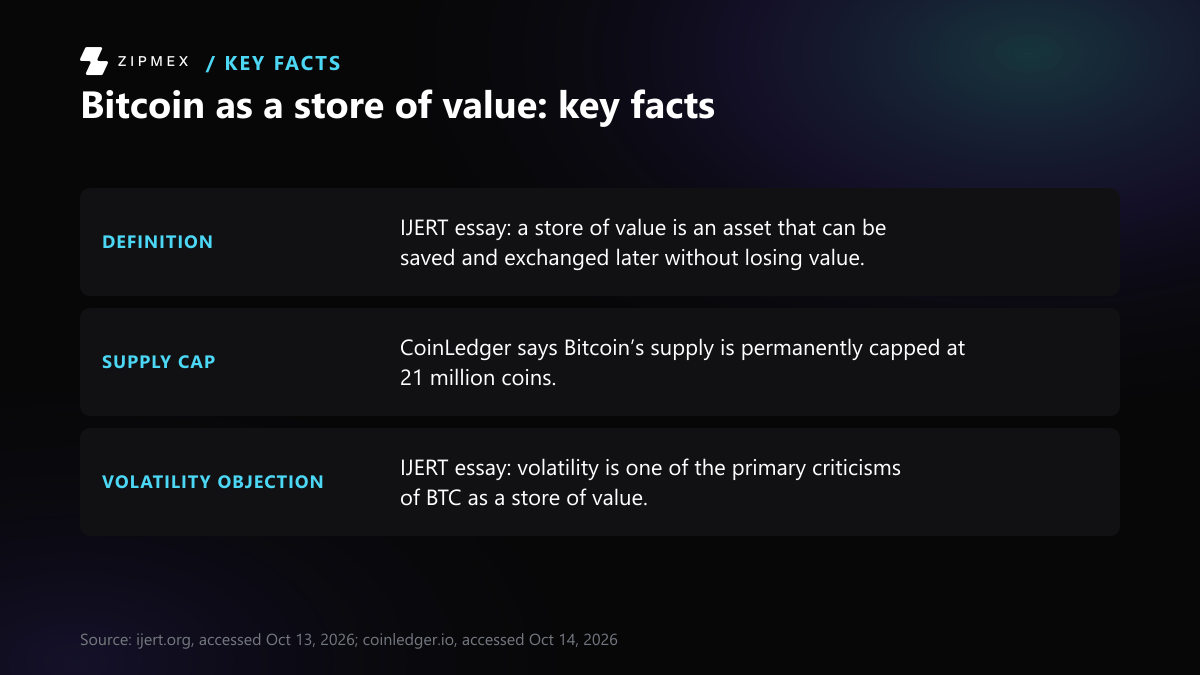
A widely cited definition, from the essay "Is Bitcoin a Store of Value?" published on IJERT (ijert.org), is "an asset that can be saved, retrieved, and exchanged in the future without deteriorating in value." The essay lists five attributes: durability, scarcity, portability, divisibility and recognizability. The page shows no author or year.
The hard part of that definition is time. You judge a store of value over a holding period, from the day you save to the day you spend, not on a single day's price. That is exactly where the main objection to bitcoin lands.
Scarcity: how the 21 million cap works
The cap is not a promise in a document. It follows from one rule in Bitcoin Core, the reference software.
The rule in the code
- Each new block starts with a subsidy of 50 BTC. The code reads
CAmount nSubsidy = 50 * COIN;. - The subsidy halves every 210,000 blocks. Mainnet sets
consensus.nSubsidyHalvingInterval = 210000;, which works out to about four years. - After 64 halvings the subsidy is zero (
if (halvings >= 64) return 0;).
Add up the halving series and you get about 21 million coins. The Bitcoin Wiki gives the exact ceiling as 20,999,999.9769 BTC. It falls slightly short because amounts are stored as whole integers of the smallest unit. The wiki expects the last subsidy around 2140, with the exact date depending on future mining power.
Where the schedule stands now
The fourth halving came at block 840,000 on April 20, 2024. It cut the block subsidy from 6.25 BTC to 3.125 BTC, according to the block's explorer record and Forklog's report. The bitcoin.org FAQ says that once issuance ends, miners "will probably be supported exclusively by numerous small transaction fees."
What the cap does and does not do
The cap fixes how many coins can exist. It does not fix what any coin is worth. Divisibility deals with the small-units problem: the FAQ says a bitcoin divides to eight decimal places, and 100,000,000 satoshis make one bitcoin.
Volatility: the main objection
The IJERT essay calls volatility "one of the primary criticisms" of bitcoin as a store of value. Bitcoin's own project site agrees on the facts. The bitcoin.org FAQ says "the price of a bitcoin is still very volatile," and adds that "in theory, this volatility will decrease as Bitcoin markets and the technology mature."
Here are the latest figures, from Fortune's Oct. 20, 2026 price page:
| Point | BTC price |
|---|---|
| All-time high, Oct. 6, 2025 | $126,198.07 |
| One year before Oct. 20, 2026 | $110,573.20 |
| Oct. 20, 2026, 8:15 a.m. ET | $81,257.31 |
That is a fall of 26.51% in a year and about 36% from the peak, our calculation from Fortune's figures. Different data providers give slightly different peaks. Bitcoin Magazine, for example, put the high at $126,279. Anyone who saved in bitcoin near the peak and needed the money in October 2026 would have lost roughly a third of its dollar value. That is the deterioration the definition rules out.
The IJERT essay sums up the supporters' answer: volatility should fall as adoption grows, helped by institutional investors and products such as futures and exchange-traded funds (ETFs). None of the sources here shows that this has happened.
What did holding bitcoin do to your savings?
Enter the BTC price on the day you saved and on the day you need the money to see how much dollar value the holding gained or lost.
| BTC price on the day you saved | BTC price on the day you need the money | Change in the dollar value of your holding |
|---|---|---|
| 126,198.07 USD | 81,257.31 USD | -35.61 % |
| 110,573.2 USD | 81,257.31 USD | -26.51 % |
| 63,000 USD | 81,257.31 USD | 28.98 % |
- Both prices are your own inputs; the defaults and examples are the article's Fortune and Bernstein-note price points, not a forecast.
- A negative result means the holding lost dollar value over the period entered; a positive result means it gained.
This is price arithmetic over one holding period only: it leaves out fees, tax and lost keys, and cannot tell you what bitcoin will be worth when you need the money.
The adoption argument: Krawisz's view (opinion)
Daniel Krawisz challenged the term itself in an essay dated Jan. 12, 2015, on the Satoshi Nakamoto Institute site. He called "store of value" "a terrible metaphor." In his view, a good stores value only if everyone wants it so badly that it "will be snapped up even at a tiny discount." He argued that people who call bitcoin a poor store of value are really saying it has not been adopted yet, which he called "not a valid complaint." His conclusion: "Bitcoin is the kind of money that works in an unstable world, which is the only kind that we know of."
Both the supporters' forecast and Krawisz's argument tie stability to adoption. So holding bitcoin for its stability is, in effect, a bet that adoption keeps growing.
What Bernstein said in June 2026
On June 8, 2026, Bitcoin Magazine and CryptoProwl (carried on Yahoo Finance) reported a note from analysts at the brokerage Bernstein. The note said bitcoin's long-term store-of-value thesis is unchanged, despite a slower capital allocation cycle and less retail activity. Both outlets quote the line "Bitcoin being boring this cycle should not be held against it."
The figures in the note, as reported:
- Net inflows into spot bitcoin ETFs and corporate treasury companies: $12 billion in 2026 so far, against $60 billion in 2025. The two periods differ in length.
- Spot bitcoin ETFs: about $2.6 billion of net outflows year to date. Bernstein said most of the selling came from treasury companies.
- 61% of circulating supply had "not moved in more than a year." Only Bitcoin Magazine reports this figure.
- Bitcoin traded around $63,000 when the note came out. Since then it has recovered to about $81,000 (Fortune, Oct. 20).
Both outlets describe the same note, and neither publishes it. In effect, this section rests on a single source.
What to check before treating bitcoin as savings
- Holding period. A store of value is judged over the period you hold it. Compare the price swings above with when you might need the money.
- Date every flow figure. Before you compare a newer ETF or treasury figure with the June 2026 numbers, check its date.
- Custody. A fixed supply does not protect coins whose keys are lost. A separate explainer covers public and private keys in crypto. Holding for years is a different question from crypto day trading.
Limitations: the price data comes from one provider at one point in time, and the Bernstein figures come secondhand. This article is not investment advice.
