After analyzing thousands of charts and trading deep-liquidity decentralized markets, I can confidently state that spotting a bullish divergence is one of the most powerful skills a crypto trader can develop. What is a bullish divergence? It is the ultimate early-warning system—a glaring signal that a downtrend is exhausted, even while the price continues to bleed.
While novice traders wait for obvious trendline breaks, professionals rely on crypto technical analysis and momentum indicators to see the silent accumulation happening underneath. When you master bullish divergence trading, you stop reacting to the market and start anticipating the trend reversal before the herd catches on.
⚡ Key Takeaways: The Mechanics of Bullish Divergence
- The Core Signal: Price makes a lower low, but the momentum indicator makes a higher low.
- The Underlying Truth: Downward price action is losing its selling pressure; smart money is quietly accumulating.
- The Golden Rule: Divergence is a condition, not a trigger. Always wait for price action confirmation before executing a trade.
What is Bullish Divergence? The Mechanics of Market Reversals
To understand the true bullish divergence meaning, you have to separate price action from momentum. Imagine a car running out of gas while rolling down a hill; the vehicle is still moving downward (price action), but the engine driving it has died (momentum).
In trading terms, a bullish divergence occurs when the price of an asset prints lower lows, yet your chosen oscillator forms higher lows. This visual contradiction tells us that the sellers are exhausted. The markdown in price is likely driven by late retail panic or stop-loss hunting, rather than genuine distribution. Understanding hidden bullish divergence vs regular setups, and how bullish momentum shifts, allows you to position yourself alongside institutional players.
The Mechanics: How Buying Pressure Overtakes Selling
Why does this happen? The new low in price is frequently the result of weak hands capitulating or forced liquidations hitting the order book. However, institutional buyers step into these heavy support and resistance zones. This silent accumulation absorbs the selling pressure.
Because the selling volume is no longer dominant, the underlying momentum flattens or rises, even if the absolute price ticks slightly lower. This hidden accumulation phase marks the critical moment when market sentiment transitions from heavily bearish to tentatively bullish. The selling pressure is exhausted, and the buying pressure indicator is flashing green.
📊 The Reversal Cycle Flowchart
- 1. Retail Panic & Stop-Loss Hunting (Price drops to new low)
- 2. Institutional Accumulation at Support
- 3. Momentum Shift (Oscillator ticks up)
- 4. Price Reversal (Trend shifts bullish)
Regular vs. Hidden Bullish Divergence
While regular divergence signals a macro trend change, hidden divergence acts as a continuation signal. Both rely on spotting higher lows, but their context is entirely different. You must know the hidden bullish divergence meaning to trade established bull markets effectively.

Top Indicators for Spotting Bullish Divergence
You cannot trade divergence naked; it requires a mathematical oscillator to measure the speed and change of price movements. While dozens exist, a few have become the gold standard for technical analysis due to their reliability. Because each oscillator calculates momentum differently, they may spot divergences at different times.
Relative Strength Index (RSI)
The Relative Strength Index (RSI) is arguably the most popular tool for a reliable rsi divergence strategy. Operating on a default 14-period setting, the RSI measures the velocity of recent price changes to evaluate overbought/oversold conditions.
For a relative strength index divergence to be valid, I always look for the divergence to form when the RSI is near or below the 30 level (oversold territory). When you spot a higher low on the RSI while it is submerged in the oversold zone, it is a massive confluence signal that exhaustion has been reached.
Moving Average Convergence Divergence (MACD)
The Moving Average Convergence Divergence (MACD) is exceptional for divergence trading because it offers two distinct readouts: the lines and the histogram.
To master what is MACD in the context of divergence, focus on the histogram. While the moving averages might lag, macd histogram bullish divergence (where the downward red bars get shallower and turn light red while the price drops to a new low) often appears much earlier. This gives traders an advanced warning of a shift in momentum before the lines even cross.
Stochastic Oscillator & Money Flow Index
When I am trading highly volatile crypto assets, the Stochastic Oscillator is an excellent, fast-acting alternative. It is highly sensitive to overbought/oversold extremes, making a stochastic divergence perfect for catching precise pivot points in choppy markets.
Conversely, the Money Flow Index (MFI) acts as a volume-weighted RSI. When trading volume diverges from price action alongside momentum, it adds a massive layer of conviction. Volume divergence confirms that the deep institutional footprint is heavily skewed toward buying.
How to Set Up Your Chart for Divergence Trading
Knowing how to trade bullish divergence starts with your charting environment. Whether you use a decentralized exchange interface or a dedicated trading platform like TradingView, you must apply technical analysis tools correctly to the right timeframe. Setting up properly is half the battle for successful crypto trading setups.
Here is my exact process to setup a divergence indicator on TradingView:
- Open your Chart: Select your target asset and adjust the timeframe (I recommend starting with the 4H for reliable signals).
- Add the Indicators: Press '/' or click 'Indicators' and search for "RSI" and "MACD". Add them to your panel.
- Adjust Settings: Leave the RSI at the standard 14 length. You may choose to format the MACD histogram to be thicker for easier visual scanning.
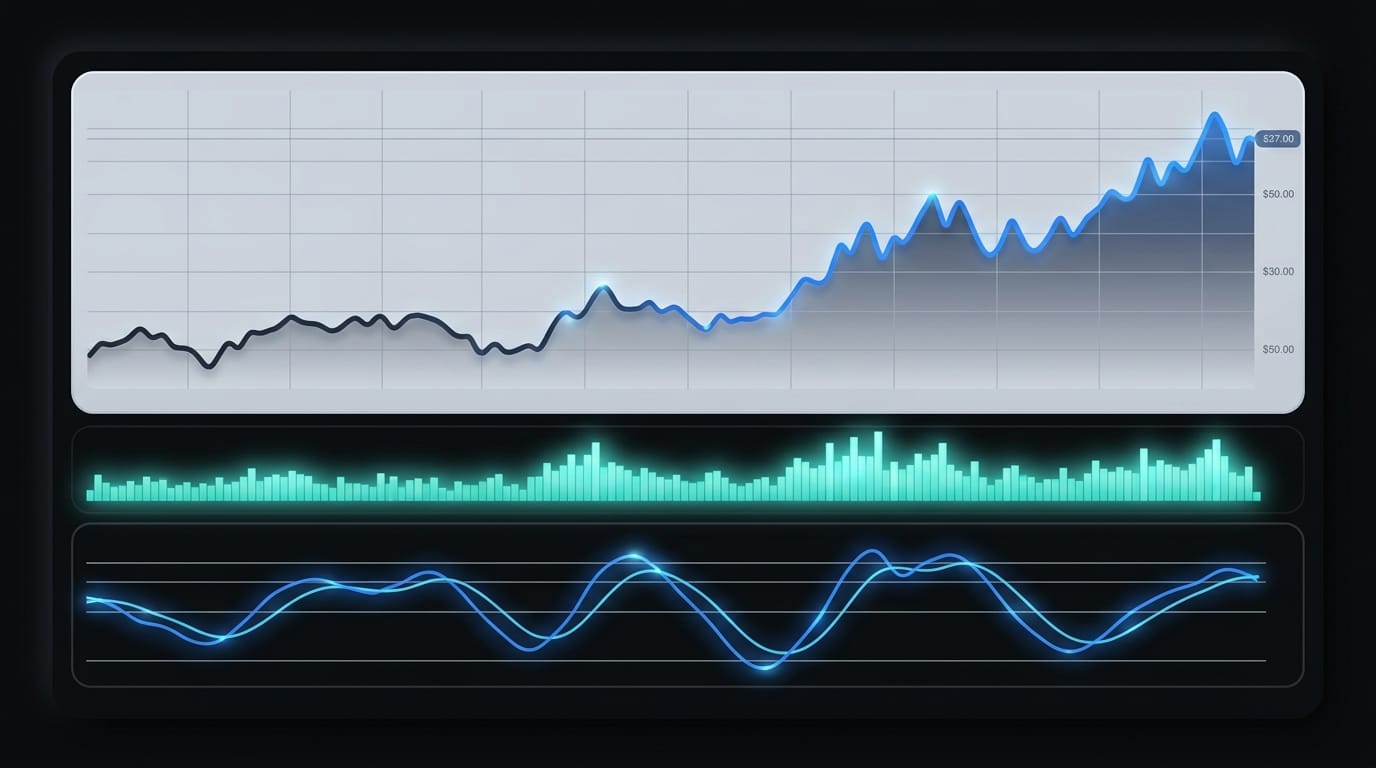
- Draw the Trendlines (The Golden Rule): To find bullish divergence, you must connect the LOWS of the price and the exact corresponding LOWS of the indicator.
📊 Divergence Drawing Cheat Sheet
- Correct: Connecting the absolute lowest wick of Price Drop A to Price Drop B, and drawing a line between the exact corresponding oscillator troughs directly beneath them.
- Incorrect: Connecting a peak to a trough, or drawing a line on the indicator that doesn't vertically align with the specific price action wicks.
Evaluating Divergence Signals: How to Filter False Positives
Divergence is not magic. A fake divergence signal is common, especially in relentless, cascading downtrends where an oscillator simply flatlines at the bottom while the price bleeds out. To protect capital, you must evaluate the validity of the setup. Bullish divergence requires strict confirmation. Never ask "is bullish divergence accurate" without also asking "did I wait for the trigger?" Divergence tells you the market wants to turn; a false breakout will remind you that it doesn't have to.
Volume Confirmation & Multi-Timeframe Analysis
A bullish divergence on a 15-minute chart means very little if the daily chart is in freefall. However, a multi timeframe divergence—where the 1-hour divergence aligns with a major 4-hour support zone—is highly actionable. Furthermore, trading volume must validate the move.
- Higher Timeframe Support: Does this signal align with a macro support level?
- Volume Influx: As the price bounces from the divergent low, is there a noticeable spike in buy volume?
- Candlestick Confirmation: Has a bullish engulfing candle closed?
Volume confirmation trading separates high-probability setups from low-probability gambles.
Free vs Paid vs AI-based Provider Comparison
Because manual scanning is tedious, many traders look for trading signals to identify setups. Over the years, I've tracked how different models—from free scanners to paid groups and artificial intelligence tools—handle automated divergence trading. Here is an objective breakdown of how you might source an ai divergence indicator or paid crypto signals.
Red Flags: When to Ignore a Bullish Divergence Signal
In a severe bear market, indicators break. When macroeconomic factors or liquidation cascades take over, an oscillator will stay crushed at the bottom, printing what looks like continuous divergence while the asset drops another 40%. You must know when does divergence fail. If the fundamental backdrop is a black swan event, a divergence indicator lagging behind the price will destroy your portfolio.
Deceptive Tactics & Market Noise Breakdown
The market is designed to trick you. During a tight, sideways consolidation phase, indicators will constantly cross and diverge. This creates a whipsaw effect. Trying to trade a sideways market divergence will result in death by a thousand cuts as you are trapped by false breakout after false breakout.
Furthermore, smart money frequently engineers divergence fakeouts. They will push the price just below a key support level to trigger retail stop-losses (creating a slight lower low on price), quickly scoop up the liquidity, and reverse the trend. Only trade divergence when there is an actual, clear trend to exhaust.

Strategic Implementation: Trading Strategies for Bullish Divergence
Spotting the divergence is only 10% of the battle. How you trade divergence—your trading strategy, position sizing, and risk management—dictates your profitability. A bullish divergence trading strategy requires mechanical execution.
Popular Trading Strategies
Different trader profiles utilize this signal differently. A day trading rsi divergence strategy looks vastly different from a crypto scalp divergence system.
Risk Management & Stop-Loss Placement
Even the most perfect divergence setups fail. This is why crypto risk management and exact stop-loss placement are non-negotiable. Your stop-loss must be placed slightly below the recent swing low (the lower wick that formed the divergence). This protects your capital from market noise and slight stop-hunts.
Furthermore, ensure your risk-to-reward ratio makes mathematical sense.
The Trade Execution Process
Do not enter a trade the second an indicator ticks up. You must wait for a divergence entry trigger. This is often a bullish engulfing divergence candlestick pattern, or the price successfully closing above a fast moving average like the 9 EMA.
⚡ The 3-Step Execution Box
- 1. Spot the Condition: Identify the lower low in price and higher low on the indicator. Draw your lines.
- 2. Wait for the Trigger: Do not front-run. Wait for a bullish candlestick pattern or a break of local market structure.
- 3. Execute & Protect: Enter the trade, immediately set your stop-loss below the swing low, and walk away. Let the setup play out.

Alternatives to Divergence Trading
Divergence trading requires you to anticipate reversals, which can feel like catching a falling knife. If this does not suit your trading psychology, there are highly effective alternatives.
Breakout trading is the philosophical opposite; instead of anticipating the bottom, you wait for the downward trendline to definitively break with momentum before entering. A divergence vs breakout debate usually comes down to risk tolerance. Moving Average Crossovers (like the Golden Cross) are another alternative, though they lag significantly behind divergence signals. Finally, traditional chart patterns, such as waiting for a confirmed double bottom pattern, offer a more structural approach to finding market floors without relying solely on oscillators.
Conclusion: Mastering the Art of the Reversal
Bullish divergence is the definitive footprint of exhausted sellers and accumulating smart money. By pairing a solid understanding of momentum with strict technical analysis and an unwavering trading strategy, you can identify major market bottoms before they become obvious to the public.
For beginners, stick to the 4-hour or Daily charts using the RSI. For intermediate traders, begin incorporating MACD histogram analysis and volume profiles. For advanced traders, utilizing algorithmic screeners to find hidden divergences across dozens of assets will maximize your capital efficiency.
Ultimately, indicators are just guides. The true state of the market is found in transparency and execution. This is why platforms built on self-custody and on-chain verifiability—like Zipmex, which offers transparent, decentralized perpetual futures with up to 100x leverage—reflect where the trading industry is heading. Trustless execution and verifiable on-chain data will always beat black-box trading. Stay disciplined, wait for your triggers, and let the momentum do the heavy lifting.
⚠️ Risk Disclaimer
Crypto trading involves substantial risk of loss. Leveraged futures trading magnifies both profits and losses and is not suitable for all investors. The strategies discussed are for educational purposes. You are solely responsible for your own funds and trading decisions. Last updated: March 2026.
Frequently Asked Questions
What is a bullish divergence?
A bullish divergence occurs when an asset's price creates a lower low on the chart, but a momentum indicator (like the RSI or MACD) creates a higher low. This mathematical contradiction indicates that the downward price momentum is exhausting, and smart money is likely accumulating the asset, signaling a potential trend reversal to the upside.
Is bullish divergence a guaranteed buy signal?
No signal in trading is guaranteed. Bullish divergence is a condition of momentum exhaustion, not an immediate trigger to buy. It simply warns you that a trend reversal is probable. You must always wait for price action confirmation, such as a bullish candlestick pattern or a break in market structure, and employ strict risk management.
What is the difference between regular and hidden bullish divergence?
Regular bullish divergence happens at the end of a downtrend (price makes lower lows, indicator makes higher lows) and signals a macro reversal. Hidden bullish divergence occurs during a pullback within an established uptrend (price makes higher lows, indicator makes lower lows) and signals trend continuation, offering a prime "buy the dip" opportunity.
Which indicator is best for spotting bullish divergence?
The Relative Strength Index (RSI) is widely considered the best standard tool due to its clear overbought/oversold boundaries. However, many professional traders prefer the Moving Average Convergence Divergence (MACD) histogram for swing trading, or the Stochastic Oscillator for high-speed scalping. The "best" tool depends entirely on your specific timeframe and trading strategy.
Does bullish divergence work in crypto?
Yes, bullish divergence works exceptionally well in crypto markets because cryptocurrency is heavily driven by retail momentum and institutional accumulation. When weak hands panic sell at the bottom, volume-backed indicators like the Money Flow Index or RSI will clearly show smart money absorbing that liquidity, preceding violent upward trend reversals.
How do I confirm a bullish divergence?
You confirm the signal through confluence. Look for the price to bounce off a major higher-timeframe support zone. Watch for a surge in trading volume as the price lifts off the low. Finally, wait for a definitive candlestick pattern, like a bullish engulfing candle, to close before executing your trading strategy.
What is a fakeout in divergence trading?
A fakeout, or false breakout, occurs when an indicator prints a bullish divergence, tricking traders into going long, but the price only bounces slightly before crashing to new lows. This frequently happens during ranging consolidation periods where the market lacks a true trend, creating "whipsaw" signals that trap impatient traders.