
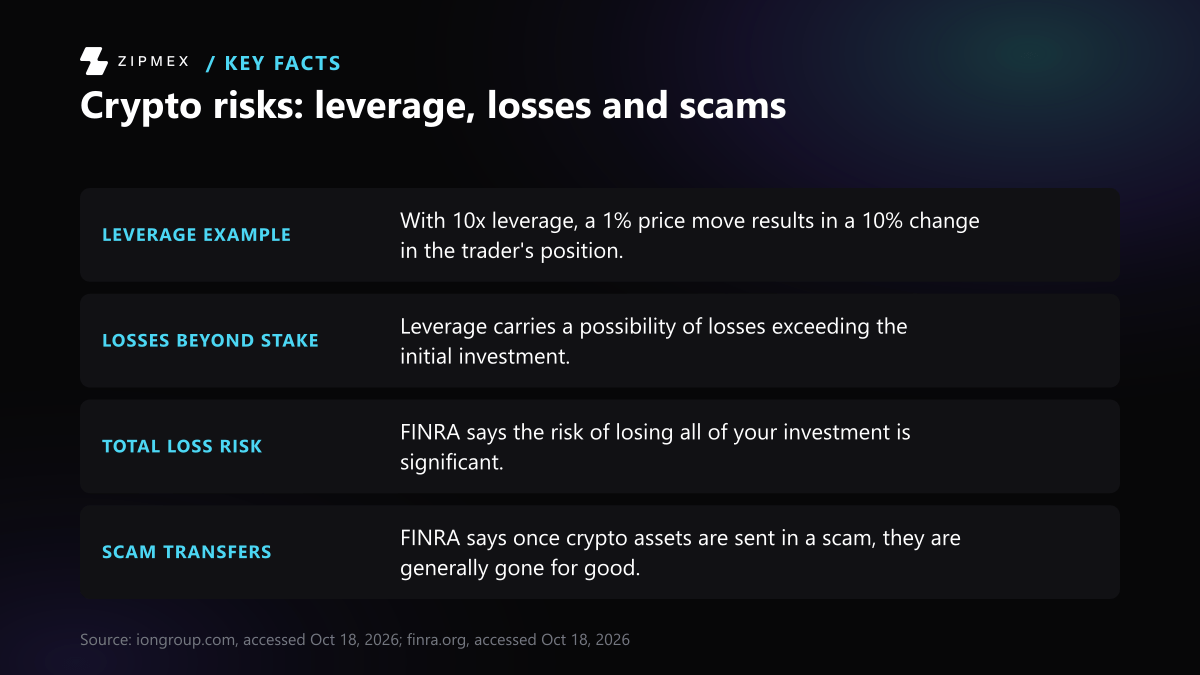
Yes, you can lose more than you put in. The U.S. Commodity Futures Trading Commission (CFTC) says traders in margined virtual currency futures "will be forced to refill their margin accounts or close out their positions, and in the end may lose more than their initial investments." Leverage is the reason. A small deposit controls a much larger position, so a modest price move against you can wipe out the deposit and then some. On top of that come the risks of crypto itself: extreme volatility, thin liquidity, scams and theft.

What a crypto futures contract is
A guide from ION Group (Feb. 21, 2025) describes a crypto futures contract as a derivative that obligates a buyer and a seller to exchange a crypto asset at an agreed price on a set future date.
The same guide covers the perpetual swap, a crypto futures contract with no expiry date. It says perpetuals use funding rates, "typically updated every 8 hours," which are "based on the difference between the contract and spot prices." Rates and how often they are charged vary by venue. Read the contract terms rather than relying on the guide's typical figure.
How leverage magnifies a price move
The CFTC glossary defines leverage as "the ability to control large dollar amounts of a commodity or security with a comparatively small amount of capital." The ION Group guide's example: "with 10x leverage, a 1% price movement results in a 10% change in the trader's position."
The arithmetic follows from that example. It is an illustration, not a sourced figure, and it leaves out fees and funding:
| Your margin | Leverage | Position size | Price move against you | Loss | Share of your margin lost |
|---|---|---|---|---|---|
| $1,000 | 2x | $2,000 | 10% | $200 | 20% |
| $1,000 | 10x | $10,000 | 1% | $100 | 10% |
| $1,000 | 10x | $10,000 | 10% | $1,000 | 100% |
| $1,000 | 20x | $20,000 | 10% | $2,000 | 200% |
The last row shows how a loss can exceed the deposit. Whether you actually owe the shortfall depends on how fast the position is closed and on your provider's terms. The CFTC's warning above is that it can happen.
Margin and margin calls
In regulated futures markets, margin is not a down payment. A CFTC education page calls margins "performance bonds designed to ensure that traders can meet their financial obligations." These deposits are "typically between two and 10 percent of the total value of the contract."
How it works, according to the CFTC:
- Daily mark-to-market. After the initial margin is posted, "the position is 'marked to the market' daily," so losses come out of your margin balance as prices move.
- Maintenance margin. The CFTC glossary defines it as "an amount that must be maintained on deposit at all times." If your account falls below it, you must post more money (variation margin).
- Margin call. The glossary defines it as "a request from a brokerage firm to a customer to bring margin deposits up to initial levels."
- Higher house requirements. Brokers (futures commission merchants) "often require their customers to maintain funds in their margin accounts that exceed the levels specified by an exchange."
The ION Group guide says the same for crypto: "Traders must maintain a minimum balance, or margin, to hold their positions." If you cannot top up, the position is closed, often at the worst moment. For more on how the two terms relate, see leverage vs margin.
Leverage and a price move
Enter your own capital, leverage and price move to see the change in your position.
| Your own capital (the amount you put up) | Leverage | Price move | Change in position value |
|---|---|---|---|
| 1,000 USD | 10 x | 1 % | 100 USD |
| 5,000 USD | 10 x | 1 % | 500 USD |
| 250 USD | 10 x | 1 % | 25 USD |
- Capital is your own figure; the sources give none.
- Leverage of 10x and a 1% price move come from the ION Group guide's example.
The calculator leaves out fees, margin calls and liquidation, which the sources do not give figures for.
Volatility and liquidity make leverage worse
FINRA says crypto assets are "risky and often extremely volatile" and that "the risk of losing all of your investment is significant." It adds that crypto assets "are also less liquid than more traditional financial instruments like stocks and bonds." That can make prices swing more and selling harder.
The CFTC's advisory makes the link to futures directly: "Profits and losses related to this volatility are amplified in margined futures contracts." It also names "volatile cash market price swings or flash crashes" as a risk. A sharp move can close a leveraged position before you can react.
Scams, theft and the provider you choose
FINRA lists the fraud schemes that target crypto investors: "Ponzi schemes, pyramid schemes, pump and dump schemes, the sale of fake coins, phishing scams, romance scams" and "pig butchering" scams. It warns that "once assets are sent, they're generally gone for good" and that "recovery of stolen crypto assets is rare."
On theft, FINRA says "theft of crypto assets is a significant risk" and that investors should "carefully vet an institution before using its service." It also notes that SIPA protection "might not apply," and crypto assets that are not SIPA securities "aren't protected under SIPA." The CFTC flags "cyber risks, such as hacking or phishing attempts."
The ION Group guide adds two more: counterparty risk, and a regulatory environment for crypto derivatives that is "less established and more uncertain" than for traditional derivatives.
What stop-losses and hedging can and cannot do
The ION Group guide says "a stop-loss order automatically sells, or buys, an asset when its price falls, or rises, to a set level," and that "hedging provides further protection by taking offsetting positions." Both limit losses. Neither removes risk. A stop can fill at a worse price in a fast market, and a hedge that cuts losses also cuts gains. FINRA's general guidance puts it plainly: "You cannot eliminate investment risk."
Checks before opening a leveraged position
- Loss terms. Find out whether your losses are capped at posted margin or whether you can owe a negative balance.
- Margin terms. Check initial and maintenance margin levels, how margin calls are sent and how fast positions are closed.
- Costs. Check trading fees and, for perpetuals, how often funding is charged.
- Provider. Check its regulatory status, how it holds customer assets and its security record, as FINRA advises.
- Position size. Work out the price move that would wipe out your margin at the leverage you plan to use. At 10x it is about 10%, before fees.
Limitations: the ION Group guide is a single industry source dated Feb. 21, 2025, the CFTC advisory dates from Dec. 15, 2017, and the FINRA pages carry no date; none gives current margin, fee or liquidation figures for any venue.
