European Central Bank (ECB) Supervisory Board Vice-Chair Frank Elderson on Oct. 6 outlined a mid-October review of accumulated bank supervisory measures. He spoke on a panel at a supervisory conference in Vienna. A supervisory finding is a weakness that supervisors identify at a bank. A measure is the corrective action they then request. Low-severity findings would receive more proportionate follow-up. Material weaknesses can still prompt escalation.
Key facts, per Elderson
- Approach: The ECB began a tiered approach in 2025. It aligns follow-up with risk severity.
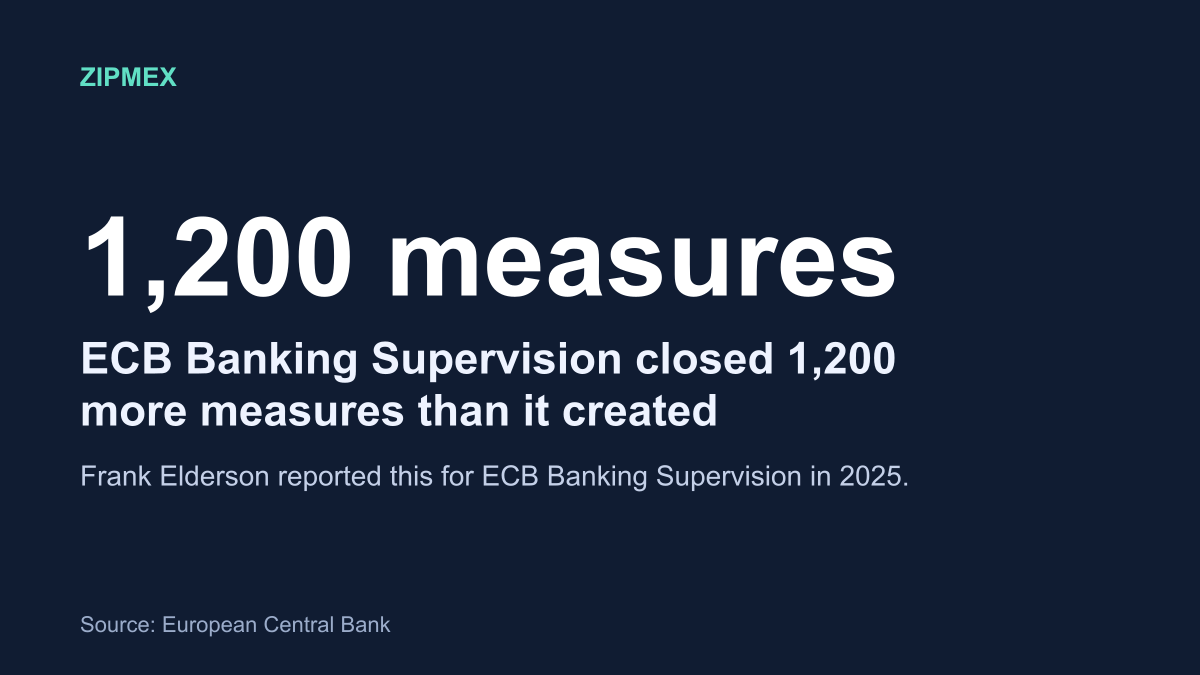
- 2025 measures: ECB Banking Supervision closed 1,200 more measures than it created.
- 2026 stock: The outstanding stock fell by a further 600 measures by the date of the Oct. 6 contribution.
- Review: A mid-October exercise would examine measures accumulated in recent years.
Why the counts need context
Elderson reported around 12,000 outstanding measures at the end of 2025. The figure covered significant banks. That is around 100 measures per bank on average. The measures ranged in severity from very low to very high. That stock is a snapshot at one point in time. The 1,200 figure is different. It describes the 2025 difference between measures closed and measures newly created. A stock count and a period change answer different questions. A large year-end stock can coexist with more closures than new measures during the same year. The tiered approach puts these counts alongside risk severity rather than treating every open measure as equivalent.
How the review fits the timeline
Elderson described the ECB’s tiered approach, which began in 2025 and aligns follow-up with risk severity. A refocusing exercise planned for mid-October would review measures accumulated in recent years. Supervisory engagement would be tailored to the risk profile of the underlying weakness. Banks would receive further information about the implications for their individual findings and measures. The stated factors include severity, prudential relevance, remediation status, time elapsed since identification, and the likelihood of further supervisory intervention. The milestones separate an approach already under way from a review still planned.
ECB supervisory follow-up milestones
Which milestone comes next as you step through the sequence?
- 2025Tiered approach beginsdone
The ECB started aligning supervisory follow-up with the risk severity of findings and measures.
Source: European Central Bank, Oct 6, 2026 - 2025Closures exceed new measuresdone
ECB Banking Supervision closed 1,200 more measures than it created, Elderson reported.
Source: European Central Bank, Oct 6, 2026 - By Oct. 6, 2026Further stock decline reporteddone
Elderson reported that the stock had fallen a further 600 in 2026 by the date of his contribution.
Source: European Central Bank, Oct 6, 2026 - Mid-October 2026Refocusing review plannedexpected
The planned exercise would review accumulated measures and tailor engagement to the underlying weakness’s risk profile.
Source: European Central Bank, Oct 6, 2026
The timeline reflects Elderson’s account and does not independently verify the reported counts or predict outcomes for individual banks.
Analysis: lighter steps and escalation
Elderson said the approach is not lowering supervisory standards or reducing resilience. The ECB began tiered follow-up in 2025, aligning its response with risk severity. This pairing suggests simplification means tailoring the supervisory process to the significance of a finding. It does not erase the difference between lighter procedures for lower-severity issues and an unresolved material weakness. The latter can still lead to intrusive tools. The described approach combines proportionate handling with a path to stronger intervention when needed.
What changes for lower-severity findings
Elderson described several specific changes for low-severity findings. Banks are expected to confirm sufficient action to ensure compliance without submitting further documentation. Least-severe F1 findings will be communicated as supervisory observations rather than generate measures. Low-severity F2 findings and measures will receive more proportionate handling. Some of them may also be closed. That applies only where further supervisory assessment is no longer warranted. Mandatory internal-audit or internal-validation verification will be removed for low-severity F1 or F2 findings related to internal models. These changes affect confirmation, classification, possible closure and verification requirements.

Escalation for material weaknesses
Elderson said the ECB is making greater use of a clear escalation ladder. It applies to material weaknesses that are not addressed in a timely manner. The tools on that ladder can be more intrusive. They include capital requirements and qualitative measures. Examples range from requiring stronger risk management to imposing business restrictions or periodic penalty payments.
Limitations
Elderson’s contribution is the only detailed source for these figures and policy changes. Its numbered notes were not available. The figures have not been independently confirmed.
The next step
The next milestone is the refocusing exercise planned for mid-October. Elderson said banks would receive information on what it means for their own findings and measures. That assessment would consider the severity of each item. It would also weigh prudential relevance, meaning the item’s importance for a bank’s safety, and remediation status. The time elapsed since identification would count too. So would the likelihood of further supervisory intervention.
Sources: European Central Bank, Oct 6, 2026
ZIPMEX promotes trading on trade.zipmex.com. Promotions are labelled and kept separate from news coverage, which is selected and checked without regard to them. Perpetual futures are leveraged derivatives. Prices can move fast and you can lose all of your margin. Not available in every jurisdiction. Not investment advice.