
A Bitcoin transaction goes through four steps. First, your wallet signs it with your private key. Next, it is broadcast to the network, and nodes hold it in their memory pools. A miner then includes it in a block. After that it gains confirmations as more blocks are added on top. Bitcoin.org says the first confirmation usually comes within about 10 to 60 minutes. Each confirmation after that makes it exponentially less likely that the payment is reversed. For low-value payments, one confirmation can be considered secure. For higher-value payments, bitcoin.org says it makes sense to wait for 6 confirmations or more.

Step 1: the wallet builds and signs the transaction
Bitcoin.org defines a transaction as "a transfer of value between Bitcoin wallets that gets recorded in the blockchain."
Inputs, outputs and change
Bitcoin does not keep account balances. According to the Bitcoin developer guide, each transaction output "waits as an Unspent Transaction Output (UTXO) until a later input spends it." A wallet's balance is really the set of UTXOs it can spend.
When you pay someone, your wallet picks one or more of your UTXOs as inputs. Each input points to an earlier output by its transaction identifier (txid) and output index number ("vout"). The wallet then creates the outputs:
- Payment output: the amount going to the recipient's address.
- Change output: the developer guide calls these "regular outputs which spend the surplus satoshis from the UTXOs back to the spender." It recommends sending change to a new address.
- Fee: the guide says the full value of the included UTXOs "must be spent or given to a miner as a transaction fee." Whatever is not assigned to an output goes to the miner.
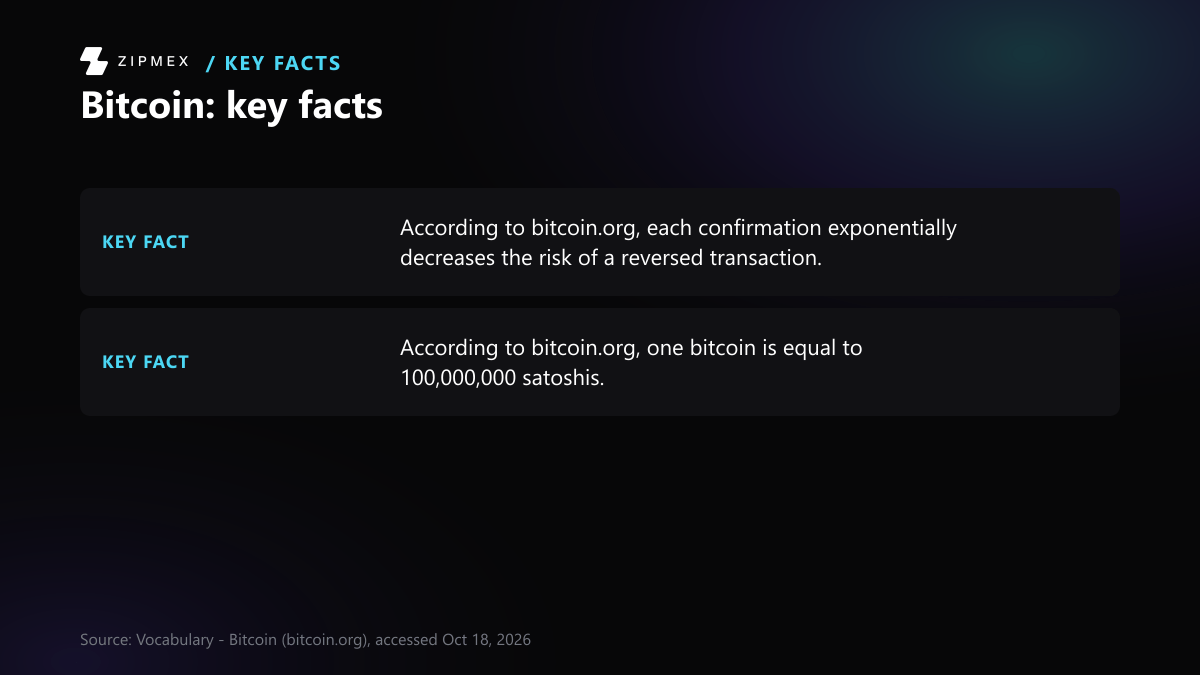
Amounts are counted in satoshis. Bitcoin.org says one bitcoin equals 100,000,000 satoshis.
The signature
The wallet signs the transaction with the private key that controls those UTXOs. Bitcoin.org says the signature gives "a mathematical proof" that the transaction came from the wallet's owner. It also "prevents the transaction from being altered by anybody after it has been issued." The developer guide says Bitcoin uses "the Elliptic Curve Digital Signature Algorithm (ECDSA) with the secp256k1 curve." SIGHASH_ALL is the default signature type. It "signs all the inputs and outputs," so nobody can change the amounts or recipients once the transaction is signed.
The private key itself is never sent to the network. Bitcoin.org warns that private keys "must never be revealed," because whoever holds a key can spend the bitcoin it controls.
Step 2: broadcast and the memory pool
Bitcoin.org says all transactions are broadcast to the network. The developer guide describes how this works. A node announces a transaction to its peers with an "inv" message. Each peer that receives a valid transaction "forwards the transaction in the same manner," so it spreads across the network.
Until a transaction is mined, it is unconfirmed. Full nodes "may keep track of unconfirmed transactions which are eligible to be included in the next block," in what Bitcoin Core calls the memory pool, or mempool. The mempool is held in non-persistent memory. The guide notes that "never-mined unconfirmed transactions tend to slowly disappear from the network as peers restart." A transaction that is never mined does not move any funds.
Step 3: a miner packs it into a block
Bitcoin.org describes mining as "a distributed consensus system that is used to confirm pending transactions by including them in the blockchain." To be confirmed, a transaction must be packed into a block that "follows very strict cryptographic rules," and the network verifies those rules. Bitcoin.org says mining "works like a competitive lottery," which makes it hard for any one participant to add blocks in a row.
How fees decide what gets in
Bitcoin.org says a fee is "a small amount of bitcoin paid by the sender to incentivize miners" to include the transaction. "Fees are not fixed; users can choose how much to pay." Higher fees usually confirm faster, especially when the network is congested.
The developer guide says fees are based on the byte size of the signed transaction. Fees per byte rise as demand for block space increases. Since the Segregated Witness upgrade (BIP 141), size is measured as virtual size: "Transaction weight / 4 (rounded up to the next integer)". Blocks are capped by the rule "block weight ≤ 4,000,000." A transaction that spends many small UTXOs is larger, so at the same fee rate it costs more than one that spends a single UTXO.
The generation transaction
The developer guide says the first transaction in every block must be a generation transaction. It collects the block reward, "comprised of a block subsidy and any transaction fees paid by transactions included in this block." The miner cannot spend that output for at least 100 blocks.
How often blocks arrive
Bitcoin.org says a new block is appended "roughly every 10 minutes, on average." That is an average, so the time to the next block varies. Every 2,016 blocks, the network adjusts the difficulty target so those blocks take about two weeks, according to the developer guide.
Which confirmation guidance applies?
Check whether the payment is in a block and whether its value is low.
Has the payment been packed into a block yet?
- No → Not yet confirmed
- Yes → next question
Is the payment low in value?
Source: Vocabulary - Bitcoin (bitcoin.org), accessed Oct 18, 2026
The first confirmation usually comes within about 10 to 60 minutes of broadcast.
Source: How does Bitcoin work? - Bitcoin (bitcoin.org), accessed Oct 18, 2026For low value transactions, bitcoin.org says a single confirmation can be considered secure.
Source: Vocabulary - Bitcoin (bitcoin.org), accessed Oct 18, 2026For higher value transactions, bitcoin.org says it makes sense to wait for 6 confirmations or more.
Source: Vocabulary - Bitcoin (bitcoin.org), accessed Oct 18, 2026These are bitcoin.org's general statements for Bitcoin, undated in the text, and they do not cover current fees or confirmation times.
A transaction is a transfer of value between Bitcoin wallets that gets recorded in the blockchain.
Step 4: confirmations
Bitcoin.org defines a confirmation as meaning that "a transaction has been processed by the network and is highly unlikely to be reversed." A transaction has one confirmation once it is in a block, and gains one more with each block added after it. The developer guide explains why depth matters: "the cost to modify a particular block increases with every new block added to the block chain."
Bitcoin.org's guidance:
- 0 confirmations: the transaction is only in mempools and can still fail to be mined.
- 1 confirmation: "can be considered secure for low value transactions."
- 6 or more: for higher value transactions, "it makes sense to wait for 6 confirmations or more."
"Each confirmation exponentially decreases the risk of a reversed transaction." Each new block cuts the remaining risk by a proportion of what is left, not by a fixed amount.
Who keeps the record
There is no central server. The Texas State Securities Board says, "Each of the computers on the network has its own copy of the entire blockchain." When a new block is found, they all add it to their copies at the same time. Bitcoin.org describes the blockchain as "a public record of Bitcoin transactions in chronological order" that is shared between all Bitcoin users. Nodes use this shared record to check that a sender has not already spent the same coins, which is called double spending.
Practical points for sending and receiving
- Check the address before you sign. Once a transaction is signed, the default signature protects its outputs from being changed. Make sure the recipient address is correct before you sign.
- Set the fee for how fast you need it. Fees are paid per virtual byte and rise with demand, so a payment that must confirm soon needs a higher fee rate when the network is busy.
- Match the wait to the amount. Treat zero confirmations as unconfirmed. One confirmation suits small amounts, and six or more suits larger ones.
- Back up your keys. Kaspersky says that if a self-custody wallet's credentials are permanently lost, "there is generally no central organization that can reset it for you."
These sources describe how Bitcoin works in general. They do not cover live fee levels or current confirmation times, or how other blockchains confirm transactions.
