The crypto token landscape has never been more crowded-or more treacherous. Over 100 million tokens now exist across major blockchain networks, with 85 million on Solana alone. Yet research from Memento shows that 85% of tokens launched in 2025 are trading below their initial TGE prices, with the median token down over 70%. The difference between the winners and the 85% that fail isn't luck-it's strategy, execution, and understanding 2026's dramatically changed landscape.
⚡ Quick Answer
Launching a crypto token in 2026 requires $500-$200,000+ depending on complexity, 3-6 months of preparation, and navigation through tokenomics design, smart contract development, regulatory compliance (including MiCA in Europe), and community building. The most cost-effective path for meme/utility tokens is Solana or Base, while serious DeFi protocols typically choose Ethereum or its Layer 2s.
Whether you're building the next viral meme coin, serious DeFi infrastructure, or tokenizing real-world assets, this comprehensive guide covers everything from your first idea to successful Token Generation Event (TGE) and beyond.
Why 2026 Is Dramatically Different: The New Token Launch Reality
The token launch landscape has undergone a seismic shift. Gone are the days when any anonymous team could launch a token and expect millions in funding. In 2026, successful launches require professional preparation, strict regulatory compliance, and genuine utility.
📊 The Harsh Reality of 2025-2026 Token Launches
According to Memento Research, 84.7% of tokens launched in 2025 are trading below their Token Generation Event prices. The median token has fallen 71% since launch. Exchange listings that once signaled momentum now often trigger immediate sell-offs as short-term traders take profits.
The current market demands a fundamentally different approach:
AI-Integrated Tokens are dominating attention, with on-chain AI agents and machine learning integrations attracting both users and investors who see the convergence of AI and crypto as the next major narrative.
Real-World Asset (RWA) Tokenization has gained serious institutional traction, with over $25 billion in tokenized assets as of mid-2025, bridging traditional finance with blockchain.
MiCA Compliance is now mandatory for any project targeting the European market, with the regulation fully applicable since December 30, 2024.
Community-First Distribution is replacing broad airdrops, as projects realize that tokens handed to unengaged users create persistent selling pressure rather than loyal communities.
Step-by-Step Guide: Launching Your Crypto Token in 2026
Step 1: Define Your Project's Purpose and Niche
Before writing a single line of code, you need absolute clarity on what problem your token solves. The crypto graveyard is filled with tokens that were "just like Ethereum, but faster" or "the next Bitcoin killer."
Ask yourself three critical questions:
- What specific problem does this token solve that existing solutions don't address?
- Who exactly will use this token and why would they choose it over established alternatives?
- What makes this token essential rather than optional for your target users?
🎯 Most Successful Token Categories in 2026
AI Agent Tokens
Enabling autonomous on-chain operations and AI-powered DeFi
RWA Tokens
Tokenizing real estate, commodities, and traditional assets
DeFi Protocols
Novel yield mechanisms and cross-chain liquidity solutions
Gaming/SocialFi
Play-to-earn with sustainable economics and social tokens
⚠ Risk Warning
Creating a token without clear utility is the #1 reason projects fail. Regulators-including the SEC and EU under MiCA-increasingly target tokens that appear to be unregistered securities. Your token must have genuine use beyond speculation.
Step 2: Design Your Tokenomics
Tokenomics-the economic model of your token-determines whether your project thrives or dies. Poor tokenomics have killed more promising projects than bad technology ever will.
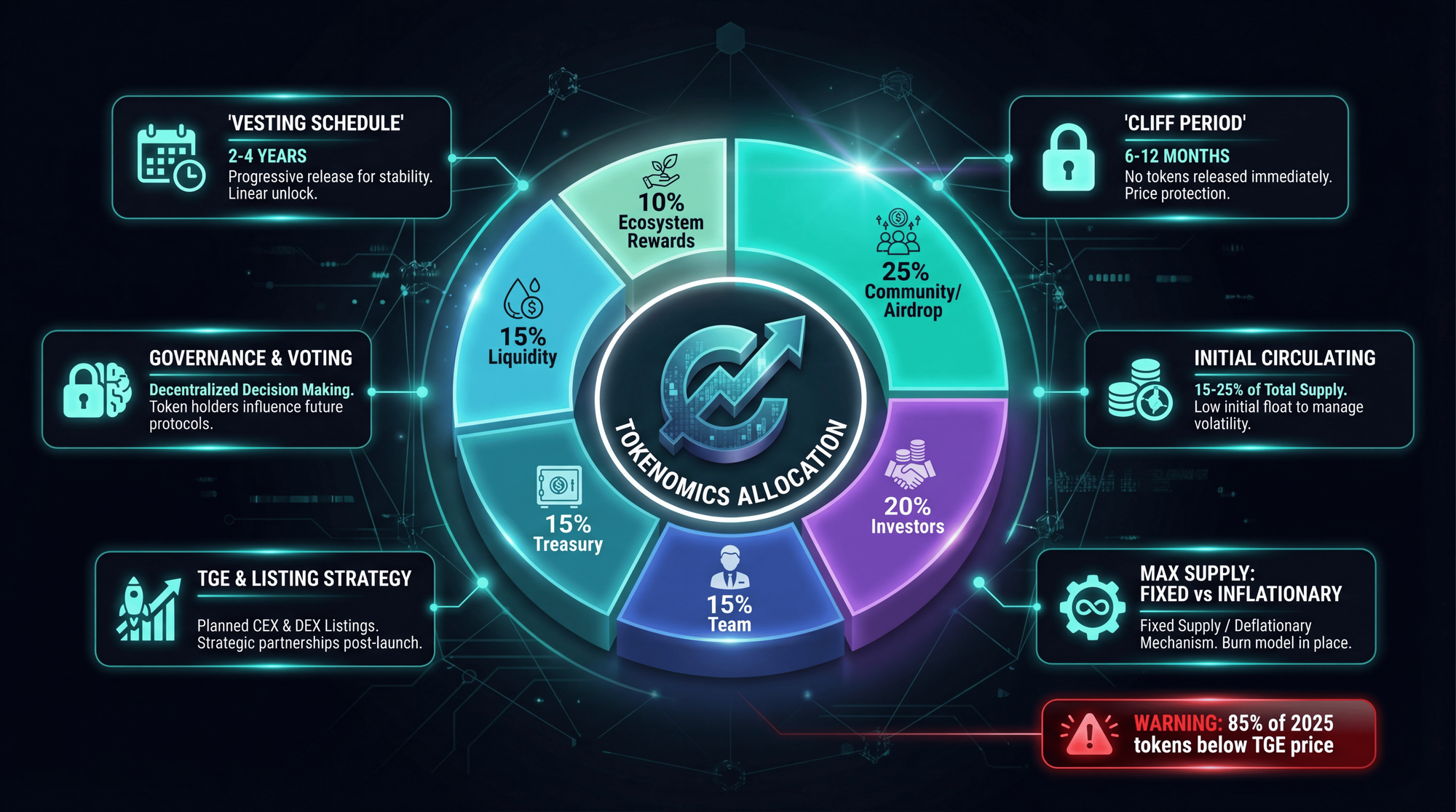
Key tokenomics components you must define:
Total Supply determines scarcity and should align with your use case. Whether capped or inflationary, justify your choice with clear reasoning.
Distribution Allocation must balance fairness with sustainability:
🎯 Tokenomics Best Practices 2026
- Team allocation: 10-20% maximum, always vested over 2-4 years with 6-12 month cliff
- Initial circulating supply: 15-25% at TGE to prevent immediate dumps
- Community allocation: 25-40% for airdrops, rewards, and governance participation
- Liquidity provision: Minimum 10-15% locked for 12+ months
- Treasury: 10-20% for ongoing development and unforeseen needs
Utility Mechanisms explain how tokens are used, earned, and potentially burned. Without clear utility driving demand, your token has no fundamental value beyond speculation.
Vesting Schedules are non-negotiable. Standard practice in 2026 is 2-4 year vesting with 6-12 month cliff for team and early investors. Projects without proper vesting are immediately flagged as potential rug pulls.
Step 3: Choose Your Blockchain Platform
Your choice of blockchain affects everything: development costs, transaction fees for users, available developer tools, security guarantees, and potential investor perception. In 2026, the landscape is more diverse than ever.
For most new projects in 2026:
- Solana offers the best combination of ultra-low costs and high visibility for consumer-facing tokens, meme coins, and gaming projects
- Base provides Ethereum security with reasonable fees for DeFi applications and has strong Coinbase ecosystem integration
- Arbitrum dominates for serious DeFi protocols with its mature ecosystem and developer tooling
- Ethereum mainnet remains the gold standard for enterprise projects, RWA tokenization, and institutional credibility
Step 4: Develop and Audit Smart Contracts
Your token's smart contract is its foundation. A single vulnerability can destroy your entire project and community trust-over $3.5 billion was lost to smart contract exploits in 2024 alone, and H1 2025 saw an additional $3.1 billion in losses.
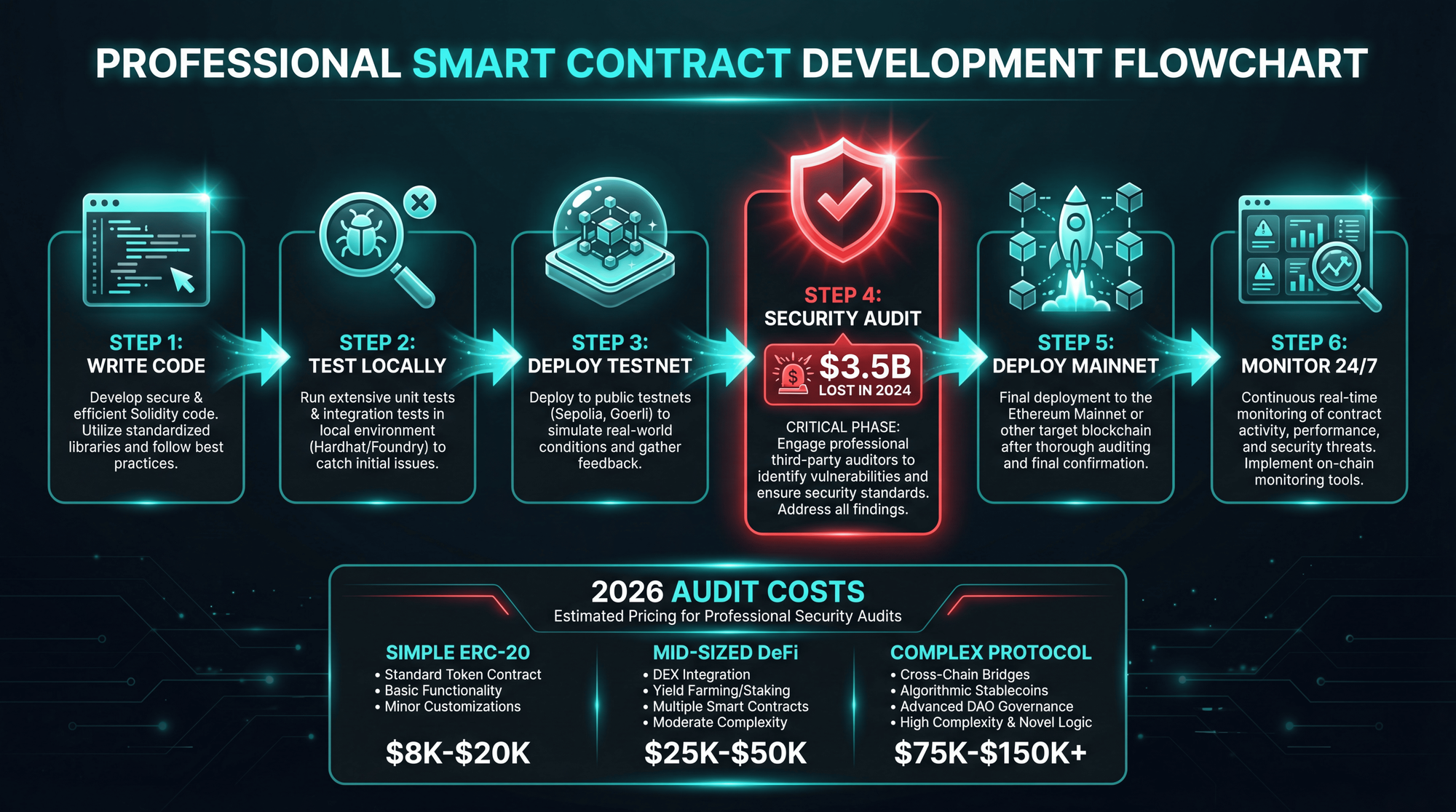
🚨 2025-2026 Security Crisis
The $1.5 billion Bybit hack in February 2025-the largest crypto heist ever-demonstrated that even major exchanges are vulnerable. By mid-July 2025, $2.17 billion had been stolen, already exceeding all of 2024. Security audits are not optional-they're existential.
Development options span a wide range:
No-Code Platforms like Smithii on Solana or ThirdWeb for EVM chains can deploy basic tokens for under $100-suitable for simple meme coins.
Standard Token Contracts using OpenZeppelin templates for ERC-20/ERC-721 cost $500-$5,000 for basic customization.
Custom Development for complex tokenomics, staking mechanisms, or governance features runs $5,000-$50,000+ depending on complexity.
Step 5: Navigate Legal Compliance and Regulatory Requirements
This is where many projects fail catastrophically or set themselves up for future legal battles. The regulatory landscape in 2026 demands serious attention-especially with MiCA now fully enforced in Europe.
⚠ Critical Legal Warning
The SEC, EU regulators under MiCA, and other global authorities actively pursue token projects that violate securities laws. Over 50 crypto firms had licenses revoked by February 2025 in the EU alone. "We didn't know" is not a defense. Budget $10,000-$50,000+ for proper legal review.
MiCA (Markets in Crypto-Assets) - The EU Framework:
MiCA became fully applicable on December 30, 2024, creating the world's first comprehensive crypto regulatory framework. Key requirements include:
🇪🇺 MiCA Compliance Checklist
- Whitepaper Requirements: Must be published in iXBRL format with standardized disclosures
- CASP Licensing: Crypto-Asset Service Providers must obtain authorization by December 2025-June 2026
- Stablecoin Rules: ARTs and EMTs require specific reserves and authorizations
- Personal Liability: Executives can be personally banned from the industry for violations
- Penalties: Fines up to €5 million or 3-12.5% of annual turnover
Key Legal Considerations by Region:
| Jurisdiction | Key Requirements | Crypto-Friendly Level |
|---|---|---|
| European Union | MiCA compliance mandatory, CASP licensing, Travel Rule (TFR) | ⭐⭐⭐ (Clear rules) |
| United States | SEC scrutiny, Howey Test for securities classification | ⭐⭐ (Uncertain) |
| Switzerland | FINMA guidelines, favorable for utility tokens | ⭐⭐⭐⭐⭐ |
| Singapore | MAS licensing, clear framework, pro-innovation | ⭐⭐⭐⭐⭐ |
| UAE (Dubai) | VARA licensing, dedicated crypto regulatory body | ⭐⭐⭐⭐ |
| BVI/Cayman | Minimal regulation, popular for offshore structures | ⭐⭐⭐ (Offshore) |
Token Classification is critical. Utility tokens with genuine use cases face less regulatory scrutiny than tokens that primarily function as investment vehicles. Get a legal opinion before launch.
KYC/AML Requirements are now standard. Most legitimate launchpads require KYC for participants, and the EU's Transfer of Funds Regulation (Travel Rule) mandates sender/receiver information for crypto transfers.
Step 6: Choose Your Token Sale Model
Understanding the different fundraising mechanisms helps you choose the right approach for your project and target audience.
Popular Launchpads in 2026:
- Seedify, DAO Maker, Polkastarter - Multi-chain IDO platforms with strong communities
- Binance Launchpad, OKX Jumpstart - Centralized exchange IEOs with massive reach
- Raydium AcceleRaytor, Jupiter LFG - Solana ecosystem launchpads
- Camelot, Arbitrum ecosystem - Growing DeFi-focused platforms
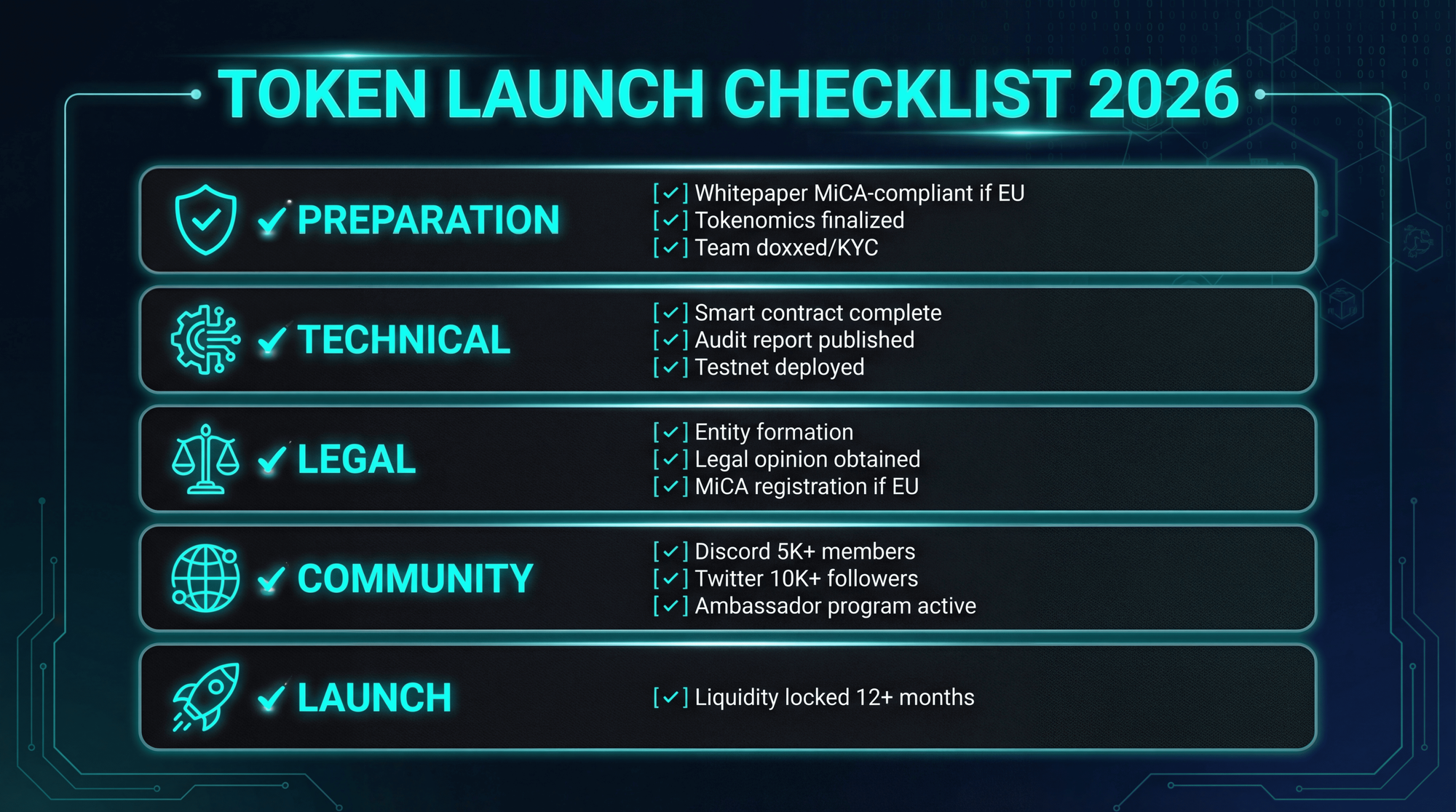
Step 7: Build Your Community Before Launch
In 2026, community-first launches consistently outperform everything else. The Memento Research data showing 85% of tokens below TGE prices reveals a clear pattern: tokens distributed broadly to unengaged audiences create persistent selling pressure, while those with genuine community alignment retain value.
Community Building Timeline (3-6 months before TGE):
Foundation Phase
Establish presence on Twitter/X, Discord, and Telegram. Share educational content about your problem space. Build core team of moderators and early believers. Target: 1,000-5,000 genuine followers.
Engagement Phase
Launch testnet or beta access. Run ambassador programs with meaningful tasks. Begin engagement-based reward campaigns (not passive airdrops). Target: 5,000-15,000 active community members.
Launch Preparation
Partner with 5-10 mid-tier crypto influencers ($500-5,000/post). Create hype through teasers and community governance votes on features. Finalize whitelist with engaged participants only. Target: 10,000-30,000+ community members.
Step 8: Execute Your Token Generation Event (TGE)
The TGE is your project's defining moment. A well-executed launch sets the foundation for everything that follows; a botched one can be unrecoverable.
🚀 TGE Execution Timeline
T-7 DAYS: Pre-Launch
- Final audit completion and publication
- Liquidity preparation ($50K-500K+ depending on scale)
- Marketing blitz: influencer posts scheduled, community contests
- Final contract verification on block explorer
T-0: Launch Day
- Token deployment on mainnet
- Liquidity pool creation (Raydium, Uniswap, etc.)
- Liquidity lock (minimum 12 months, verifiable on-chain)
- Airdrop distribution to qualified participants
- Trading begins-24/7 team monitoring
T+1 to T+30: Post-Launch
- Round-the-clock community management
- CEX listing applications (Binance, Coinbase, etc.)
- First product milestone delivery
- Weekly community updates and AMAs
- Partnership announcements to maintain momentum
Real Cost Breakdown: Launching a Token in 2026
Let's get specific about what you'll actually spend. These ranges reflect real market rates in early 2026.
💰 Token Launch Budget Calculator 2026
🎭 Meme Coin (Basic)
$500 - $5,000
No-code deploy, basic marketing, community focus
⚡ Utility Token
$15,000 - $50,000
Custom contract, basic audit, marketing campaign
🏦 DeFi Protocol
$75,000 - $250,000
Complex development, full audit, legal compliance
🏢 Enterprise/RWA
$250,000+
Full legal, MiCA compliance, institutional grade
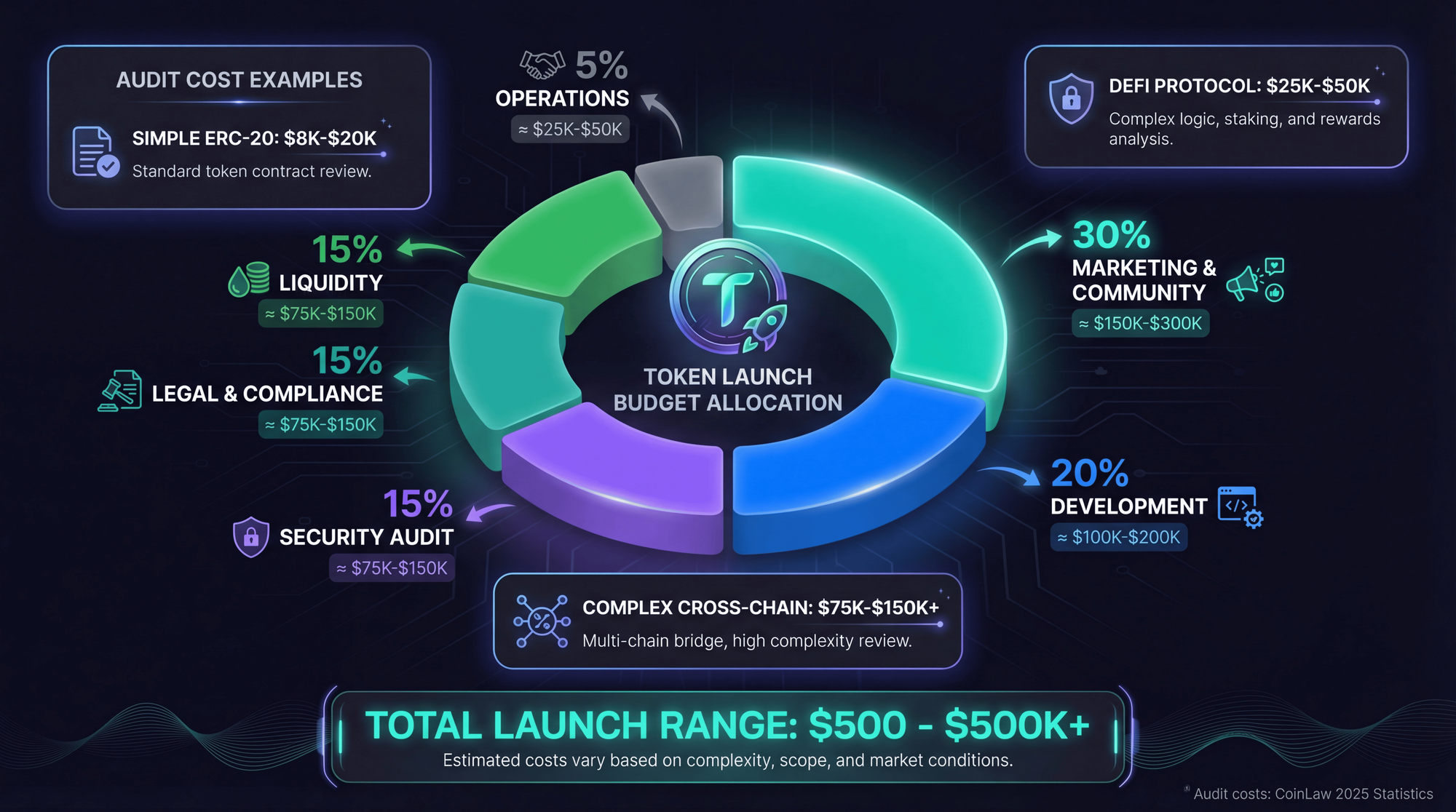
Detailed Budget Breakdown:
| Category | % of Budget | Notes |
|---|---|---|
| Smart Contract Development | 15-25% | Custom: $5K-50K, No-code: <$500 |
| Security Audit | 10-20% | $8K-$150K+ depending on complexity |
| Legal & Compliance | 15-25% | Higher if MiCA/SEC compliance needed |
| Marketing & Community | 25-35% | Influencers, ads, community management |
| Liquidity Provision | 15-25% | Minimum for healthy trading |
| Operations & Contingency | 10-15% | Buffer for unexpected costs |
Common Mistakes That Kill Token Projects
Understanding what not to do is as important as knowing what to do.
📉 Fatal Mistakes to Avoid in 2026
- Broad, engagement-free airdrops: 85% of 2025 tokens failed partly because airdrops went to traders with no product connection
- Unlocked team tokens: Nothing screams "rug pull" like team tokens that can dump immediately-always vest 2-4 years
- Skipping the audit: $3.5 billion lost in 2024 to exploits-audits are insurance, not optional
- Ignoring MiCA/regulations: 50+ firms lost EU licenses by Feb 2025-compliance is existential
- Over-promising roadmaps: Missing deadlines destroys credibility faster than anything else
- Insufficient liquidity: Under-capitalized pools lead to extreme volatility and instant dumps
Frequently Asked Questions
How much does it cost to create a cryptocurrency token in 2026?
The minimum cost to deploy a basic token is under $100 using no-code tools on Solana or BSC-Solana transactions cost approximately $0.00025. However, a professional launch with proper smart contract development, security audit ($8,000-$150,000+), legal compliance, marketing, and liquidity typically costs $15,000-$50,000 for utility tokens and $75,000-$250,000+ for DeFi protocols.
What blockchain is best for launching a token in 2026?
For meme coins and consumer apps: Solana offers the lowest costs (sub-cent transactions) and highest visibility. For DeFi: Base or Arbitrum provide Ethereum security with low fees and mature ecosystems. For enterprise or RWA tokenization: Ethereum mainnet still carries the most institutional credibility. Your choice should align with your target audience and use case.
Do I need a license to launch a crypto token in Europe?
Yes, under MiCA (Markets in Crypto-Assets Regulation), which became fully applicable December 30, 2024. Crypto-Asset Service Providers (CASPs) must obtain authorization by December 2025-June 2026 depending on jurisdiction. Penalties can reach €5 million or 3-12.5% of annual turnover, and executives can face personal liability including industry bans.
Can I launch a token without coding knowledge?
Yes, platforms like Smithii (Solana), ThirdWeb, and Token Tool allow non-technical founders to deploy basic tokens. However, for anything beyond a simple meme coin, you'll need technical expertise or a development partner to implement custom tokenomics, staking mechanisms, or governance features-and you'll definitely need professional auditing regardless.
How long does it take to launch a crypto project?
A minimum viable meme coin launch can happen in 2-4 weeks. Professional utility token launches typically take 3-6 months for proper development, auditing, community building, and legal preparation. Complex DeFi protocols may take 6-12+ months. Rushing the process is how projects end up in the 85% that fail.
What's the difference between ICO, IDO, IEO, and TGE?
ICO (Initial Coin Offering) is the original method where projects sell directly to the public-now largely obsolete due to regulatory concerns. IEO (Initial Exchange Offering) is conducted through centralized exchanges like Binance Launchpad, offering credibility and user access. IDO (Initial DEX Offering) is conducted through decentralized launchpads like DAO Maker or Seedify, providing immediate liquidity. TGE (Token Generation Event) is the modern umbrella term for any token launch, often combining multiple distribution methods.
What makes a token launch successful in 2026?
Based on Memento Research's analysis of 2025 launches, successful tokens share key traits: usage-based distribution (tokens earned through engagement, not given away broadly), clear utility beyond speculation, proper vesting for all insiders, community alignment before launch, and continuous delivery on roadmap promises. The projects that survived 2025's brutal market weren't the most hyped-they were the ones with genuine product-market fit.
Ready to Explore the Crypto Market?
Start your crypto journey with a trusted platform. Trade, earn, and grow your portfolio.
Start Trading Now →Conclusion: Your 2026 Token Launch Roadmap
Launching a cryptocurrency token in 2026 is simultaneously more accessible and more challenging than ever. The tools are better, the infrastructure is mature, but the market is saturated and unforgiving. With 100+ million tokens already in existence and 85% of 2025 launches trading below their TGE prices, success requires genuine differentiation and flawless execution.
Your launch checklist summary:
- Start with "why" - If you can't explain your token's purpose in one sentence, you're not ready
- Design sustainable tokenomics - Proper vesting, realistic allocations, genuine utility
- Choose your chain wisely - Match your blockchain to your use case and audience
- Never skip the audit - $3.5 billion lost in 2024 proves this isn't optional
- Comply with regulations - MiCA in EU, SEC awareness in US, legal opinion everywhere
- Build community before code - Usage-based distribution beats broad airdrops
- Execute precisely - Your TGE sets the tone for everything after
- Deliver consistently - Post-launch execution matters more than launch hype
The crypto space rewards builders who combine innovation with disciplined execution. Your token could join the successful minority-but only if you approach the launch with the seriousness, preparation, and long-term thinking it deserves.
⚠ Disclaimer: The information provided in this article is for educational purposes only and should not be considered investment, legal, or financial advice. Launching a cryptocurrency token involves significant legal, financial, and technical risks. Regulatory requirements vary by jurisdiction-MiCA in the EU, SEC considerations in the US. Always consult qualified legal and financial professionals before proceeding. Cryptocurrency investments and token launches are subject to high market risk, with 85% of 2025 tokens trading below their launch prices. Past performance does not guarantee future results.