Studies consistently show that 70% of crypto traders lose money. In October 2025 alone, the market crashed from its all-time high of $126,000 to below $90,000, wiping out over $1 trillion in value and liquidating billions in leveraged positions. Yet some traders not only survived but profited. Their secret? Disciplined risk management.
⚡ Quick Answer
Effective crypto risk management centers on never risking more than 1-2% of your account per trade. Use stop-loss orders on every position, diversify across different crypto sectors, employ dollar-cost averaging for entries, and remove emotion from trading decisions. Professional traders who follow these rules survive market crashes and compound gains over time.
Whether you lost money in the October 2025 correction or you are just starting your crypto journey, this comprehensive guide delivers the exact frameworks, calculations, and psychological tools that separate the 30% who profit from the 70% who do not.
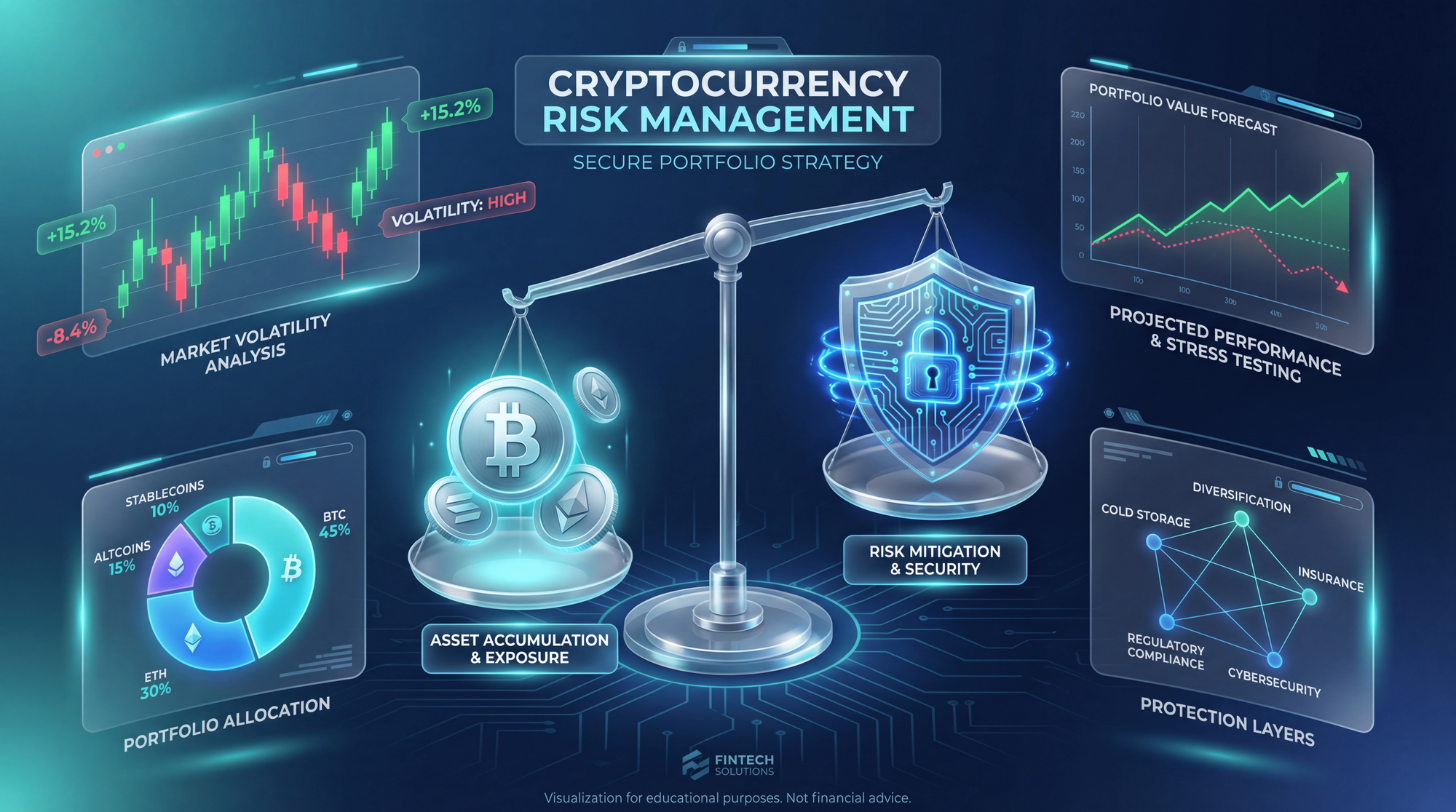
What Is Crypto Risk Management?
Risk management in crypto trading is the systematic process of identifying, measuring, and controlling potential investment losses before they occur. Unlike traditional markets that close on weekends, cryptocurrency operates 24/7 with extreme price swings that can trigger 10-30% moves within hours.
The goal is not avoiding risk entirely-that would mean avoiding opportunity. Instead, effective risk management ensures no single trade, hack, or market crash can devastate your portfolio. Professional traders approach each position knowing exactly how much they could lose and accepting that outcome before clicking buy or sell.
The crypto market presents unique challenges that demand robust risk controls:
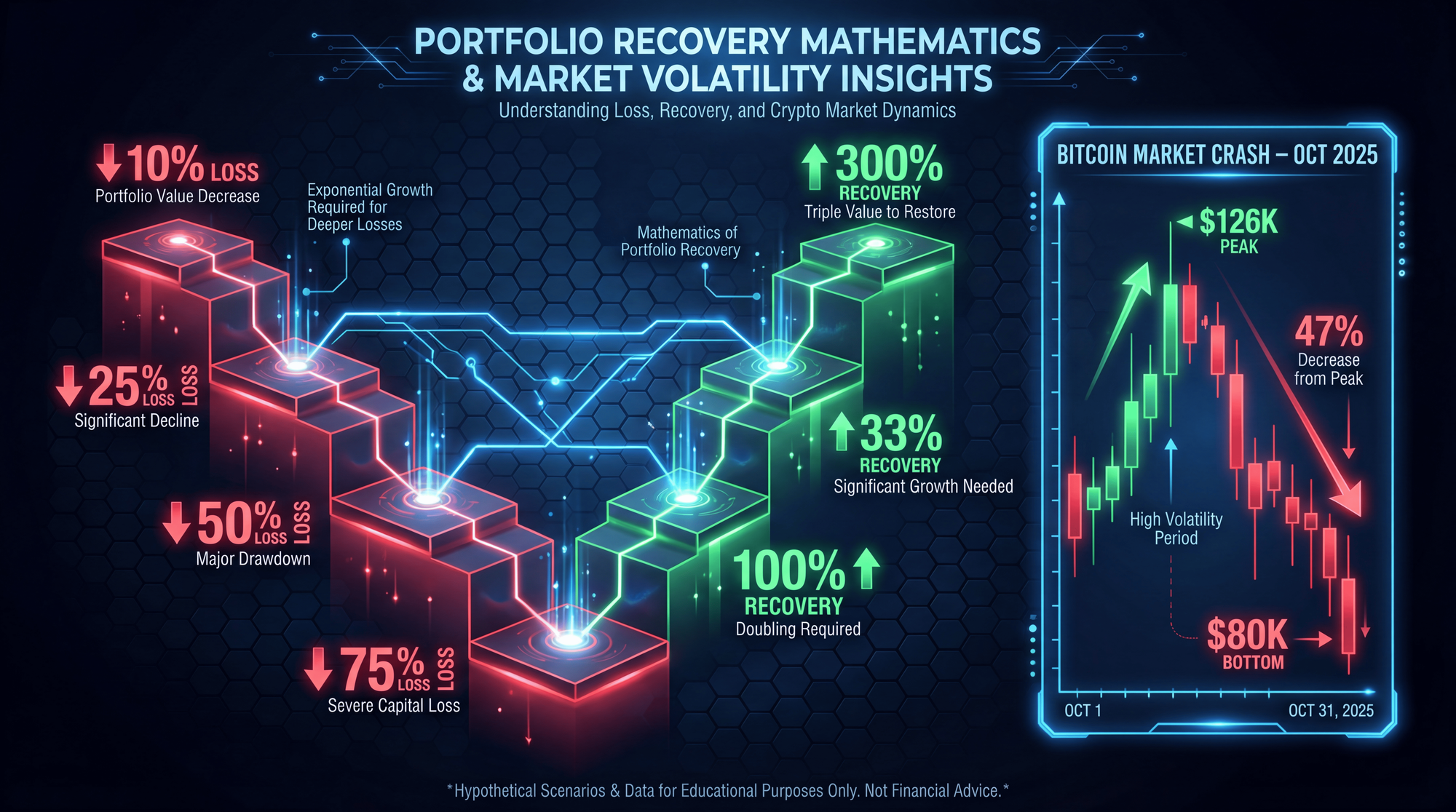
- Extreme volatility: Bitcoin dropped from $126,000 to $80,000 in October 2025-a 36% crash
- Security threats: Over $3.5 billion was lost to hacks and scams in 2025 alone
- Leverage liquidations: The October crash triggered billions in forced liquidations
- 24/7 trading: Markets never close, creating constant exposure
- Sentiment-driven moves: Prices react instantly to news, social media, and whale activity
Understanding Bitcoin fundamentals helps contextualize why the market behaves this way, but even expert knowledge cannot eliminate risk-only manage it.
Why Risk Management Matters More Than Ever in 2026
The cryptocurrency landscape has evolved dramatically. Institutional participation has increased, regulatory frameworks like the GENIUS Act have emerged, and market volatility remains elevated compared to traditional assets.
The Mathematics of Drawdowns
Consider what happens when you experience losses:
📉 The Devastating Math of Recovery
-10%
LOSS
+11%
to recover
-25%
LOSS
+33%
to recover
-50%
LOSS
+100%
to recover
-75%
LOSS
+300%
to recover
A 50% loss requires a 100% gain just to break even. A 75% drawdown needs a 300% recovery. The deeper you fall, the steeper-and less likely-the climb back becomes. Risk management prevents these holes from forming in the first place.
The Psychology of Loss
Research shows the pain of losing money feels twice as powerful as the pleasure of gaining the same amount. This phenomenon, called loss aversion, drives traders to hold losing positions too long (hoping they recover) and exit winners too early (fearing gains will disappear).
The October 2025 crash demonstrated this perfectly. Traders who used excessive leverage hoping to maximize gains faced forced liquidations. According to Galaxy Digital's head of research, this leverage proved "very damaging," transforming a market correction into catastrophic losses for many participants.
The 1-2% Rule: Foundation of Position Sizing
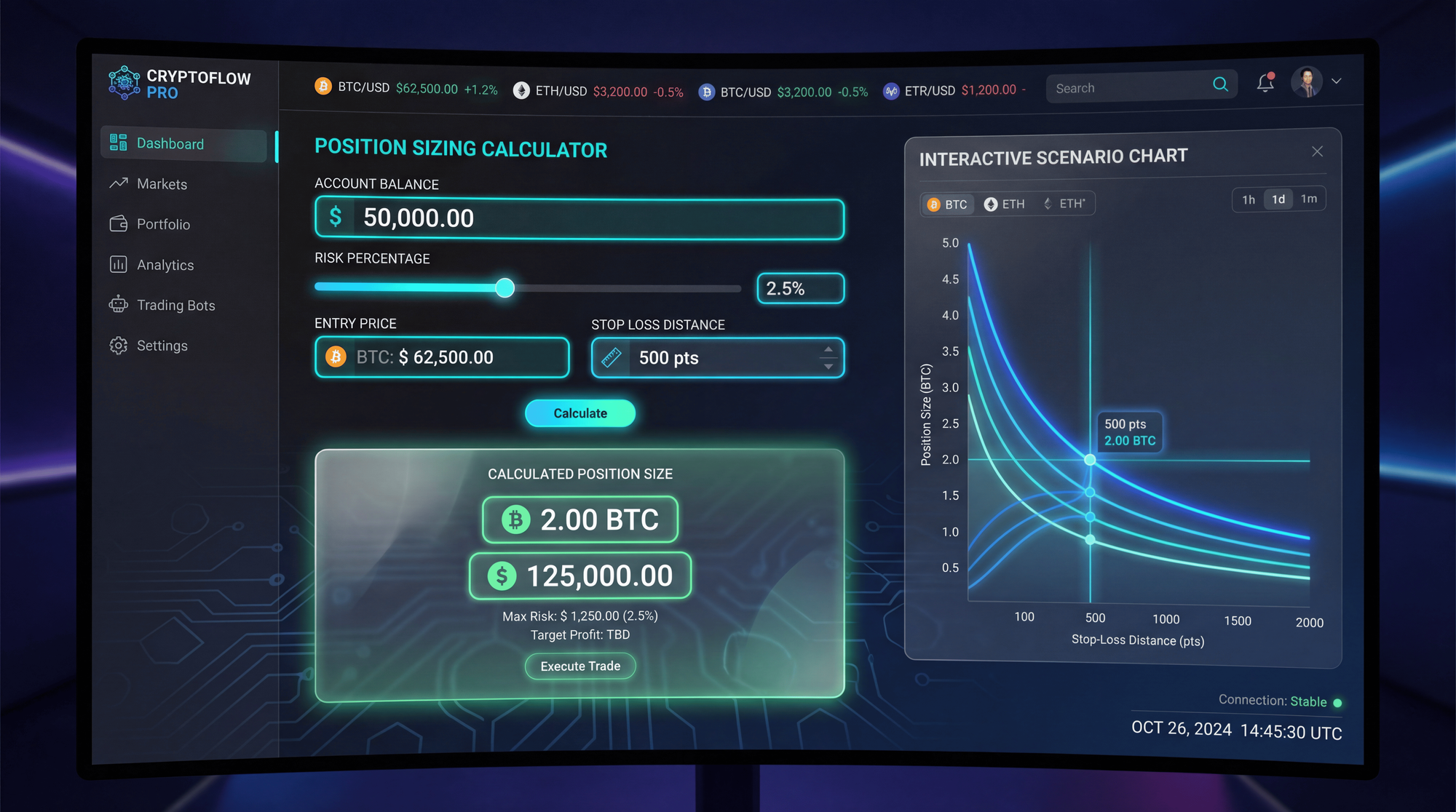
The most important risk management principle is deceptively simple: never risk more than 1-2% of your total trading account on any single trade. Professional traders typically stay closer to 1% until they demonstrate consistent profitability.
This rule transforms the math of survival. With 1% risk per trade, you can suffer 50 consecutive losing trades before losing half your capital. Such a streak is statistically improbable for any reasonable strategy, giving you the runway to learn, adapt, and improve.
⚠ Warning: Why Most Traders Fail
According to industry research, 70% of crypto traders lose money. The primary causes? Emotional trading, excessive position sizes, and lack of stop-losses. The October 2025 crash liquidated traders who risked 30%, 50%, or even 100% of their capital on single leveraged positions. Do not become a statistic.
How to Calculate Position Size
The position sizing formula connects your account size, risk tolerance, and stop-loss distance:
Position Size = (Account Balance . Risk %) ÷ (Entry Price - Stop Loss Price)
📊 Position Size Calculation Example (January 2026)
Account Balance: $10,000
Risk Per Trade: 1% = $100
Entry Price (BTC): $95,000 (current price range)
Stop Loss Price: $90,000 (5.3% below entry)
Price Risk Per Unit: $5,000
Position Size: $100 ÷ $5,000 = 0.02 BTC ($1,900)
This position represents 19% of your account, but your actual dollar risk is only 1% ($100).
Notice how the position size adjusts based on stop-loss distance. A tighter stop allows a larger position while maintaining the same dollar risk. A wider stop requires reducing position size to stay within risk parameters.
Adjusting for Volatility
Different cryptocurrencies exhibit different volatility profiles. What works for Bitcoin may be inappropriate for smaller altcoins that routinely move 20-30% daily.
Use the Average True Range (ATR) indicator to calibrate stops for each asset:
- Bitcoin/Ethereum: 1.5-2x daily ATR for stop distance
- Large-cap altcoins: 2-2.5x daily ATR
- Small-cap/speculative: 3x+ daily ATR or avoid entirely
Stop-Loss Strategies: Your Safety Net
A stop-loss order automatically exits your position when price reaches a predetermined level. Without stop-losses, a 50% crash requires manual intervention while you may be sleeping, working, or emotionally compromised. Stop-losses remove this vulnerability.
Types of Stop-Loss Orders
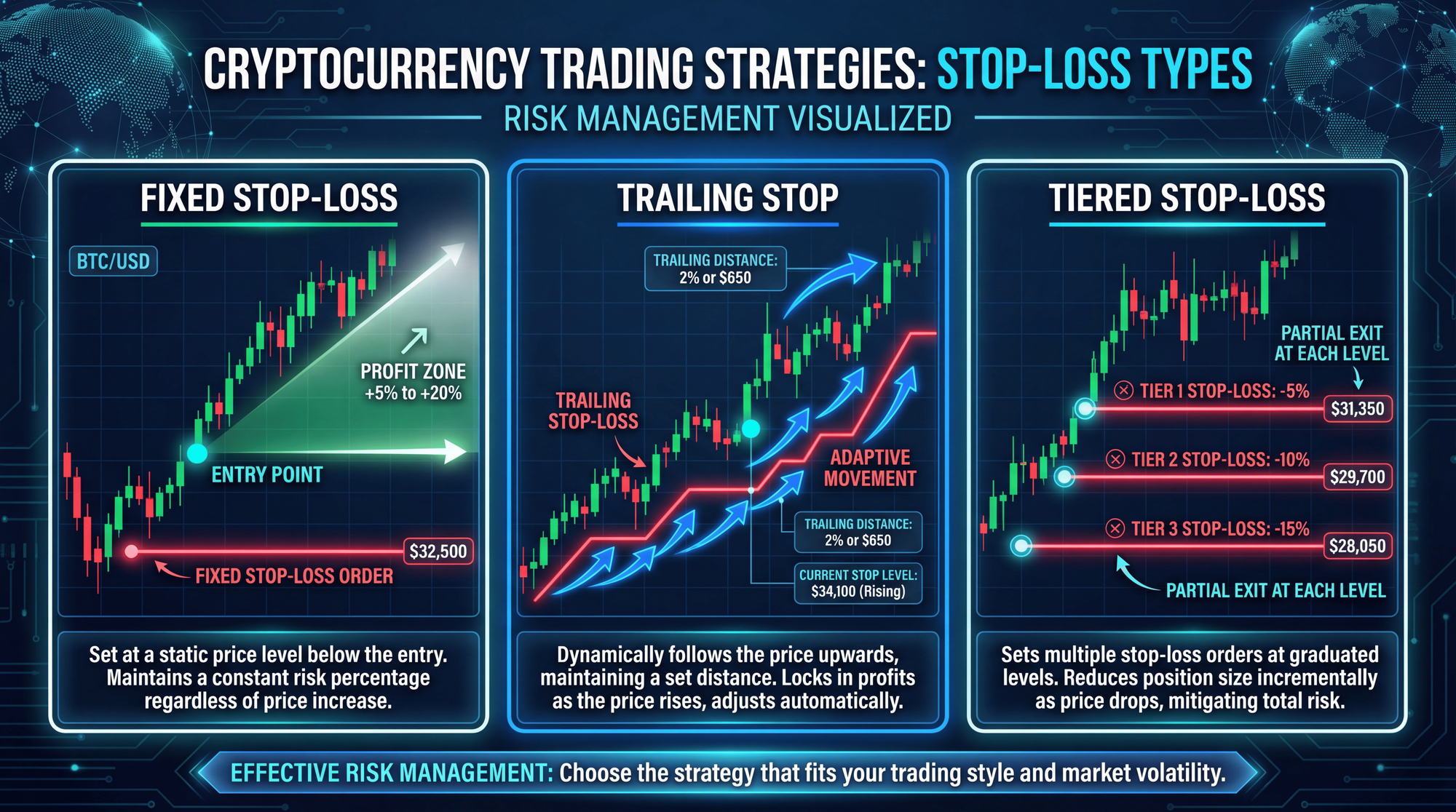
Fixed Stop-Loss: A static price level where your position closes regardless of market conditions. Simple and reliable, but does not adapt to changing volatility or protect profits as they grow.
Trailing Stop-Loss: Automatically adjusts upward as price rises, locking in profits while maintaining downside protection. When Bitcoin moves from $95,000 to $105,000, a 5% trailing stop moves from $90,250 to $99,750. Your potential profit is protected without limiting upside.
Stop-Limit Order: Combines stop and limit orders. When the stop price triggers, a limit order executes at your specified price or better. This prevents slippage in fast markets but risks the order not filling if price gaps through your limit.
Tiered Stop-Loss Strategy (Advanced)
Rather than exiting 100% at one level, professional traders often use tiered stops that exit positions gradually:
🎯 Tiered Stop-Loss Example
TIER 1: -5%
Exit 33%
Initial protection level
TIER 2: -10%
Exit 33%
Increased caution
TIER 3: -15%
Exit 34%
Full exit, thesis broken
This approach reduces the impact of stop hunts (temporary wicks) while still protecting against major downside. If price recovers after hitting Tier 1, you retain 67% of your position.
Where to Place Your Stop-Loss
Stop placement should be based on technical analysis, not arbitrary percentages. Consider these approaches:
Below Support Levels
Place stops below key support zones where price has previously bounced. If price breaks through support, your trade thesis is invalidated.
Based on ATR (Average True Range)
Use 1.5-2x the ATR to account for normal volatility. This prevents getting stopped out by regular price noise while still protecting against significant moves.
Percentage-Based for Beginners
For beginners, a standard 5-10% stop on major cryptocurrencies provides basic protection while learning to identify better technical levels.
Portfolio Diversification Strategies
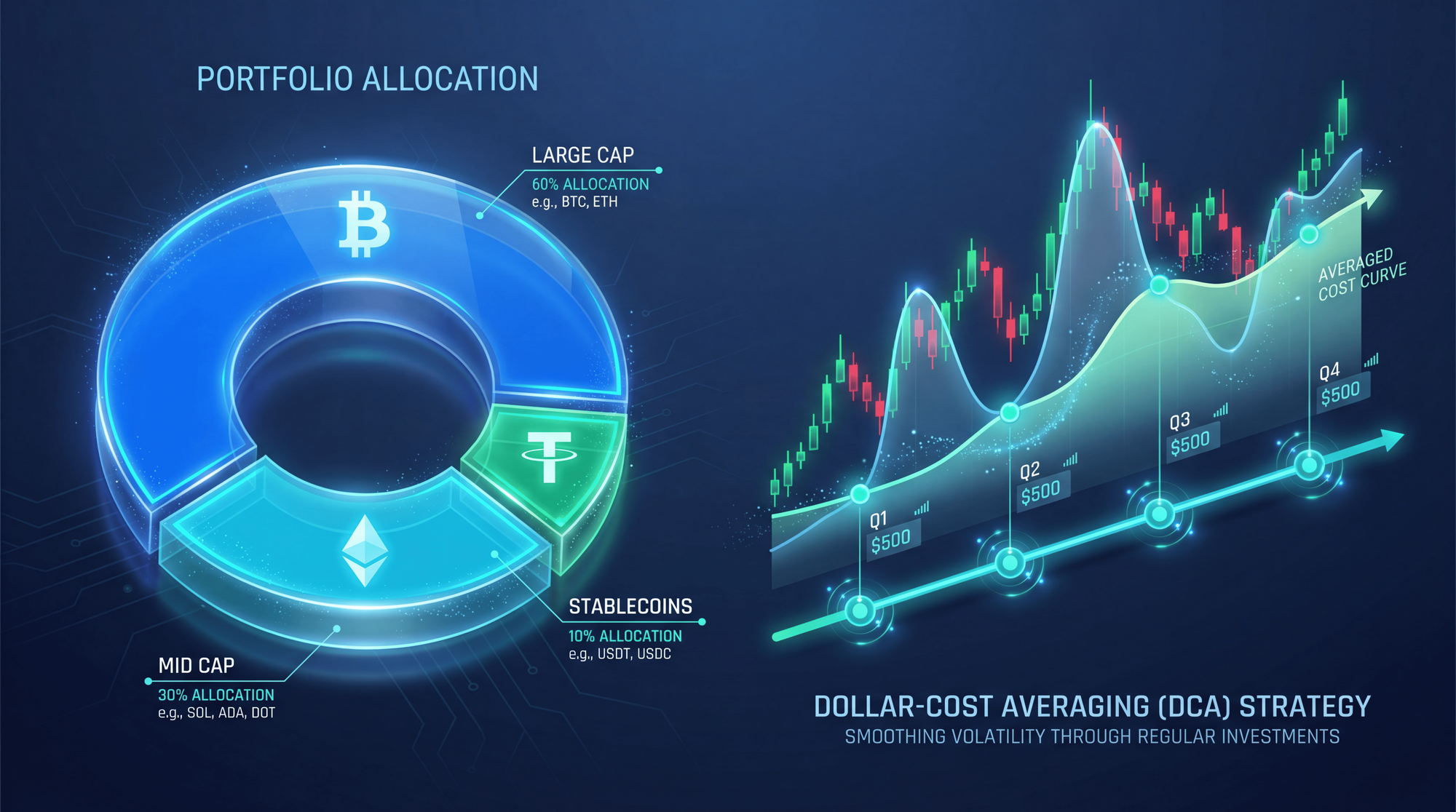
Diversification spreads risk across multiple assets so no single position can devastate your portfolio. In crypto, this means allocating across different market capitalizations, use cases, and blockchain sectors.
The 60-30-10 Framework
A balanced crypto portfolio typically follows this allocation:
📊 Portfolio Allocation Model
Large Cap (Core)
60%
BTC, ETH
Mid Cap (Growth)
30%
Top altcoins, DeFi, L2s
Stablecoins (Safety)
10%
USDT, USDC
Large-cap cryptocurrencies like Bitcoin and Ethereum provide relative stability and liquidity. They form the foundation of most portfolios due to their established track records and lower volatility compared to smaller assets.
Mid-cap altcoins offer growth potential with moderate risk. This includes Layer-1 blockchains, DeFi protocols, and infrastructure projects with proven utility. Research fundamentals carefully before allocating to this tier.
Stablecoins serve as dry powder for opportunities and protection during market downturns. Having cash on the sidelines allows you to buy dips rather than sell bottoms to free up capital.
Sector Diversification
Beyond market cap, consider spreading allocations across crypto sectors:
The key is ensuring your assets do not all move together. True diversification means holding positions that respond differently to market conditions, not simply owning multiple cryptocurrencies that crash in unison.
Dollar-Cost Averaging (DCA): Reducing Timing Risk
Timing the market is nearly impossible-even professional traders rarely call tops and bottoms correctly. Dollar-cost averaging solves this by spreading your entries over time, removing the pressure of perfect timing.
How DCA Works
Instead of investing $12,000 at once, you invest $1,000 monthly regardless of price:
📈 DCA vs Lump Sum: The Trade-off
DOLLAR-COST AVERAGING
- Lower emotional stress
- Smooths out volatility
- Protects against bad timing
- Builds discipline
- May miss some gains in bull runs
LUMP SUM INVESTING
- Maximum upside in bull markets
- Money working immediately
- Simpler execution
- Historically higher returns
- Maximum downside if timing wrong
Historical data shows lump sum investing outperforms DCA about 65% of the time in traditional markets. However, crypto's extreme volatility makes DCA's psychological benefits particularly valuable for most investors.
DCA Implementation Strategy
- Choose your asset(s): Bitcoin and Ethereum are the most common DCA targets
- Set a fixed amount: $100, $500, or $1,000 monthly-whatever fits your budget
- Pick a schedule: Weekly or monthly purchases work well
- Automate: Most exchanges offer recurring buy features
- Ignore price: Buy regardless of whether markets are up or down
DCA is especially powerful during bear markets when prices are depressed. You accumulate more units at lower prices, lowering your average cost basis and positioning for the next bull cycle.
Platform and Security Risk
Your risk management strategy means nothing if the exchange holding your crypto gets hacked or becomes insolvent. The $1.5 billion Bybit hack in February 2025-the largest DeFi breach ever-demonstrated that even major platforms can be compromised.
Choosing a Secure Exchange
Evaluate exchanges based on:
- Security track record: Has the platform been hacked? How did they respond?
- Regulatory compliance: Licensed exchanges face stricter security requirements
- Proof of reserves: Transparent platforms publish regular audits
- Insurance coverage: Some exchanges insure user funds against theft
- Two-factor authentication: Mandatory 2FA is a minimum requirement
Storage Best Practices
🔐 Storage Strategy by Portfolio Size
Hot Wallet (Exchange)
Only for active trading amounts-typically <5% of total holdings. Accept that these funds face platform risk.
Software Wallet (Self-Custody)
For medium-term holdings. You control private keys but remain vulnerable to device compromise.
Hardware Wallet (Cold Storage)
For long-term holdings and large amounts. Private keys never touch the internet. Devices like Ledger or Trezor provide maximum security.
Understanding blockchain transaction security helps you appreciate why cold storage provides superior protection against remote attacks.
Trading Psychology: Controlling Your Emotions
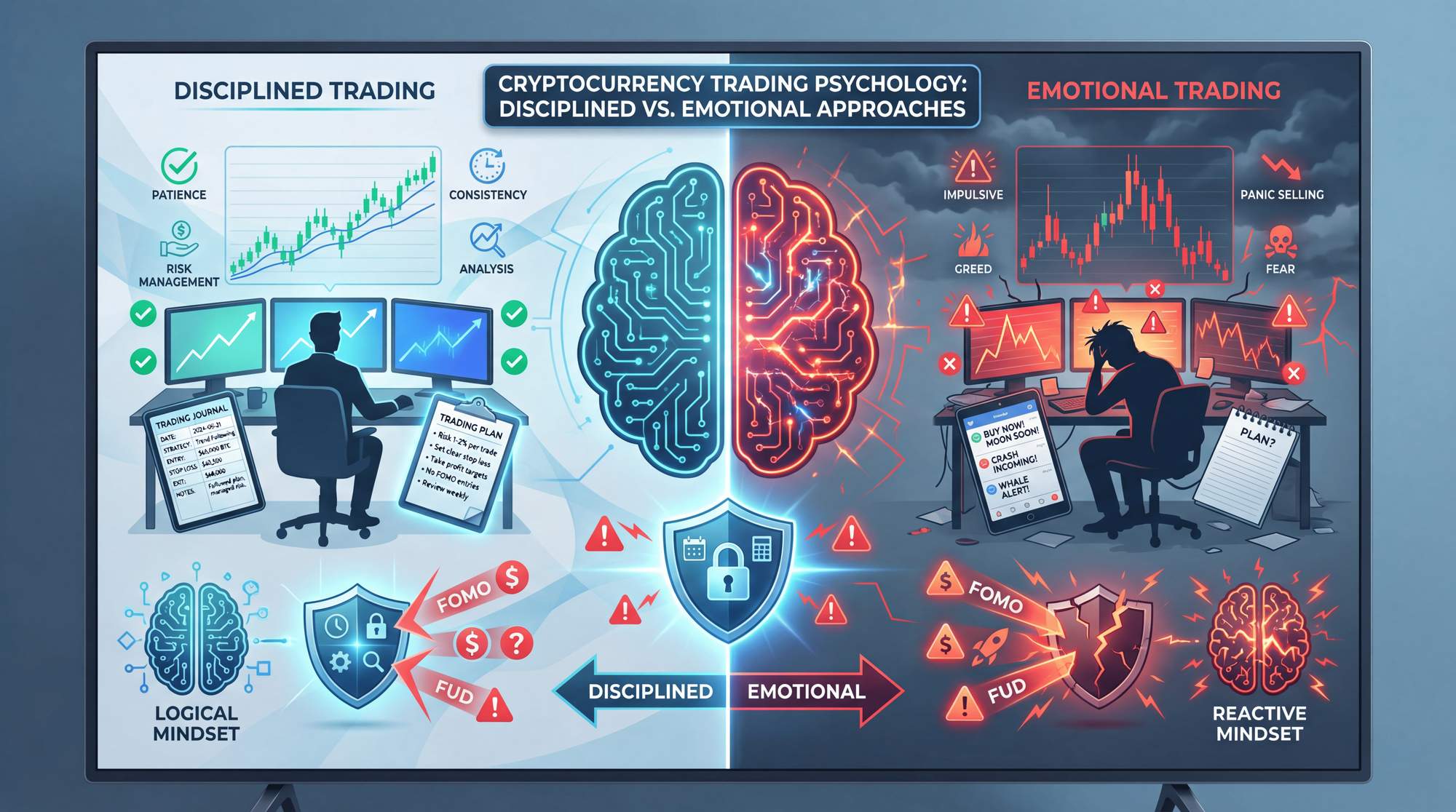
Technical knowledge means nothing if emotions override your rules. The psychological challenges of crypto trading are intensified by 24/7 markets, extreme volatility, and constant information flow.
Understanding FOMO and FUD
Research by Kraken found that a significant portion of retail trader losses stem from emotional decision-making rather than poor strategy.
FOMO (Fear of Missing Out) drives traders to chase pumps, entering positions at peaks because they cannot bear watching others profit without them. Classic signs include buying after 20%+ rallies, using excessive leverage to maximize imagined gains, and abandoning your trading plan because "this time is different."
FUD (Fear, Uncertainty, and Doubt) causes panic selling at bottoms. Traders liquidate positions based on scary headlines or social media fear without evaluating whether fundamental conditions have actually changed.
✅ Disciplined Trader
- Follows predetermined rules
- Accepts losses as business cost
- Sizes positions based on risk
- Waits for setups to come to them
- Uses DCA to remove timing stress
❌ Emotional Trader
- Chases pumping coins
- Panic sells during dips
- Increases size after losses
- Trades based on fear and greed
- Checks portfolio obsessively
Building a Trading Plan
A written trading plan removes emotion from decision-making. Document the following before market hours:
Entry Rules: What conditions must exist to open a position? Define specific technical setups, fundamental criteria, or signals you will act on.
Exit Rules: Where will you take profit? Where is your stop-loss? Determine these levels before entry and stick to them.
Position Sizing Rules: How much will you risk per trade? Document your formula and maximum allocation per position.
Trading Schedule: When will you analyze markets and execute trades? Constant screen time breeds impulsive decisions.
The Trading Journal
Keep detailed records of every trade including entry reasoning, exit reasoning, emotions during the trade, and lessons learned. Reviewing your journal reveals patterns in your behavior-both productive and destructive.
Many traders discover their losses cluster around specific emotional states: trading while tired, trading immediately after a loss, or trading during high-impact news events. Identifying these triggers allows you to build rules preventing future mistakes.
Common Risk Management Mistakes
Learning from others' failures is cheaper than making your own. These are the most devastating mistakes traders make:
❌ Mistake 1: Averaging Down on Losers
Adding to losing positions hoping to lower your average entry. This increases exposure to a failing thesis and compounds losses. If your original analysis was wrong, adding more money does not make it right.
❌ Mistake 2: Moving Stop-Losses
Widening your stop to avoid being stopped out. This converts a small, planned loss into an uncontrolled disaster. If price reaches your stop, your thesis was wrong-accept it and move on.
❌ Mistake 3: Revenge Trading
Immediately entering a new trade to recover losses. Emotional decisions compound problems. After a losing trade, step away from screens before making any new decisions.
❌ Mistake 4: Over-Leveraging
Using excessive leverage to maximize gains. The October 2025 crash liquidated traders using 10x-100x leverage. Leverage magnifies losses as much as gains-often faster due to liquidation mechanics.
❌ Mistake 5: Ignoring Correlation
Holding multiple assets that all crash together is not diversification. During market panics, most cryptocurrencies move in unison. True diversification includes stablecoins or assets outside crypto entirely.
Risk-Reward Ratio: The Profit Equation
Even with a 50% win rate, you can be profitable if your winners are larger than your losers. The risk-reward ratio measures potential profit against potential loss for each trade.
Before entering any trade, calculate your potential reward by measuring the distance to your profit target. Only take trades where reward exceeds risk by at least 2:1. This mathematical edge compounds over many trades into consistent profitability.
🎯 Key Takeaways: Risk Management Essentials
- Never risk more than 1-2% per trade-this rule protects you from catastrophic losses
- Use stop-losses on every position, placed based on technical levels not arbitrary percentages
- Diversify across market caps and sectors with the 60-30-10 framework
- Use DCA to remove timing pressure and build positions over time
- Store long-term holdings in cold wallets to eliminate platform risk
- Maintain a trading journal to identify emotional patterns
- Target minimum 1:2 risk-reward on every trade
Frequently Asked Questions
What percentage should I risk per trade in crypto?
Most professional traders recommend risking 1-2% of your total account per trade. Beginners should stick to 1% until demonstrating consistent profitability. This approach ensures no single trade can significantly damage your portfolio, allowing you to survive losing streaks and continue improving.
How do I set a stop-loss for volatile cryptocurrencies?
Place stops based on technical levels like support zones rather than arbitrary percentages. For volatile assets, use wider stops calculated from Average True Range (ATR) indicators-typically 1.5-2x the ATR. Remember to reduce position size when using wider stops to maintain consistent dollar risk at 1-2%.
Is diversification really necessary in crypto?
Yes. While most cryptocurrencies correlate during major market moves, diversification across sectors and market caps reduces risk from project-specific failures. The 60-30-10 framework (large caps, mid caps, stablecoins) provides a balanced approach. Adding stablecoins provides dry powder for opportunities and protection during crashes.
How do I control emotions when trading crypto?
Develop a written trading plan with specific rules for entries, exits, and position sizing. Keep a trading journal to identify emotional patterns. Use dollar-cost averaging to remove timing pressure. Consider using automated orders like stop-losses and take-profits to remove real-time decision-making from volatile situations.
What is a good risk-reward ratio for crypto trading?
Aim for minimum 1:2 risk-reward, meaning your potential profit is at least twice your potential loss. Higher ratios like 1:3 allow profitability even with lower win rates-you only need to be right 25% of the time to break even at 1:3. Calculate this before entering any position.
Should I use leverage in crypto trading?
Leverage significantly increases risk and is not recommended for beginners. The October 2025 crash liquidated billions in leveraged positions. If using leverage, reduce position size proportionally so your dollar risk remains within 1-2% of your account. A 10x leveraged position should be 1/10th the size of an unleveraged position with the same stop-loss.
How often should I rebalance my crypto portfolio?
Review allocations quarterly or when any position drifts more than 5% from target allocation. Rebalancing forces you to sell high (trim winners) and buy low (add to laggards), systematically implementing sound investment principles. This discipline prevents overconcentration in assets that have run up significantly.
What is dollar-cost averaging and should I use it?
Dollar-cost averaging (DCA) means investing fixed amounts at regular intervals regardless of price. Instead of investing $12,000 at once, you invest $1,000 monthly. This strategy removes the stress of timing the market and smooths out volatility. DCA is especially valuable for beginners and during uncertain market conditions.
How do I choose a safe cryptocurrency exchange?
Evaluate exchanges based on security track record, regulatory compliance, proof of reserves transparency, and insurance coverage. After the $1.5 billion Bybit hack in 2025, platform security is critical. Only keep active trading funds on exchanges-transfer long-term holdings to hardware wallets for maximum security.
Start Trading with Confidence
Apply these risk management principles on a secure, regulated platform
Open Your Zipmex Account →Conclusion
Risk management separates the 30% who profit from the 70% who blow up their accounts. The principles are straightforward: never risk more than 1-2% per trade, always use stop-losses, diversify intelligently with the 60-30-10 framework, employ dollar-cost averaging for entries, secure your assets in cold storage, and maintain emotional discipline through written rules and trading journals.
The crypto market offers extraordinary opportunities, but only for those who approach it with professional risk controls. The October 2025 crash that wiped out $1 trillion in value was devastating for unprepared traders-but a buying opportunity for those with dry powder and proper risk management.
Start implementing these strategies today. Your future self will thank you when the next market crash comes and your portfolio remains intact while others panic-sell at bottoms.
Understanding blockchain technology and cryptocurrency fundamentals helps inform better trading decisions. Consider exploring staking opportunities for passive income that complements active trading strategies.
⚠ Investment Disclaimer: The information provided in this article is for educational purposes only and does not constitute investment or financial advice. Cryptocurrency investments are subject to high market risk and extreme volatility. The October 2025 market crash and other historical examples cited demonstrate that significant losses are possible. Past performance does not guarantee future results. Always conduct your own research and consider consulting with a qualified financial advisor before making investment decisions. Never invest more than you can afford to lose.