⚡ Quick Answer
To position for a potential Base airdrop, you need to download the new Base App, bridge ETH to Base, actively use DeFi protocols like Aerodrome and Aave, mint NFTs, and engage with social apps like Farcaster. Budget $100-300 for meaningful activity over 3-6 months. Based on Arbitrum and Optimism airdrop data, realistic returns if an airdrop happens could be $500-5,000+ for active users.
Base has become the undisputed leader among Ethereum Layer 2 networks. Incubated by Coinbase - a publicly traded company with 110 million verified users - Base now dominates the L2 landscape with 46.6% of all DeFi TVL and processes between 7-10 million transactions daily.
In September 2025, Base creator Jesse Pollak confirmed the team is "exploring a network token". While no official timeline exists, JPMorgan analysts estimate a potential Base token could reach $12-34 billion in market cap. If Coinbase allocates 20-25% to the community (as other L2s have done), this could translate to $2.4-8.5 billion in potential user rewards - making it potentially the largest airdrop in crypto history.
The crypto community remembers that Arbitrum's airdrop came suddenly in March 2023, rewarding users who had been active for months beforehand. Those who waited for an announcement received nothing. This guide walks you through exactly what to do, how much to spend, which protocols matter, and what realistic outcomes look like.
Why Base Matters: The Coinbase L2 Opportunity
Base represents something unique in the Layer 2 landscape. Unlike other L2s built by crypto-native teams, Base is incubated by Coinbase, a publicly traded company managing over $420 billion in quarterly trading volume. This backing creates both constraints and opportunities that set Base apart from competitors like Arbitrum and Optimism.
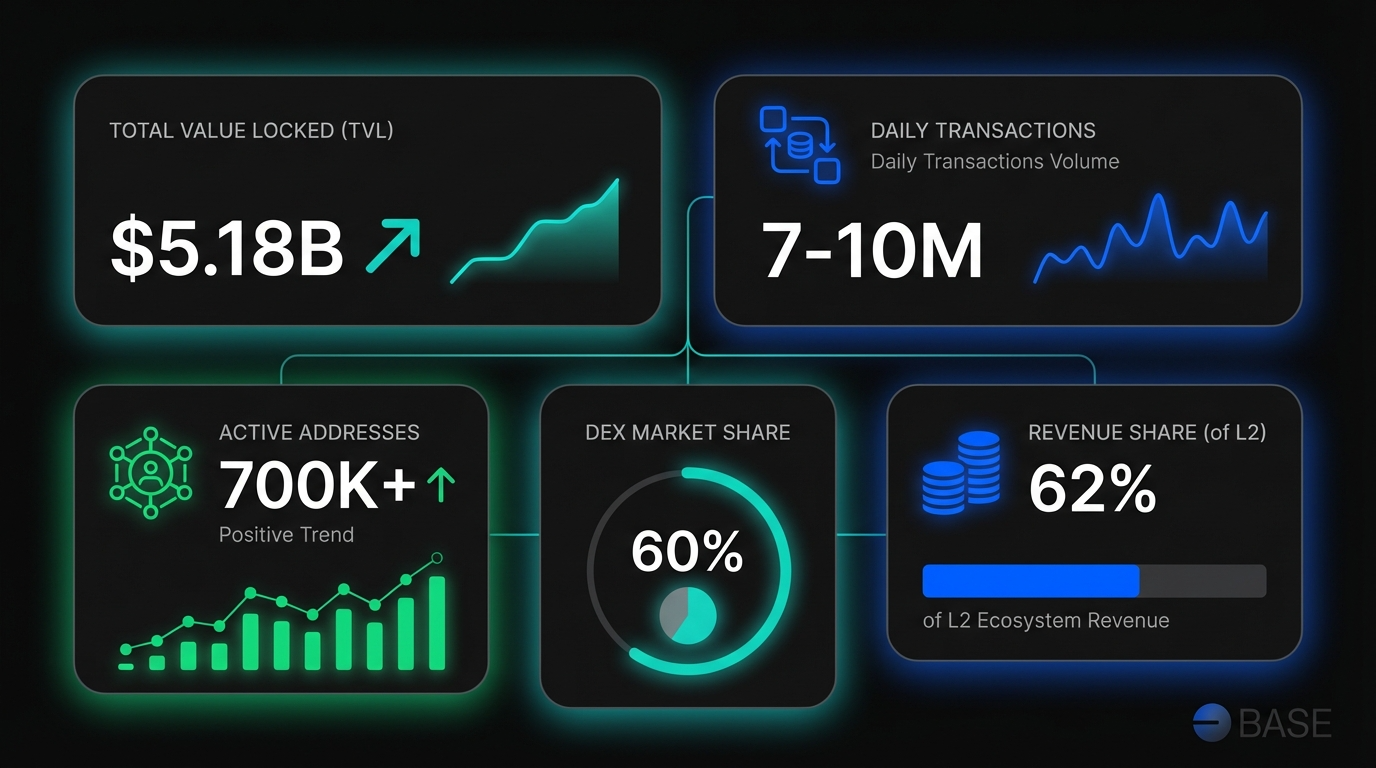
📊 Base Network Statistics (January 2026)
| DeFi TVL | $5.18 Billion (46.6% of L2 market) |
| Total Value Secured | ~$14+ Billion |
| Daily Transactions | 7-10 Million |
| Daily Active Addresses | ~700,000 |
| DEX Volume Share | ~60% of L2 DEX volume |
| 2025 On-chain Revenue | $75.4M (62% of L2 market) |
Distribution Advantage: Why Base is Different
Base's greatest competitive advantage lies in its distribution channel. According to Coinbase's Q3 2025 10-Q filing, the exchange had 9.3 million monthly active trading users - giving Base direct access to a massive, already-onboarded user base that other L2 networks cannot match.
While most L2s must rely on incentive programs to attract liquidity and users, Base enjoys organic growth through Coinbase product integration. Morpho's integration into the Coinbase app alone has generated $866.3 million in loans, accounting for 90% of Morpho's active loans on Base.
Institutional Validation
The institutional interest in Base extends beyond Coinbase. In November 2025, J.P. Morgan deployed JPM Coin on Base, marking a significant milestone in institutional L2 adoption. This enterprise adoption signals that Base is becoming critical infrastructure for traditional finance, not just retail crypto users.
Additionally, Base achieved Stage 1 decentralization in May 2025 by implementing fault proofs - a major step toward trustless security that places it among the most decentralized L2s according to L2Beat's framework.
What We Know About Base Airdrop Eligibility
The Base team has not released official eligibility criteria, which means positioning strategies must be based on patterns from previous L2 airdrops and Base-specific signals. Here's what we can piece together from official communications and precedent.
The Token Confirmation
On September 15, 2025, Jesse Pollak publicly confirmed Base is exploring a network token:
"Base is beginning to explore a network token. We're in the early phases of exploration, and don't have any specifics to share around timing, design, or governance."
- @base, September 15, 2025
Likely Eligibility Factors
Based on historical L2 airdrops and community analysis from sources like Bankless, KuCoin, and Whales Market, likely eligibility factors include:
🎯 Likely Eligibility Criteria
- Early & Active On-chain Usage - Bridge transactions, protocol interactions, transaction count
- Base App Engagement - Using the new Base App (formerly Coinbase Wallet), completing Base Verify
- On-chain Score - Trackable metric measuring your activity diversity and consistency
- Farcaster & Social Integration - Active Farcaster profile, social verification
- NFT & Creator Economy - Minting, trading, creator coin participation
- Coinbase Connection - Verified Coinbase user status (potential bonus multiplier)
- Time-Weighted Activity - Consistent usage over months, not concentrated bursts
Sybil Detection Warning
⚠ Critical Warning: Sybil Detection
Multi-wallet farming is the fastest way to get excluded. Arbitrum's anti-sybil mechanisms caught wallets with identical transaction patterns, minimal balances, and activity concentrated in short time windows. According to analysis, 85% of new airdrops now filter out Sybil farms. One authentic wallet beats ten farmed wallets every time.
Step-by-Step Base Airdrop Farming Strategy
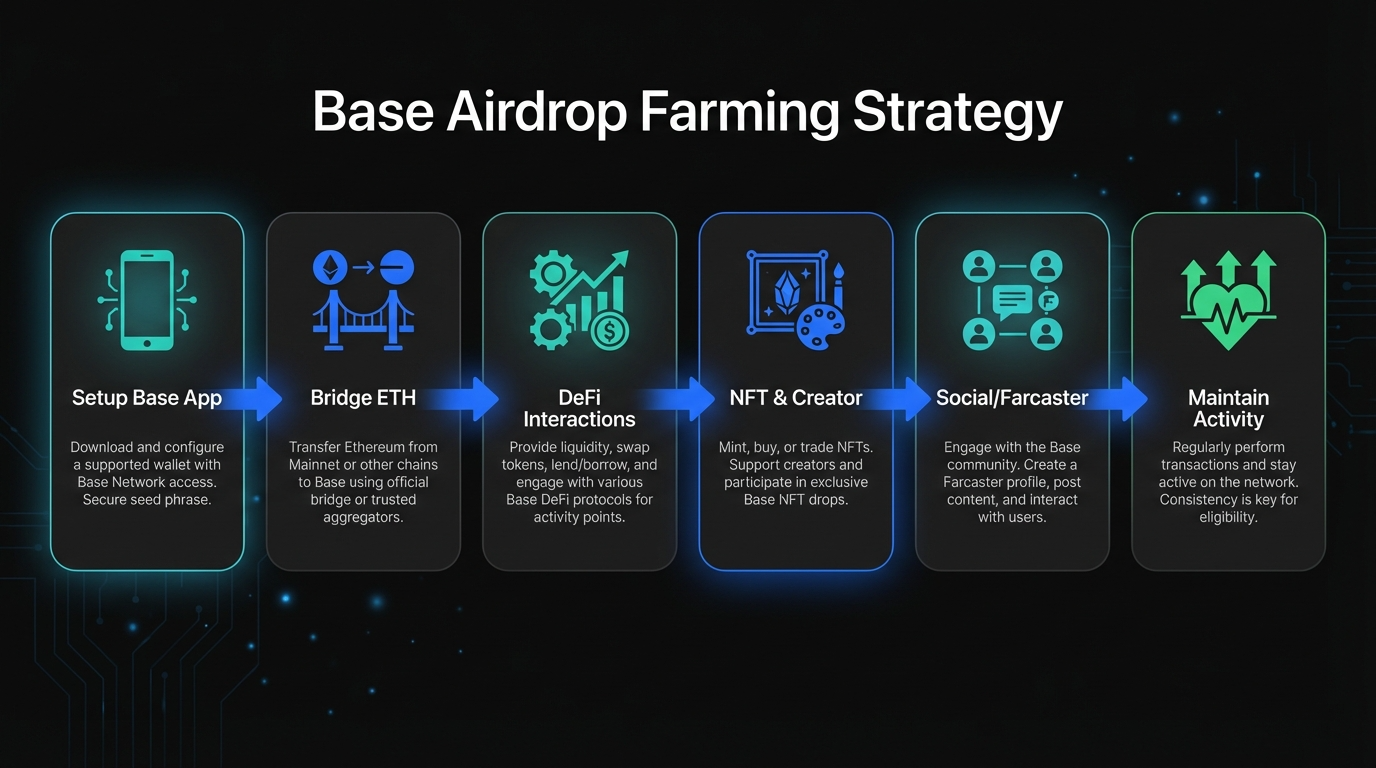
The following strategy combines best practices from successful L2 airdrop recipients with Base-specific ecosystem engagement. Each step builds on the previous one to create a comprehensive on-chain footprint that demonstrates genuine usage.
Step 1: Set Up Base App & Wallet
Set Up Base App & Wallet
Download the new Base App (rebranded from Coinbase Wallet in December 2025). This "super app" integrates wallet, trading, social features, and DeFi in one interface. Complete Base Verify using your Coinbase account, Twitter/X (100+ followers, 1+ year old), Instagram, or TikTok (500+ followers). This verification serves as Sybil resistance.
Alternative Wallets: If you prefer non-Coinbase options, MetaMask, Rabby, or Zerion Wallet all support Base natively.
Security Note: Never use your main storage wallet with significant holdings for airdrop farming. Secure your seed phrase offline before proceeding.
Step 2: Bridge ETH to Base
Bridge ETH to Base
Use the official Base Bridge to transfer ETH from Ethereum mainnet. Start with 0.05-0.1 ETH ($150-300) as your working capital. The bridge fee is typically $1-5 depending on Ethereum gas prices. This is your foundational on-chain activity.
New: Base-Solana Bridge
In December 2025, Base launched a Solana bridge via Chainlink CCIP, allowing users to bridge SPL tokens to Base. This creates additional cross-chain activity that could factor into eligibility criteria.
Alternative Bridges: Zerion Bridge aggregates multiple bridge options to find the cheapest and fastest routes from Ethereum, other EVM chains, and Solana.
Step 3: Execute DeFi Interactions
Execute DeFi Interactions
Swap tokens on Uniswap or Aerodrome Finance. Make deposits in Aave or Compound lending markets. Provide liquidity to a major pool. Each protocol interaction adds to your diversity score. Aim for 5+ different protocols in your first month.
Step 4: NFT & Creator Economy
Mint NFTs & Engage Creator Economy
Use Zora or OpenSea on Base to mint low-cost or free NFTs. Participate in creator coin activities through the Base App. These on-chain cultural activities signal you're more than just a DeFi farmer. Base is heavily focused on the creator economy as a key growth driver.
Step 5: Connect Social Identity via Farcaster
Connect Social Identity via Farcaster
Create a Farcaster account and link your wallet. The founding team has ex-Coinbase connections and the platform is deeply integrated with Base (and now integrated into the Base App). An active Farcaster profile can serve as proof-of-humanity via the Neynar Score for Sybil resistance.
Step 6: Maintain Consistent Activity
Maintain Consistent Activity Over Time
Eligibility snapshots are typically retroactive and consider activity over extended periods. Plan for weekly interactions: a swap here, a liquidity adjustment there, occasional NFT mints. The goal is organic usage patterns spread across months, not concentrated bursts. According to airdrop analysis, six months of regular usage outweighs six days of intensive farming.
Top Base Protocols for Airdrop Positioning
The Base ecosystem includes both established DeFi giants and Base-native projects. Your strategy should include interactions with both categories to maximize diversity and potential eligibility.
Aerodrome: The Liquidity King
Aerodrome Finance dominates Base's DEX landscape with $602 million in TVL and over $238 billion in cumulative trading volume. In late 2025, Aerodrome and Velodrome merged under Dromos Labs to form "Aero", creating a unified cross-chain DEX.
The protocol uses a veToken model where locking AERO tokens provides voting rights on pool emissions. For airdrop positioning, focus on:
- Swapping tokens on Aerodrome
- Providing liquidity to major pairs (ETH/USDC, etc.)
- Optionally locking AERO for veAERO to participate in governance
Morpho: The Lending Leader
Morpho has grown explosively on Base, with TVL increasing from $48.2 million to over $2 billion in 2025 - a 1,906% growth rate. This growth is largely driven by Morpho's integration into the Coinbase app, which simplified access to on-chain lending for millions of users.
Realistic Cost and Return Analysis
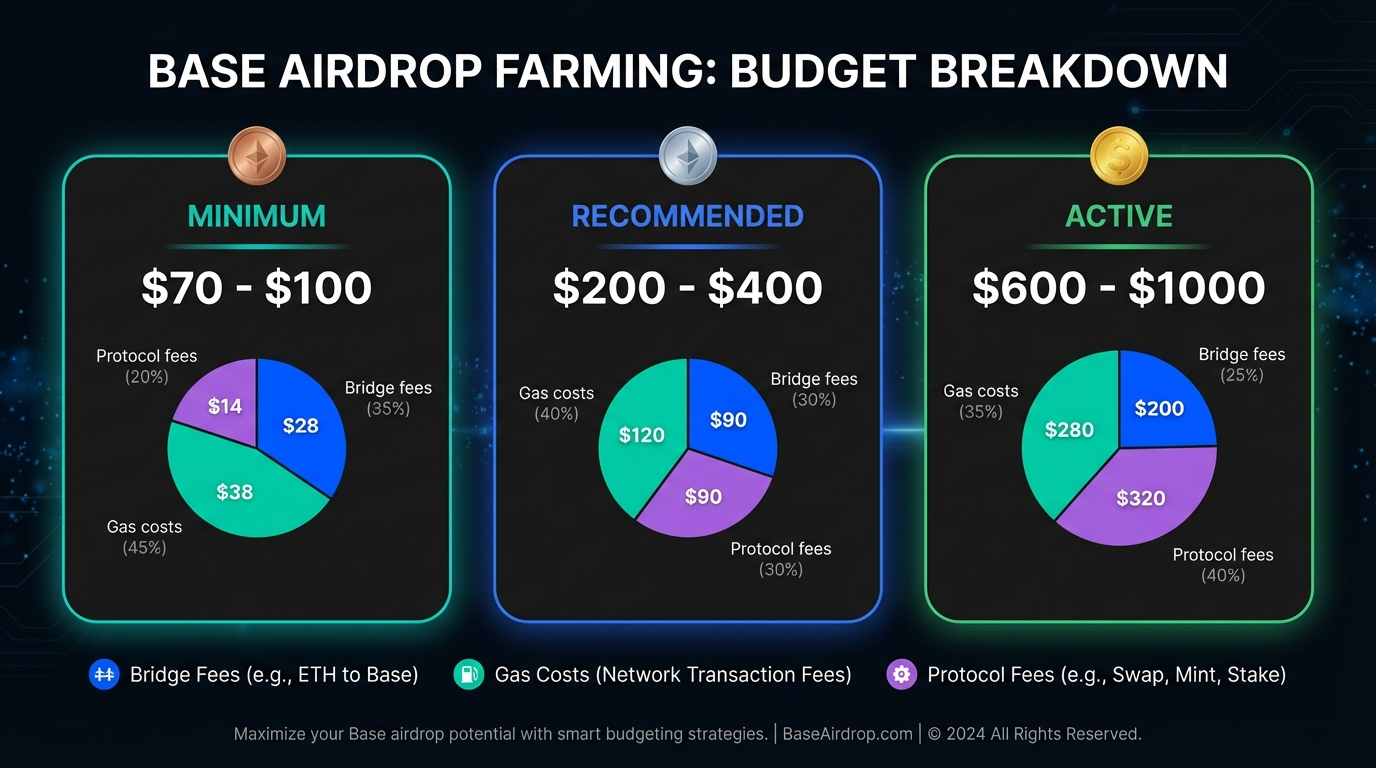
Understanding the economics of airdrop farming prevents both over-investment and under-preparation. The goal is positioning that makes sense even if no airdrop materializes because you're using a genuinely useful L2 network.
Potential Returns: What Historical Data Shows
📈 Potential Upside Scenarios
- Conservative: $500-1,000 - if allocation is low or many users qualify
- Moderate: $1,500-3,000 - matching ARB/OP precedent with Base scale
- Optimistic: $5,000-15,000+ - early adopters with high activity multipliers
Risk Assessment
📉 Realistic Downside Risks
- No airdrop at all: Coinbase regulatory concerns could delay or cancel token plans indefinitely
- Sybil exclusion: Activity patterns flagged as inauthentic = $0 reward
- Snapshot already passed: Unknown timing means you might already be too late
- Low allocation: High user count could dilute individual rewards significantly
- Token price crash: 88% of airdropped tokens lose value within 3 months
The key insight is that even a $200-400 investment over six months offers asymmetric upside. If Base delivers an airdrop matching L2 precedent, returns could be 5-20x the farming cost. If no airdrop comes, you've spent a modest amount using a genuinely efficient L2 for DeFi activities you might have done anyway.
Critical Risks and How to Avoid Them
Airdrop farming carries specific risks that differ from typical crypto investing. Understanding these helps you avoid costly mistakes that could result in exclusion from any potential distribution or loss of funds.
Phishing & Scam Prevention
🛡 Security Checklist
- ✅ Bookmark official URLs: base.org, bridge.base.org
- ✅ Never share seed phrases - legitimate airdrops NEVER ask for this
- ✅ Use a dedicated farming wallet separate from main holdings
- ✅ Verify all contract addresses on BaseScan before interacting
- ✅ Enable 2FA on any connected centralized accounts
- ✅ Be wary of DMs - official announcements come only from @base on Twitter/X
- ❌ There is currently NO official Base airdrop checker - any site claiming otherwise is a scam
Past Incident Warning: In November 2025, Aerodrome Finance experienced a DNS hijacking attack where users were redirected to a phishing site, resulting in over $1 million stolen. Always verify URLs, use bookmarks, and consider hardware wallets for larger amounts.
Regulatory Uncertainty
The regulatory uncertainty around Base specifically relates to Coinbase's status as a publicly traded company. Any token issuance must comply with SEC regulations and shareholder obligations. This adds unpredictability to timing and structure that wouldn't exist with crypto-native projects. The token could take forms that differ significantly from typical L2 airdrops, or face delays that extend well beyond current speculation.
Tax Implications
💰 Tax Reminder
Airdropped tokens are typically considered taxable income in many jurisdictions at their fair market value upon receipt. Consult a tax professional familiar with cryptocurrency in your jurisdiction. Keep records of all your on-chain activity for tax reporting purposes.
Your Base Airdrop Farming Checklist
This actionable checklist summarizes everything you need to do to position for a potential Base airdrop. Complete these items over weeks and months, not in a single session, to demonstrate organic usage patterns.
✅ Week 1: Foundation Setup
- ☐ Download Base App or create dedicated wallet (MetaMask/Rabby/Zerion)
- ☐ Complete Base Verify (Coinbase/social accounts)
- ☐ Bridge 0.05-0.1 ETH to Base via official bridge
- ☐ Execute first swap on Uniswap or Aerodrome
- ☐ Make small deposit in Aave or Morpho
✅ Week 2-4: Ecosystem Exploration
- ☐ Provide liquidity in an Aerodrome or Uniswap pool
- ☐ Mint 2-3 NFTs on Zora
- ☐ Create Farcaster account and link wallet
- ☐ Interact with 5+ different Base protocols
- ☐ Try a yield optimizer like Pendle or Beefy
- ☐ Play Clusters puzzle game in Base App for points
✅ Ongoing: Monthly Maintenance
- ☐ 2-3 swaps or protocol interactions per week
- ☐ Adjust liquidity positions periodically
- ☐ Participate in new protocol launches and campaigns
- ☐ Engage on Farcaster (casts, replies, follows)
- ☐ Monitor @base Twitter for official announcements
- ☐ Track your on-chain activity via BaseScan
- ☐ Check your on-chain score in Base App
❌ What NOT To Do
- ❌ Run multiple wallets with similar activity patterns
- ❌ Concentrate all transactions in 24-48 hours
- ❌ Use bots or automation scripts
- ❌ Connect to unverified "airdrop checker" sites
- ❌ Share seed phrases for any reason
- ❌ Invest more than you can afford to lose
Frequently Asked Questions
Is the Base airdrop confirmed?
No official Base token or airdrop has been announced. In September 2025, Base creator Jesse Pollak confirmed the team is "exploring a network token," but no timeline, allocation, or eligibility criteria have been released. All positioning strategies are based on speculation and historical L2 precedent.
When will the Base airdrop happen?
There is no confirmed timeline. Based on Base's ecosystem maturity and the September 2025 token exploration announcement, analysts speculate a potential window between late 2025 and 2026. However, Coinbase's regulatory requirements as a public company add uncertainty that doesn't exist with typical crypto projects.
How much could a Base airdrop be worth?
JPMorgan analysts estimate a potential Base token market cap between $12 billion and $34 billion. If 20-25% goes to community distribution as seen with other L2s, and assuming 1-2 million qualifying users, individual allocations could range from $500 to $5,000 or more. Heavy early adopters with diverse activity could receive significantly higher amounts.
Can I use multiple wallets to farm Base?
This is strongly discouraged. Arbitrum and other L2 airdrops implemented sybil-detection algorithms that excluded wallets with similar transaction patterns, low balances, and automated behavior. According to analysis, 85% of new airdrops now filter out Sybil farms. One wallet with authentic, diverse activity over time is far more likely to qualify.
What's the minimum investment needed?
You can start with as little as $50 in ETH bridged to Base. However, $150-300 provides more flexibility for meaningful DeFi interactions across multiple protocols. Gas fees on Base are under $0.01 per transaction, so ongoing costs are minimal once you've bridged your initial capital.
Which Base protocols are most important?
Prioritize protocols that demonstrate diverse ecosystem usage: Aerodrome or Uniswap for swaps and LP, Aave or Morpho for lending, Zora for NFTs, and Farcaster for social engagement. Interacting with 5+ different protocols shows you're a genuine user rather than a single-action farmer.
What is the Base App and should I use it?
The Base App (formerly Coinbase Wallet) is Coinbase's "super app" that integrates wallet, trading, social features, and DeFi in one interface. It includes Base Verify for identity verification and an on-chain score to track your activity. Given Coinbase's direct involvement with Base, using the Base App could be advantageous for airdrop positioning.
What if I miss the snapshot?
Snapshots for airdrops are typically retroactive and often cover extended time periods. Starting now is better than waiting for an announcement because by the time criteria are revealed, it's usually too late to qualify. Consistent activity from today forward positions you for any future snapshot dates.
Will Coinbase users automatically qualify?
While not confirmed, being a verified Coinbase user connected with Base could provide advantages. The integration between Coinbase and Base (including Morpho's in-app lending) suggests that Coinbase user verification may serve as a Sybil resistance mechanism or bonus multiplier.
Is airdrop farming still profitable in 2026?
Yes, but profitability depends on strategy, ecosystem selection, and realistic expectations. Successful farmers report earning between $500 and $5,000+ per high-quality project, though 88% of tokens lose value within 3 months and many projects yield nothing. Focus on quality over quantity and use protocols you genuinely find valuable.
Conclusion: Position Now, Benefit Later
The Base airdrop represents one of the most significant potential opportunities in crypto for 2026. With JPMorgan projecting a $12-34 billion valuation and the Base team actively exploring tokenization, the combination of Coinbase backing and explosive ecosystem growth creates conditions for what could be the largest L2 airdrop in history.
The key to positioning successfully lies in authentic, sustained engagement:
- Download the Base App and complete verification
- Bridge your ETH and interact with protocols
- Mint NFTs and engage with the creator economy
- Build a presence on Farcaster
- Spread your activity across months, not hours
- Use one wallet genuinely rather than many wallets mechanically
This approach maximizes your chances while protecting against sybil exclusion.
Most importantly, approach this with appropriate expectations. The airdrop is not confirmed. Your investment of time and money could result in nothing if Base doesn't launch a token or if criteria exclude you. But the asymmetric upside of potentially thousands of dollars in return for hundreds invested makes this one of the better risk-reward opportunities available to crypto users today.
Whether Base delivers an airdrop or not, you'll gain experience using the leading Layer 2 network in the Ethereum ecosystem. The skills and familiarity you develop will serve you across future opportunities in DeFi and beyond.
Ready to Start Your Base Journey?
Get the ETH you need to bridge to Base and begin positioning for potential rewards.
Buy ETH on Zipmex →⚠ Disclaimer: This article is for educational purposes only and does not constitute financial advice. Airdrop farming involves risk, including the possibility of receiving no rewards. The Base airdrop has not been officially confirmed. Never invest more than you can afford to lose. Cryptocurrency investments are subject to high market risk. Always conduct your own research before participating in any crypto activity.