Over $3.4 billion was lost to crypto scams and hacks in just the first half of 2025 - and much of that happened during withdrawals. Whether you're cashing out Bitcoin profits, converting altcoins to pay bills, or moving stablecoins to your bank account, knowing how to turn crypto into cash safely is essential in 2026.
⚡ Quick Answer
The safest way to turn crypto into cash in 2026 is through a regulated centralized exchange (CEX) like Coinbase, Kraken, or Binance. Sell your crypto, then withdraw fiat via bank transfer (1-5 business days). Expect trading fees of 0.1%-0.6% and withdrawal fees of $0-$25 depending on your method. For fee-free trading up to $10,000/month, consider Coinbase One ($29.99/month) or Kraken+ subscriptions.
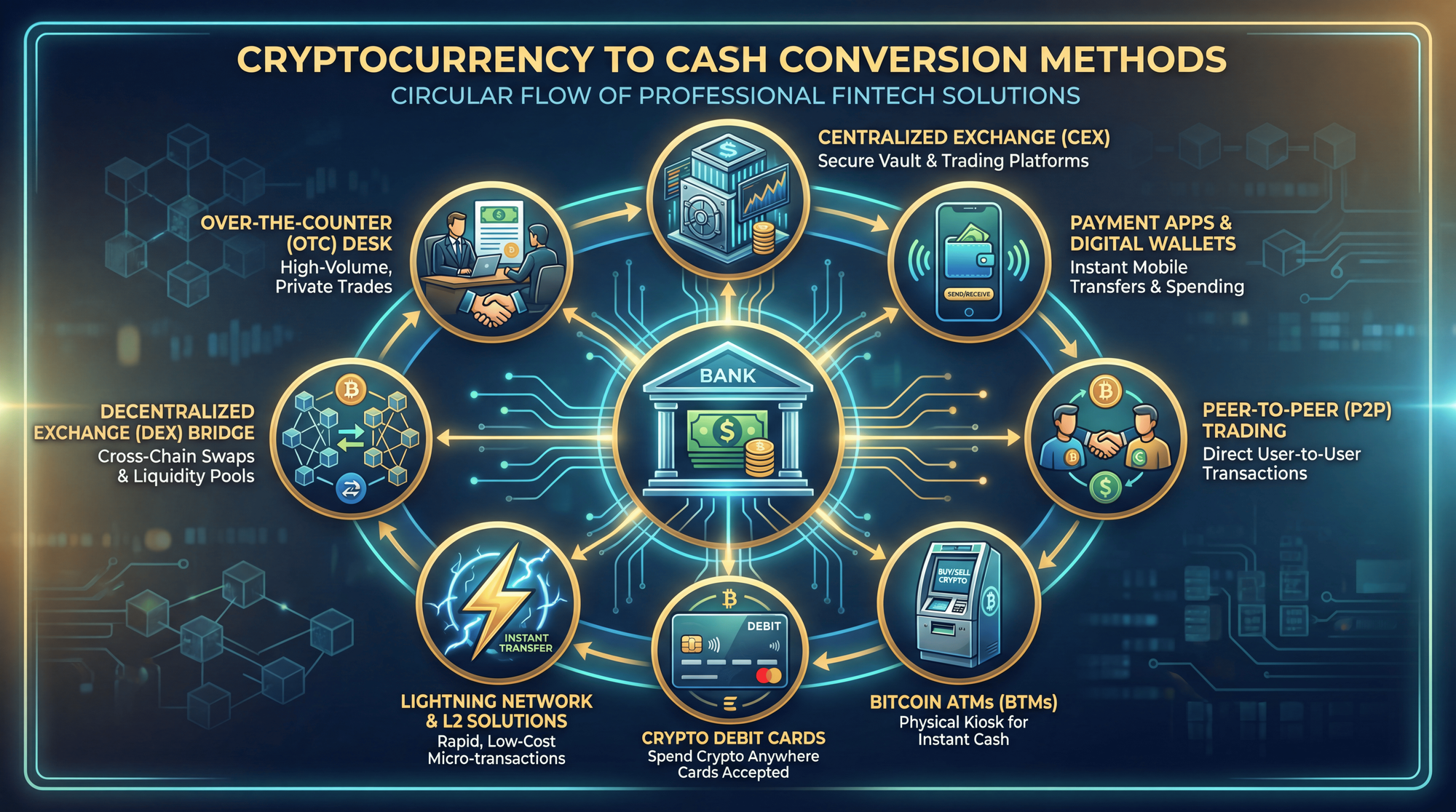
This comprehensive guide covers eight proven methods to convert cryptocurrency to fiat money - from centralized exchanges to Lightning Network wallets, OTC desks for large amounts, and DEX-to-fiat bridges. You'll also find fee comparisons, security best practices, and tax implications every crypto holder needs to understand in 2026.
Why Convert Crypto to Cash?
Before diving into methods, let's understand when converting makes sense:
Lock in profits: Crypto's volatility means gains can disappear quickly. Converting to fiat secures your returns in stable currency.
Pay real-world expenses: Despite growing adoption, most merchants still don't accept crypto directly. Cash conversion enables everyday spending.
Tax obligations: In most jurisdictions, you'll eventually need fiat to pay capital gains taxes on profitable crypto sales.
Portfolio rebalancing: Moving some crypto to cash can reduce overall portfolio risk and provide liquidity for future opportunities.

8 Methods to Turn Crypto into Cash in 2026
Converting cryptocurrency to fiat currency has become increasingly streamlined, but each method comes with distinct advantages, costs, and security considerations. Understanding how cryptocurrency exchanges operate will help you choose the right approach for your situation.
Method 1: Centralized Exchanges (CEX) — Most Popular & Reliable
Centralized exchanges like Coinbase, Kraken, Binance, and Zipmex remain the most straightforward path to convert crypto into cash. These platforms act as intermediaries, handling the matching of buyers and sellers while providing bank-grade security and regulatory compliance.
Step-by-step process:
Complete KYC Verification
Provide government ID, proof of address, and complete identity verification. Most platforms approve within 24-48 hours. Higher withdrawal limits may require additional documentation.
Link Your Bank Account
Connect your bank account for fiat withdrawals. ACH transfers are free on most US platforms; SEPA is free in Europe. Wire transfers cost $5-30 but arrive faster.
Transfer Crypto to Exchange
If your crypto is in an external wallet, send it to your exchange wallet address. Double-check the address and network to avoid losing funds.
Sell Your Crypto
Navigate to "Sell" or "Trade," select your crypto and amount, review the rate. Use limit orders for better prices, or market orders for immediate execution.
Withdraw to Bank
Initiate withdrawal to your linked account. ACH/SEPA transfers take 1-5 business days; wire transfers arrive in 1-2 days. Instant options cost 1-2% extra.
CEX Advantages:
- Highest liquidity — best prices for large orders
- Regulatory compliance — funds often insured up to certain limits
- Multiple fiat withdrawal options
- Customer support available
CEX Disadvantages:
- Requires identity verification (KYC)
- Custodial — exchange holds your crypto
- Subject to platform outages during high volatility
- May freeze accounts for compliance reviews
Method 2: Payment Apps — Fastest for Small Amounts
Apps like Cash App, PayPal, and Revolut now support buying and selling crypto directly within their platforms. If you already use these services, this can be the fastest path from crypto to spendable cash.
Cash App:
- Buy/sell Bitcoin only
- Instant deposits to Cash App balance
- Funds immediately available for spending or transfer
- 1.75% fee on Bitcoin sales
PayPal:
- Supports BTC, ETH, LTC, BCH
- Sell to PayPal balance instantly
- Transfer to bank in 1-3 days
- ~1.5% spread on crypto sales
Revolut:
- Supports 100+ cryptocurrencies
- Instant conversion to fiat
- Free transfers within Revolut
- Premium tiers offer better rates
✓ Best For
Small to medium amounts ($100-$5,000) when you need instant access to funds. Perfect for everyday users who already have these apps installed and verified.
Method 3: Peer-to-Peer (P2P) Platforms — Best for Privacy & Flexibility
P2P platforms like Binance P2P, Paxful, and LocalBitcoins connect buyers and sellers directly. This method offers more payment flexibility and sometimes better rates, but requires more caution.
Advantages:
- Choose from dozens of payment methods: bank transfer, PayPal, Zelle, cash deposits, gift cards
- Negotiate rates directly with buyers
- Often lower fees than centralized exchanges (0.5-1%)
- Available in regions with limited exchange access
- More privacy than CEX (some trades below thresholds don't require KYC)
How P2P escrow works:
- Create an offer or find a buyer matching your requirements
- Agree on price and payment method in chat
- Platform locks your crypto in escrow
- Buyer sends payment to your account
- Verify payment clears in your bank (not just "pending")
- Release crypto from escrow to buyer
⚠️ Critical Warning
Never release crypto before confirming payment has fully cleared — not just "pending" or "processing." Scammers often send fake payment screenshots, initiate reversible transfers, or use stolen payment accounts. Wait 24-48 hours for bank transfers to fully settle before releasing crypto.

Method 4: Bitcoin ATMs - Instant Physical Cash
Bitcoin ATMs (BTMs) allow you to sell crypto and receive physical cash immediately. With over 40,000 machines worldwide as of January 2026 (87% in the USA), they're increasingly accessible - though fees remain the highest of any method.
How to sell at a Bitcoin ATM:
- Find a nearby BTM using CoinATMRadar - filter for "sell" capability (only 22% support selling globally)
- Select "Sell Bitcoin" (or your crypto)
- Enter phone number and verify via SMS
- For larger amounts, complete on-screen KYC
- Scan the QR code displayed and send crypto from your wallet
- Wait for blockchain confirmations (1-3 for smaller amounts)
- Collect your cash from the machine
Bitcoin ATM Fee Breakdown (2026):
ATM Limits: Daily limits typically range from $500-$25,000 depending on the operator and your verification level. Transactions under $300 often don't require KYC.
Method 5: Crypto Debit Cards - Spend Without Converting First
Rather than converting to cash, crypto debit cards let you spend your holdings anywhere Visa or Mastercard is accepted. The card automatically converts your crypto to fiat at the point of sale.
Popular crypto cards in 2026:
| Card | Crypto Supported | Rewards | Annual Fee |
|---|---|---|---|
| Coinbase Card | 100+ coins | Up to 4% back | $0 |
| Crypto.com Card | 20+ coins | Up to 8% back | $0-$400 |
| BitPay Card | 15+ coins | No rewards | $0 |
| Wirex Card | 50+ coins | Up to 2% back | $0-$30 |
Advantages:
- No need for separate conversion step
- 1-8% cashback rewards offset fees
- Works globally at 80M+ merchants
- ATM cash withdrawals available
Drawback: Each purchase triggers a taxable event. The card converts at the moment of sale, which may not be the optimal price.
Method 6: Lightning Network & Strike - Fastest + Cheapest
The Lightning Network is a Layer 2 solution that enables near-instant, ultra-low-fee Bitcoin transactions. Apps like Strike leverage this technology to provide seamless crypto-to-fiat conversion.
How Strike works:
- Download Strike app and verify identity
- Deposit Bitcoin (or buy within app)
- Convert BTC to USD instantly
- Withdraw to linked bank account (free ACH)
- Or spend directly with Strike debit card
Why use Lightning/Strike:
- Near-instant transactions (seconds, not minutes)
- Fees under $0.01 for most transactions
- Direct bank deposits
- No spread on BTC/USD conversion
- Available in US, El Salvador, and expanding
Method 7: DEX-to-Fiat Bridges - Self-Custody to Bank
For users who prefer to keep crypto in self-custody wallets, fiat off-ramp services like MoonPay, Ramp, and Transak integrate directly with wallets like MetaMask, Trust Wallet, and Uniswap.
How DEX-to-fiat bridges work:
- Connect your wallet (MetaMask, Trust Wallet, etc.) to the bridge service
- Select the crypto you want to sell
- Choose your fiat currency and payout method (bank, card, PayPal)
- Complete KYC if required (usually one-time)
- Approve the transaction in your wallet
- Receive fiat in 1-3 business days
Popular off-ramp providers:
| Provider | Supported Chains | Payout Methods | Fees |
|---|---|---|---|
| MoonPay | 50+ chains | Bank, Card, PayPal | 1-4.5% |
| Ramp | 30+ chains | Bank, Card | 0.99-2.9% |
| Transak | 75+ chains | Bank, Card | 1-5% |
| Coinbase Pay | Ethereum, Polygon | To Coinbase | 0.5-1% |
Pro tip: Convert volatile crypto to stablecoins (USDC, USDT) first using a DEX, then use the off-ramp. This locks in your dollar value before the bridge processing time.
Method 8: OTC Trading - For Large Amounts ($100K+)
Over-the-Counter (OTC) desks are specialized services for high-volume traders who need to convert large amounts without impacting market prices.
Why use OTC for large withdrawals:
- No slippage: Selling $500K on an exchange can move the market against you. OTC desks provide fixed quotes.
- Privacy: Transactions don't appear on public order books
- Personalized service: Dedicated account managers
- Flexible settlement: Wire transfers, stablecoin settlements, even physical cash in some jurisdictions
Major OTC desks:
- Coinbase Prime (Institutional)
- Kraken OTC
- Cumberland (DRW)
- Circle Trade
- Genesis Trading
- Binance OTC
Minimum amounts: Usually $100,000+, though some services accommodate $50,000+
🎯 Which Method Should You Choose?
- Under $1,000: Payment apps (Cash App, PayPal) or crypto debit card
- $1,000 - $25,000: Centralized exchange with bank transfer
- $25,000 - $100,000: CEX with wire transfer or Lightning (for BTC)
- $100,000+: OTC desk for best execution
- Need cash today: Bitcoin ATM (accept higher fees)
- Self-custody preferred: DEX-to-fiat bridge
- Maximum privacy: P2P with escrow protection
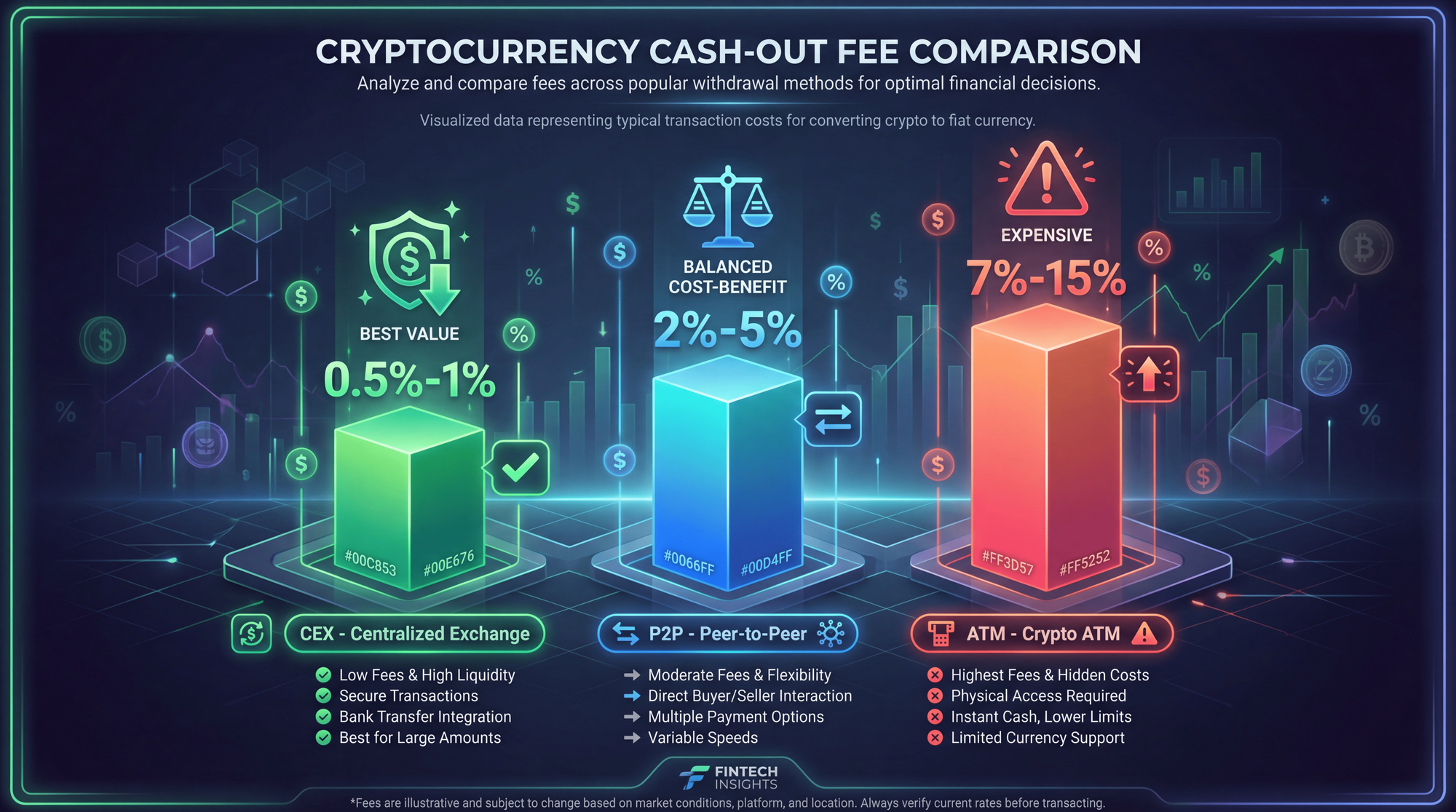
Crypto Withdrawal Fee Comparison 2026
Understanding fee structures is crucial when deciding how to sell crypto for cash. A seemingly small percentage difference can mean hundreds of dollars on larger withdrawals.
Fee-Free Trading Options:
- Coinbase One: $29.99/month for 0% trading fees up to $10,000/month
- Kraken+: Subscription for 0% fees up to $10,000/month
- Robinhood: Commission-free trading (spread ~0.3-0.4%)
Real cost example - Selling $10,000 of Bitcoin:
| Method | Trading Fee | Withdrawal Fee | Total Cost |
|---|---|---|---|
| Binance + ACH | $10 | $0 | $10 |
| Kraken + ACH | $25-40 | $0 | $25-40 |
| Coinbase + ACH | $40-60 | $0 | $40-60 |
| Coinbase One | $29.99/mo | $0 | $29.99 |
| Bitcoin ATM | $600-1,500 | $0 | $600-1,500 |
| Strike (Lightning) | <$1 | $0 | <$1 |
How to Sell Crypto Securely: 10 Essential Safety Tips
The crypto space saw nearly $6 billion lost to rug pulls alone in early 2025, with social engineering scams costing Coinbase users approximately $300 million annually. Protect your withdrawal with these critical security measures:
1. Use Two-Factor Authentication (2FA) - Always
Enable 2FA on every platform where you hold crypto. Use an authenticator app (Google Authenticator, Authy, Microsoft Authenticator) rather than SMS, which is vulnerable to SIM-swap attacks. For maximum security, use hardware keys like YubiKey or Ledger Nano.
2. Verify All Wallet Addresses - Character by Character
"Address poisoning" is a growing threat in 2026. Scammers create wallets with similar-looking addresses (matching first and last characters) and send small transactions to your wallet. When you copy an address from history, you might grab the scammer's address instead.
Prevention: Always copy addresses from official sources, not transaction history. Verify the entire address, not just the beginning and end.
3. Never Share Private Keys or Seed Phrases
No legitimate exchange, support team, wallet provider, or airdrop will ever ask for your private key or recovery phrase. Anyone requesting these is attempting to steal your funds - no exceptions, no matter how official they appear.
4. Complete Verification Before You Need to Sell
Having KYC already completed means you can act quickly when prices reach your target. Rushed verification during market volatility leads to mistakes and missed opportunities.
5. Use Hardware Wallets for Storage
Keep the majority of your holdings in a hardware wallet like Ledger or Trezor. Only transfer what you plan to sell to exchange wallets, minimizing exposure to exchange hacks.
6. Beware of "Customer Support" Scams
Scammers impersonate exchange support staff on Twitter/X, Telegram, Discord, and Reddit. They may DM you after you post about issues. Official support will never:
- Contact you first via DM
- Ask for screen sharing
- Request remote access to your device
- Ask for your seed phrase or password
7. Check Platform URLs Carefully
Phishing sites mimic legitimate exchanges with nearly identical URLs (coinbase-wallet.com instead of coinbase.com). Bookmark your exchange's login page and always access it from your bookmark - never from email links, ads, or search results.
8. Start with Small Test Transactions
Before sending a large withdrawal, send a small test amount first. This confirms you have the correct address and network, protecting against costly mistakes.
9. Enable Withdrawal Address Whitelisting
Many exchanges offer the option to whitelist specific addresses for withdrawals. Once enabled, crypto can only be sent to pre-approved addresses, preventing thieves who compromise your account from draining funds.
10. Use Unique, Strong Passwords
Never reuse passwords across exchanges and crypto services. Use a password manager to generate and store unique, complex passwords for each platform.
⚠ Pig Butchering Scam Alert
One of the fastest-growing crypto scams involves fake romantic interests or "successful traders" who build trust over weeks before directing victims to fraudulent investment platforms. These sites show fake profits but steal all deposited funds. Never invest based on unsolicited contact, regardless of how genuine the relationship seems.

Crypto Tax Implications When Cashing Out
Converting cryptocurrency to fiat is a taxable event in most jurisdictions. Understanding your obligations before selling helps you plan effectively and avoid surprises.
US Tax Rates on Crypto Sales (2026)
What Triggers a Taxable Event?
Taxable:
- Selling crypto for fiat (USD, EUR, etc.)
- Trading one crypto for another (BTC to ETH)
- Spending crypto on purchases
- Using crypto debit cards
- Receiving crypto as payment
Not Taxable:
- Buying crypto with fiat
- Transferring between your own wallets
- Gifting crypto (US under annual exclusion limits: $19,000 in 2026)
- Donating to qualified charities
Tax-Saving Strategies
1. Hold for over 1 year - Long-term capital gains rates (0-20%) are significantly lower than short-term rates (up to 37%).
2. Tax-loss harvesting - Sell losing positions to offset gains. You can offset unlimited gains and deduct up to $3,000 against ordinary income annually.
3. Strategic timing - If you're near a tax bracket threshold, spread sales across tax years.
4. Use tax software - Platforms like Koinly, CoinLedger, and TokenTax automatically calculate your crypto taxes across all exchanges and wallets.
2026 Reporting Requirements
Starting January 1, 2026, cryptocurrency exchanges and brokers must report customer transactions using Form 1099-DA (Digital Assets). This means the IRS will receive records of your crypto sales automatically - making accurate reporting more important than ever.
CEX vs DEX: Which Is Better for Cashing Out?
Understanding the trade-offs between centralized and decentralized exchanges helps you choose the right approach.
Recommendation: For most users, CEX remains the simplest and most cost-effective path to cash. Use DEX + off-ramp if you prefer self-custody until the last possible moment or need access to tokens not listed on major exchanges.

Frequently Asked Questions
What is the cheapest way to convert crypto to cash?
For Bitcoin, Strike (using Lightning Network) offers near-zero fees and instant bank deposits. For other cryptocurrencies, Binance has the lowest trading fees at 0.10% with free SEPA/ACH withdrawals in supported regions. Subscription services like Coinbase One ($29.99/month) offer fee-free trading up to $10,000/month, which can save significant money for active traders.
Can I withdraw crypto directly to my bank account?
Not directly - crypto must first be sold for fiat currency on an exchange or through a service. Once converted, you can withdraw fiat to your bank via ACH (US), SEPA (Europe), wire transfer, or instant transfer options. Some payment apps like Cash App and PayPal allow selling crypto directly to your app balance, which can then transfer to your bank.
How long does it take to cash out Bitcoin?
The timeline depends on your method:
- Exchange sale: Instant
- ACH withdrawal: 1-5 business days
- Wire transfer: 1-2 business days
- Instant withdrawal: Minutes (1-2% fee)
- Bitcoin ATM: Immediate cash
- Strike (Lightning): Minutes to bank
Do I have to pay taxes when I sell crypto?
In most countries, yes. Selling crypto for fiat is a taxable event that triggers capital gains tax on any profit. In the US, short-term gains (held under 1 year) are taxed at ordinary income rates (10-37%), while long-term gains (over 1 year) receive preferential rates (0-20%). Consult a tax professional for your specific situation.
What happens if I don't report crypto on my taxes?
Failure to report crypto gains can result in penalties, interest, and potential criminal prosecution for tax evasion. Starting 2026, exchanges must report transactions via Form 1099-DA, meaning the IRS will have records of your trading activity. Voluntary disclosure and amended returns are options if you've failed to report in past years.
Is it better to sell crypto or use a debit card?
Selling gives you control over timing and price, and typically offers better rates on larger amounts. Debit cards are convenient for everyday spending but each purchase is a taxable event and conversion rates may be less favorable. For amounts over $1,000, selling on an exchange is usually more cost-effective.
Can I cash out crypto without ID?
For small amounts, some Bitcoin ATMs allow transactions without full KYC (typically under $300). P2P platforms may have lower thresholds in some regions. However, most methods requiring bank deposits need identity verification due to anti-money laundering regulations. Attempting to avoid KYC on regulated platforms can result in frozen accounts.
What is the maximum you can withdraw from crypto?
Daily and monthly limits vary by platform and verification level:
- Coinbase: Up to $50,000/day with full verification
- Kraken: Up to $10,000,000/day at Pro level
- Binance: Varies by verification tier
- Bitcoin ATMs: Usually $500-$25,000/day
For amounts exceeding $100,000, OTC desks offer better execution without impacting market prices.
How do I convert stablecoins to cash?
Stablecoins (USDT, USDC) can be sold on any major exchange just like Bitcoin or Ethereum. Because they're pegged to the dollar, there's no price volatility during the withdrawal process. Many users convert volatile crypto to stablecoins first to lock in dollar value, then withdraw when convenient.
Are Bitcoin ETFs a way to cash out?
If you own spot Bitcoin ETFs (like IBIT, FBTC) in a brokerage account, you can sell them like any stock during market hours. This provides immediate cash settlement in your brokerage account without the complexity of crypto exchanges. However, this only works if you initially bought Bitcoin through ETFs - you cannot deposit actual Bitcoin into an ETF.
Your Crypto Cash-Out Checklist
Converting cryptocurrency to fiat doesn't have to be complicated or risky. By following security best practices and understanding your options, you can confidently access the value of your digital assets.
✅ Before You Withdraw - Complete Checklist
- ☐ Complete KYC verification on your chosen platform
- ☐ Enable 2FA with an authenticator app (not SMS)
- ☐ Link and verify your bank account
- ☐ Enable withdrawal address whitelisting if available
- ☐ Compare fees across multiple platforms for your amount
- ☐ Calculate potential tax implications (use tax software)
- ☐ Start with a small test transaction
- ☐ Double-check all addresses before confirming
- ☐ Keep detailed records for tax purposes
Ready to convert your crypto holdings to cash? Start by choosing a regulated exchange that operates in your region, complete the verification process, and you'll be ready to make your first withdrawal safely and securely.
Start Trading Cryptocurrency Today
Buy, sell, and trade crypto with competitive fees and bank-grade security on Zipmex.
Create Free Account →⚠ Disclaimer: The information provided in this article is for educational purposes only and should not be considered financial, tax, or legal advice. Cryptocurrency investments carry substantial risk, including the potential loss of principal. Tax laws vary by jurisdiction and change frequently - consult with a qualified tax professional regarding your specific situation. Past performance does not guarantee future results. Always conduct your own research before making investment decisions.