
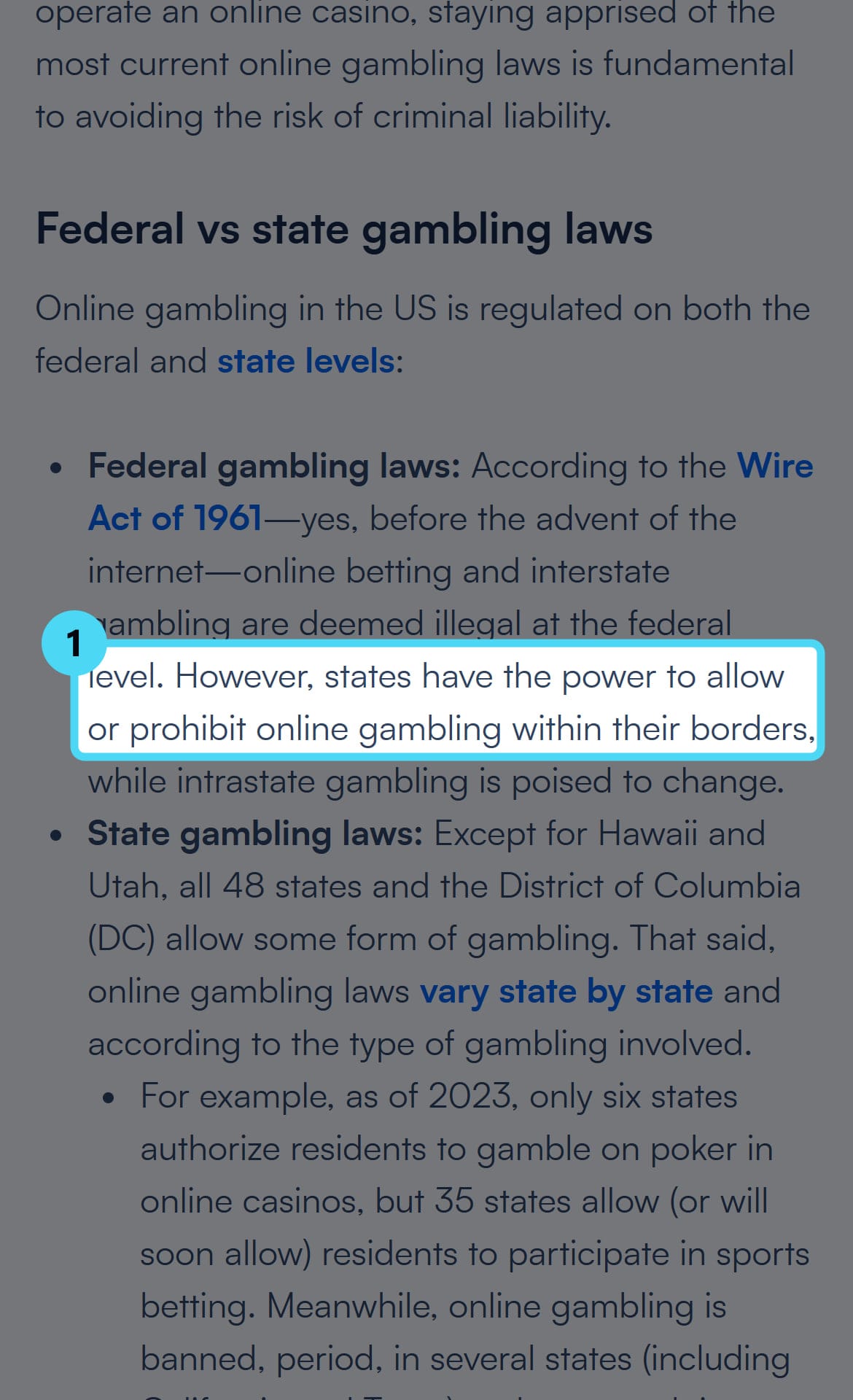
Federal law does not explicitly ban crypto gambling, Sumsub said in a compliance guide dated Sept. 10, 2025. It says the legal status of both gambling and crypto use still varies from state to state. So the answer is not a simple yes or no for every player in the United States. A key federal law on internet gambling payments is the Unlawful Internet Gambling Enforcement Act, or UIGEA. It is aimed at betting businesses and the payments they accept. Microblink publishes a guide to US online gambling laws. It says states can allow or ban online gambling within their borders.
Key facts from the Federal Trade Commission (FTC), Sumsub and Microblink
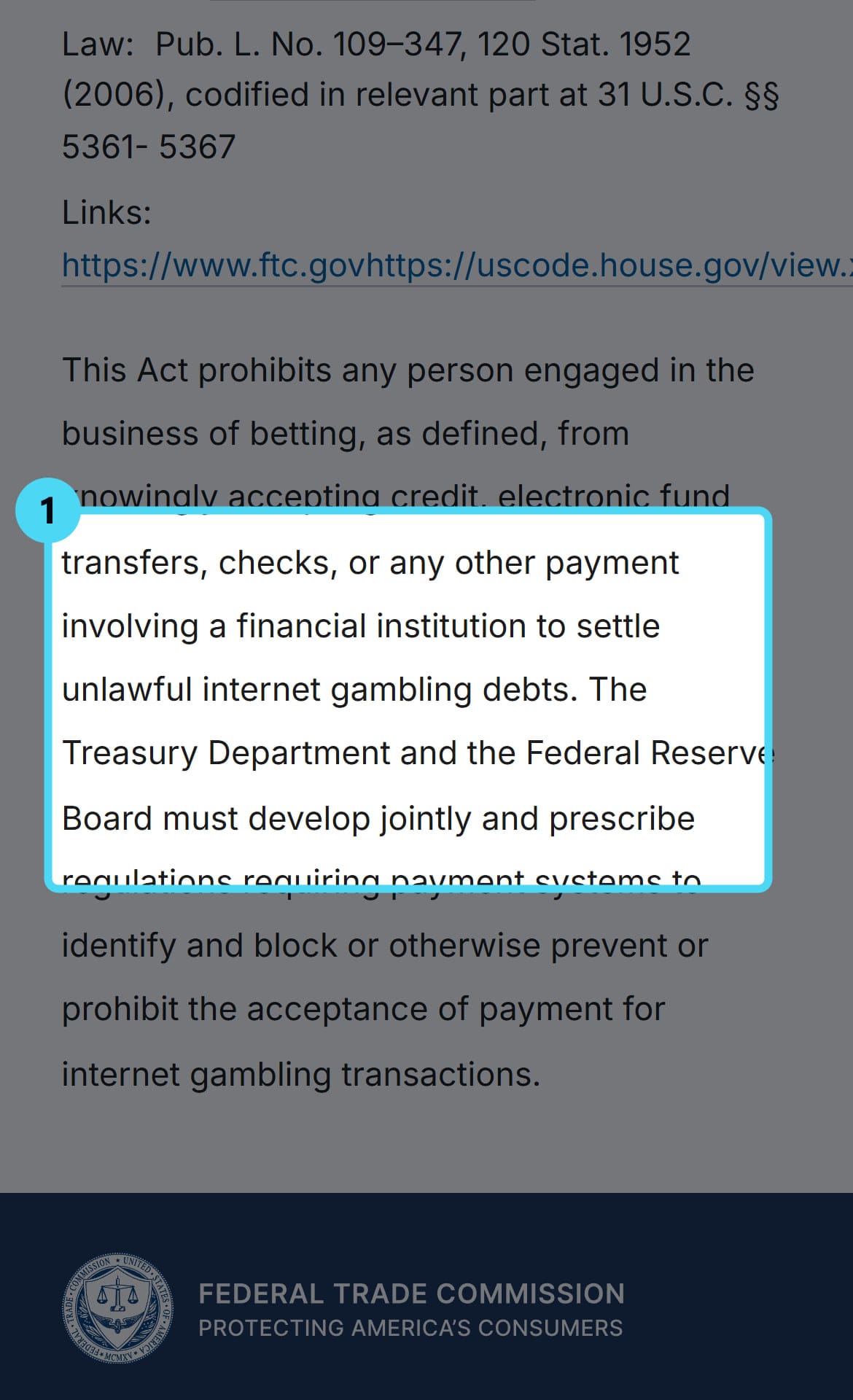
- Federal payment rule: Betting businesses may not knowingly accept payments involving a financial institution to settle unlawful internet gambling debts.
- Payment blocking: The Treasury Department and the Federal Reserve Board must jointly write rules for payment systems. Those systems must identify and block internet gambling payments.
- Federal crypto ban: None explicit in federal law, though status varies by state.
- State choice: Each state can allow or ban online gambling inside its borders.
- US-licensed operators: Not approved to accept crypto.
- Where crypto casinos operate: Typically offshore.
What the federal payment rule covers
The FTC's legal-library summary describes UIGEA as a payment rule. It covers anyone in the business of betting. Such a business may not knowingly accept payments that involve a financial institution. The ban covers payments to settle unlawful internet gambling debts. Electronic fund transfers are one of the payment types it names. The Act also gives the Treasury Department and the Federal Reserve Board a joint task. The two agencies must write rules that require payment systems to identify and block payments for internet gambling. Both parts deal with the business that takes the money and the systems that process it.
Where state law and licensing come in
Microblink's guide to US online gambling laws says each state can permit or ban online gambling inside its own borders. Sumsub's guide adds a crypto layer to that state question. In its summary, crypto use has its own legal status, which also differs by state. Gambling operators licensed in the United States are not approved to accept crypto. That leaves separate checks. One is the federal payment rule. Another is whether the state allows online gambling. The last is the operator's license and crypto policy.
Which legal question applies to your crypto bet?
Which legal layer applies to your situation: the federal payment rule, your state's law, or the site's license and crypto policy?
What do you want to know?
- Can the site legally take my payment? → A federal payment rule applies to the business
- Does my state allow this online gambling? → next question
- Can a US-licensed site take my crypto? → US-licensed operators are not approved for crypto
Does the site you plan to use hold a license from your state?
- Yes, it holds my state's license → Your state's rules govern the question
- No, or I don't know → next question
Is the site based outside the United States?
- Yes → Offshore access is not a state license
- No or not sure → Check the license before the bet
Under UIGEA, betting businesses may not knowingly accept payments involving a financial institution to settle unlawful internet gambling debts. The Treasury Department and the Federal Reserve Board must jointly write rules for payment systems to block internet gambling payments. Whether your state allows online gambling is a separate question.
Source: Unlawful Internet Gambling Enforcement Act (ftc.gov), Jul 19, 2013 · Understanding Today’s US Online Gambling Laws (microblink.com), Apr 26, 2024Sumsub says gambling operators licensed in the United States are not approved to accept crypto. It also says federal law does not explicitly ban crypto gambling, and that status varies by state.
Source: Is Crypto Gambling Legal? Global Regulations in 2025 (sumsub.com), Sep 10, 2025Microblink says each state can allow or ban online gambling inside its borders. Sumsub says US-licensed operators are not approved to accept crypto, so a site licensed by your state is not expected to take it.
Source: Understanding Today’s US Online Gambling Laws (microblink.com), Apr 26, 2024 · Is Crypto Gambling Legal? Global Regulations in 2025 (sumsub.com), Sep 10, 2025Sumsub says crypto casinos typically operate offshore. Microblink says an offshore operator accepting US customers is not necessarily licensed or regulated by the player's state. It adds that players on unregulated offshore platforms may not get the same protections or regulatory remedies in a dispute.
Source: Is Crypto Gambling Legal? Global Regulations in 2025 (sumsub.com), Sep 10, 2025 · Understanding Today’s US Online Gambling Laws (microblink.com), Apr 26, 2024Microblink says each state can allow or ban online gambling inside its borders. It also says an offshore operator is not necessarily licensed where the player is located. Confirm the site's license with your state before treating a bet as lawful.
Source: Understanding Today’s US Online Gambling Laws (microblink.com), Apr 26, 2024This routes each question to what the sources state; it cannot decide whether a bet is legal in a named state or for a specific person.
What an offshore crypto site does not establish
Sumsub says crypto casinos typically operate offshore. Microblink says an offshore operator accepting US customers is not necessarily licensed or regulated by the player's state. It also says players on unregulated offshore platforms may not get the same protections. The same applies to regulatory remedies if a dispute arises. Being reachable from the United States is not the same as holding a license in the player's state.

Analysis: why a crypto option does not answer the legal question
UIGEA, as the FTC summarizes it, is written around payments that involve financial institutions. That framing can make crypto look like a route around the law. The state-level picture points the other way. States decide whether online gambling is allowed. Sumsub says crypto's own legal status also varies by state. It says US-licensed operators are not approved to accept crypto. A site that offers crypto deposits is therefore unlikely to hold a license from a US state. Offshore operation is the typical pattern. On that reading, a crypto deposit option is a payment feature. It is not a sign that a bet is lawful where the player is located. A sensible order of checks follows. First, confirm whether the player's state allows online gambling. Second, confirm whether the operator is licensed in that state. Third, treat an unlicensed offshore site as one that may offer fewer protections and fewer remedies in a dispute.
Limits and further reading
Sumsub and Microblink are companies publishing guides, not state regulators. Their state-level summaries do not settle legality in any named state. The FTC's legal-library entry on UIGEA is the starting point for the federal text. For comparison with another country, a separate explainer covers how crypto licensing works in Thailand.
Sources: Is Crypto Gambling Legal? Global Regulations in 2025 (sumsub.com), Sep 10, 2025 · Unlawful Internet Gambling Enforcement Act (ftc.gov), Jul 19, 2013 · Understanding Today’s US Online Gambling Laws (microblink.com), Apr 26, 2024
ZIPMEX promotes trading on trade.zipmex.com. Promotions are labelled and kept separate from news coverage, which is selected and checked without regard to them. Perpetual futures are leveraged derivatives. Prices can move fast and you can lose all of your margin. Not available in every jurisdiction. Not investment advice.
