Understanding the maker vs taker meaning is the single fastest way to immediately increase your crypto trading profit margins. I have spent years trading on-chain derivatives and managing high-leverage positions, and I still see intermediate traders bleeding thousands of dollars annually simply because they don't understand how order routing affects their fee schedule.
In short: a market maker creates liquidity by placing orders that rest on the books, while a market taker removes liquidity by executing orders instantly against what is already available. Mastering this dynamic dictates whether you pay premium rates or secure heavily discounted execution costs.
⚡ Key Takeaways: Maker vs Taker Fees
- Makers provide liquidity: They use limit orders that do not fill immediately, adding depth to the exchange.
- Takers consume liquidity: They use market orders to buy or sell instantly, paying a premium for speed.
- Fee disparity: Taker fees are almost universally higher than maker fees across all major platforms.
- The "Post-Only" rule: Advanced traders use the "Post-Only" toggle to guarantee their trades only execute as maker orders, completely avoiding taker fees.

What Are Makers and Takers in Crypto Trading?
Every cryptocurrency exchange functions through an order matching engine. This engine pairs buyers who want a specific asset with sellers willing to provide it. The lifeblood of this entire system is Liquidity. Without sufficient liquidity, an exchange cannot offer stable prices or fast execution, which is why platforms financially incentivize traders who provide it.
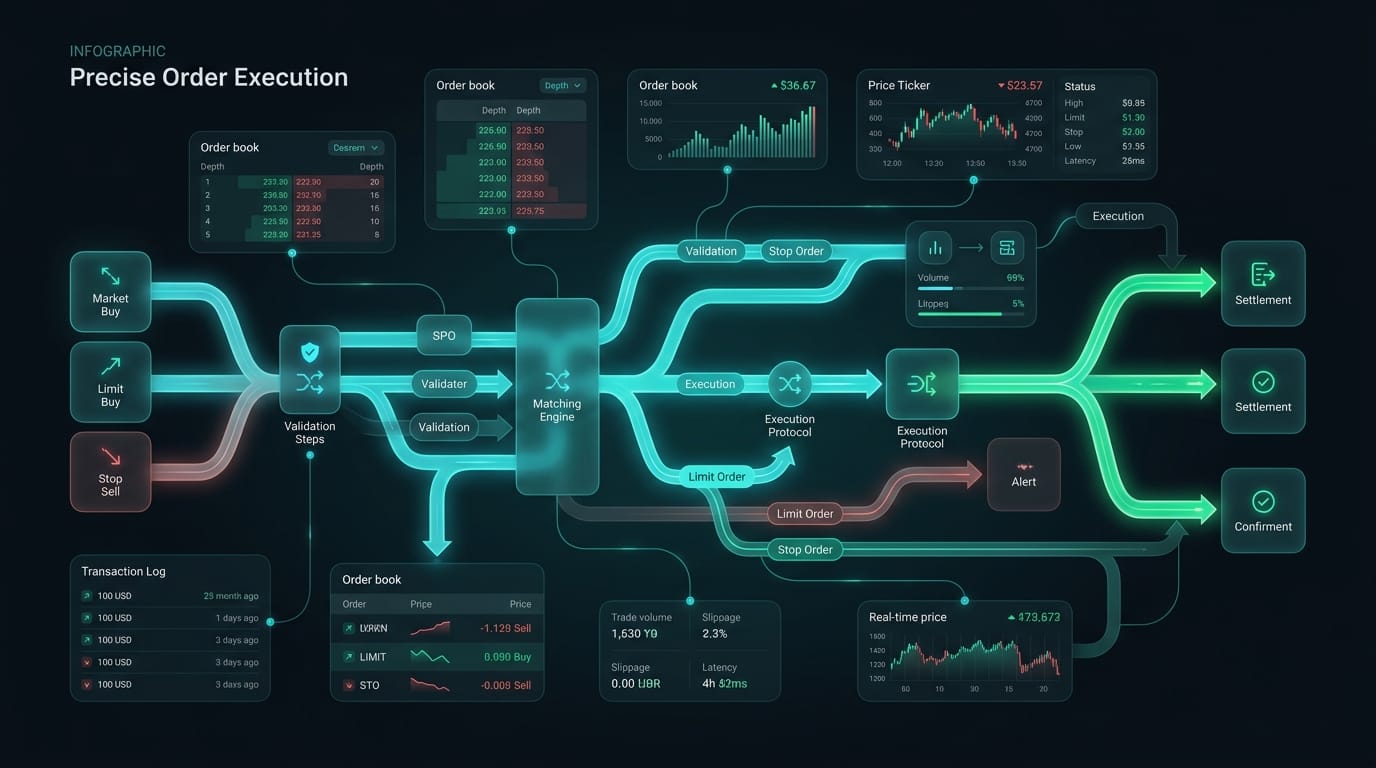
The ledger where all this action happens is the Order Book. When you place a Limit Order at a price different from the current market rate, your order rests on the order book. Because you are adding depth to the market, you are classified as a maker. Conversely, when you demand immediate execution using a Market Order, you pull existing resting orders off the book. You are taking liquidity away, establishing your role as a taker.
Sophisticated market makers do not guess where to place these resting orders. They rely on technical indicators like the MACD (Moving Average Convergence Divergence) to identify momentum shifts, placing their limit orders at calculated levels where they anticipate the price will eventually arrive.
📊 Visualizing the Order Book
- Maker Buy Orders (Bids): Resting below the current price. Example: BTC is $65,000; maker places a limit buy at $64,500.
- Maker Sell Orders (Asks): Resting above the current price. Example: BTC is $65,000; maker places a limit sell at $65,500.
- Taker Market Order: Strikes the book instantly, consuming the closest available green or red orders.
The Mechanics of the Order Book
To truly grasp the maker vs taker dynamic, you must understand the physical structure of the order matching process. The order book consists of two sides: the "bid" (buyers) and the "ask" (sellers). The gap between the highest willing buyer and the lowest willing seller forms the Bid-Ask Spread.
When a taker executes a market order, they automatically consume the closest available prices on the opposite side of the book. If the order book is thin, a large taker order will chew through multiple price levels to fulfill its size. This phenomenon causes Slippage, meaning the final average execution price is significantly worse than the initially quoted price. Makers avoid slippage entirely because they dictate their exact entry or exit price.
How Liquidity Defines Your Trading Role
Exchanges obsess over liquidity because it is the actual product they sell to active traders. High liquidity translates to tight spreads and minimal price manipulation, which subsequently attracts massive institutional volume.
While professional High-Frequency Trading (HFT) firms use algorithmic bots to constantly quote both sides of the market and capture fractions of a cent, retail traders also provide vital liquidity. Anytime you use a limit order and wait for the market to come to you, you provide a service to the platform. The exchange rewards you with a lower fee for this service. Your trading role isn't a fixed identity; it shifts trade-by-trade based entirely on how you interact with the exchange's liquidity pool.

Key Differences Between Market Makers vs. Market Takers
The distinction between these two roles fundamentally impacts your bottom line. Exchanges use a Maker-Taker Fee Model to balance supply (resting orders) and demand (instant execution). If everyone used limit orders, the market would freeze. If everyone used market orders, the order book would empty. The fee structure forces an equilibrium.
When evaluating how you want to execute your next trade, focus on three core differences: Cost, Execution Speed, and Price Certainty.
Impact on the Bid-Ask Spread and Execution Speed
Takers prioritize Execution Speed. By using a Market Order, they buy certainty of entry. However, that speed comes with a hidden tax: crossing the Bid-Ask Spread. The taker pays the spread as an immediate cost of doing business.
Makers, on the other hand, capture the spread. If their order is filled, they secure a mechanically superior entry. The trade-off is execution uncertainty. A limit order might sit on the book for days, or the market might reverse just pennies away from filling it. Takers buy time and certainty; makers risk non-execution to dictate their exact price.
Fee Structures and Exchange Rebates
Taker fees typically range from 0.05% to 0.60% per trade, depending on the platform. Maker fees frequently sit between 0.00% and 0.20%.
This Maker-Taker Fee Model heavily favors the liquidity provider. As your trading activity increases, you move up the exchange's Volume Tier system, which slashes your base fees further. On highly competitive platforms, top-tier makers don't just pay zero fees-they receive Rebates. A rebate is a negative fee; the exchange actually pays the market maker a percentage of the taker's fee to subsidize their liquidity provision.
Maker vs Taker Comparison Table
I built this matrix so you can see exactly what you are trading away when you choose speed over price. Save this reference for your next high-leverage entry.

How to Place Maker and Taker Orders (Getting Started)
Many beginners accidentally pay taker fees because they don't know how to navigate their platform's advanced interface. Even if you select a limit order, if your limit price crosses the current market price, the exchange will execute it instantly as a taker order.
To prevent this, you must use a Post-Only Order. This is a specific toggle that guarantees your order will only be placed if it rests on the order book. If the system detects that your order would execute instantly, the post-only mechanism cancels the order entirely, protecting you from unexpected taker fees.
Here is exactly how you execute a guaranteed maker order on any standard Cryptocurrency Exchange:
- Open the Advanced Trade panel: Never use the basic homepage "Buy/Sell" widgets.
- Select the Limit Order tab: Switch away from Market.
- Check the "Post-Only" box: This is usually a small checkbox under the amount field.
- Set your specific price: Ensure it sits below the current price for buys, or above for sells.
- Confirm placement: Your order is now resting safely on the book.
Be extremely careful with your Stop-Loss placements. Standard stop-losses trigger as market orders to guarantee you exit a crashing trade. This means your risk management protocol inherently executes as a taker, charging you the highest possible fee precisely when you are already taking a loss.
Evaluating Exchange Fee Models: How to Choose
Hunting for the platform with the absolute lowest taker fee is a rookie mistake. A low fee on an exchange with zero Liquidity is a trap. You might save 0.05% on the fee schedule, but lose 1.5% to severe slippage because the order book is hollow.
Institutional traders measure their true execution costs using VWAP (Volume Weighted Average Price). VWAP calculates the real, blended cost of a trade taking slippage into account. Always evaluate an exchange's true liquidity depth before committing capital. Major players like Binance and leading decentralized perpetual platforms offer deep books that ensure your VWAP remains tight even on six-figure market orders.
Assessing Tiered Volume Discounts
Your execution costs will plummet as you climb a platform's Volume Tier. Exchanges calculate your 30-Day Trading Volume on a rolling basis.
If you trade $50,000 a day, your monthly volume hits $1.5 million. On many platforms, crossing the $1 million threshold bumps you into a VIP tier, slicing your taker fees in half. Because of this volume-weighted system, I strongly advise active traders to consolidate their activity onto a single, highly liquid exchange. Splitting your capital across four different platforms dilutes your 30-day trading volume, keeping you stuck in the highest fee brackets everywhere.
Free vs Paid vs AI-based Provider Comparison
When evaluating where to route your trades, you will encounter three distinct business models. Understanding their underlying mechanics is critical for protecting your capital.
- Zero-Fee Platforms: These retail brokerages advertise "no trading fees." In reality, they act as the market maker themselves. They widen the bid-ask spread significantly, burying your execution cost directly into the price of the asset. You pay heavily for this illusion of free trading.
- Premium Exchanges: Traditional order book platforms that charge a transparent maker/taker percentage. While you see the fee upfront, you get direct market access, tighter spreads, and the ability to dictate your execution as a maker.
- AI-based Smart Order Routers: Institutional-grade aggregators that take your market order and instantly slice it into smaller chunks, routing it across multiple decentralized and centralized exchanges simultaneously. This minimizes slippage for massive taker orders.
Hidden Costs and Red Flags in Exchange Fees
The maker-taker fee schedule is only the first layer of your true trading cost. Unethical platforms routinely advertise rock-bottom maker fees while weaponizing other mechanics to extract your capital.
The most common trap is spread manipulation. If an exchange claims a 0.01% taker fee but maintains an artificially wide Bid-Ask Spread, you are losing money on the execution itself. High Slippage is a hidden fee. Furthermore, some platforms lock you in with low trading fees but impose exorbitant Withdrawal Fees to prevent you from taking self-custody of your assets.
Deceptive Tactics Breakdown
If you are serious about your profitability, you must recognize when a platform is actively working against you. Avoid platforms that rely on these extraction methods.
⚠ Major Fee Red Flags
- The "Convert" Feature: The simple swap buttons on exchange homepages are massive taker orders loaded with aggressive Spread Markups. You are paying a heavy premium for the convenience of not using the advanced order book.
- Inactivity Fees: Predatory platforms charge your account balance simply for holding fiat or crypto without executing trades over a 90-day period.
- Dynamic Withdrawal Fees: Exchanges that alter network withdrawal costs based on market volatility, frequently overcharging the actual on-chain gas fee to pocket the difference.
Strategic Implementation: Optimizing Your Maker and Taker Trades
Understanding the fee structure is useless if you don't apply it to your Trading Strategy. Profitable traders do not exclusively use maker orders to save pennies; they deploy both order types strategically based on current market conditions.
You must use Technical Analysis to dictate your execution style. If you anticipate a violent breakout, paying the taker fee to guarantee your entry is smart business. If you are accumulating a long-term position during a sideways consolidation, paying taker fees is a waste of capital.
Popular Trading Strategies
Your chosen trading style entirely dictates your fee sensitivity. Here is how the maker vs taker dynamic maps to the five core strategies.
Risk Management and Slippage Control
The most dangerous moment in any trade is the exit. When the market moves against you, you transition from a patient maker to an urgent taker.
A hard Stop-Loss order is the foundation of Risk Management. You must understand that when the price hits your stop level, the system fires a market taker order to liquidate your position. During extreme volatility, the order book thins out. Your market order slams into the book and suffers massive Slippage. You end up paying the premium taker fee and exiting at a substantially worse price than your stop level. This is the brutal reality of risk management-you pay the highest costs exactly when you are losing.
Using Technical Indicators for Order Placement
You do not randomly place limit orders and hope for the best. You must use mathematical indicators to find the exact zones where price is most likely to reverse, allowing you to park your liquidity there safely.
I frequently use Bollinger Bands to identify volatility extremes. By placing maker limit buy orders exactly at the lower band during a ranging market, I force the market to come to my price. Similarly, an oversold RSI (Relative Strength Index) reading heavily informs where I layer my limit orders at historical Support and Resistance levels. By combining these technical metrics, you drastically increase the probability that your resting maker order gets filled right at the optimal pivot point.
LIMIT ORDER PLACEMENT STRATEGY (EXAMPLE: ETH/USDT)
Step 1
Identify major Support Level on the 4H chart (e.g., $3,120).
Step 2
Confirm 4H RSI is approaching oversold territory (< 35).
Step 3
Verify the lower Bollinger Band aligns with the support zone.
Step 4
Set Post-Only Maker Buy Limit at $3,125.
Result
You dictate the exact entry, avoid taker fees, and buy the technical bounce.

Alternatives to Traditional Maker/Taker Order Books
The centralized exchange model is no longer the only way to trade. The decentralized finance (DeFi) sector has fundamentally altered how liquidity is sourced and fees are collected.
A Decentralized Exchange (DEX) like Uniswap does not use an order book. Instead, it relies on an Automated Market Maker (AMM). In this system, liquidity providers pool pairs of assets into a smart contract. When you trade on a DEX, you are strictly acting as a taker against the algorithm's liquidity pool. You pay a fee directly to the users who pooled their assets, rather than to a centralized corporate entity.
For institutional whales moving eight-figure sums, neither order books nor AMMs are sufficient due to slippage. They utilize an OTC Desk (Over-The-Counter). OTC desks bypass the public markets entirely, offering a fixed, guaranteed quote for massive taker orders, eliminating slippage risk completely.
📊 Order Book vs AMM Liquidity Flow
- Centralized Order Book: Trader A (Maker) places limit order → Exchange matches → Trader B (Taker) executes → Exchange collects fee.
- DeFi AMM Pool: Users pool assets → Smart contract holds liquidity → Trader (Taker) swaps tokens against pool → Pool providers earn the trading fee.
Conclusion and Final Recommendations
Mastering the maker vs taker meaning comes down to a simple rule: default to maker limit orders to protect your capital, but aggressively pay taker fees when securing a momentum entry is more critical than saving a fraction of a percent.
If you are a beginner, immediately switch your interface to "Advanced Trade" and exclusively use post-only limit orders. Stop giving away your capital to the "Convert" button. If you are an intermediate trader, actively track your 30-day volume. Consolidate your capital to hit the volume tiers that significantly reduce your baseline taker costs.
Ultimately, the market is moving toward platforms that respect the user. Decentralized, self-custodial crypto platforms that offer perpetual futures trading are proving that you can access deep liquidity and transparent fee structures without giving up control of your private keys. Trustless, verifiable approaches-where real yield comes purely from transparent platform fees rather than hidden spread manipulation-reflect exactly where the serious trading industry is heading. Secure your execution, understand your fees, and always maintain custody of your own capital.
Last updated: March 2026.
Frequently Asked Questions
What is the simple maker vs taker meaning?
A market maker creates liquidity by placing limit orders that rest on the exchange's order book, waiting to be filled. A market taker removes liquidity by executing market orders that buy or sell instantly at the current available prices. Makers wait for their price and generally pay lower fees.
Why are maker fees cheaper than taker fees?
Exchanges need high liquidity to function efficiently and attract institutional volume. By offering lower maker fees-or even paying rebates-platforms financially incentivize traders to leave their limit orders resting on the books. Taker fees are higher because takers consume this valuable liquidity.
What happens if a taker order is larger than the available liquidity?
If a market taker places an order that exceeds the volume available at the best current price, the order matching engine will continuously move up or down the order book to fill the remaining size. This consumes multiple price levels, resulting in severe price slippage.
Are all limit orders automatically maker orders?
No. If you place a limit buy order at $60,000 while the current market price is $59,000, your order crosses the spread and executes instantly against existing sellers. Because you removed liquidity, the exchange will charge you the higher taker fee, despite the fact that you used the limit order function.
What is a "post-only" order in crypto trading?
A post-only order is a critical toggle available on advanced trading interfaces that guarantees your trade will strictly act as a market maker. If you place a post-only limit order that would execute instantly upon submission, the exchange will automatically cancel it instead of filling it.
Can stop-loss orders accidentally trigger taker fees?
Yes, this is a critical risk management concept. A standard stop-loss order is designed to trigger as a market order once your designated price is hit, guaranteeing you exit the position. Because it executes instantly, it removes liquidity from the order book, incurring the maximum taker fee.
How do decentralized exchanges (DEXs) handle maker vs taker dynamics?
Decentralized exchanges generally replace order books with Automated Market Makers (AMMs). You cannot place a traditional resting limit order. Instead, you act as a maker by depositing your crypto into a smart contract liquidity pool. Active traders then act as takers by swapping tokens against that pool.
Disclaimer: Crypto trading involves substantial risk of loss and is not suitable for every investor. The valuation of cryptocurrencies and futures contracts may fluctuate, and, as a result, clients may lose more than their original investment. This content is for informational purposes only and should not be construed as financial advice.