
A mining calculator estimates what your hardware would earn. It multiplies your share of the network's hashrate by the coins issued per day, converts that at the current price, and subtracts the cost of electricity and pool fees. The result is a snapshot, not a forecast. On 25 October 2026 Bitcoin difficulty stood at 140.58T, with network hashrate near 1.08 ZH/s (mempool.space, one-week average). Every input moves daily, so a figure that looks profitable today can turn negative after the next difficulty adjustment or a price drop. Used carefully, these calculators are good for comparing machines and electricity rates. They are not good at predicting income months ahead.
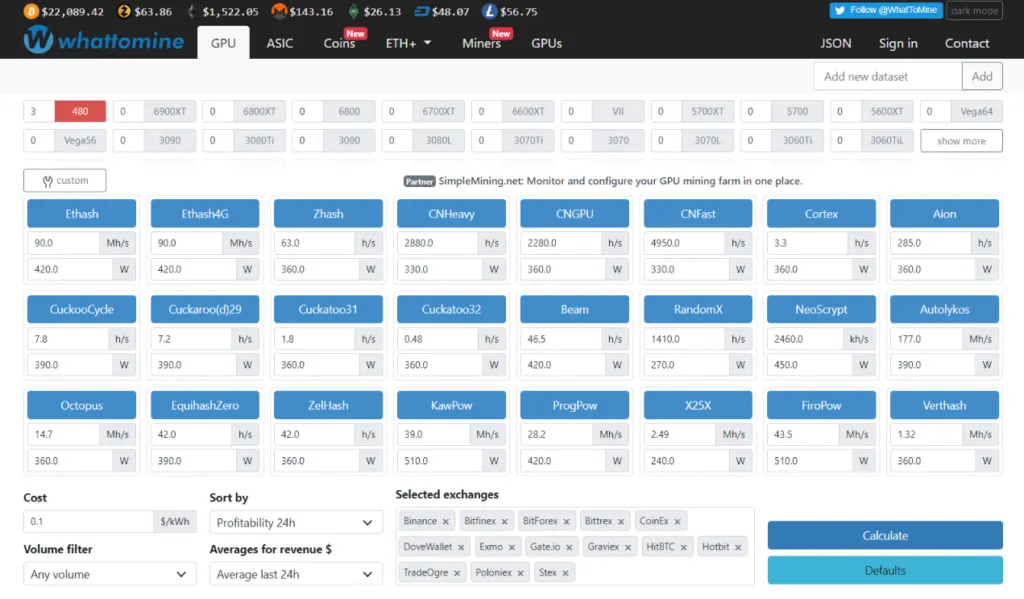
What a mining calculator actually computes
Every calculator, whatever its interface, runs the same arithmetic:
- Your share of the network: your hashrate divided by total network hashrate. Network hashrate is estimated from difficulty, because it can't be measured directly.
- Coins issued per day: blocks per day multiplied by the block reward. The reward is "comprised of a block subsidy and any transaction fees paid by transactions included in this block" (Bitcoin developer guide). The miner collects it in the block's first transaction, the generation transaction.
- Gross revenue: share × coins per day × coin price.
- Costs: power draw in kW × 24 hours × electricity price per kWh, plus the pool fee.
- Profit: gross revenue minus costs. Some tools also show break-even time if you enter the hardware cost.
The Bitcoin inputs that matter most
- Block subsidy: 3.125 BTC per block since block 840,000, reached on 20 April 2024. The subsidy halves every 210,000 blocks (Bitcoin Wiki).
- Next halving: at block 1,050,000. The chain was at block 973,069 on 25 October 2026. The remaining ~77,000 blocks at ten minutes each come to roughly a year and a half, so around 2028 by our arithmetic. Projections vary, and the Bitcoin Wiki lists its own estimate. A calculator that runs past that block without halving the subsidy overstates revenue.
- Difficulty: recalculated every 2,016 blocks against a target of 1,209,600 seconds (two weeks) per period (Bitcoin developer guide). This keeps the average block interval at about ten minutes. On 25 October 2026 mempool.space estimated the next adjustment at +5.09%. If that holds, every miner's share drops by about that much overnight.
- Transaction fees: these vary block by block. Many calculators leave them out or use a recent average.
A worked example with October 2026 data
CoinWarz's Bitcoin calculator loads with a preset ASIC rated at 1,160 TH/s and 11,020 W, electricity at $0.10/kWh, a 1% pool fee, a 3.125 BTC block reward and a BTC price of $80,479 (page data, 25 October 2026). We ran the arithmetic ourselves using mempool.space's 1.08 ZH/s hashrate:
| Step | Calculation | Result |
|---|---|---|
| Network share | 1,160 TH/s ÷ 1,080,000,000 TH/s | ~0.000107% |
| BTC issued per day (subsidy only) | 144 blocks × 3.125 BTC | 450 BTC |
| Your BTC per day | 450 × share | ~0.00048 BTC |
| Gross revenue | × $80,479 | ~$38.9 |
| Electricity | 11.02 kW × 24 h × $0.10 | ~$26.4 |
| Pool fee | 1% of revenue | ~$0.4 |
| Daily profit before fees income | ~$12 |
What this shows:
- Electricity is most of the cost. At $0.10/kWh, power takes about two-thirds of gross revenue. At $0.15/kWh the same machine would cost ~$39.7 a day to run and would lose money.
- The +5% difficulty step alone cuts revenue by about $1.9 a day, or roughly a sixth of the profit.
- Hashprice is a quick cross-check. Luxor's Hashrate Index defines hashprice as the expected value of one unit of hashrate per day. It is driven by difficulty, BTC price, block subsidy and transaction fees. Our example works out to about $33.5 per PH/s per day, in line with the roughly $32–36/PH/day range the index's widgets showed at the time of writing. If your calculator's number is far from the current hashprice, check its inputs.
Transaction fees, hardware cost, cooling, hosting and taxes are left out above. Fees raise revenue. The rest lower profit.
What would your miner earn per day?
Enter your machine's hashrate and power draw, the network hashrate, block subsidy, BTC price, pool fee and electricity rate to see daily profit from the block subsidy alone.
| Your machine's hashrate | Your machine's power draw | Total network hashrate | Block subsidy | BTC price | Pool fee | Electricity price | Daily profit from the block subsidy, after electricity and pool fee |
|---|---|---|---|---|---|---|---|
| 1,160 TH/s | 11.02 kW | 1.08 ZH/s | 3.125 BTC | 80,479 $ | 1 % | 0.1 $/kWh | 12.06 $ |
| 1,160 TH/s | 11.02 kW | 1.08 ZH/s | 3.125 BTC | 80,479 $ | 1 % | 0.15 $/kWh | -1.16 $ |
| 1,000 TH/s | 0 kW | 1.08 ZH/s | 3.125 BTC | 80,479 $ | 0 % | 0.1 $/kWh | 33.53 $ |
- Every value is an input you can change. The defaults are the 25 October 2026 snapshot used in the article's worked example.
- 144 blocks a day assumes the ten-minute average block interval that difficulty adjustments target.
- The second example sets power and pool fee to zero for 1,000 TH/s (1 PH/s), which gives gross revenue per PH/s per day. Compare it with current hashprice as a cross-check.
- A negative result means electricity and the pool fee cost more than the subsidy earned on those inputs.
This is arithmetic on the block subsidy only. It leaves out transaction fees, hardware cost, cooling, hosting and tax, and it cannot predict future difficulty, the BTC price or the next halving. This is not investment advice.
Calculators that still work in 2026
All of the tools below were reachable on 25 October 2026. Their features are described from their own pages.
CoinWarz
Covers SHA-256 and other algorithms. You enter hashrate, power draw, electricity cost, pool fee and optional hardware cost. Difficulty, price and block reward are preloaded with live values, and you can edit each one. That makes it handy for "what if difficulty rises 10%" scenarios.
WhatToMine
Aimed at GPU miners. It compares profitability across GPU-mineable coins (for example Ethereum Classic, Ravencoin, Ergo, Firo, Beam and Grin). You enter per-algorithm hashrate and power plus electricity cost. Revenue can be shown on current, 24-hour, 3-day or 7-day averages. The site notes that its calculations "are based on mean values". Its defaults assume three RTX 3070 cards, so replace them with your own numbers.
2CryptoCalc
A GPU and ASIC calculator. You pick a device from ASIC, NVIDIA or AMD lists. Its coin table includes Bitcoin, Kaspa, Zcash, Bitcoin Cash, Ethereum Classic, Ravencoin and others, with results in several fiat currencies.
Hashrate.no
A hardware reference site with estimates for GPUs, ASICs, CPUs and FPGAs, plus a coin calculator. One power-cost field ($/kWh) feeds every calculation, which makes side-by-side hardware comparison quick.
minerstat
You pick hardware and set an electricity price. It returns ranked opportunities with revenue, electricity cost, profit and break-even.
NiceHash profitability calculator
You select an algorithm (SHA-256 with AsicBoost, Scrypt, Etchash, KawPow and others) and enter a hashrate or choose a device. Its top-hardware list shows daily earnings in BTC with USD equivalents. The page doesn't list electricity cost as an input and gives no methodology. Treat its output as gross revenue.
Why calculators and real payouts differ
- Stale or averaged data. Tools use current or averaged difficulty and prices. The averaging window you pick changes the answer.
- Your hashrate isn't the label rating. Firmware, cooling, ambient temperature and, for GPUs, memory type all shift real hashrate and power draw. Measure at the wall where you can.
- Pool payout method and fees. The pool fee and how the pool handles fees and luck change what reaches your wallet.
- Coins that can no longer be mined. Ethereum ended proof-of-work mining with the Merge on 15 September 2022 (ethereum.org). Older guides and calculators that still list ETH for GPU mining are out of date.
- Scheduled supply cuts. Long-range break-even estimates must account for the next halving.
Choosing a tool
- Bitcoin ASIC with editable assumptions: CoinWarz.
- GPU coin comparison: WhatToMine, 2CryptoCalc or Hashrate.no.
- Hardware shortlist by electricity price: minerstat or Hashrate.no.
- Sanity check: compare any result against current hashprice.
Limitations: network figures are a 25 October 2026 snapshot, and the worked example covers the block subsidy only. This article is not investment advice.
