You've been there. A trade runs 25% in your favor, you hold through the dip, and before you can act, it's given back 20 of those 25 points. You exit at breakeven - or worse, at a small loss - on a position that was deeply profitable an hour ago. That's exactly the scenario a trailing stop is built to prevent.
A trailing stop is a dynamic exit mechanism that follows price as it moves in your favor, then locks in and triggers automatically when the market reverses. Unlike a fixed stop-loss sitting frozen at a price you set on entry, a trailing stop is alive - it chases gains higher and only fires when the tide turns. This guide covers everything: mechanics, setup, strategy by trading style, platform differences, and the risks most traders underestimate.
⚡ Key Takeaways
- A trailing stop is a dynamic stop-loss that automatically adjusts upward (or downward for shorts) as price moves in your favor
- Two setting types: percentage-based (scales with price) and fixed dollar/point amount
- Most effective in trending markets; can cause premature exits in sideways, choppy conditions
- When triggered, a trailing stop typically submits a market order - execution is guaranteed, but the exact price is not
- Platform-specific rules matter: crypto exchanges like Binance.US and Kraken support 24/7 trailing stops; traditional brokers restrict execution to regular market hours
What Is a Trailing Stop Order? Definition and Core Mechanics
A trailing stop order is a conditional order that uses a trailing offset - a distance below the current price, measured in percentage or fixed dollar/point terms - to determine when to submit an exit order. The offset follows price when it moves favorably but freezes the moment price reverses, triggering the order when the reversal hits the defined threshold.
The fundamental difference from a regular stop-loss: a fixed stop-loss sits at $95 regardless of whether the stock climbs to $120. A trailing stop at 5% below current price moves from $95 to $114 as the stock rises to $120. When price falls back to $114, it triggers. You capture a $14 gain instead of a $5 gain - or instead of exiting at a loss.
Once the trailing stop triggers, it typically submits a market order, which executes at the best available price at that moment. This guarantees you get out - but not at an exact price. Slippage is the real-world cost of that guarantee.
The trailing stop never moves downward. That one-directional ratchet is the entire point.
Trailing Stop Sell Orders - How They Work Step by Step
A trailing stop sell order is placed below the current market price and follows it upward as price climbs. Here's the exact sequence:
- Set the trailing offset - choose a percentage (e.g., 5%) or fixed amount (e.g., $1,000)
- Order activates - the trailing stop price is calculated as: Current Price . (1 - trailing offset %)
- Price rises - the stop price rises proportionally, always maintaining the same percentage gap
- Price peaks - the stop price freezes at Peak Price . (1 - offset)
- Price falls by offset amount from peak - sell order triggers, submitting to the market
Numerical example using Kraken-style mechanics:
- BTC at $20,000, trailing offset: 5% → initial stop: $19,000
- BTC rises to $22,000 → stop moves to $20,900
- BTC rises to $25,000 → stop moves to $23,750
- BTC drops from $25,000 to $23,750 → sell order triggers
The stop never drops below $23,750 even if price first dips to $24,500 and recovers. It only ever ratchets higher.
Trailing Stop Buy Orders - Mechanics for Short Sellers and Dip Buyers
The buy-side version works in reverse, tracking the lowest price downward and triggering when price rises by the offset from the trough. Two situations where this is useful:
1. Protecting a short position: You're short BTC at $20,000 with a 5% trailing buy stop. If BTC drops to $16,000, your stop moves to $16,800. If BTC rallies from $16,000 to $16,800, the buy triggers and closes your short - locking in the gain.
2. Buying a dip with confirmation: Set a trailing buy stop 5% above the lowest price. When the bounce hits that threshold, you enter automatically without trying to call the exact bottom.
Platforms including Binance.US and Kraken support an optional Activation Price - a price level that must be reached before the trailing stop begins tracking. This prevents the stop from triggering immediately after placement if the current price is near your target threshold.
Fixed Amount vs Percentage Trailing Stop - Which Should You Use?
Both methods define the same thing - how far price must pull back from its peak to trigger your order - but they behave differently as price scales up or down.
Percentage trailing stops are the standard starting point. They automatically scale - a 5% trailing stop on BTC at $80,000 gives you a $4,000 buffer; the same 5% at $30,000 gives you $1,500. That proportional scaling means you're always exposed to the same relative risk regardless of where you entered.
Fixed dollar stops are cleaner for stocks trading in a predictable range. If a stock typically moves $2-3 per day and you set a $5 trailing stop, you're giving it roughly 1.5-2. its daily range - a reasonable cushion against noise.
The professional approach: ATR calibration. Average True Range (ATR) measures an asset's average price movement over a given period - typically 14 days. Setting your trailing stop at 1.5. to 2. the ATR keeps it outside normal noise while still catching real reversals. On a crypto asset with a 14-day ATR of $3,000, a trailing stop of $4,500-$6,000 is statistically outside routine fluctuation.
Binance.US allows trailing deltas between 0.1% and 20%. Kraken supports both percentage and absolute USD offsets. The right choice always comes down to the asset's volatility profile - not a fixed rule.
How to Place a Trailing Stop Order - Step-by-Step Setup on Major Platforms
The mechanics vary by platform. Here's how to actually place the order on the most commonly used exchanges and brokers.
Platform Comparison - Trailing Stop Features Across Exchanges and Brokers
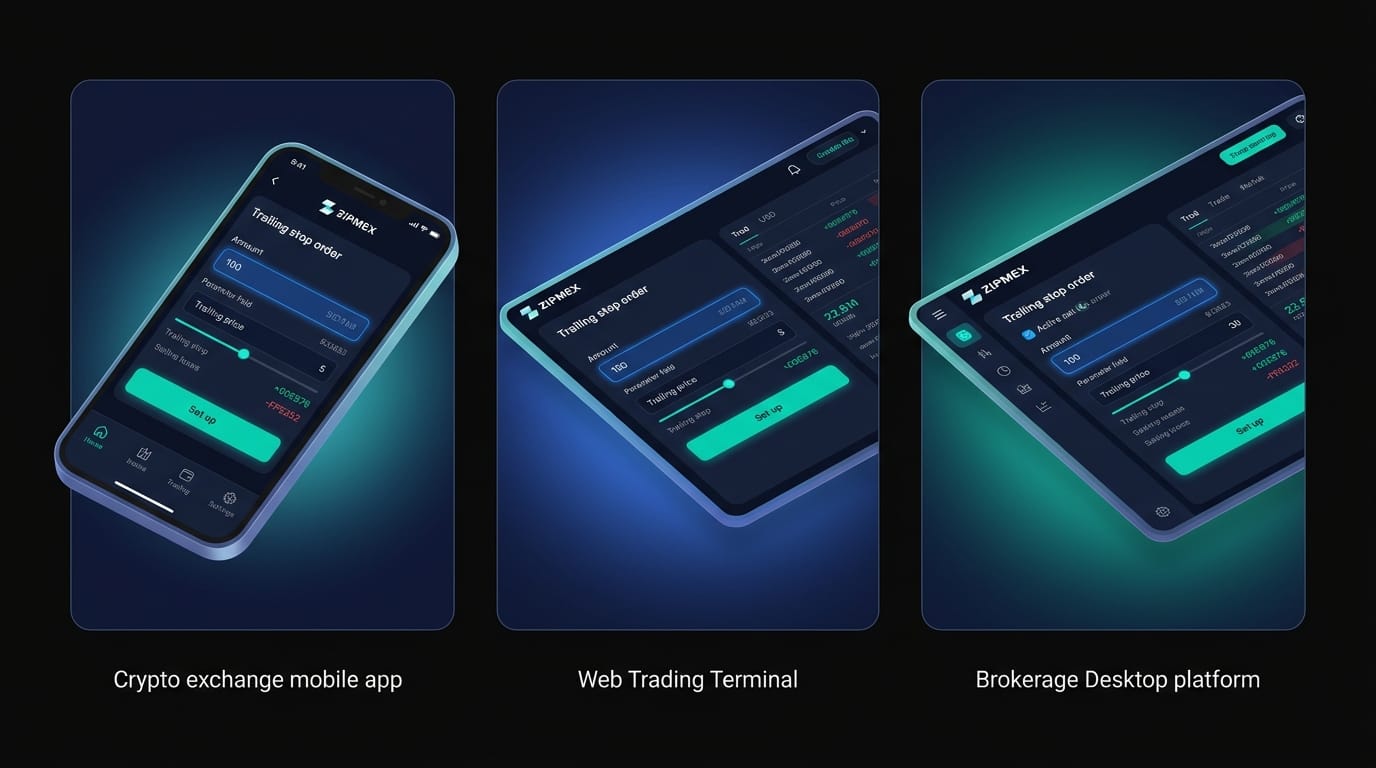
Setting up on Binance.US (web):
- Hover over Trade → click Spot Trading
- Select your trading pair
- Hover over Stop-Limit → select Trailing Stop from the dropdown
- Set Activation Price (optional), Trailing Delta (%), Limit Price, and Amount
- Click Buy or Sell to submit
Critical Binance.US note: The platform requires you to set a Limit Price in addition to the trailing delta. For sell orders, set the Limit Price below where the trailing delta will activate - this ensures your order fills even if price drops quickly.
Setting up on Kraken:
- Navigate to your trading pair on Kraken Pro
- In the order form, select Trailing Stop as order type
- Set Trailing Offset (% or fixed USD) and Quantity
- Submit - Kraken submits a market order when triggered, not a limit order
Setting up on Charles Schwab:
- Navigate to the trading ticket for your stock
- Select Trailing Stop from the order type dropdown
- Choose % of market price or $ amount below market
- Set duration: Day (expires at market close) or GTC (persists up to 180 days)
- Submit during regular market hours (9:30 AM - 4:00 PM ET)
Schwab trailing stops don't execute in pre-market or after-hours sessions - something crypto traders moving to equities frequently overlook.
Trailing Stop Strategy - How to Use Trailing Stops Effectively in Different Market Conditions
The biggest mistake I see traders make with trailing stops is treating them as a universal tool - placing them on every position regardless of market structure. A trailing stop is a trend-following instrument. In a trending market, it's one of the most effective exit tools available. In a choppy, sideways market, it will bleed you out with premature exits on perfectly normal noise.
The strategic principle is simple: trailing stops help you stay in the trade as long as the trend is intact, then exit automatically when it isn't. That requires matching your trailing offset to the asset's volatility regime, not picking an arbitrary round number like 5%.
Support, resistance, and moving averages all inform intelligent trailing stop placement. A trailing stop set just below a key moving average gives the trade room to test that level without exiting, while still closing the position if price breaks decisively lower. You can read more about managing crypto positions in volatile conditions.
Trailing Stop for Day Trading - Strategies and Best Practices
Day traders work in compressed timeframes where a 3% intraday swing is routine on volatile crypto assets. Set a trailing stop too tight - say 1.5% on a crypto pair that regularly swings 4% intraday - and you'll be stopped out of good trades repeatedly.
📊 3 Rules for Day Traders Using Trailing Stops
- Use ATR to set distance - calculate the 14-period ATR on your timeframe (1H or 4H) and set your trailing offset at 1.5. that value
- Widen stops in high-volatility sessions - during major news events or market open, ATR spikes; recalibrate accordingly
- Tighten or cancel near session close - if holding through close isn't your plan, tighten the trailing stop in the final 30 minutes or cancel and exit manually
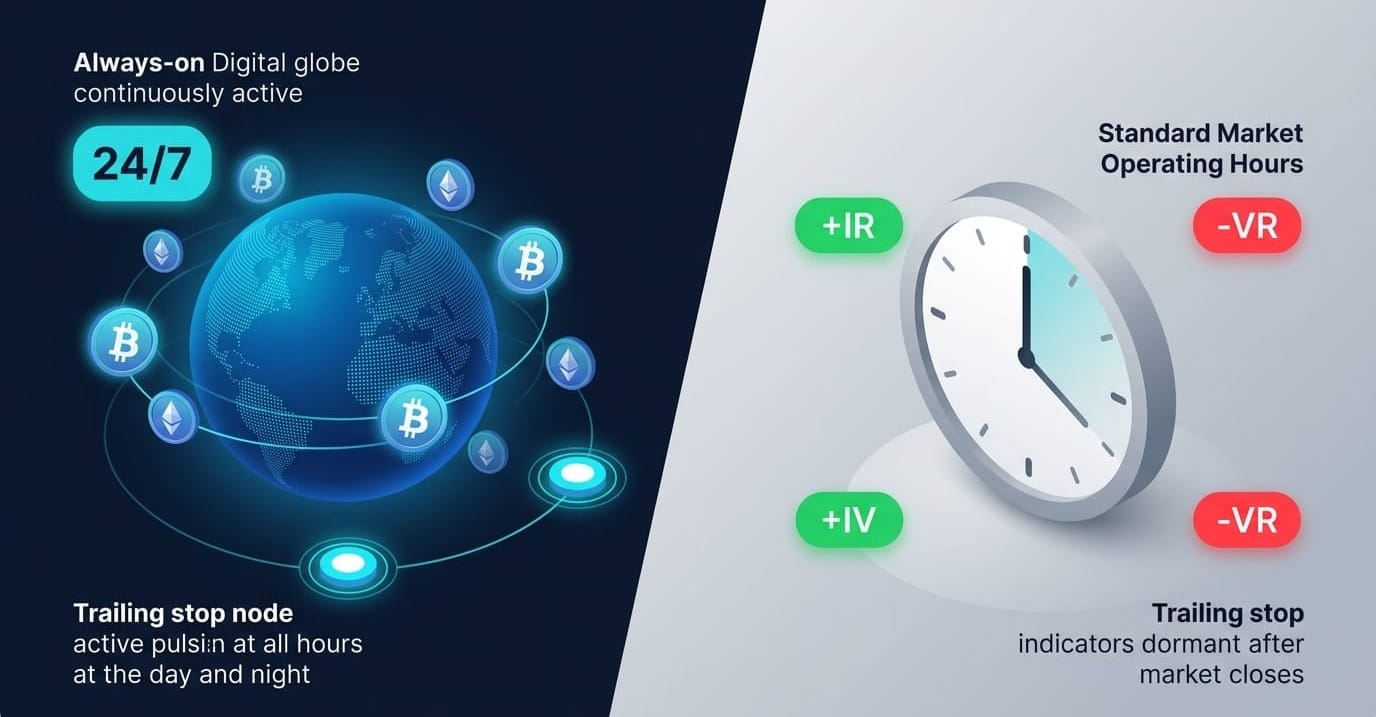
For crypto, the 24/7 market eliminates the session restriction problem that equity traders face. On Binance.US and Kraken, a trailing stop placed at 2 AM is just as active at 2 PM. A typical day trading trailing stop on a volatile crypto asset might use a 2-4% offset on an hourly chart, where the 14-period ATR reflects roughly 1.5-2.5% average candle ranges.
Trailing Stop for Swing Trading - Holding Winners Across Days and Weeks
Swing traders hold positions from days to weeks, capturing the meat of a price trend without trying to pinpoint exact tops and bottoms. Trailing stops are particularly well-suited here - they remove the need to monitor positions constantly while ensuring you exit automatically when the trend reverses.
The key distinction from day trading: swing traders use wider trailing offsets (typically 8-20%) and anchor the stop distance to technical structure rather than a fixed percentage. GTC (Good Till Canceled) orders are essential for swing traders. A Day order expires at market close - useless for a position you intend to hold for two weeks.
Practical swing trade example:
- Swing entry on ETH at $2,400
- 20-day EMA at $2,300 → initial trailing stop set 3% below EMA: $2,231
- ETH rises to $3,000; EMA rises to $2,850 → trailing stop now at $2,765
- ETH rises to $3,400; EMA rises to $3,200 → trailing stop now at $3,104
- ETH falls from $3,400 to $3,104 → trailing stop triggers → position exits near $3,104
You captured $700+ of the $1,000 move without checking the chart every hour. Anchoring the trailing stop to the moving average rather than a static percentage gives it technical validity - it exits when the trend structure itself breaks, not when noise hits an arbitrary threshold.
Trailing Stop for Trend Following and HODL Strategies - Maximizing Long-Term Gains
For trend followers and longer-horizon crypto traders, the trailing stop solves a specific problem: how do you stay in a multi-month bull run without getting shaken out by 20% corrections, while still having a defined exit when the trend definitively breaks?
The answer is a wide trailing offset - typically 20-30% for high-volatility crypto assets - combined with patience. This approach accepts that you won't exit at the exact top, but it guarantees you'll capture the majority of a major trend move.
Without the trailing stop, many holders watch a $70,000 gain compress to $15,000 during a bear market before finally capitulating. The trailing stop automates the exit at a disciplined level - on-chain or on an exchange, the logic is the same.
Trailing Stop vs Stop-Loss vs Stop-Limit - Key Differences Compared
Three order types, three different trade-offs. Getting this wrong is expensive.
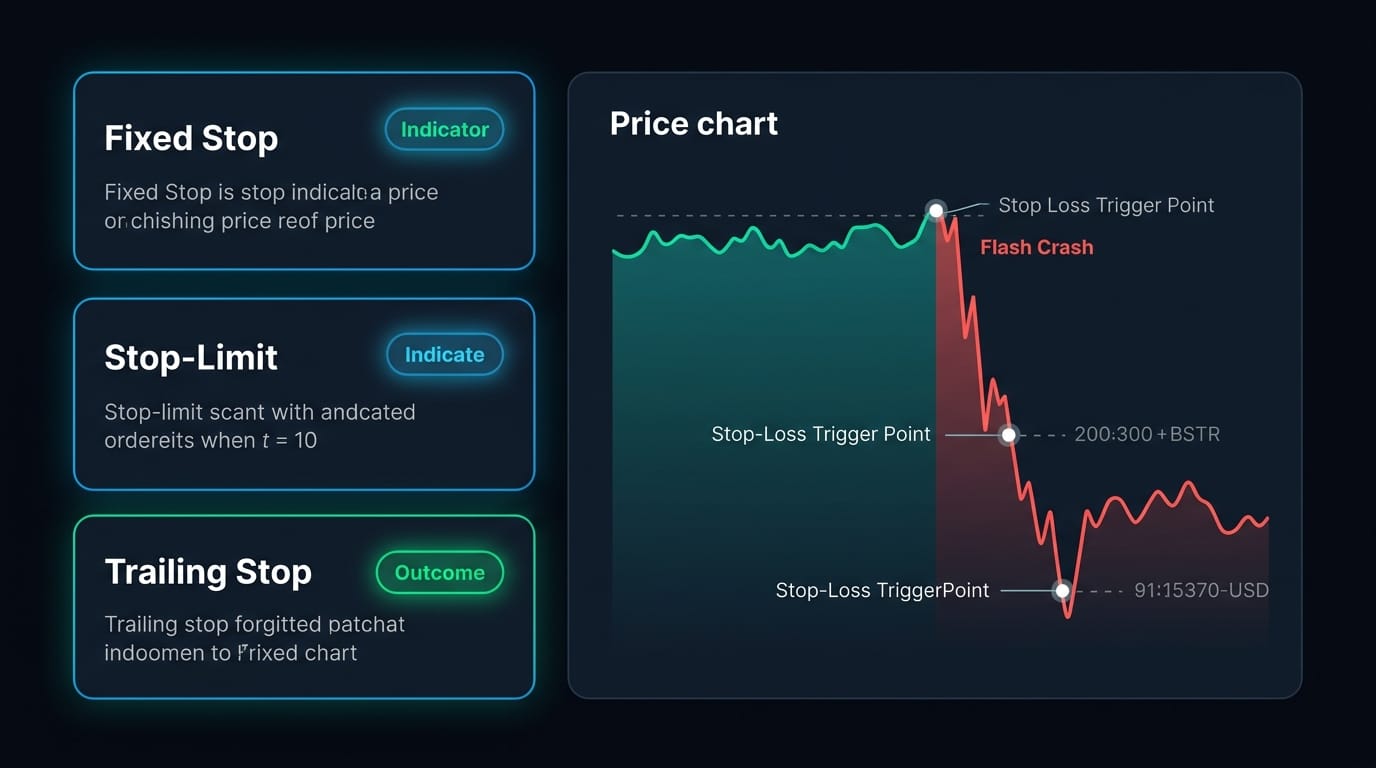
A fixed stop-loss is simple and reliable. Set it below a key support level, it fires as a market order, you're out. The problem: if price runs 50% above your entry, your stop-loss is still sitting at the original level. You're leaving gains unprotected.
A stop-limit guarantees your exit price - but not your exit. In fast-moving markets, particularly crypto flash crashes, price can gap straight through your limit level without filling. You set a stop-limit sell at $47,000 on BTC; price drops from $50,000 to $43,000 in three minutes. Your order triggers but never fills because no one bought at $47,000 on the way down.
A trailing stop solves the gap problem by submitting a market order - you will exit, just not necessarily at the trigger price. The trailing stop's combination of automatic adjustment and market-order execution makes it the most practical choice for trend-riding positions where protecting gains matters more than pinpointing the exact exit price.
Trailing Stop Risks and Common Mistakes - What to Watch Out For
Trailing stops are genuinely useful. They're also genuinely capable of costing you money when misapplied. Here's what actually goes wrong.
⚠ 5 Common Trailing Stop Mistakes
- Setting the offset too tight → triggers on normal volatility, not real reversals; use ATR to calibrate
- Using trailing stops in ranging markets → sideways price action hits stop thresholds repeatedly; switch to manual stops
- Ignoring gap risk → overnight gaps (stocks) or flash crashes (crypto) can execute far below your trigger price
- Setting Limit Price too close to trigger (Binance.US) → results in non-execution in fast markets; always leave a buffer
- Treating it as a complete risk strategy → trailing stops handle exits only; position sizing and entry selection still require separate management
Premature exits in choppy markets are the most common complaint. If an asset typically oscillates 4% around a mean without trending, a 3% trailing stop will trigger on multiple routine swings before the real move happens. Check the market structure before placing a trailing stop. If the asset has been ranging for two weeks, it's the wrong tool.
Slippage is real and unavoidable when a trailing stop triggers as a market order. In liquid markets - major crypto pairs, large-cap stocks - slippage is typically minimal (0.05-0.2%). In thin markets or during extreme volatility events, slippage can be substantial. Never assume you'll exit exactly at the trigger price.
Gap risk is the scenario most traders don't think about until it happens. On a stock, if the company reports earnings after hours and opens 15% lower, your trailing stop triggers at the open - potentially well below where you expected. On crypto, a flash crash can move price 20-30% in minutes. The ATR-based calibration approach helps: a stop set at 2. ATR typically only fires on genuine structural breaks.
When to Use Trailing Stops - and When to Avoid Them
✓ USE TRAILING STOP WHEN...
- Asset is in a clear uptrend or downtrend
- You're in a profitable position and want to protect gains
- You can't monitor the position actively
- Holding a trend-following or momentum position
- Running a swing trade or longer-term crypto position
✕ AVOID TRAILING STOP WHEN...
- Market is ranging sideways without direction
- Immediately before major news events (FOMC, earnings, crypto protocol upgrades)
- Trading low-liquidity assets where slippage would be severe
- The asset regularly gaps overnight
- You have a specific target price and want to exit there
The "avoid before major news events" rule deserves emphasis. A trailing stop sitting 5% below current price can be obliterated by a single earnings miss or surprise macro announcement. Either exit before the event, widen the stop significantly, or use a different hedging mechanism for event risk.
Trailing Stop in Crypto vs Stocks - Key Differences You Must Know
The trailing stop mechanics are the same across asset classes. The environment where they operate is not. Four critical differences shape how you should configure and use trailing stops depending on whether you're trading equities or crypto.
The volatility implication is significant. A 5% trailing stop that's appropriate for a large-cap stock will trigger constantly on Bitcoin's normal daily swings. According to CoinGecko, BTC has historically averaged 4-6% daily ranges in active market conditions. An altcoin in a momentum phase can swing 15-20% intraday. Calibrating trailing stops for crypto requires wider offsets - typically 10-25% for spot positions, or ATR-based calculation on the relevant timeframe.
The 24/7 nature of crypto markets is both an advantage and a risk. The advantage: your trailing stop works while you sleep. The risk: a flash crash at 3 AM executes at whatever price the market gives you, with no circuit breakers. On crypto exchanges, the trailing stop activation range (0.1%-20% on Binance.US) is specifically calibrated for crypto's wider price ranges.
Crypto futures traders need an additional layer of awareness. Leveraged positions amplify both gains and the consequences of trailing stop execution. A 5% adverse move on a 20x leveraged BTC futures position represents a 100% drawdown on margin. Trailing stop configuration on leveraged positions must account for the magnified effect - typically using smaller trailing offsets relative to the position size, and integrating the trailing stop with overall liquidation price awareness. For self-custodial platforms with on-chain execution, the trailing stop mechanism interacts directly with smart contract logic - understanding how your platform handles stop execution directly affects your actual exit price.
Conclusion - Putting Trailing Stops to Work in Your Trading Strategy
A trailing stop is not a trading strategy. It's an exit mechanism - one component of a complete risk management system that also requires disciplined position sizing, clear entry criteria, and honest market structure analysis.
Used correctly, it solves the hardest psychological problem in trading: knowing when to exit a winner. Set it once, calibrate it to the asset's volatility, and let it run. The position stays open as long as the trend is intact. When the trend breaks, the exit happens automatically without emotional interference.
BEGINNER TRADER
- Start with percentage-based stops on liquid assets (BTC, ETH, major stocks)
- Use 10-15% offsets - wide enough to survive normal volatility
- Stick to spot trading before applying to leveraged positions
INTERMEDIATE TRADER
- Layer in ATR-based calculations for volatility-aware calibration
- Combine with support/resistance analysis for technical placement
- Use GTC trailing stops for swing trades across multiple sessions
ADVANCED / CRYPTO TRADER
- Integrate into leveraged futures with explicit liquidation price awareness
- Consider 20-25% wide stops for trend-following positions in bull markets
- Understand your platform's on-chain execution model - it affects real exit prices
The automation angle is worth noting: trailing stops are a first step toward systematic trade management. Platforms built on self-custody and on-chain verifiability - where all mechanics are transparent and user-controlled - represent the direction crypto trading infrastructure is moving. Zipmex's approach to self-custodial perpetual futures reflects exactly this trajectory, giving traders direct control over their positions and exit mechanics without intermediary risk. For crypto traders building a structured approach to risk, understanding trailing stops positions you well for increasingly sophisticated automated exit tools as they become available.
The best time to configure your first trailing stop is before your next position opens, not after you're watching a gain evaporate.
Crypto trading and leveraged futures involve substantial risk of loss and are not appropriate for all investors. Trailing stop orders do not guarantee execution at a specific price. Past performance of any strategy does not guarantee future results. This content is for educational purposes only and does not constitute financial advice.
Last updated: March 2026
Frequently Asked Questions
What is a trailing stop order?
A trailing stop order is a dynamic exit order that automatically adjusts its trigger price as the market moves in your favor. For sell orders, the stop price follows the asset's price upward, maintaining a set distance - the trailing offset - below the highest price reached. When price reverses and falls by that offset amount from its peak, the order triggers and submits a market order to exit the position. Unlike a fixed stop-loss, a trailing stop locks in progressively more profit as the position gains, without requiring manual adjustment.
How does a trailing stop work?
When you place a trailing stop, you define the trailing offset - either as a percentage or fixed dollar amount. For a sell order, the system tracks the highest price reached after order placement. The trigger price is always calculated as: highest price minus trailing offset. If price rises, the trigger price rises with it. If price falls, the trigger price freezes at the level tied to the peak. When the current price reaches the trigger price, a market order executes. The key mechanic: the trailing stop only moves in your favor and never follows price lower.
What is the difference between a trailing stop and a stop-loss?
A fixed stop-loss is set at a static price when you enter a trade and remains there regardless of how much the asset gains afterward. A trailing stop is dynamic - it moves with the market, ratcheting upward as price rises, protecting an increasingly large portion of your unrealized gain. The practical difference: a fixed stop-loss protects you from initial losses; a trailing stop protects you from watching a large gain shrink back to entry or below. Both submit market orders on trigger, but only the trailing stop grows with your position.
What is ATR and how does it help set trailing stops?
Average True Range (ATR) measures an asset's average price movement over a defined period - typically 14 days or 14 bars on your chosen timeframe. It gives you an objective measure of the asset's normal volatility range. For trailing stop calibration, setting your offset at 1.5. to 2. the ATR places the stop outside routine price noise while remaining close enough to catch real reversals. A crypto asset with a 14-period ATR of 3% should have a trailing stop of at least 4.5-6%. ATR is available on virtually every trading platform and charting tool including TradingView.
Do trailing stops work in crypto markets?
Yes - trailing stops are available on major crypto exchanges including Binance.US and Kraken, and are well-suited to crypto's trending, volatile markets. Crypto's 24/7 trading eliminates the session restriction problem that equity traders face, meaning trailing stops remain active continuously. The wide volatility of crypto assets means trailing offsets should generally be wider than those used for stocks - typically 10-25% for spot crypto versus 3-7% for large-cap equities. Calibrate using ATR on your trading timeframe for the most volatility-adjusted setup.
When should you avoid using a trailing stop?
Trailing stops work best in trending, directional markets and can be counterproductive in ranging or sideways conditions. Avoid them immediately before major news events - FOMC announcements, earnings releases, or crypto protocol upgrades - where sudden gaps can execute far below your trigger price. Also avoid them on low-liquidity assets where slippage would be severe, and in consolidating markets where normal price oscillation regularly exceeds your trailing offset threshold. In these conditions, fixed manual stops or no automated stop at all is the more appropriate risk management approach.
What is the difference between a trailing stop and a stop-limit order?
A stop-limit order triggers at a set price and then submits a limit order at a specified price - guaranteeing the price but not the execution. In fast-moving markets, price can blow straight through the limit level without filling the order. A trailing stop submits a market order on trigger, guaranteeing execution at the best available price but not a specific price. For crypto markets prone to flash crashes and gap moves, the execution guarantee of a trailing stop's market order is generally safer than the price guarantee (with execution risk) of a stop-limit.