Azuki NFT is one of the most recognizable - and most debated - collections in Web3. A 10,000-piece anime-inspired series built on the Ethereum blockchain, it launched in January 2022 and sold out in under three minutes, raising over $29 million in a single Dutch auction. Since then, it's grown into a full ecosystem: companion collections, a native blockchain, a cryptocurrency token, and a genuine attempt to reshape the global anime industry.
If you're searching for what Azuki actually is - beyond the floor price speculation - this guide breaks down everything worth knowing.
⚡ Key Takeaways
- Azuki is a 10,000-piece anime-style NFT collection minted on the Ethereum blockchain, created by Chiru Labs in January 2022.
- Holders gain access to "The Garden," an exclusive community offering asset drops, live events, and brand collaborations.
- The Azuki ecosystem has expanded to include Beanz, Azuki Elementals, AnimeCoin (ANIME), AnimeChain, and Anime.com.
- The collection has faced notable controversies - including founder history and the Elementals backlash - which this guide covers honestly.
- Azuki's stated long-term goal is to build the infrastructure for "Anime 2.0," targeting over one billion global anime fans.
What Is Azuki? Definition and Core Concept
Azuki is a collection of 10,000 unique, anime-inspired profile picture (PFP) NFTs minted on the Ethereum blockchain. Each avatar is algorithmically generated from a combination of 12 distinct characteristics spanning 450 individual traits, placing every token somewhere on a rarity spectrum divided into four tiers: Human, Blue, Red, and Spirit. Spirit is the rarest, with only 97 in existence.
Beyond the art, the value proposition rests on community access. Every Azuki NFT serves as a membership key to "The Garden" - a private online collective for holders. That framing isn't accidental. Chiru Labs, the team behind Azuki, built the project on what they call a "brand-first" philosophy: develop a coherent identity, narrative, and cultural aesthetic before chasing external partnerships. The result is an NFT collection that reads less like a JPEG sale and more like a franchise launch.
The cultural DNA pulls from anime, Japanese streetwear, and skateboard culture. The project's informal motto - "skaters of the internet" - captures that blend of subculture credibility and digital-native positioning.
On the technical side, Azuki deployed the ERC-721A token standard, a contract improvement the team built specifically for this collection and subsequently open-sourced. Standard ERC-721 contracts charge gas for each individual token in a batch mint - ERC-721A restructures the contract logic to dramatically reduce that cost, charging near-equivalent gas whether you mint one token or ten. Other projects, including Antonym and TastyBones, adopted it. That uptake matters: it signals the Azuki team built something technically credible that benefited the broader NFT ecosystem, not just their own launch.
Who Created Azuki? The Chiru Labs Team
Chiru Labs is the Los Angeles-based studio behind Azuki. The founding team combined experience from big tech - Facebook among the companies on that list - with backgrounds in crypto, game design, and professional art direction.
The key public figure is ZAGABOND, the pseudonymous co-founder who acts as the project's creative and strategic lead. His cryptic tweets and Instagram posts drove much of the early community engagement - a deliberate communication style that blurred the line between hype and genuine mystique. Most other co-founders remain pseudonymous.
The credentialed exception is Arnold Tsang - former Character Art Director at Blizzard Entertainment. His involvement explains why Azuki's character artwork met a quality bar that most generative NFT projects couldn't touch. Where many PFP collections revealed underwhelming traits post-mint, Azuki delivered on the visual promise.
The team's approach to development deserves mention too. Unlike most NFT projects that publish aggressive roadmaps and then struggle to execute, Azuki deliberately avoided hard timelines. No public deadline means no public failure when things take longer than expected. That restraint drew criticism from users wanting concrete promises - but it also protected the project from the kind of disappointment that collapsed Cool Cats' floor price when their delayed game release alienated their community.
The team's diverse pedigree helps explain Azuki's unusually polished execution - but it also makes the controversies that followed all the more striking.
How Azuki Works: Blockchain Mechanics
An NFT - non-fungible token - is a unique digital asset whose ownership is recorded on a blockchain. Unlike a regular cryptocurrency (where every unit of ETH is identical to every other unit), each NFT is distinct. Owning one means holding a specific, verifiable entry in a public ledger that no single party controls.
Azuki NFTs live on the Ethereum blockchain, governed by smart contracts - self-executing code that handles ownership transfers, royalty splits, and marketplace interactions without requiring a middleman. When you buy an Azuki on a marketplace like OpenSea or Blur, the smart contract updates the ownership record on-chain. That record is permanent and publicly auditable.
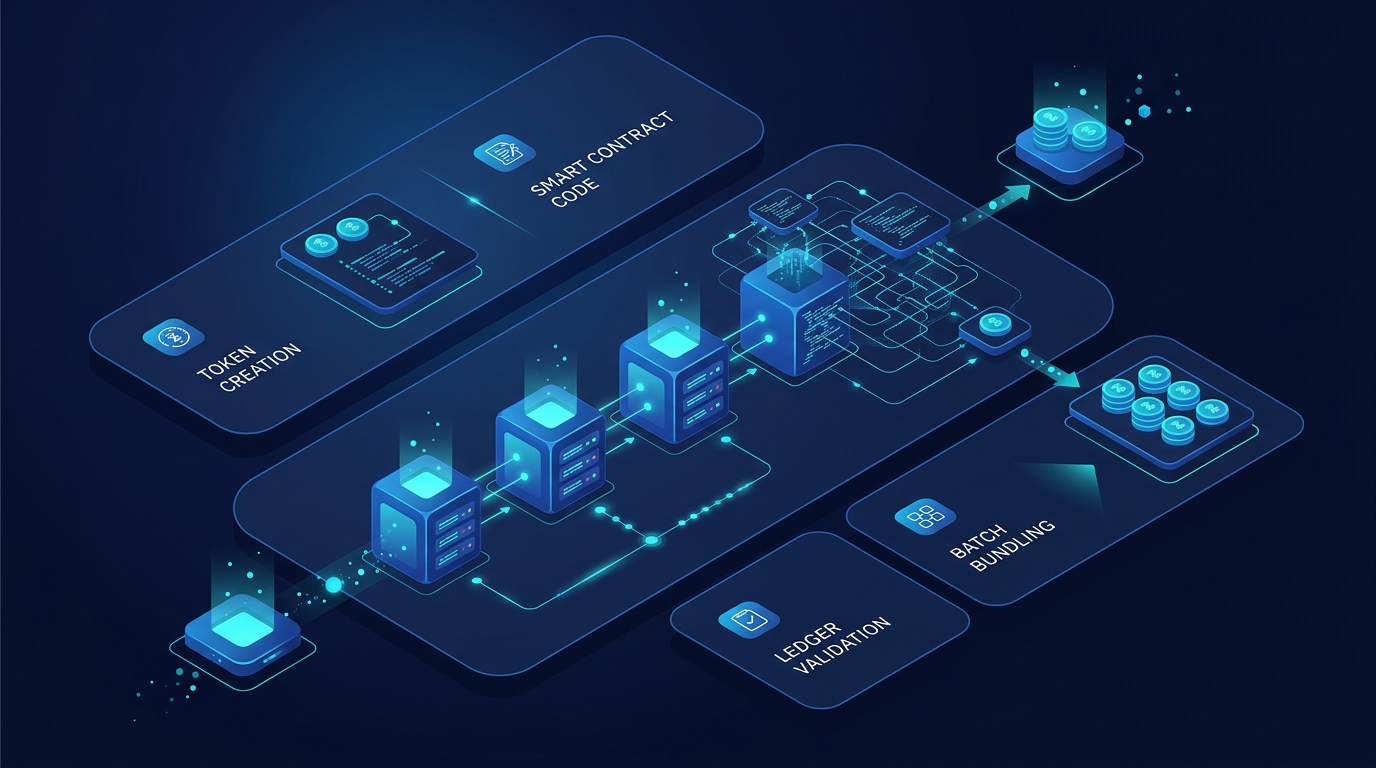
The ERC-721A standard that Azuki built operates on this same infrastructure but solves a cost problem: batch minting under the original ERC-721 standard was expensive because each token required a separate storage update. ERC-721A defers those writes, bundling them efficiently. For collectors minting multiple tokens at once, the savings are material.
HOW AZUKI NFT OWNERSHIP WORKS
Step 1
Set up Ethereum wallet (e.g., MetaMask)
Step 2
Fund wallet with ETH
Step 3
Connect wallet to marketplace (OpenSea, Blur)
Step 4
Find and purchase Azuki NFT
Step 5
Transaction confirmed → ownership recorded on-chain
Step 6
NFT appears in your wallet; ownership is permanent and verifiable
With its technical foundation set, Azuki's growth story is unlike most NFT projects - starting with a record-breaking mint that no one saw coming at that scale.
The Azuki Ecosystem: Collections and Lore
Azuki isn't a single collection anymore. Over four years, Chiru Labs built out a layered universe - multiple NFT collections, a companion token, a dedicated blockchain, and an entertainment platform - each piece designed to expand community touchpoints without diluting the exclusivity of the original 10,000.
Understanding the full ecosystem matters whether you're evaluating a purchase or just trying to follow what "Azuki" means when it comes up in conversation.
AZUKI ECOSYSTEM MAP
Genesis
Azuki Genesis (10,000)
Companion
Beanz (19,928) - companion collection
Expansion
Azuki Elementals (20,000) - second major collection
Token
AnimeCoin (ANIME) - ecosystem token (launched Jan 2025)
Infrastructure
AnimeChain - Layer 3 blockchain on Arbitrum
Platform
Anime.com - consumer anime platform (launched Sep 2024)
Azuki Genesis Collection
January 12, 2022. The collection launched using a Dutch auction format - prices start high and decline at set intervals, letting the market find equilibrium rather than setting an arbitrary fixed price. The initial price was 1 ETH. It didn't stay there long. The 8,700 available tokens sold out in under three minutes, with the whitelist filling the rest.
Total raised: 8,700 ETH - worth over $29 million at the time.
Secondary market trading followed immediately. Within weeks, Azuki NFTs exceeded $300 million in total trading volume, with the floor price climbing into double-digit ETH territory. Lifetime volume has since surpassed $1.15 billion, placing the collection in the top four on DappRadar's all-time NFT ranking.
The Dutch auction format was itself a strategic choice. By letting the price discover naturally, the team captured maximum treasury funding - those funds went into a development vault rather than sitting idle post-mint. It was an industry-first approach executed at scale, and the market rewarded it.
Beanz - The Companion Collection
April 2022. Chiru Labs airdropped Beanz - a 19,928-piece companion collection - directly to Azuki holders. No purchase required. Each Beanz token is a quirky, bean-shaped character (a nod to "azuki," a type of Japanese red bean) that complements rather than competes with the original avatars.
Beanz served two strategic purposes. First, they rewarded existing holders with additional utility and tradeable assets. Second, they lowered the barrier to entry - Beanz floor prices have consistently run below Azuki genesis prices, letting fans who can't afford a genesis token participate in the ecosystem.
The Bobu experiment stands out as an early example of community governance on-chain. The team fractionalised a single team-owned Azuki (token #40, named Bobu) into 50,000 governance pieces. Holders voted on decisions about Bobu's character development - merchandise, storylines, visual updates. At a mint price of 0.01 ETH with a one-per-wallet limit, participation was deliberately accessible.
Azuki Elementals and AnimeChain
June 2023. Chiru Labs launched Azuki Elementals - 20,000 NFTs tied to the four classical elements: earth, water, fire, and air. Each comes with a distinct set of traits drawing from mythological aesthetics.
The mint didn't go smoothly. No maximum minting limits meant that Azuki and Beanz holders collectively claimed the entire supply before public access opened. Buyers who expected a fresh visual direction got characters that closely echoed what they already knew. Refund demands totalled over $38 million.
AZUKI ECOSYSTEM TIMELINE
Jan 2022
Azuki genesis mint ($29M+ raised in minutes)
Apr 2022
Beanz airdrop to holders
May 2022
ZAGABOND controversy (past projects revealed)
Apr 2023
LINE FRIENDS / IPX partnership announced
Jun 2023
Azuki Elementals launch (community backlash)
Sep 2024
Anime.com revealed + AnimeChain private launch
Jan 2025
AnimeCoin (ANIME) token launched on Ethereum + Arbitrum
AnimeChain is a Layer 3 blockchain built on Arbitrum, currently in staged rollout as of this writing. Its purpose is purpose-built infrastructure for anime-native applications: original content, third-party studio integrations, games, merchandise, and NFTs.
AnimeCoin (ANIME) launched in January 2025 on both Ethereum and Arbitrum, with initial airdrops distributed to HYPE stakers and ecosystem participants.
Anime.com went public in September 2024, introducing new Azuki mascots Ayame and Decky alongside a public waitlist. The platform is designed as a consumer-facing anime hub targeting over one billion global fans.
What Do Azuki NFT Holders Get? Benefits and Utility
The practical question prospective buyers ask first: what does holding an Azuki NFT actually give you?
Early criticism of the project - and it was fair - pointed to limited tangible utility in the first year. Discord access and a Los Angeles party don't justify a five-figure price tag for most buyers. Chiru Labs acknowledged this directly, arguing that brand-building was the priority and that utility would follow once the foundation was solid. Whether that argument satisfies you depends on your own risk tolerance.
As of 2026, the ecosystem has matured considerably. Here's what holders currently receive:
Core Member Benefits:
- The Garden access - exclusive online community with private channels, early announcements, and direct engagement with the Chiru Labs team.
- Exclusive asset drops - NFT drops, digital collectibles, and merchandise distributed to holders ahead of or instead of the public.
- Holder-only live events - in-person gatherings, conference activations, and premiere events (the EtG Tokyo premiere was a holder event first).
- Streetwear and brand collaborations - partnerships with labels and brands where holders receive first access or exclusive merchandise runs.
- AnimeCoin (ANIME) eligibility - holders were part of the airdrop distribution network when ANIME launched in January 2025.
- Community governance - through mechanisms like Bobu, holders participate in decisions about character and brand development.
- Dynamic Billboard feature - Azuki holders can display their NFTs on digital billboards within the ecosystem.
- Creative community programs - events like "Mizuki Month" reward submitted artwork and animations with prizes and recognition.
The creative ecosystem adds a layer most PFP collections don't offer. Collectible mints on projects like "Azuki Mizuki Anime Shorts" direct sale proceeds back to the creators involved.
Azuki and the Anime Industry: The Bigger Vision
Most NFT projects pitch a roadmap. Few execute at scale. Azuki's stated goal - creating "Anime 2.0" via AnimeCoin and the broader ecosystem - sounds grandiose until you look at the production record.
In 2024, Azuki premiered Enter the Garden (EtG) Episode 1: The Waiting Man in Tokyo. The episode accumulated over 8 million views globally. That's not an inflated Web3 metric - it's mainstream reach for a project-funded anime production competing at studio quality.
The partnership with Dentsu - Japan's largest advertising agency - extends this ambition into markets that community-driven Web3 growth couldn't reach independently.
Azuki also runs charity initiatives: a genga (animation sketch) auction raised $5,800 for St. Jude Children's Research Hospital, and the project donated $100,000 to California wildfire relief.
None of this guarantees that Anime 2.0 lands at mainstream scale. The gap between Web3 ambition and mainstream entertainment adoption remains real. But Azuki has demonstrated something rare: they can actually ship content worth watching.
Azuki Controversies and Risks
Credibility requires honesty. Two controversies have meaningfully shaped Azuki's reputation, and any guide that glosses over them isn't giving you the full picture.
The ZAGABOND Controversy (May 2022)
In May 2022, it emerged publicly that ZAGABOND had previously led three NFT projects - Tendies, CryptoZunks, and CryptoPhunks - all abandoned without completing their stated objectives. For a community that had paid significant sums for Azuki, the revelation triggered immediate fear.
The Elementals Controversy (June 2023)
Azuki Elementals minted and immediately attracted criticism on two fronts: no minting limits meant the public never accessed the collection, and the character designs were widely perceived as too similar to the original collection. Refund demands exceeded $38 million.
⚠ Risk Factors for Prospective Buyers
- NFT market volatility → floor prices can move 50%+ in either direction over short periods; past performance carries no predictive value.
- Speculative asset class → PFP NFT value is substantially driven by community sentiment and narrative, not intrinsic utility.
- Concentration risk → significant investment thesis depends on Chiru Labs' ability to execute Anime 2.0 and AnimeChain over a multi-year horizon.
- Liquidity risk → in bear market conditions, the number of active buyers shrinks, making exits at target prices more difficult.

How to Buy Azuki NFTs: Step-by-Step
Azuki NFTs trade on secondary marketplaces. The original collection sold out in 2022, so every purchase today happens peer-to-peer on platforms like OpenSea or Blur.
Step 1: Set up an Ethereum wallet like MetaMask. Store your seed phrase offline.
Step 2: Acquire ETH. Purchase Ethereum and transfer it. Account for gas fees on top of the NFT price.
Step 3: Connect to a marketplace like OpenSea or Blur.
Step 4: Find the official Azuki collection. Look for the blue verified checkmark.
Step 5: Browse and purchase.
Step 6: Confirm in your wallet.
Azuki Alternatives: Similar NFT Collections to Know
Azuki sits in a competitive landscape of blue-chip PFP NFT collections. Understanding where it fits helps clarify what makes it different.
Conclusion - Is Azuki Worth Your Attention in 2026?
Different readers land on this guide for different reasons. Here's what the picture looks like depending on who you are.
If you're a crypto-native collector evaluating blue-chip NFT exposure: Azuki has the volume history, ecosystem depth, and track record that distinguish genuine projects from ones that faded after their mint.
If you're an anime fan curious about Web3: Azuki is building something with direct relevance to the medium you care about. Enter the Garden proves they can make content worth watching, not just content worth minting.
If you simply searched "what is Azuki": It's a 10,000-piece anime-inspired NFT collection on Ethereum, created by Chiru Labs in 2022. Holders get access to an exclusive community (The Garden), asset drops, live events, and the AnimeCoin (ANIME) ecosystem.
Where Azuki's trajectory leads - toward a decentralized model where community members are stakeholders in the anime content they love - points to a broader shift in digital entertainment ownership. Platforms built on on-chain verifiability and genuine user control represent a fundamentally different relationship between creators, fans, and capital.
Frequently Asked Questions
What is Azuki NFT?
Azuki NFT is a collection of 10,000 unique, anime-inspired digital avatars built on the Ethereum blockchain. Created by Chiru Labs and launched in January 2022, each token serves as a membership pass to "The Garden" - an exclusive holders-only community.
Who created Azuki?
Azuki was created by Chiru Labs, a Los Angeles-based studio founded by a team with backgrounds in big tech, game development, and professional art. The public-facing co-founder is ZAGABOND, alongside Arnold Tsang, former Character Art Director at Blizzard Entertainment.
How many Azuki NFTs exist?
The original Azuki genesis collection consists of exactly 10,000 unique tokens. The broader ecosystem includes Beanz (19,928 pieces) and Azuki Elementals (20,000 pieces).
What blockchain is Azuki on?
Azuki NFTs are built on the Ethereum blockchain, using the ERC-721A token standard developed by Chiru Labs. AnimeChain, their dedicated Layer 3 blockchain, is built on Arbitrum.
What is AnimeCoin (ANIME)?
AnimeCoin (ANIME) is the native cryptocurrency of the Azuki ecosystem, launched on Ethereum and Arbitrum in January 2025. The token functions as the governance and utility layer for AnimeChain and the Anime.com platform.
Is Azuki a rug pull?
Based on available evidence, no. Azuki has operated continuously since January 2022, expanded its ecosystem substantially, produced verifiable anime content, launched the ANIME token, and built dedicated blockchain infrastructure.