Chainlink is the decentralized oracle network that connects smart contracts to real-world data - and in 2026, it has become the infrastructure layer underpinning trillions of dollars in on-chain financial activity. If you've spent any time in DeFi, you've interacted with Chainlink whether you realized it or not. Understanding what it does, how LINK tokens fit in, and where this technology is heading is fundamental crypto knowledge at this point.
This guide covers oracle mechanics, the LINK token's utility, Chainlink's institutional integrations, how to acquire LINK, and an honest look at the risks.
⚡ Key Takeaways
- Chainlink is the industry-standard decentralized oracle network connecting blockchains to external data and systems
- LINK is its native ERC-20 token, used to pay for oracle services, stake as node collateral, and participate in governance
- Chainlink powers DeFi, cross-chain applications, and tokenized institutional assets - used by Swift, Aave, JPMorgan, and many others
- Current LINK price sits around $9, with a market cap of approximately $6.5B (ranked ~#17) by market cap
- The network has secured over $28 trillion in total transaction value - making it one of the most battle-tested crypto infrastructure projects in existence
What Is Chainlink? The Oracle Problem Explained
Blockchains are remarkably good at one thing: verifying what happens on-chain. A transaction occurred, a wallet holds X tokens, a smart contract executed - all of that is cryptographically verifiable by anyone. What blockchains cannot do natively is reach outside their own walls to pull in information from the real world. This isn't a bug; it's by design. Immutability and determinism require that the chain only process what's already been agreed upon by the network.
That limitation creates a serious problem the moment smart contracts try to do anything financially meaningful. A lending protocol needs to know the current price of ETH to determine whether a position is undercollateralized. A parametric insurance contract needs weather data to trigger a payout. A derivatives platform needs an accurate BTC/USD feed to settle positions correctly. Without a reliable way to pipe this information onto the chain, smart contracts are limited to shuffling tokens around - powerful, but nowhere near their full potential.
This is the Oracle Problem: how do you get off-chain data onto a blockchain in a way that's as trustworthy as the chain itself? A single centralized data source - one company providing prices, one API call - defeats the entire point. If the data source lies, gets hacked, or goes offline, your "trustless" smart contract executes based on false inputs. The trustlessness you paid for with blockchain architecture evaporates the moment a centralized oracle enters the picture.
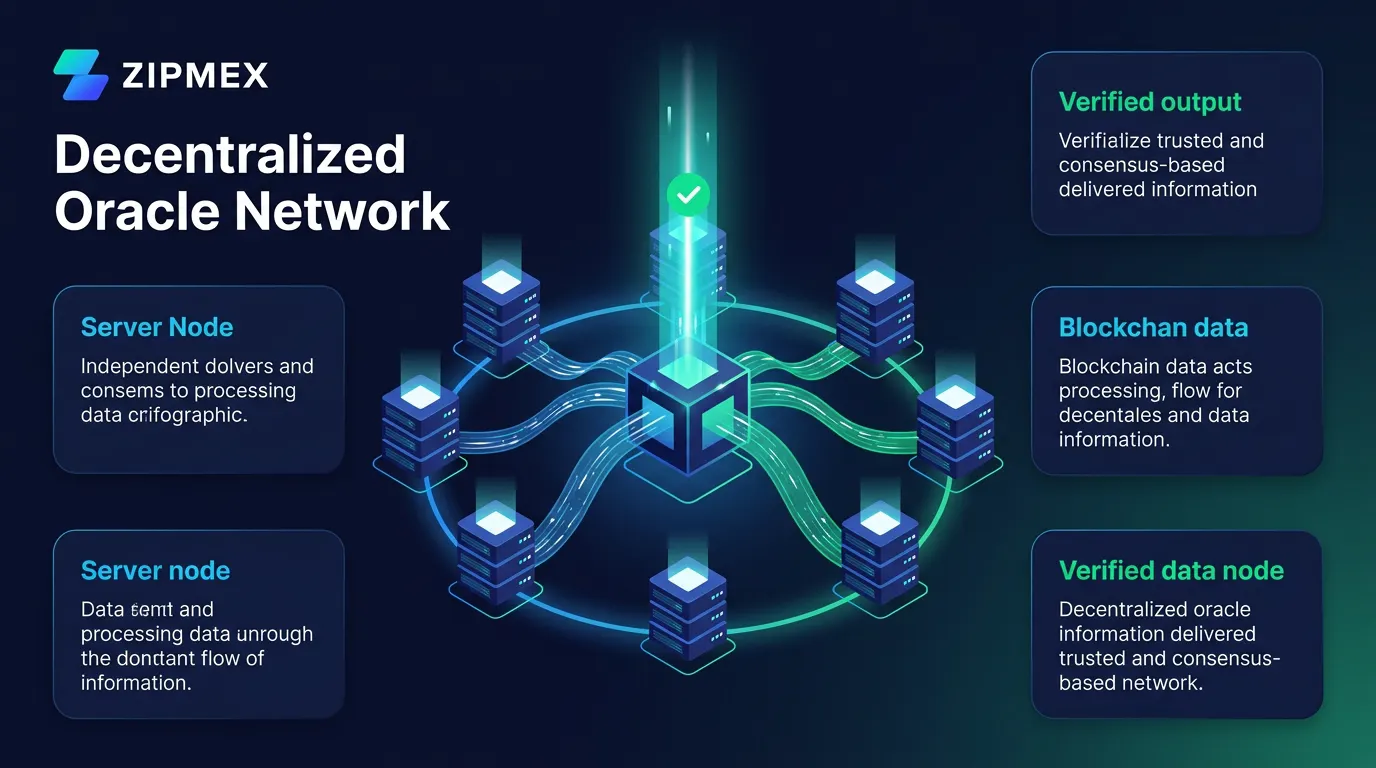
Chainlink solves this by replacing centralized data feeds with Decentralized Oracle Networks (DONs) - independent networks of node operators that retrieve data from multiple sources, reach consensus, and deliver a single validated answer on-chain.
How Chainlink Works: Nodes, Aggregation & Consensus
When a smart contract needs external data, here's exactly what happens:
- The smart contract sends a data request - this is called a Requesting Contract. It specifies what data is needed and what it's willing to pay.
- Chainlink registers the request as an event and creates a corresponding Chainlink SLA (Service Level Agreement) Contract on-chain.
- Three sub-contracts are generated from the SLA Contract to manage the process:
- Reputation Contract - checks each oracle node's historical performance, reliability, and stake size. Unreliable nodes are filtered out before data retrieval begins.
- Order-Matching Contract - delivers the data request to eligible Chainlink nodes, accepts their bids, and selects the optimal set of nodes to fulfill the request.
- Aggregating Contract - collects responses from all selected nodes, validates them, and reconciles the data into a single trustworthy result.
- Each selected node runs Chainlink Core software - middleware that translates the on-chain request into a format external data sources can understand, fetches the data, and translates the response back into on-chain language.
- The Aggregating Contract validates the responses - if seven nodes return a BTC price of $95,800 and two return $12,000, those outliers are flagged as faulty (or potentially malicious) and discarded. The aggregate of the valid responses becomes the final data point.
- The validated data is delivered to the original smart contract, which can now execute correctly based on real-world inputs.
Node operators aren't anonymous entities running consumer hardware. Chainlink's DONs include institutional infrastructure providers: Deutsche Telekom, Swisscom, Vodafone, and Infura are among the node operators securing real data pipelines. That's a meaningful trust signal - these are regulated telecommunications and infrastructure firms with reputations to protect.
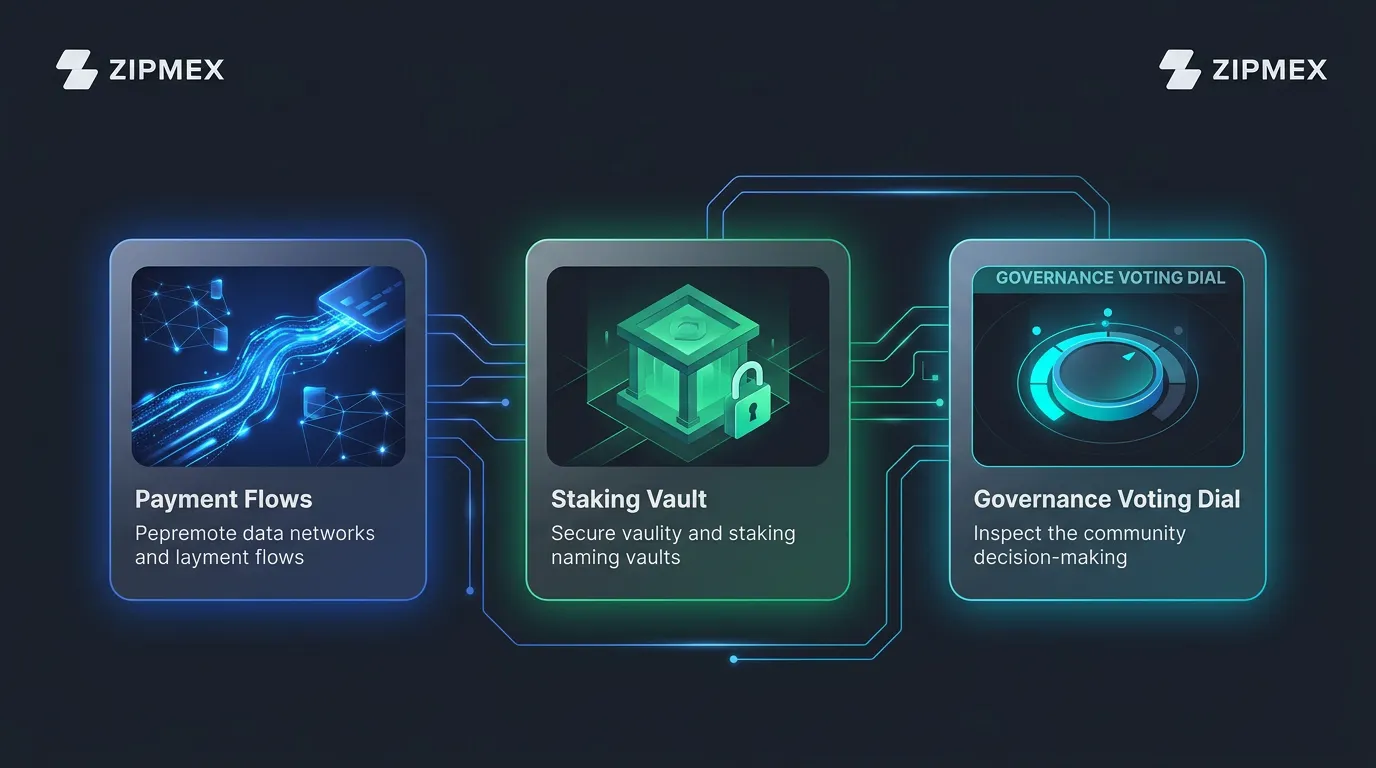
The LINK token flows through this entire process: Requesting Contract holders pay node operators in LINK for their services, and node operators stake LINK as collateral to signal commitment. Poor performance triggers slashing - nodes lose a portion of their staked LINK, which aligns incentives toward accuracy.
Chainlink's Core Services: Data Feeds, CCIP, VRF & More
Chainlink has expanded well beyond a single data feed service. The platform now offers a full suite of products:
CCIP deserves particular emphasis in 2026. It's no longer just an oracle network feature - it's become the interoperability backbone for institutional tokenized finance. According to Chainlink's official network data, CCIP is already processing approximately $18 billion in monthly cross-chain volume, with JPMorgan and UBS running live blockchain settlement pilots directly on Chainlink infrastructure. The bridge between traditional finance and DeFi runs on CCIP.
What Is the LINK Token and What Is It Used For?
LINK is an ERC-20 token on Ethereum with a maximum supply of 1 billion tokens and approximately 730 million currently in circulation. At around $9 per token, the market cap sits near $6.5 billion - placing it around #17 globally. The all-time high was $52.70.
Beyond price action, LINK has three functional roles in the Chainlink ecosystem:
1. Payment for oracle services
When a smart contract (the Requesting Contract) needs data, it pays node operators for their work in LINK tokens. Prices are set by node operators based on data demand and current market rates - it's a competitive marketplace for oracle services, not a fixed fee structure.
2. Staking collateral
Node operators must stake LINK with the Chainlink network to participate. This stake serves as skin in the game: nodes with larger stakes are prioritized for data requests (and earn more LINK in return), while nodes that deliver inaccurate or malicious data face slashing - losing a portion of their staked LINK as a penalty. Chainlink Staking v0.2 is currently open for general access. It moved away from the old fixed-rate reward model toward a flexible reward design intended to support multiple reward sources over time.
3. Governance participation
LINK holders can participate in governance decisions that shape the strategic direction of the Chainlink protocol.
One thing worth understanding clearly: LINK's value is structurally tied to Chainlink network usage. More oracle requests, more CCIP transactions, more protocols paying for data feeds - all of this drives demand for LINK. In September 2024, the U.S. SEC and CFTC classified LINK as a digital commodity, which reduces the regulatory ambiguity that has historically weighed on many altcoins.
Staking is not passive income in the casual sense. It requires self-custody, active on-chain management, Ethereum gas costs, and a clear understanding that reward rates vary. For long-term LINK holders already comfortable with wallet security, staking can make sense. For anyone not yet comfortable with self-custody mechanics, it adds operational complexity that deserves careful consideration first.
Who Uses Chainlink? Real-World Integrations & Institutional Adoption
According to Chainlink's on-chain data, the network has secured over $28 trillion in total value enabled across its oracle network - that's not a theoretical figure, it's on-chain verifiable transaction volume. Here's who's building on it:
The DeFi side of this is well-established. What's newer - and more significant for 2026 - is the institutional column. CCIP is the enabling layer here: it allows a smart contract on one blockchain to receive data from and settle against systems on another chain or even a traditional financial messaging network like SWIFT.
Coinbase is using Chainlink's DataLink service to push real-time order book, perpetuals, and futures data directly on-chain for DeFi protocols. FTSE Russell has integrated with Chainlink to bring its equity indices on-chain. Brazil's Drex CBDC pilot used Chainlink's infrastructure to connect its digital currency network with Hong Kong's Ensemble platform - a cross-border CBDC interoperability test using CCIP as the bridge.
This isn't DeFi infrastructure pretending to be institutional. It's institutional infrastructure running on DeFi rails.
How to Buy Chainlink (LINK): Step-by-Step for Beginners
LINK is available on virtually every major crypto exchange. The buying process is straightforward:
Step 1: Choose an exchange
Coinbase, Binance, and Kraken all list LINK with solid liquidity. Check that the exchange operates in your jurisdiction before creating an account.
Step 2: Create and verify your account
Standard KYC (identity verification) is required on regulated exchanges - this typically means providing a government-issued ID and proof of address. Verification usually completes within minutes to a few hours.
Step 3: Deposit fiat currency
Fund your exchange account via bank transfer, debit card, or other supported methods. Each exchange has different processing times and fees - check their fee schedule directly.
Step 4: Buy LINK
Search for LINK/USD (or LINK/USDT if you're depositing stablecoins). Place a market order for immediate execution at the current price, or a limit order if you want to set a specific entry price.
Step 5: Decide where to hold it
For small active positions, leaving LINK on the exchange is convenient. For larger holdings or long-term storage, withdrawing to a self-custody wallet is the more secure approach. MetaMask supports LINK natively as an ERC-20 token. Hardware wallets (Ledger, Trezor) remain the gold standard for significant holdings.
⚠ Critical Note on Withdrawals
- Wrong withdrawal network → permanent, unrecoverable loss of funds
- LINK is ERC-20 on Ethereum → always confirm the network before withdrawing from any exchange
- Multi-network exchanges (Binance, OKX) → extra caution required - verify destination wallet network first
How to Evaluate Chainlink: Key Metrics, Risks & Considerations
Nothing in this section constitutes financial advice. Crypto markets carry substantial risk of loss, and LINK is no exception to that reality.
Evaluating any crypto infrastructure project means separating genuine utility from narrative. Chainlink is unusual in that both are exceptionally strong - which also makes it important to look at where the friction points actually exist.
Chainlink Metrics That Matter: TVE, Fees & On-Chain Activity
Chainlink publishes its own core metric: Total Value Enabled (TVE) - the cumulative USD value of transactions that used a Chainlink oracle at some point in their execution. It's the oracle network's equivalent of transaction volume, and it measures real usage, not speculative positioning.
The divergence between network fundamentals and token price is one of the more analytically interesting aspects of LINK in 2026. The protocol is generating real revenue - approximately $75 million annualized from oracle services and CCIP fees. The network is securing more total value than ever. Yet the token trades roughly 83% below its all-time high. That gap could reflect undervaluation or simply the reality that markets move on different timelines than utility curves. Historically, that kind of divergence has preceded re-ratings - but it's not an assurance of any particular outcome.
Chainlink vs Competitors: Oracle Landscape Comparison
Chainlink is dominant, but it isn't the only oracle network. Here's an objective comparison:
Pyth Network deserves a serious mention - its direct publisher model produces faster data with lower latency, which is why several perpetual DEXs have integrated it alongside or instead of Chainlink for their price feeds. API3's first-party model is architecturally interesting: if the data provider itself runs the oracle, you eliminate the middleman and the associated trust assumption. Neither has come close to matching Chainlink's institutional footprint or DeFi integration depth, but both serve specific niches well.
Chainlink's moat is deepest in institutional-grade, high-stakes applications where the cost of data failure is catastrophic. For lighter, faster, cheaper use cases, the competitive pressure is real.
Chainlink Risks and Red Flags: What to Watch Out For
Like any blockchain infrastructure project, Chainlink carries specific risks that every participant should understand before engaging.
1. The "is LINK necessary?" tokenomics question
This is a legitimate critique, not FUD. Some analysts argue that node operators could theoretically be compensated in ETH or stablecoins rather than LINK, which would undermine the token's value accrual. Chainlink's counter-argument is that staking LINK as collateral creates skin-in-the-game for node operators - without the stake-and-slash mechanic, operators have weaker incentives to maintain data accuracy. Whether that's sufficient to sustain long-term LINK demand at scale is a reasonable open question.
2. Smart contract risk
All blockchain-based systems carry smart contract exploit risk. Chainlink's security score on independent auditing platforms sits at approximately 86%, and the protocol is covered by an active bug bounty program on Immunefi. That doesn't make it invulnerable - it means known risks have been systematically reviewed.
3. Market volatility
LINK dropped from its all-time high of $52.70 to approximately $9 - roughly an 83% drawdown. That trajectory is consistent with high-beta altcoins during market cycle downturns, and it's important to hold that reality clearly alongside any narrative about network fundamentals. Strong utility doesn't protect token prices from macro-driven sell-offs.
4. Organizational centralization
While Chainlink's DON architecture is decentralized, Chainlink Labs as an organization still exerts meaningful influence over protocol direction, partnerships, and development priorities. The degree to which this concentration matters depends on your personal trust model.
5. Regulatory risk
The SEC/CFTC commodity classification is a positive development. But broader regulatory changes in crypto markets - particularly around DeFi infrastructure and cross-border digital asset flows - could create friction for Chainlink's expansion into institutional finance, especially in jurisdictions without clear crypto regulatory frameworks.
Understanding these risks prepares you to use Chainlink strategically - here's how the network is actually being deployed in practice.
How to Use Chainlink: Developer Integration & Strategic Applications
Chainlink serves different users in fundamentally different ways. For developers and protocols, it's infrastructure. For DeFi participants, it's the reliability layer underlying every yield-generating position. Understanding both paths matters.
The two main integration paths are:
- Consumer/investor path - buying LINK on exchanges, optionally staking via Chainlink's official staking interface (requires self-custody and Ethereum gas)
- Developer/builder path - integrating Chainlink Data Feeds, CCIP, or Functions directly into smart contracts via Chainlink's documentation at docs.chain.link
Chainlink Functions is particularly significant for developers: it eliminates the need to manage your own oracle node entirely. Smart contracts can connect to any public API and run custom computations off-chain - then return results to the chain - without the overhead of infrastructure management.
Chainlink in DeFi: Lending, Derivatives & Automated Protocols
The clearest way to understand Chainlink's DeFi role is through Compound and Aave. Every time a borrower takes an undercollateralized position on a lending protocol, a liquidation bot is watching. When the collateral-to-debt ratio breaches a threshold, the liquidation triggers automatically. That threshold check requires knowing the real-time price of the collateral asset - which comes from Chainlink's price feeds.
Three core DeFi mechanics run on Chainlink:
- Lending collateral valuation - Aave, Compound, and similar protocols use Chainlink Data Feeds to determine whether positions are adequately collateralized in real time
- Derivatives settlement - perpetual and options contracts settle against Chainlink price feeds; feed manipulation would invalidate settlement mechanics
- Automated protocol management - Chainlink Automation enables time-based and event-based execution: yield rebalancing, liquidity adjustments, and parametric payouts
The most technically sophisticated recent example is Aave's Smart Value Recapture (SVR) integration. SVR has recaptured over $16.7 million in non-toxic liquidation MEV (Maximum Extractable Value) by auctioning order flow to independent searchers - on Ethereum, Arbitrum, and Base. This integration simultaneously increases Aave's protocol revenue and strengthens network security, with Chainlink as the enabling infrastructure. That's not a theoretical benefit; it's verified, on-chain value recapture.
Chainlink and Real-World Asset (RWA) Tokenization
This is where the 2026 picture gets genuinely interesting - and where most older content on Chainlink misses the evolution entirely.
Real-world asset tokenization is the process of representing traditional financial instruments (equities, bonds, real estate, commodities) as on-chain tokens. For tokenized assets to function in DeFi - as collateral, for pricing, for settlement - they need trusted, accurate price feeds. That's precisely what Chainlink provides.
Four live 2026 integrations that illustrate the direction:
- Ondo Finance tokenized equities - SPYon, QQQon, and TSLAon (tokenized versions of major ETFs and equities) are live on Ethereum, using Chainlink price feeds as collateral in DeFi lending markets
- FTSE Russell stock indices - FTSE Russell is using Chainlink's DataLink service to bring its equity indices on-chain, making traditional index data available to DeFi protocols
- Brazil's Drex CBDC pilot - Chainlink's CCIP was used to connect Brazil's central bank digital currency network with Hong Kong's Ensemble platform for cross-border interoperability testing
- Coinbase DataLink - Coinbase is pushing order book, perpetuals, and futures data on-chain via Chainlink's DataLink service, making premium exchange data accessible to DeFi applications
The thesis underneath all of this is what some analysts are calling the "Settlement Era" - the shift from speculative crypto to functional financial infrastructure, where blockchains and smart contracts settle real economic activity using real-world data. Chainlink is positioned at the center of that transition, providing the data and interoperability rails that make it technically possible.

Chainlink Alternatives: Oracle Networks Worth Knowing
Honest coverage of any infrastructure project means acknowledging what else exists.
Pyth Network has made genuine inroads in the perpetual DEX space - several high-frequency trading protocols use Pyth specifically for its sub-second data latency. API3's first-party model is theoretically cleaner (no middleman between data provider and chain), though it places the trust assumption directly on the data publisher rather than distributing it across a DON. Band Protocol covers multi-chain data needs at lower infrastructure cost than Chainlink, which makes it viable for protocols where institutional-grade reliability isn't the primary requirement.
None of these alternatives have come close to Chainlink's institutional depth or DeFi integration breadth. But they serve real niches, and in specific use cases - particularly high-frequency trading data or protocols prioritizing minimal infrastructure cost - they're worth evaluating on their merits.
Platforms built around on-chain verifiability and trustless infrastructure - like Zipmex's self-custodial trading environment - reflect the broader trajectory that Chainlink's architecture represents: verifiable, transparent systems where users can confirm the integrity of underlying data rather than taking anyone's word for it.
Conclusion: What Is Chainlink and Should You Pay Attention in 2026?
Chainlink solved a foundational problem in blockchain architecture: getting real-world data into smart contracts without reintroducing the trust failure that blockchain was designed to eliminate. That remains its core value proposition in 2026 - but the scope of what it's doing with that infrastructure has expanded dramatically.
The network now processes $18 billion in monthly cross-chain volume via CCIP, generates roughly $75 million in annualized fees, and has secured over $28 trillion in cumulative transaction value. Its oracle feeds underpin the lending, derivatives, and automated protocols that the DeFi ecosystem depends on. Its CCIP infrastructure is running live pilots with JPMorgan, UBS, Swift, and central banks.
LINK, the token, is structurally tied to all of that activity. The current price - roughly $9 against an all-time high of $52.70 - reflects a significant divergence from network fundamentals that some analysts flag as notable. Whether that divergence closes, and when, isn't something anyone can predict reliably.
Who should pay attention to Chainlink in 2026:
- Developers and builders - Chainlink remains the most battle-tested, most deeply integrated oracle and cross-chain infrastructure stack available. For production DeFi applications where data failure is costly, it's the lowest-risk foundation.
- DeFi users - knowing which protocols rely on Chainlink data feeds (Aave, GMX, Lido, and hundreds of others) helps you understand the reliability architecture of the positions you hold. Oracle health is counterparty risk you should assess.
- LINK holders and prospective buyers - the fundamentals case is genuine and documented on-chain. The risk profile is that of a high-beta altcoin with real revenue but a history of severe drawdowns. Do your own research, and don't rely on any article - including this one - as a substitute for that process.
The tokenization of traditional financial assets, the cross-chain interoperability layer for institutional DeFi, and the data infrastructure for the "Settlement Era" all converge on Chainlink's architecture. Whether that translates to token price performance is a separate question. What it means for the technology's relevance is increasingly clear.
For a deeper look at DeFi protocols that integrate Chainlink's data feeds - including Synthetix and other oracle-dependent platforms - the Zipmex blog covers individual protocol mechanics in detail.
⚠ Risk Disclaimer
- Crypto trading and on-chain activity → involve substantial risk of loss
- Nothing in this article → constitutes financial advice or an investment recommendation
- Leveraged trading and DeFi protocols → carry additional risks including liquidation and smart contract vulnerabilities
- Always conduct independent research → before making any financial decisions
Last updated: April 2026.
Frequently Asked Questions
What is Chainlink in simple terms?
Chainlink is a decentralized oracle network that connects blockchain smart contracts to data from the real world - prices, weather data, sports results, API feeds, and more. Smart contracts are self-executing agreements that live on blockchains, but blockchains can't access external information on their own. Chainlink solves that by routing data requests through a network of independent node operators who retrieve, validate, and deliver real-world data to smart contracts in a trustless, on-chain verifiable way. Without oracles like Chainlink, smart contracts would be limited to processing only on-chain information, which dramatically restricts their utility for real financial applications.
What problem does Chainlink solve?
Chainlink solves the Oracle Problem - the fundamental challenge of getting real-world data into smart contracts without introducing a trusted middleman. Blockchains are isolated, self-contained systems that can't natively access external data. Before oracle networks, smart contracts could only respond to on-chain events, limiting their use cases dramatically. Chainlink's decentralized oracle networks (DONs) retrieve data from multiple independent sources, aggregate the responses through consensus, and deliver a single verified data point on-chain - maintaining the trustlessness of the underlying blockchain while dramatically expanding what smart contracts can do.
What is LINK token used for?
LINK has three functional roles: payment, staking, and governance. Smart contract developers pay node operators in LINK for oracle services - this is the primary utility driver. Node operators stake LINK as collateral to demonstrate commitment to the network and qualify for data requests; larger stakes increase selection probability and potential earnings. Nodes that deliver inaccurate data face slashing and lose staked LINK. LINK holders can also participate in governance decisions that shape the protocol's direction. LINK's value is structurally tied to Chainlink network usage - as more protocols consume oracle services and CCIP transactions, demand for LINK increases proportionally.
What is Chainlink CCIP?
CCIP (Cross-Chain Interoperability Protocol) is Chainlink's standard for sending tokens and messages between different blockchains. It's the secure messaging layer that allows an application on Ethereum to communicate with, or transfer assets to, an application on Avalanche, Polygon, or a private bank blockchain. CCIP is already processing approximately $18 billion in monthly cross-chain volume. It's the infrastructure layer behind JPMorgan and UBS blockchain settlement pilots, Brazil's central bank digital currency cross-border interoperability test, and Coinbase's on-chain exchange data service. For developers, CCIP provides a standardized, security-reviewed integration path rather than requiring bespoke bridge infrastructure.
Is LINK an ERC-20 token?
Yes, LINK is built on Ethereum as an ERC-20 token with a maximum supply of 1 billion and approximately 730 million currently in circulation. Being ERC-20 means LINK is compatible with the entire Ethereum wallet ecosystem - MetaMask, Ledger, Trezor, and any wallet that supports standard Ethereum tokens. It can be stored, transferred, and traded across the full range of ERC-20-compatible exchanges and DeFi protocols. The U.S. SEC and CFTC classified LINK as a digital commodity, placing it outside the securities regulatory framework that affects many other crypto tokens - a meaningful distinction for compliance-conscious holders and institutional participants.
What are the main risks of holding LINK?
The primary risks include market volatility (LINK has experienced 80%+ drawdowns in past bear markets), tokenomics uncertainty (LINK's value depends on sustained Chainlink network growth - if adoption plateaus, token demand weakens), smart contract risk (the protocol carries an 86% security score on independent auditing platforms and is covered by an Immunefi bug bounty, but no on-chain system is exploit-proof), organizational concentration risk (Chainlink Labs retains significant influence over protocol direction), and regulatory risk (despite favorable U.S. commodity classification, cross-border crypto regulations continue to evolve). Standard crypto custody risks also apply - lost private keys mean permanently lost tokens.
Is Chainlink the same as Oracle (the tech company)?
No - these are completely unrelated entities. Chainlink is a blockchain oracle network founded in 2017 as a crypto infrastructure project. Oracle Corporation is a major enterprise software and database company founded in 1977, publicly traded on NYSE. The shared word "oracle" in both contexts refers to the general concept of a data source or trusted information provider - a usage that predates both organizations. Chainlink's oracle network has no relationship, partnership, or affiliation of any kind with Oracle Corporation, despite the confusingly similar terminology.
ZIPMEX promotes trading on trade.zipmex.com. Promotions are labelled and kept separate from news coverage, which is selected and checked without regard to them. Perpetual futures are leveraged derivatives. Prices can move fast and you can lose all of your margin. Not available in every jurisdiction. Not investment advice.