Yearn Finance is one of the most important protocols ever built on Ethereum - and if you've spent any time in DeFi, you've almost certainly encountered it. At its core, Yearn Finance is a yield aggregator: a system of smart contracts that automatically moves your assets across lending protocols and liquidity strategies to generate the highest available return. No manual rebalancing. No monitoring rate tables at 2am. Just deposit, hold your yToken, and let the code work.
This guide covers everything you need to know - how the protocol works, what each product does, how YFI governance functions, and how to evaluate whether a specific vault fits your risk profile.
⚡ Key Takeaways
- Yearn Finance is a DeFi yield aggregator running on Ethereum, automating yield optimization across protocols like Aave, Compound, and Curve
- Founded by Andre Cronje and launched in July 2020 - with no VC funding and no founder token allocation
- The flagship product, yVaults, deploys assets across up to 20 simultaneous strategies to maximize returns
- The YFI governance token was distributed entirely to early community participants via a fair launch - zero pre-mine
- Governance is conducted on-chain through veYFI (vote-escrowed YFI), with token holders directing protocol upgrades and treasury allocation
What Is Yearn Finance? Understanding the DeFi Yield Aggregator
Yearn Finance is a suite of DeFi protocols running on Ethereum that automates yield optimization - shifting your capital across lending markets and liquidity pools to capture the best available returns without you lifting a finger. The protocol doesn't custody your funds in any traditional sense: everything runs through audited smart contracts, and the logic is fully transparent on-chain.
The simplest mental model: Yearn is a robo-advisor for DeFi. You deposit DAI, USDC, or ETH. Yearn's smart contracts do the rest - scanning rates across Aave, Compound, Curve Finance, and MakerDAO, then allocating capital dynamically based on whatever strategy is currently generating the best risk-adjusted yield.
What made Yearn genuinely revolutionary when it launched wasn't just the automation. It was the ethos behind it: a single developer built and deployed it without raising a cent from investors, then gave away the governance token entirely to users. No seed round. No team allocation. In 2020, that was almost unheard of.
How Yearn Finance Solves the Yield Farming Problem
DeFi interest rates don't behave like traditional savings accounts. Rates on Aave, Compound, and Curve fluctuate constantly - sometimes dramatically within a single day - because they're driven by utilization ratios and liquidity incentives rather than fixed terms. Think of it like a variable mortgage rate that reprices every few minutes.
Manually chasing the best APY across protocols sounds straightforward in theory. In practice, each reallocation costs gas fees on Ethereum, which can range from $5 to $50+ depending on network congestion. If your position is small, the gas costs eat your yield before you've earned it. If your position is large, the time cost of monitoring is still real.
Yearn solves both problems simultaneously. Gas costs are pooled across all depositors in a vault, so the protocol can rebalance efficiently even when individual positions are modest. And because smart contracts execute the strategy logic, reallocation happens continuously - not when you remember to check.
The History and Origins of Yearn Finance
Andre Cronje, a South African developer with a background in computer science and law, didn't set out to build a DeFi empire. He built the first version - originally called iEarn.finance - in early 2020 to automate his own yield farming across Aave, dYdX, and Compound. The tool worked. He open-sourced it.
What happened next is now DeFi legend. In July 2020, Cronje launched the rebranded Yearn Finance alongside its governance token, YFI. The launch was structured as a fair launch - a term that has since become a benchmark in crypto: all 30,000 initial YFI tokens were distributed exclusively to users who provided liquidity to Yearn's early contracts. Cronje received zero tokens. No investors received allocations. No pre-mine, no private sale, no unlock schedule favoring insiders.
YEARN FINANCE - FROM SIDE PROJECT TO DEFI STANDARD
Feb 2020
iEarn.Finance launched by Andre Cronje to automate personal yield farming across Aave, dYdX, and Compound
Jul 2020 - KEY EVENT
Rebranded to Yearn Finance; YFI governance token distributed via fair launch - 0% founder allocation
Aug 2020
YFI surpasses $40,000; protocol attracts approximately $800M in assets in its first month
May 2021
YFI reaches all-time high of approximately $93,435 alongside broader crypto market peak
2023
Yearn v3 launched with multi-strategy vaults and ERC-4626 compliance
2024-2026
veYFI governance model introduced; community votes to reduce vault fee burdens for participants
YFI went from roughly $30 at launch to over $43,000 within two months - not on speculation about future utility, but on actual protocol usage and fee generation. The fair launch model established Yearn as a proof-of-concept for what decentralized ownership could look like when aligned with real users rather than early investors.
Yearn Finance Products Explained: yVaults, Earn, Zap, and More
Yearn isn't a single product - it's a protocol suite. The products have evolved significantly since 2020, with some becoming core infrastructure and others fading into legacy status as newer mechanisms proved more effective. Understanding what each does helps you decide where your capital fits best.
The flagship product is yVaults - and by a wide margin. Everything else in the Yearn ecosystem is secondary to the vault architecture. But the supporting tools - Earn, Zap, and the APY dashboard - still serve specific use cases worth knowing.
yVaults Deep Dive - How Automated Strategies Work
A yVault accepts a single asset and deploys it across a portfolio of strategies - up to 20 simultaneously in Yearn v3. Strategies are created by community members called Strategists, who submit their logic to the Yearn governance forum, go through a review and audit process, and earn a share of the vault's performance fees if their strategy is approved and generates yield.
The fee model is worth understanding clearly: Yearn charges a performance fee on earned yield - not on your principal. Your deposited capital isn't touched. You pay fees only on what the vault actually earns for you.
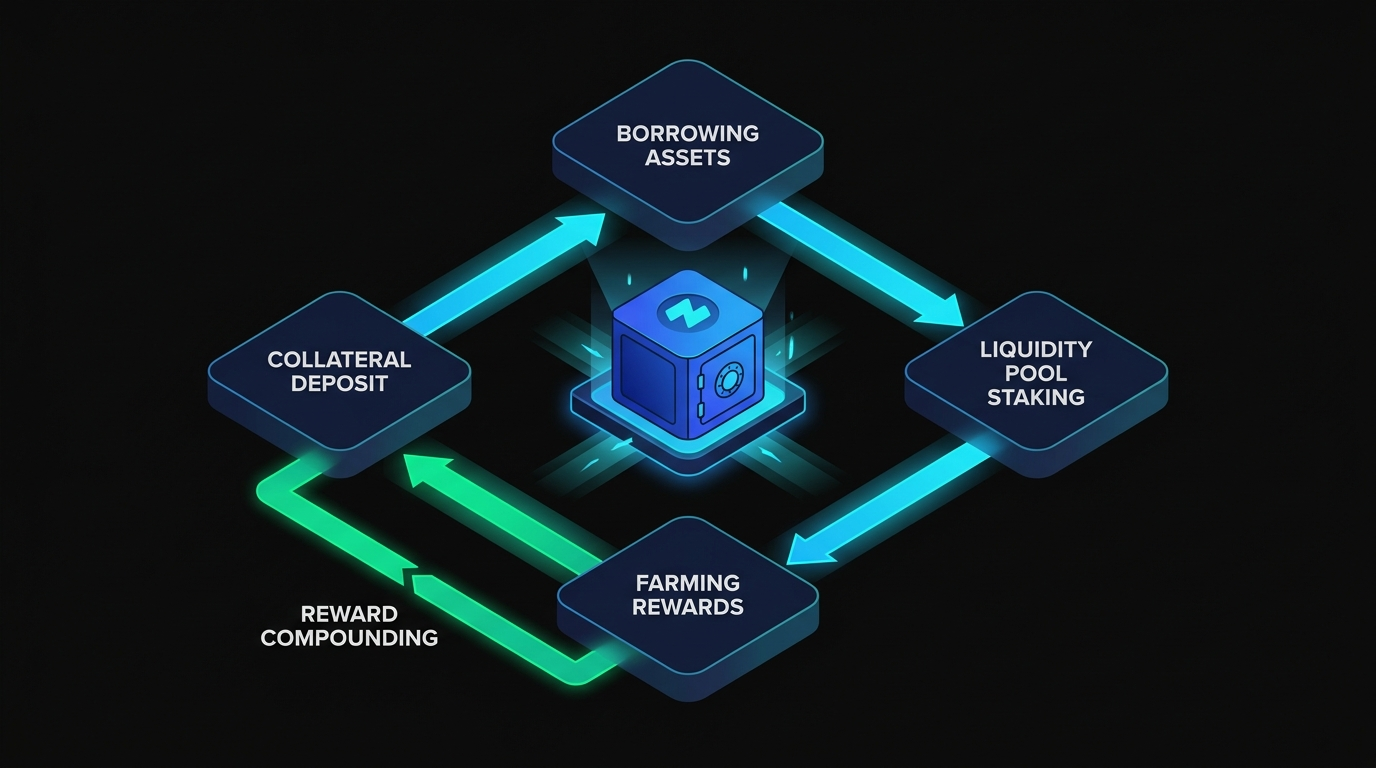
The most illustrative example is the yETH vault, which uses both MakerDAO and Curve in a multi-step leveraged strategy:
- ETH is deposited to MakerDAO as collateral
- DAI is borrowed from MakerDAO against that ETH collateral
- The borrowed DAI is deposited to the yDAI vault
- The yDAI vault supplies DAI to Curve Finance to earn trading fees
- The Curve LP token is staked to earn CRV token rewards
- Earned CRV tokens are sold for ETH
- ETH is deposited back to MakerDAO as additional collateral - restarting the cycle
From your perspective as a depositor, none of those steps are visible. You deposit ETH, receive yvETH in return, and the smart contract handles everything else autonomously.
One important flag: because this strategy involves borrowing, it carries liquidation risk. If the value of your ETH collateral drops below the required collateralization threshold (MakerDAO requires a minimum 150% collateral ratio), the vault's smart contract is designed to repay DAI debt before liquidation can occur - aiming to maintain a safer 200% ratio. But leveraged strategies compound risk alongside returns. That's not a reason to avoid them, but it is a reason to understand them before you deposit.
Yearn v3 also introduced ERC-4626 compliant vault contracts, making yVaults composable with the broader DeFi ecosystem. Other protocols can integrate Yearn vaults directly without custom adapters.
Earn, Zap, and APY - Yearn's Supporting Products
Earn is the simpler, older sibling to yVaults. It searches across Aave, Compound, and Curve to find the best lending rate for stablecoins - DAI, USDC, USDT, TUSD - and deposits your assets accordingly. No multi-step strategies, no leverage, no complexity. You get the best available stablecoin rate with a single deposit.
📊 Earn vs. Zap vs. APY - Quick Reference
- Earn - Finds best stablecoin lending rate; supports DAI, USDC, USDT, TUSD; no leverage
- Zap - Compresses multi-step DeFi transactions into one click; reduces gas fees for token swaps and liquidity entry
- APY Dashboard - Real-time interest rate tracker comparing rates across Aave, Compound, Curve, and Yearn vaults
Zap addresses a practical gas problem. Converting, say, DAI to yCRV (a Curve liquidity provider token) normally requires multiple sequential transactions - each costing gas. Zap bundles those into a single transaction, reducing both fees and the execution window during which prices can shift.
Both Earn and Zap are considered legacy tools today. Yearn v3's multi-strategy vault architecture has largely superseded their original functionality, especially for users with meaningful capital. That said, Earn remains a solid entry point for risk-averse users who want simple stablecoin yield without the complexity of vault strategies.
What Is the YFI Token? Governance, Utility, and Tokenomics
The YFI token is Yearn Finance's on-chain governance mechanism - and one of the most studied examples of a fair launch token distribution in crypto history. Understanding what YFI actually does (versus what it represents) matters for anyone considering exposure to the protocol.
Holding YFI gives you the right to vote on protocol proposals: fee adjustments, new vault strategies, treasury allocation, protocol upgrades, and partnerships. Proposals are submitted publicly on the Yearn governance forum, debated by the community, and then put to an on-chain vote. A proposal requires more than 50% of votes cast to pass. Any wallet holding YFI can submit a proposal; any YFI holder can vote.
The scarcity angle is real: 36,666 total YFI is extraordinarily limited compared to almost any other major DeFi governance token. According to CoinGecko, the YFI community voted to mint an additional 6,666 tokens beyond the original 30,000 - bringing the fixed maximum supply to 36,666 - with 2,222 allocated to contributors and 4,444 to a protocol treasury.
veYFI is the more recent evolution of governance. Users who want maximum governance weight lock their YFI tokens for a defined period, receiving vote-escrowed YFI (veYFI) in return. The longer the lock, the more veYFI you receive, and the more protocol revenue you earn. This mechanic aligns governance incentives with long-term protocol participation - users who lock for years have significantly more governance influence than those who hold but don't lock.
One clarification that often confuses newcomers: YFI's value derives from governance rights and protocol revenue sharing, not from any promise of price appreciation. The protocol generates fees from vault performance; those fees flow to veYFI holders. That's the fundamental yield mechanism for token holders - not token emissions.
How to Get Started with Yearn Finance - Step-by-Step for Beginners
Most Yearn guides stop at explaining the protocol. This section covers the part that actually matters: getting your funds into a vault and understanding what happens next.
What you'll need before starting:
- An Ethereum-compatible wallet (MetaMask is the most common; any WalletConnect-compatible wallet also works)
- Assets to deposit - DAI, USDC, USDT, or ETH are the most supported vault assets
- ETH for gas fees (you pay gas even when depositing stablecoins, since the transaction runs on Ethereum)
Step-by-step deposit process:
- Set up your wallet - Install MetaMask or connect your hardware wallet. Never share your seed phrase with any site, app, or support representative.
- Acquire your deposit asset - Purchase DAI, USDC, or ETH through any major exchange, then transfer to your self-custody wallet.
- Navigate to the official site - Always verify you're on yearn.finance - phishing sites that mimic Yearn's interface exist and have cost users real funds. Bookmark the official URL.
- Connect your wallet - Click "Connect Wallet" and approve the connection in your wallet app. Yearn does not take custody of your funds at this step - you remain in control.
- Browse available vaults - The vault dashboard displays each available vault with its estimated APY, total value locked (TVL), and the number of active strategies. Click any vault to see the strategy breakdown.
- Deposit and receive your yToken - Enter your deposit amount, approve the token spend (one-time transaction per asset), then confirm the deposit. You'll receive a yToken (e.g., yvDAI for a DAI deposit) representing your share of the vault. This yToken is your claim on the vault's assets plus earned yield.
- Monitor and redeem when ready - Your yToken appreciates in value relative to the underlying asset as yield accumulates. When you want to exit, redeem your yToken for the original asset plus earned returns.
On gas fees: Ethereum network fees apply to both deposits and withdrawals. On a stablecoin vault with a small position, gas costs can meaningfully erode your returns - especially in periods of high network congestion. If you're depositing under $1,000, calculate whether the round-trip gas cost (deposit + withdrawal) is worth it against expected yield. Larger positions amortize gas costs more effectively.

How to Evaluate Yearn Finance Vaults - What to Look For
Not every vault is right for every situation. The Yearn interface presents each vault with APY figures and TVL numbers, but those metrics alone don't tell the full story. Here's how I approach vault evaluation before committing capital.
⚠ Vault Evaluation Checklist - Before You Deposit
- APY vs. risk profile → Higher APY typically means more complex strategies with more potential failure points. Understand what's generating the yield before chasing the number.
- TVL (Total Value Locked) → Larger TVL means more community capital at stake and more battle-testing. A $500M TVL vault has been stress-tested in ways a $2M vault has not.
- Number of active strategies → Yearn v3 vaults run up to 20 strategies simultaneously. More strategies mean diversification - but also more smart contract exposure.
- Audit status → Check whether the vault's contracts have been audited. Yearn publishes audit reports for its core contracts; individual strategies may have additional audits.
- Liquidation risk → Any vault that involves borrowing (like yETH) carries liquidation risk. Stablecoin vaults generally don't.
- Historical APY vs. advertised APY → The displayed figure is typically a trailing average. Significant variance between advertised and realized APY is worth investigating.
Technical traders who use indicators like RSI and MACD to time market entries sometimes combine on-chain vault data - TVL trend, APY momentum, net deposits vs. withdrawals - with technical analysis when deciding when to enter or exit vault positions. That level of analysis isn't necessary for most depositors, but it's worth knowing the on-chain data is there for those who want it.
Stablecoin Vaults vs. Volatile Asset Vaults - Risk Profiles Compared
The most useful segmentation for new Yearn users isn't by protocol or APY - it's by the underlying asset type.
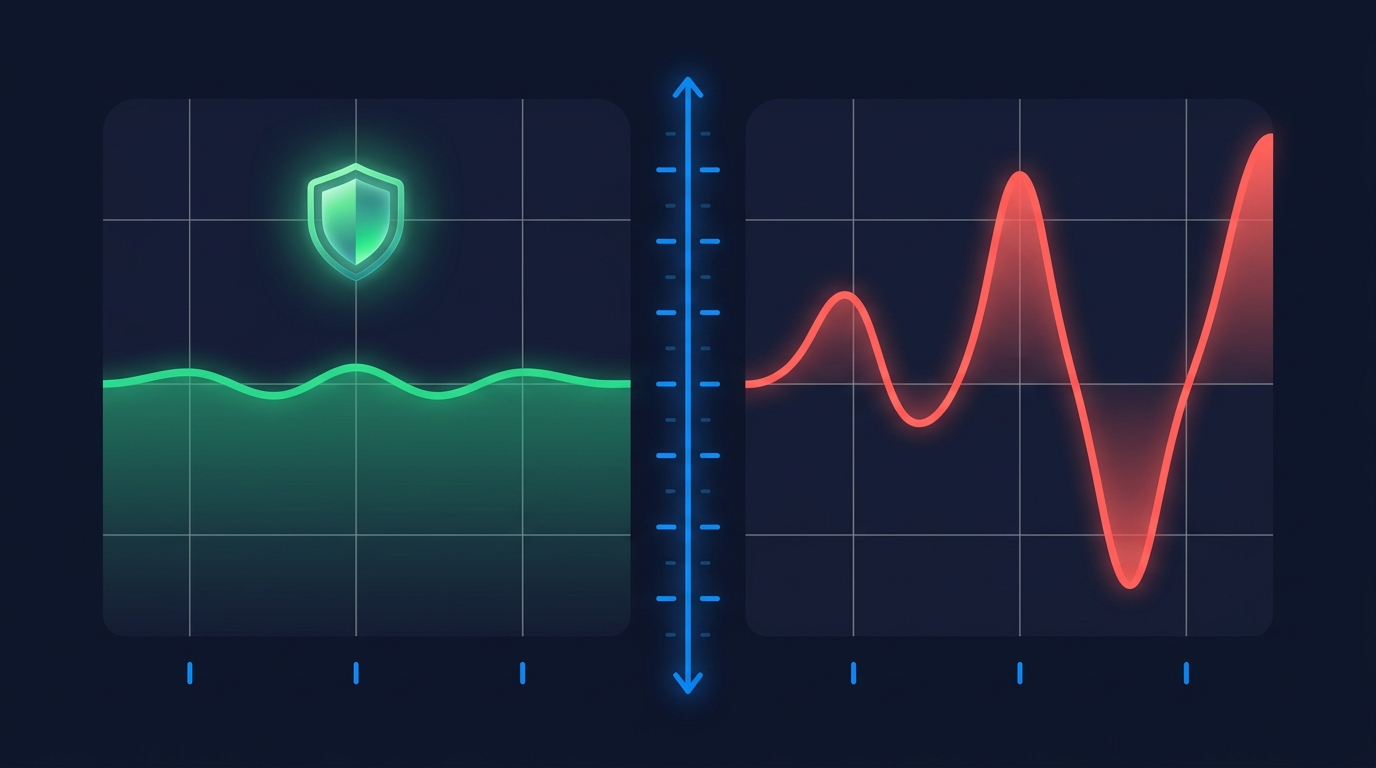
Stablecoin vaults (DAI, USDC, USDT) offer the most predictable risk profile. You're not exposed to crypto price volatility - your downside is limited to smart contract risk and depegging events in the underlying stablecoin. For someone new to Yearn, a USDC or DAI vault is the lowest-friction entry point.
Volatile asset vaults (ETH, and similar) can offer higher APY, but they combine yield farming returns with price exposure and, in leveraged strategies, liquidation risk. You can earn yield while ETH appreciates - but if ETH drops sharply, the leveraged vault mechanics can work against you. If you want to learn more about how impermanent loss affects liquidity-based strategies, we've covered it in detail separately.
If you're following this guide as your first Yearn deposit, a stablecoin vault is the rational starting point. Get comfortable with the deposit/redeem cycle, understand how yTokens work, and then assess more complex vault strategies from there.
Yearn Finance Risks and Red Flags - What Every User Should Know
DeFi doesn't come with deposit insurance. No regulatory body guarantees your funds. Being honest about that isn't pessimism - it's the minimum required for informed participation.
Here are the risks that matter most on Yearn:
Smart contract risk is the foundational risk of all DeFi. Yearn's core vault contracts have undergone multiple independent audits, and the protocol has operated since mid-2020 without a catastrophic exploit - a meaningful track record in a space where new protocols get drained constantly. But audits don't guarantee security; they reduce probability of exploits. Every smart contract carries residual risk.
Protocol composability risk is specific to Yearn's architecture. Because vault strategies rely on third-party protocols - Aave, Compound, Curve, MakerDAO - an exploit in any of those underlying protocols can impact yVault returns. If Curve gets exploited and a vault's strategy is 40% Curve-allocated, that vault takes a hit. Yearn cannot fully insulate against risks in the protocols its strategies interact with.
Liquidation risk applies specifically to leveraged vault strategies like yETH. If ETH's price falls sharply, the smart contract attempts to repay DAI debt before the MakerDAO collateral ratio breaches the liquidation threshold. But rapid price movements can outpace the contract's ability to respond. Understand this risk explicitly before depositing into leveraged vaults.
Phishing and fake sites are not hypothetical. Fake Yearn interfaces have stolen funds from users who bookmarked wrong URLs or clicked phishing links. Always access Yearn through yearn.finance directly. The official site does not have alternate domains, does not have a support chat asking for your seed phrase, and does not require you to "reconnect your wallet by entering your 12 words."
⚠ 5 Warning Signs of Yearn Finance Scams
- APY claims above 500%+ → with no strategy breakdown - sustainable vault yields don't look like this
- Altered URLs → yearnfinance.io, yearn-finance.app, and similar impostors are not the official protocol
- Seed phrase requests → Telegram or Discord "Yearn support" that asks you to share your seed phrase or private key
- Unaudited forks → "Yearn fork" protocols launched by anonymous teams with no audit history
- Pressure tactics → urgent deposit deadlines, "pool closes in X hours," or VIP access offers
The legitimate Yearn protocol will never ask for your seed phrase. Any site or account that does is a scam, without exception.
Yearn Finance vs. Alternatives - How Does It Compare?
Yearn isn't the only yield aggregator in DeFi, and depending on your goals, alternatives might serve you better. This comparison is about fit, not a ranking of winners and losers.
Choose Yearn if your capital is primarily on Ethereum and you want automated multi-strategy yield optimization without managing individual protocol positions yourself. Yearn's vault architecture is the most sophisticated multi-strategy system in the Ethereum ecosystem.
Choose Convex if you're deeply embedded in the Curve ecosystem and your primary goal is maximizing CRV/cvxCRV yields - Convex specializes in this slice of the market more precisely than Yearn.
Choose Beefy if you're operating across multiple chains (BNB Chain, Polygon, Arbitrum). Yearn's footprint is primarily Ethereum; Beefy's multi-chain architecture is built for broader cross-chain deployment.
Choose Aave or Compound directly if you want simple, transparent lending with no strategy layer - pure rate exposure without smart contract strategy risk from aggregation.
The DeFi space evolves quickly. TVL figures, APY ranges, and supported assets change frequently - always verify current data directly on each protocol before committing capital.
Conclusion - Is Yearn Finance Right for You?
Yearn Finance has spent six years proving a thesis that wasn't obvious in 2020: that automated, community-governed yield optimization on a decentralized protocol can consistently deliver value for depositors at scale. The yVault architecture, the fair launch model, the veYFI governance system - these aren't gimmicks. They're the outputs of a community that has iterated in public, on-chain, with real capital.
Whether Yearn is the right fit depends on what you're trying to accomplish:
Who Should Use Yearn Finance?
IF YOU'RE NEW TO DEFI
Start with a stablecoin vault (DAI or USDC). Deposit a small amount, observe how the yToken appreciates, and redeem once to understand the full cycle before scaling.
IF YOU'RE AN EXPERIENCED DEFI USER
Yearn v3's multi-strategy vaults offer sophisticated yield optimization across 20+ simultaneous strategies with ERC-4626 composability - worth evaluating against your current manual strategy rotation.
IF YOU'RE INTERESTED IN ON-CHAIN GOVERNANCE
Locking YFI for veYFI gives you proportional governance rights and a share of protocol revenue from vault performance fees. Long-term lock periods provide the highest governance weight.
The trend across DeFi is clear: users increasingly demand on-chain verifiability, self-custody, and yield that derives from real protocol activity rather than inflationary token emissions. Platforms built on those principles - transparent mechanics, audited contracts, community-governed strategy development - represent where the industry is headed. Yearn Finance has been building that model since 2020.
Crypto trading and DeFi participation involve substantial risk of loss. Smart contract risk, liquidation risk, and market volatility are inherent to on-chain protocols. Only deploy capital you can afford to lose. This article does not constitute financial advice.
Last updated: April 2026.
Frequently Asked Questions
What is Yearn Finance in simple terms?
Yearn Finance is a DeFi protocol on Ethereum that automatically moves your deposited assets across lending platforms and liquidity strategies to maximize yield. Instead of manually monitoring interest rates on Aave, Compound, and Curve Finance and rebalancing your position yourself, Yearn's smart contracts do it for you continuously. You deposit an asset - say, DAI or ETH - receive a yToken representing your position, and the protocol earns yield on your behalf. When you redeem your yToken, you receive the original asset plus accumulated returns, minus a performance fee charged only on earned yield.
What does the YFI token do?
YFI is Yearn Finance's governance token. Holding YFI grants you the right to vote on protocol proposals - fee structures, new vault strategies, treasury management, protocol upgrades, and partnerships. Any wallet holding YFI can submit a governance proposal; proposals require over 50% of votes cast to pass. More recently, the veYFI mechanism allows users to lock YFI for enhanced governance weight and a proportional share of protocol fee revenue. YFI doesn't directly entitle holders to yield from vaults - that accrues to depositors. Token holders earn via the revenue sharing built into veYFI.
Is Yearn Finance safe to use?
Yearn Finance's core vault contracts have been audited multiple times by independent security firms, and the protocol has operated without a catastrophic smart contract exploit since its 2020 launch - a meaningful track record in DeFi. That said, "safe" in DeFi is relative. Every smart contract carries residual risk, and Yearn's strategies interact with third-party protocols (Aave, Curve, MakerDAO) - exploits in those underlying protocols can affect vault returns. Leveraged vaults add liquidation risk on top. Stablecoin vaults are lower-risk; complex multi-step strategies carry more. Understand the specific strategy before depositing, and never deploy capital you can't afford to lose.
What is a yVault and how does it work?
A yVault is Yearn Finance's primary product - a smart contract pool that accepts a single asset and deploys it across multiple yield-generating strategies simultaneously. When you deposit DAI into the DAI yVault, you receive yvDAI in return. That yvDAI token is your claim on the vault's underlying assets plus any yield earned while your funds were deployed. Yearn v3 vaults can run up to 20 strategies concurrently, diversifying yield sources across lending markets, liquidity pools, and token incentives. When you redeem your yvDAI, you receive your original DAI plus the accumulated returns, minus the performance fee on earned yield.
How do I deposit funds into a Yearn Finance vault?
Connect an Ethereum-compatible wallet (MetaMask is the most common) to the official Yearn Finance website at yearn.finance. Browse the vault dashboard to find a vault for the asset you want to deposit. Click the vault, review the strategy details and current APY, enter your deposit amount, and confirm two transactions: an approval (allowing Yearn's contract to spend your tokens) and the deposit itself. Both transactions cost Ethereum gas fees. After confirmation, you'll receive a yToken in your wallet - for example, yvDAI for a DAI deposit. To exit, return to the vault and redeem your yToken for the underlying asset plus earned yield.
Can I lose money on Yearn Finance?
Yes - and any representation to the contrary would be false. Loss scenarios include: a smart contract exploit in a vault or underlying protocol (permanent loss of deposited funds), liquidation in leveraged vaults during sharp price drops (partial loss of collateral), depegging of a stablecoin used in vault strategies (temporary or permanent value impairment), and a governance attack where a large YFI holder passes a malicious proposal. The probability of these scenarios varies significantly by vault type - stablecoin vaults in well-audited, high-TVL strategies carry meaningfully lower risk than newer, complex leveraged vaults. The DeFi principle of "don't deploy what you can't afford to lose" is not rhetorical. It's accurate.
What is the difference between Yearn Finance and Convex Finance?
Both Yearn Finance and Convex Finance are DeFi yield optimization protocols on Ethereum, but they have different specializations. Yearn is a general-purpose yield aggregator - it deploys strategies across Aave, Compound, Curve, MakerDAO, and other protocols, optimizing across a broad range of yield opportunities. Convex Finance is specifically optimized for Curve Finance - it allows users to earn enhanced CRV rewards by pooling voting power and boosting Curve yields more efficiently than most individual holders could achieve alone. For users who are heavily invested in Curve ecosystem positions, Convex may offer better CRV-specific optimization. For users who want broad, multi-protocol yield automation on Ethereum, Yearn's wider strategy coverage is the better fit.