Zilliqa is a Layer 1 blockchain built from the ground up to solve the scalability problem that still throttles most public networks today. At the center of it is sharding - a parallel processing architecture that makes the network faster as it grows larger, not slower. The native token, ZIL, powers everything from transaction fees to governance to staking under the upgraded Zilliqa 2.0 protocol.
⚡ Key Takeaways
- Zilliqa was the first public blockchain to implement sharding in production, enabling parallel transaction processing that scales with node count
- Zilliqa 2.0 transitioned the network from a Proof of Work hybrid model to full Proof of Stake, repositioning the ecosystem toward gaming and Web3 entertainment
- ZIL is the native token used for transaction fees, staking, governance voting, and interacting with decentralized applications
- The proprietary smart contract language Scilla uses formal verification - mathematical proofs - to identify vulnerabilities before deployment
To understand why Zilliqa matters, start with the technology that makes it different.
What Is Zilliqa? Definition, Origins, and Core Purpose
Zilliqa is a public Layer 1 blockchain designed specifically around one problem: scalability. Most first-generation blockchains process transactions sequentially - every node on the network validates every transaction. That works at small scale, but as activity grows, the network doesn't speed up. It grinds. Zilliqa's answer was to rebuild the architecture entirely, putting sharding at the protocol level rather than bolting it on as an afterthought.
The project was launched in June 2017 by Amrit Kumar and Xinshu Don, two researchers from the National University of Singapore. The academic pedigree matters here - Zilliqa wasn't conceived in a trading group or a startup garage. It came out of formal computer science research into Byzantine fault tolerance and distributed systems. The mainnet went live in January 2019 after a 2017 ICO that raised over $22 million in ETH.
ZILLIQA KEY MILESTONES
2017
Founded by NUS researchers Amrit Kumar and Xinshu Don; ICO raises $22M+ in ETH
2019 - KEY MILESTONE
Mainnet launches - first public blockchain with production sharding; ZIL ERC-20 tokens swapped 1:1 for native ZIL
2020
Zilswap AMM launches on the network
2021
Zilliqa 2.0 announced
2026
Full Proof of Stake transition complete; ecosystem pivots to Web3 gaming
The core pitch is straightforward: if you need a blockchain for high-volume, computationally intensive applications, Zilliqa's architecture is built for that workload in a way that Ethereum - designed for generality - was never optimized to handle.
Zilliqa's Mission: Scalability-First Blockchain
Zilliqa wasn't built to be a jack-of-all-trades chain. The architecture is purpose-built for throughput-intensive tasks: financial modeling, data mining, machine learning applications, IoT data processing, and - under Zilliqa 2.0 - high-frequency Web3 gaming transactions. These are use cases where network congestion and unpredictable fees kill the product experience.
Here's the specific claim that makes Zilliqa's design compelling: throughput scales linearly with node count. If Zilliqa had 20,000 nodes, the network could be divided into 25 shards of 800 nodes each, processing transactions simultaneously across all 25 sub-networks in parallel. More nodes → more shards → more throughput. That's a fundamentally different scaling model from any network where all nodes process all transactions.
What Zilliqa's architecture is built to power:
- High-frequency micropayments and microtransactions
- On-chain gaming with real-time settlement
- Data-intensive enterprise computation (financial modeling, ML training)
- IoT device networks requiring parallel data processing
- DeFi protocols requiring stable, low-cost transaction fees at scale
- NFT marketplaces with high transaction volumes
The implication for sharded blockchains is significant as industries like machine learning and connected devices continue growing - and it's why the Zilliqa team positioned the network for this class of application from day one.

How Does Zilliqa Work? Sharding, Consensus, and Architecture
Sharding is the mechanism that makes Zilliqa architecturally distinct from most public blockchains. Rather than all nodes processing all transactions, the network is divided into smaller groups - shards - where each group handles a fraction of total transaction volume simultaneously. The result: as the network grows, total throughput grows with it, while individual node storage requirements stay manageable because shard nodes only store a subset of the full blockchain history.
The full Zilliqa architecture involves two distinct blockchain types working in tandem. Transaction Blocks (TX-Blocks) store user transaction data. Directory Service Blocks (DS-Blocks) store data about the network miners and validators who secure the system. TX-Blocks link back to their corresponding DS-Blocks, creating a verifiable two-layer record that underpins Zilliqa's security model.
One practically important outcome of this architecture: Zilliqa achieves transaction finality without requiring additional confirmation rounds after block validation. For micropayments and high-frequency dApps, that matters - it means a confirmed transaction is settled, not probabilistically finalized.
Sharding Deep Dive: Parallel Processing Explained
The sharding process on Zilliqa runs in two stages. First, Directory Service (DS) Committee Nodes are elected. These DS nodes then initiate sharding - assigning other nodes to individual shards. Each shard operates as its own mini-blockchain, independently validating a subset of network transactions and producing microblocks. Once a shard's microblock is finalized, DS nodes aggregate microblocks from all shards into a complete Transaction Block, which is added to the global Zilliqa blockchain.
The pBFT (Practical Byzantine Fault Tolerance) consensus within each shard requires unanimous agreement from all assigned nodes before a microblock is finalized. This is a strict finality requirement - stronger than probabilistic consensus - which is why Zilliqa can achieve immediate finality without confirmation rounds.
Zilliqa 2.0: The Proof of Stake Transition
The original Zilliqa network ran a hybrid model: Proof of Work for node identity verification combined with pBFT for block finality. PoW served as a Sybil resistance mechanism - you couldn't spam fake nodes without spending real computational resources. The downside was energy consumption and the barrier it created for small-scale participation.
Zilliqa 2.0 changed this fundamentally.
📊 What Changed in Zilliqa 2.0
- Consensus transitioned from hybrid PoW+pBFT to full Proof of Stake
- ZIL holders can now stake tokens directly to become validators and earn staking rewards
- Energy requirements dropped significantly by eliminating the PoW mining component
- Strategic ecosystem focus shifted toward Web3 gaming and entertainment applications
Under PoS, validators stake ZIL to participate in block validation. This removes the mining hardware barrier, opens participation to any ZIL holder willing to stake, and aligns incentives around long-term network health rather than short-term block rewards. The energy efficiency gains also bring Zilliqa's environmental profile in line with post-Merge Ethereum and other modern PoS chains.
The Zilliqa 2.0 upgrade isn't just a consensus change - it's a strategic repositioning. The ecosystem pivot toward gaming and Web3 entertainment reflects where the team sees the network's scalability advantages translating into real product-market fit.

Scilla: Zilliqa's Purpose-Built Smart Contract Language
Most blockchains use an existing smart contract language - typically Solidity on the EVM. Zilliqa built its own. Scilla (Smart Contract Intermediate-Level Language) was developed specifically for the Zilliqa network, and the motivation was security, not differentiation for its own sake.
Smart contract vulnerabilities have caused billions in losses across the DeFi ecosystem. Most of these exploits happen because the contract's logic can't be fully verified before deployment - bugs that only surface under specific conditions, reentrancy vulnerabilities, integer overflow issues. Scilla addresses this through formal verification: developers can apply mathematical proofs to verify that a contract's behavior meets defined requirements before it ever goes live. Think of it as having a mathematician check the contract's entire logic tree - not a test suite that catches known scenarios, but a formal proof that covers all possible execution paths.
Beyond security, Scilla was designed to fully utilize Zilliqa's sharding architecture - contracts written in Scilla can be executed in parallel across shards rather than queued sequentially, which keeps throughput high even under heavy dApp load. The Scilla layer handles computation; ZIL is the fuel that powers it.
ZIL Token: Utility, Economics, and Supply
ZIL isn't just a speculative asset - it's the operational currency of the entire Zilliqa network. Every transaction, every smart contract execution, every governance vote, every staking position runs on ZIL. Understanding the token's mechanics is essential before touching the ecosystem.
The 0.1 ZIL average transaction fee is a structural design choice, not just a market outcome. With a fee level that low, Zilliqa is genuinely viable for micropayments - use cases where Ethereum's variable gas fees would make the transaction economically nonsensical.
Governance works on a stake-weighted basis: your voting power is proportional to the ZIL you've staked. This isn't just theoretical - it means long-term holders who stake have meaningful influence over network upgrades and protocol changes, which aligns with the Zilliqa 2.0 philosophy of decentralized governance.
One tokenomics detail worth knowing: Zilliqa's validation rewards don't halve at set intervals the way Bitcoin does. Instead, rewards decay gradually over approximately a decade. The goal was supply stability - preventing the volatility spikes that halvings can trigger - while still maintaining a long-term incentive for validators. The supply of ZIL is capped at 21 billion, and that limit is enforced at the protocol level.
ZIL started life as an ERC-20 token on Ethereum in 2017, used for the ICO. When the Zilliqa mainnet launched in January 2019, those early tokens were migrated to native ZIL at a clean 1:1 ratio - no dilution, no reissuance complexity.
Now that you understand what ZIL does, here's how to get some.
How to Buy, Store, and Stake ZIL: Getting Started Guide
Buying ZIL follows the standard process for any mid-cap altcoin. The token is listed on several major exchanges, including Binance and Gate.io. Worth noting: Kraken has stated it doesn't currently offer ZIL trading, so check availability on your preferred platform before creating an account specifically for this purpose.
How to Buy ZIL in 4 Steps:
- Choose a supported exchange - Binance, Gate.io, Huobi, and several other major platforms list ZIL. Verify current availability as listings can change.
- Create and verify your account - Standard KYC process: email, ID verification, and optionally 2FA (use it - always).
- Deposit funds - Either transfer crypto you already hold, or use a fiat on-ramp (bank transfer or card) if the exchange supports it in your region.
- Purchase ZIL - Use a market order for immediate execution or a limit order if you have a specific target price.
Wallet Options for Storing ZIL
- Hardware wallets (Ledger) - highest security for long-term holdings; ZIL support available through Zilliqa's own wallet interface
- Software wallets - ZilPay (Zilliqa's native browser extension wallet), Trust Wallet, and Atomic Wallet support ZIL
- Exchange wallets - convenient for active trading but means the exchange controls your private keys, not you
The self-custody principle applies here: if you're holding ZIL for the medium-to-long term, getting it off an exchange into a wallet you control is the move that aligns with how trustless blockchain infrastructure actually works.
Staking ZIL under Zilliqa 2.0:
Since the PoS transition, staking is available directly to ZIL holders. You delegate ZIL to a validator node, which participates in block validation on your behalf. Staking rewards are distributed in ZIL from transaction fees and the protocol's validation incentive structure - not from token inflation or emissions. Check the Zilliqa official docs for current minimum stake requirements and validator selection criteria, as these parameters are set by community governance and may update.
Once you hold ZIL, the Zilliqa ecosystem opens up - from dApps to NFTs and gaming.
The Zilliqa Ecosystem: dApps, NFTs, DeFi, and Gaming
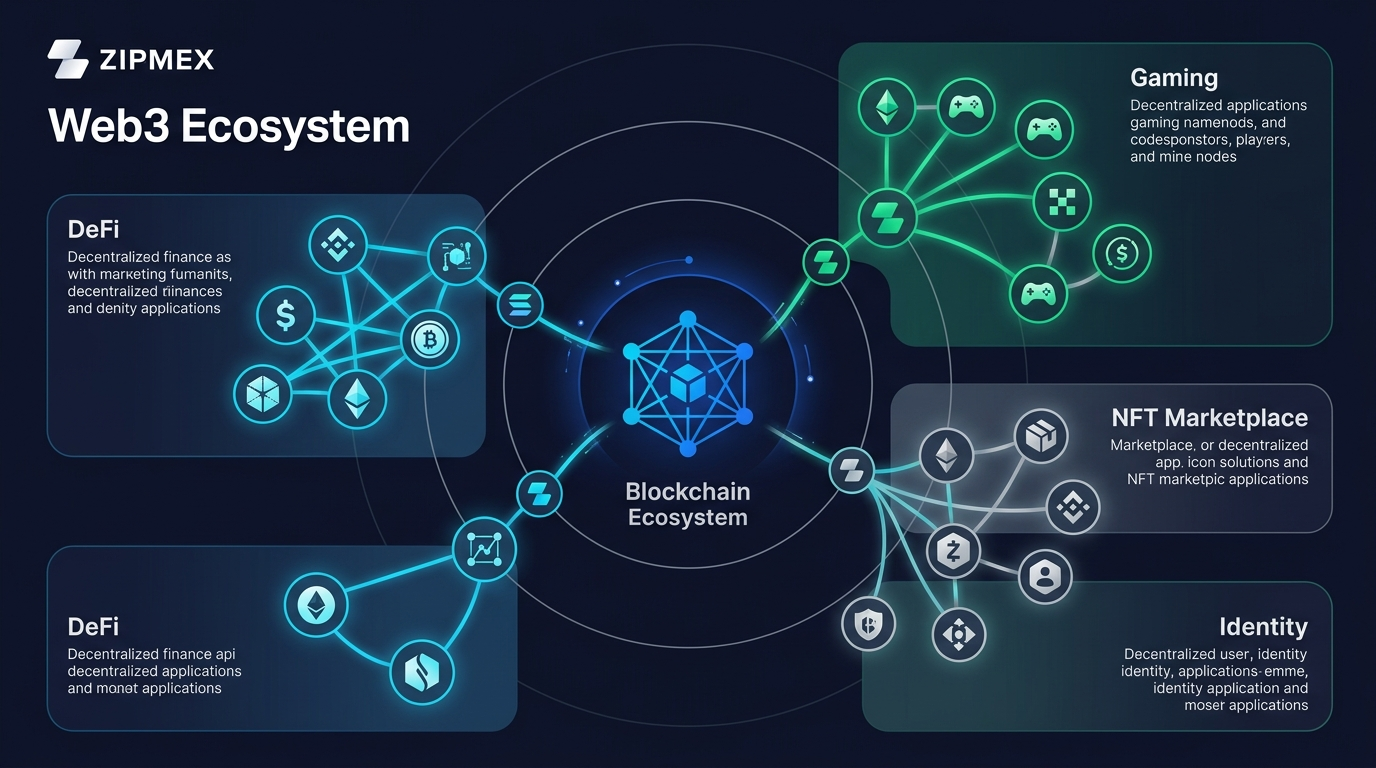
Zilliqa's sharding architecture isn't running in a vacuum - there's an active application layer built on top of it. The ecosystem spans DeFi, NFTs, digital identity, asset tokenization, and Web3 gaming, with the Zilliqa 2.0 upgrade specifically accelerating the gaming and entertainment vertical.
Zilswap is worth a specific mention for DeFi participants. As an AMM (automated market maker), it uses liquidity pools and a constant product formula to price token swaps - no order book, no counterparty required. You can provide liquidity to Zilswap pools and earn a share of trading fees in return, which is one of the ways to generate yield within the Zilliqa ecosystem beyond staking.
The CommX partnership is genuinely interesting from a structural standpoint: tokenized fractional ownership of real-world assets is one of the cleaner use cases for blockchain infrastructure that doesn't require high throughput, but does require low transaction costs - which Zilliqa's ~0.1 ZIL fee structure handles well.
All of this activity raises a natural question: where does Zilliqa actually sit in the broader Layer 1 landscape?
Zilliqa vs. Competitors: How It Compares to Ethereum, Solana, and Other Layer 1s
This is a content gap in most Zilliqa explainers - they describe what Zilliqa is without placing it relative to the chains developers and investors actually compare it against. Here's an honest comparison.
The honest assessment: Zilliqa holds a meaningful technical distinction as the blockchain that proved sharding could work at scale in production - that's not a marketing claim, it's a historical first. Ethereum, which is far larger, is still retrofitting scalability through Layer 2 rollups rather than native Layer 1 sharding.
Where Zilliqa trails: the developer ecosystem is smaller than Ethereum by a substantial margin, the ZIL liquidity profile is thinner than Solana or ETH, and Scilla's formal verification approach - while genuinely more secure - has a steeper learning curve than Solidity. These are real constraints, not trivial footnotes.
The Zilliqa 2.0 pivot toward Web3 gaming is a deliberate bet that gaming and entertainment represent the next wave of blockchain adoption at scale - and that Zilliqa's throughput architecture, combined with sub-cent transaction costs, gives it a structural advantage there over chains with higher fee floors.
Understanding where Zilliqa sits in the landscape helps clarify who it's actually built for.

Conclusion: Is Zilliqa Worth Your Attention in 2026?
Zilliqa earns genuine technical respect for a simple reason: it did something first that the rest of the industry is still working toward. Sharding at the production Layer 1 level - not as a testnet concept, not as a Layer 2 workaround - went live on Zilliqa in 2019. That's a real engineering milestone.
The Zilliqa 2.0 upgrade adds another layer to the story. The PoS transition removed the energy overhead of mining, opened staking to any ZIL holder, and - crucially - gave the ecosystem a strategic direction with the Web3 gaming pivot. Whether that bet pays off depends on execution and timing, but the foundational infrastructure for high-frequency, low-cost gaming transactions is genuinely in place.
FOR DEVELOPERS
Scilla's formal verification model offers a security guarantee that EVM-based contracts can't match. The learning curve is real, but for applications where smart contract exploits would be catastrophic, that trade-off is worth evaluating seriously.
FOR ZIL HOLDERS
Staking under Zilliqa 2.0 offers yield from actual network activity - transaction fees and validation incentives - rather than token emissions. A structurally clean setup for PoS participation without inflationary reward mechanics.
FOR CURIOUS READERS
Watch the Web3 gaming vertical. If Zilliqa's gaming ecosystem gains traction the way Solana did during the 2021 NFT cycle, the network's throughput advantages will become more visible. That's the thesis worth tracking.
Zilliqa isn't competing for the same space as Ethereum's DeFi blue chips or Solana's high-frequency trading infrastructure. It's carving a specific lane - enterprise-grade throughput, gaming, and verifiable smart contracts - where its architecture has a legitimate edge.
Platforms built around on-chain verifiability and real yield - like Zipmex - reflect the direction the space is heading: away from trust assumptions and toward cryptographically provable outcomes. Zilliqa's sharding model and Scilla's formal verification philosophy sit squarely in that trajectory.
⚠ Risk Disclaimer
- Crypto trading → involves substantial risk of loss
- This article → does not constitute financial or investment advice
- All decisions → should be based on your own independent research and risk tolerance
Last updated: April 2026.
Frequently Asked Questions
What is Zilliqa in simple terms?
Zilliqa is a Layer 1 blockchain engineered for high throughput via sharding - a parallel processing architecture that divides the network into smaller groups of nodes, each handling a fraction of transactions simultaneously. Unlike most blockchains where all nodes process all transactions, Zilliqa scales linearly with node count. ZIL is the native token powering fees, staking, and governance. Since its 2019 mainnet launch, it's been the only major public chain with native production-level sharding.
What makes Zilliqa different from other blockchains?
Three things stand out. First, Zilliqa was the first public blockchain to implement sharding in production - a historical engineering first, not a future roadmap item. Second, its Scilla smart contract language uses formal mathematical verification to prove contract behavior before deployment, offering stronger security guarantees than Solidity auditing. Third, transaction fees average around 0.1 ZIL - structurally low enough to support genuine micropayments and high-frequency dApp interactions that would be economically unviable on fee-volatile chains.
What is Zilliqa 2.0 and what changed?
Zilliqa 2.0 is a major protocol upgrade completed in 2026 that made two significant changes: the consensus mechanism transitioned from a hybrid Proof of Work + pBFT model to full Proof of Stake, and the ecosystem's strategic focus shifted toward Web3 gaming and entertainment. Under PoS, ZIL holders can stake directly to become validators and earn rewards - no mining hardware required. The core sharding architecture remained intact; 2.0 built on the existing foundation rather than replacing it.
How do I buy and store ZIL?
ZIL is available on major exchanges including Binance and Gate.io - verify current listings before creating an account. The process is standard: create and verify an account (KYC), deposit funds, and place a market or limit order for ZIL. For storage, ZilPay (Zilliqa's native browser wallet), Trust Wallet, and Atomic Wallet all support ZIL. Ledger hardware wallets offer the highest security for long-term holders. Moving ZIL off an exchange into self-custody removes counterparty risk.
Can I stake ZIL and earn rewards?
Yes. Under Zilliqa 2.0, ZIL holders can delegate tokens to a validator node to participate in Proof of Stake consensus. Rewards are distributed in ZIL from transaction fees and protocol validation incentives - not from token emissions or inflationary minting. This means staking yield is derived from real network activity. Current minimum stake requirements and validator selection criteria are governed by community parameters, so check the official Zilliqa documentation for up-to-date specs before staking.
How does Zilliqa compare to Ethereum?
The core difference is where scaling happens. Ethereum addresses throughput through Layer 2 rollups (Optimism, Arbitrum, Base) built on top of its base chain - a retrofitted solution. Zilliqa's sharding is native Layer 1 architecture, designed in from day one. Ethereum holds a commanding lead in developer ecosystem size, DeFi liquidity, and dApp adoption. Zilliqa's structural advantages are lower fees, linear throughput scaling, and Scilla's formal verification security model - positioning it for high-volume enterprise and gaming applications rather than general DeFi.
What dApps and use cases exist on Zilliqa?
The Zilliqa ecosystem includes Zilswap (AMM-based DEX using liquidity pools for ZIL token swaps), Unstoppable Domains (blockchain domain names that accept ZIL payments), Mintable (NFT marketplace with ZIL-denominated transactions), CommX (tokenized and fractionalized real-world assets), and Web3 gaming applications with in-game NFT economies. Under Zilliqa 2.0, the gaming vertical is the primary strategic focus. The ~0.1 ZIL fee structure makes all of these use cases economically viable for high transaction volumes.