
Central bank digital currencies - CBDCs - are no longer a theoretical concept. Right now, 137 countries representing 98% of global GDP are somewhere on the path from research to live deployment. Understanding what is a CBDC, how it works, and why it matters isn't optional anymore. This guide covers everything: the core definition, the mechanics, the global status, the real benefits, the legitimate risks, and how a CBDC compares to the crypto assets you already know.
⚡ Key Takeaways
- A CBDC is a digital form of a country's fiat currency issued and backed by the central bank - not a private company.
- Unlike Bitcoin or Ethereum, a CBDC is centrally controlled, government-backed, and legal tender.
- There are two distinct types: retail CBDCs (for everyday consumers) and wholesale CBDCs (for financial institutions and interbank settlement).
- As of 2026, three countries have fully launched CBDCs: the Bahamas, Nigeria, and Jamaica. China's Digital Renminbi is the most advanced pilot from a major economy.
- The US halted all federal retail CBDC development via Executive Order in January 2026 - making it a notable outlier among major economies.
- CBDCs promise faster payments, financial inclusion, and stronger monetary policy tools - but carry serious risks around privacy, bank stability, and state surveillance.
What Is a CBDC? Definition, Meaning, and Core Concept
A central bank digital currency (CBDC) is a digital form of a country's official fiat currency, issued and fully backed by the nation's central bank. Not a private company. Not a decentralized protocol. The central bank itself - the same institution that issues physical banknotes - creates and guarantees it.
That distinction sounds minor. It isn't. When you hold a CBDC, your digital money is a direct liability of the central bank - the same legal standing as physical cash in your wallet. By contrast, the "digital money" sitting in your commercial bank account is technically a liability of that private bank. If the bank collapses, your CBDC doesn't. That's a fundamental architectural shift in how monetary value is held.
📊 One-sentence definition
A CBDC is the digital equivalent of a banknote, but the ledger recording your holdings is maintained by the central bank rather than a commercial institution.
How Does a CBDC Work? Mechanics and Infrastructure
Most proposed CBDC designs follow a two-tier distribution model: the central bank issues the CBDC and manages the core infrastructure; licensed financial intermediaries - your bank, a fintech app, a payment provider - handle customer-facing services. You interact with the CBDC through a wallet app, not directly with the central bank's ledger.
The underlying infrastructure varies. A CBDC can run on a distributed ledger (similar to blockchain architecture) or on a conventional centralized database. Here's the important nuance: blockchain is what inspired the CBDC concept, but most serious central bank implementations don't require it. A CBDC is centrally controlled by design - decentralization would contradict the entire premise of sovereign monetary control. Cryptographic algorithms verify and record transactions, ensuring integrity without necessarily requiring a decentralized consensus mechanism.
The consumer touchpoint is a digital wallet - either integrated into an existing banking app or a standalone CBDC wallet provided by the central bank or an approved intermediary. Payments flow directly from wallet to wallet, settling in real time.
Retail CBDC vs. Wholesale CBDC - Key Differences Explained
Two fundamentally different animals share the CBDC label. Understanding which type is being discussed changes the entire conversation.
Retail CBDCs are designed for households and businesses. The use cases are everyday: buying groceries, paying rent, receiving a government benefit transfer, splitting a bill. India's Digital Rupee is primarily a retail project. So are the Sand Dollar (Bahamas), e-Naira (Nigeria), and JamDex (Jamaica).
Wholesale CBDCs operate entirely within the financial system. They're designed for interbank settlement, securities transactions, and high-value cross-border transfers - essentially a digital upgrade to central bank reserves. Project mBridge, connecting central banks in China, Thailand, the UAE, Hong Kong, and Saudi Arabia, is the most prominent wholesale CBDC initiative globally.
The two types don't conflict - a country can develop both simultaneously. China is doing exactly that.
Global CBDC Landscape - Countries, Pilots, and Launched Projects
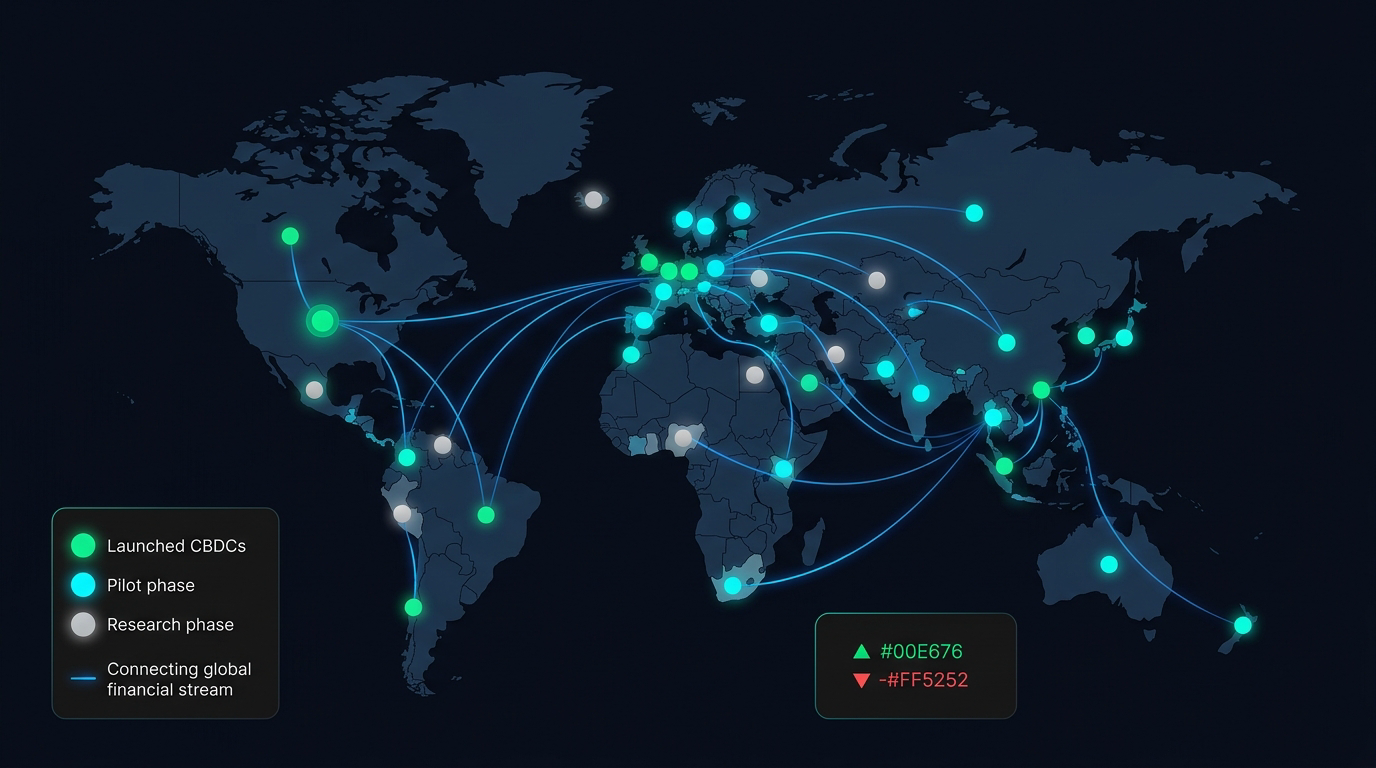
The headline number: 137 countries and currency unions - representing 98% of global GDP - are actively exploring CBDCs as of early 2026, according to the Atlantic Council's CBDC Tracker. In May 2020, that number was 35. The pace of development has been remarkable.
Three distinct tiers characterize the global picture:
China's Digital Renminbi (e-CNY) - The World's Most Advanced CBDC
No other major economy comes close to China's progress on CBDC. The People's Bank of China began formal research in 2014. By 2026, Chinese consumers have collectively created over 2.25 billion digital wallets to transact in the e-CNY - a scale no other country has approached.
📊 Scale context
2.25 billion e-CNY wallets in a country of 1.4 billion people means multiple wallets per active user - reflecting extensive merchant adoption and app integrations across Alipay, WeChat Pay, and dedicated PBOC apps.
The e-CNY is technically still in the pilot stage, but the practical reality is a fully operational system at consumer scale. China also anchors Project mBridge, a wholesale cross-border CBDC initiative with Thailand, the UAE, Hong Kong, and Saudi Arabia - a geopolitically significant architecture for settling international trade outside the SWIFT network.
The Digital Euro, Digital Pound, and Other Major Economy Projects
Europe is taking a deliberate, phased approach. The European Central Bank moved the Digital Euro project into its formal preparation phase in November 2023 - finalizing its regulatory rulebook and calling for technical platform providers. The earliest a development phase could begin is late 2026, with actual consumer rollout likely years beyond that.
The Bank of England and HM Treasury continue to explore a digital pound but haven't committed to development. Their primary concern mirrors the global debate: how much financial privacy should citizens retain in a CBDC system?
India's Digital Rupee tells a different story. It's the world's second-largest CBDC pilot by circulation - with strong YoY growth tracked by the Reserve Bank of India. The RBI is expanding both retail and wholesale use cases, including offline functionality.
The United States is the notable outlier. President Trump's Executive Order 14178 in January 2026 explicitly prohibited federal agencies from establishing, issuing, or promoting a CBDC. Yet the US continues to participate in Project Agorá, a BIS-led wholesale cross-border initiative - highlighting a pragmatic split between retail and wholesale policy.
Benefits of CBDC - Why Central Banks Are Pursuing Digital Currency
Central banks don't move quickly. The fact that 94% of them are actively working on CBDC projects - according to a 2024 BIS survey - signals that the use case is compelling. The benefits proponents argue are real and worth understanding clearly.
Financial inclusion is the most universally cited driver. Approximately 1.7 billion people globally lack access to basic financial services, according to World Bank data. A smartphone-based CBDC wallet requires no existing bank account - it creates a direct link between the individual and a government-backed monetary system. For unbanked populations in emerging markets, that's a genuine leap forward.
Payment efficiency is the second pillar. Current payment infrastructure - Visa, Mastercard, bank-to-bank wires - layers transaction fees at each step. Managing physical cash costs countries as much as 1.5% of GDP annually. Real-time CBDC settlement eliminates intermediary fees, operates 24/7, and enables instant P2P transfers without clearing delays.
Monetary policy precision improves dramatically. Central banks currently assess economic health through lagging indicators. A CBDC gives them real-time visibility into payment flows and economic velocity - more granular data for policy decisions. Programmable money takes this further: a government could issue a targeted stimulus that can only be spent at approved retailers within a defined time window, ensuring economic impact lands exactly where intended.
Anti-money laundering (AML) compliance strengthens through immutable transaction records. Every CBDC transfer creates a verifiable on-chain entry - harder to obscure than cash transactions, more auditable than the current fragmented banking system.
Cross-border payment efficiency is where wholesale CBDCs shine. Projects like Agorá (BIS) and mBridge demonstrate that central banks can settle cross-border transactions in seconds at near-zero cost - compared to the days and 5-7% fees typical of current correspondent banking.
Risks, Concerns, and Criticisms of CBDC
The concerns around CBDCs aren't fringe arguments. They're the reason Florida became the first US state to ban CBDC use in government payments, why the Trump administration halted federal development, and why Switzerland held a national vote on maintaining sufficient cash in circulation. These are legitimate structural risks that any honest assessment must address.
Privacy and surveillance risk tops the list. A CBDC creates a complete, government-visible record of every financial transaction a citizen makes. Cash is anonymous by design. A CBDC is the opposite - and the degree of anonymity is a design choice, not a technical necessity. Critics describe the potential for governments to use CBDC infrastructure as a "tool for coercion and control" - restricting access to funds based on social compliance, political status, or behavior. Florida cited precisely this concern in its ban.
Bank disintermediation is the structural risk that keeps financial regulators up at night. If citizens move significant deposits from commercial banks into CBDC wallets, those banks lose their funding base. Without deposits, lending contracts - potentially triggering a credit crunch. In countries with unstable banking systems, a CBDC launch could trigger the very bank-run dynamics it was meant to modernize past. This is why virtually every serious CBDC proposal includes holding limits - caps on individual CBDC balances to prevent mass migration from commercial bank accounts.
Cybersecurity exposure is the third pillar of concern. Concentrating a nation's monetary infrastructure in a centralized system creates a high-value target. A successful cyberattack on CBDC infrastructure wouldn't just affect one bank - it could paralyze national payment rails entirely.
Financial stability in volatile contexts is a fourth risk the IMF has flagged explicitly. Countries with weak or politically unstable banking systems face amplified disintermediation risk. The speed at which citizens could move from commercial deposits to CBDC wallets - particularly during a crisis - could destabilize institutions faster than policy responses can manage.
⚠ CBDC Risk Summary
- Privacy → Complete transaction visibility for governments; potential tool for financial coercion
- Bank disintermediation → Capital flight from commercial banks could restrict lending
- Cybersecurity → Centralized infrastructure = centralized attack surface
- Financial stability → Rapid adoption in fragile economies could trigger systemic shocks
The US Anti-CBDC Surveillance State Act - passed by the House in 2026 - exists because these concerns have crossed from academic debate into legislative action. The tradeoffs are real.

CBDC vs. Cryptocurrency vs. Stablecoin - How Are They Different?
Three types of digital money. Very different architectures. The confusion is understandable - all three are digital, none have physical forms, and they sometimes use similar infrastructure. But the distinctions matter enormously for anyone operating in this space.
The clearest distinction: CBDCs are centrally controlled by design; cryptocurrencies are decentralized by design. These are philosophical opposites, not just technical variants. Bitcoin's entire value proposition rests on no single entity controlling issuance. A CBDC's entire value proposition rests on a sovereign entity guaranteeing it.
Stablecoins sit in an awkward middle - they mimic CBDC-like price stability (pegged to a fiat currency) but lack the government guarantee. The collapses of prominent stablecoins - particularly algorithmic variants - demonstrated that not all pegged tokens are actually stable. This fragility was a direct accelerant for central bank CBDC research: if private stablecoins gain widespread payment adoption without government backing, monetary sovereignty erodes.
One technical nuance worth understanding: despite blockchain being the conceptual origin of the CBDC idea, most CBDC implementations don't require blockchain at all. Blockchain's value proposition is trustless decentralization. A CBDC managed by a central bank achieves trust through sovereign authority - not through decentralization. A conventional database with strong cryptographic controls can achieve the same integrity at far greater speed and lower cost.
How Would a CBDC Work for Everyday Users? A Practical Guide
Most people reading about CBDCs have never used one - because full retail deployment remains limited to the Bahamas, Nigeria, Jamaica, and a handful of active pilots. But the consumer experience is already taking shape from these early deployments.
How to Use a CBDC Wallet in 5 Steps:
- Access your CBDC wallet - either through your existing bank's mobile app (in the intermediated model favored by the ECB and Fed) or through a dedicated central bank app. In China's e-CNY system, wallets integrate directly into Alipay and WeChat Pay.
- Verify your digital identity (KYC) - most CBDC designs require identity verification to comply with AML standards. Tiered models allow limited anonymity for small transactions (similar to prepaid cash cards) with stricter verification for larger balances.
- Load funds - convert existing bank deposits or receive government payments (salaries, benefits, tax refunds) directly to your CBDC wallet. In the intermediated model, your bank handles this exchange.
- Make payments - P2P transfers, retail purchases, bill payments. Payments settle in real time, with no clearing delays.
- Receive payments or government benefits - CBDCs open a direct channel for government-to-citizen transfers. Stimulus programs, social benefits, and tax refunds can arrive instantly to any citizen with a wallet.
Offline functionality is an emerging capability worth noting. India's Digital Rupee is actively testing offline transactions - enabling payments without an internet connection, which is critical for financial inclusion in areas with poor connectivity.
Crypto trading involves substantial risk of loss. CBDC systems described here are government-issued monetary instruments - not investment vehicles.

How to Evaluate a CBDC Design - Key Policy and Technical Criteria
Most CBDC coverage stops at describing what CBDCs are. Understanding how a CBDC is designed - the specific architectural choices that determine whether it enhances or restricts financial freedom - is where the real analytical value lies. This applies whether you're a citizen assessing policy proposals, an analyst covering digital finance, or a market participant tracking monetary evolution.
Five dimensions determine the quality of any CBDC design:
The US Treasury's analysis identified four essential CBDC characteristics: privacy-protected, intermediated, widely transferable, and identity-verified. The IMF's 5P Methodology - Preparation, Proof-of-Concept, Prototype, Pilot, Production - provides a structured framework for how central banks should sequence their development process.
Privacy Tiers, Holding Limits, and the Free vs. Programmable CBDC Design Spectrum
The most contested design question in CBDC development is how much spending visibility the issuing authority should have. Two technical approaches exist:
Token-based CBDCs operate more like digital cash - the token carries the value, and possession constitutes ownership. This approach allows greater anonymity for small transactions, closer to the privacy profile of physical cash.
Account-based CBDCs tie every transaction to a verified identity. Every payment is linked to you - and by extension, to anyone with access to the ledger. This is the model with the highest surveillance potential.
CBDC DESIGN SPECTRUM
← Pure Digital Cash (Maximum Freedom)
Token-based . Anonymous for small transactions . No spending conditions . Closest to physical cash privacy
Tiered Hybrid Model (Most Proposed Designs)
Token-like anonymity for low balances . Account-linked verification for high-value transactions . Holding limits (e.g. €3,000 for the Digital Euro)
Fully Programmable CBDC → (Maximum Control)
Account-based . Identity-linked . Conditional spending . Geographic or categorical restrictions possible
Holding limits are a critical stability mechanism. Most serious proposals cap individual CBDC balances - the ECB has discussed €3,000 limits for the Digital Euro. The logic: allow enough CBDC for everyday use, but not enough to trigger mass deposit flight from commercial banks.
Programmability is the double-edged feature in CBDC design. The ability to issue a targeted government stimulus that can only be spent on food and medicine within 90 days has genuine welfare benefits. The same technical capability could restrict purchases by category, geography, or social status - which is precisely the "tool for coercion" concern critics raise. The design choices being made now will define these boundaries for decades.

CBDC and the Future of Money - What Comes Next?
The trajectory is clearer than the timeline. CBDCs are coming to most major economies - the question is when, in what form, and with what tradeoffs built in.
Near-term milestones to watch:
- Digital Euro: The ECB's preparation phase is actively underway. Development could begin in late 2026, with consumer rollout likely 2-3 years beyond that.
- India's Digital Rupee: The fastest-scaling retail pilot globally. Offline functionality and expanded merchant adoption are the current priorities.
- Project Agorá: The BIS-led cross-border initiative with seven central banks (US, UK, EU, Japan, Korea, Mexico, Switzerland) is developing the infrastructure for wholesale CBDC interoperability - even as the US maintains its retail CBDC ban.
KEY CBDC TIMELINE
2014
People's Bank of China begins formal CBDC research
2019
"CBDC" enters mainstream policy vocabulary; 35 countries researching
2020
Sand Dollar (Bahamas) becomes first national CBDC launch
2021
e-Naira (Nigeria) launches; China expands e-CNY pilot significantly
2023
ECB moves Digital Euro to preparation phase; JamDex (Jamaica) launches
2026 ← NOW
Trump EO halts US retail CBDC; India Digital Rupee expands; 137 countries exploring; Digital Euro preparation phase ongoing
2027+
Digital Euro development phase expected; multiple major-economy decisions on launch vs. delay
The geopolitical dimension has accelerated wholesale CBDC development in ways retail CBDC never could. Since Russia's invasion of Ukraine and the subsequent G7 sanctions response, cross-border wholesale CBDC projects have more than doubled - now totaling 13 active projects according to the Atlantic Council. mBridge, connecting China, Thailand, the UAE, Hong Kong, and Saudi Arabia, represents the most explicit architectural alternative to SWIFT-based dollar settlement.
The US position is internally contradictory in an interesting way: retail CBDC banned, wholesale CBDC research continuing. This bifurcation likely reflects the reality that wholesale CBDCs serve institutional infrastructure needs without the consumer privacy and bank disintermediation risks that make retail CBDCs politically toxic in the current environment.
The BIS is clear on realistic timelines: widespread retail CBDC rollout is likely years away for most major economies. Technical standards, regulatory frameworks, cross-border interoperability, and - crucially - public trust are all unresolved.
Conclusion - What CBDC Means for You
As digital money moves from concept to deployment reality, understanding CBDCs is a baseline financial literacy requirement - not just for policymakers and analysts, but for anyone who holds, trades, or builds on digital assets.
For everyday consumers: CBDCs aren't available in most markets yet. When they arrive, expect them through your existing bank's app - not as a disruptive new wallet from scratch. The core question to ask of any CBDC rollout: is this system token-based with tiered anonymity, or account-based with full transaction visibility? That distinction determines whether a CBDC is a financial tool or a financial surveillance instrument.
For DeFi and crypto market participants: The relationship between CBDCs and decentralized finance is complex. CBDCs represent the state's direct response to crypto's challenge to monetary sovereignty. Their wholesale variants could eventually provide a settlement layer that interacts with DeFi infrastructure. The friction between centralized digital money and trustless on-chain systems will define much of the next decade of fintech development. Platforms built on verifiable on-chain mechanics and genuine self-custody - where users control their own assets and all outcomes are auditable - represent the philosophical counterpoint to what fully programmable state money could become.
For policymakers and analysts: The IMF's 5P Methodology, the BIS cross-border research programs, and the ECB's preparation phase rulebook are the primary documents worth tracking. The design choices locked in during these preparation phases - on privacy, programmability, and holding limits - are not easily reversed post-launch.
The CBDC story is still being written. The 137 countries researching it today will make decisions that determine whether digital sovereign money becomes a tool for inclusion and efficiency, or a mechanism for financial surveillance at scale.
Last updated: April 2026.
Crypto trading and digital asset activity involves substantial risk of loss. This article is for informational purposes only and does not constitute financial or investment advice. Leveraged trading and digital asset participation may not be suitable for all users.
Frequently Asked Questions
What is a CBDC in simple terms?
A CBDC - central bank digital currency - is the digital version of your country's official money, issued and fully backed by the central bank. Think of it as a government-issued digital banknote: unlike the balance in your commercial bank account (a liability of a private institution), a CBDC is a direct liability of the central bank - the same legal standing as physical cash. It works alongside existing money rather than replacing it.
How is a CBDC different from cryptocurrency like Bitcoin?
The differences are fundamental. Bitcoin is decentralized - no single entity controls issuance, supply, or transaction verification. A CBDC is the opposite: centrally controlled, centrally issued, and backed by the full faith and credit of a sovereign government. Bitcoin was designed to operate outside government monetary systems; a CBDC is the government monetary system in digital form. They may coexist in portfolios, but they serve entirely different purposes.
Which countries have already launched a CBDC?
Three countries have fully launched retail CBDCs as of 2026: the Bahamas (Sand Dollar), Nigeria (e-Naira), and Jamaica (JamDex). The Eastern Caribbean Currency Union has also launched DCash across eight member islands. China's Digital Renminbi (e-CNY) operates at massive consumer scale but remains technically classified as a pilot, with over 2.25 billion digital wallets created.
What are the biggest risks of a CBDC?
Four risks dominate serious analysis: privacy and surveillance (a CBDC creates complete government visibility into every transaction); bank disintermediation (if citizens shift deposits to CBDC wallets, commercial banks lose their funding base); cybersecurity exposure (centralized infrastructure creates a high-value attack target); and financial stability risk in fragile economies where rapid adoption could trigger systemic bank runs. Holding limits and tiered privacy architectures are the primary design mechanisms used to manage these risks.
What is the difference between retail and wholesale CBDC?
Retail CBDCs are designed for everyday consumers and businesses - everyday purchases, government benefit receipt, P2P payments. Wholesale CBDCs operate exclusively within the financial system, used by banks and institutions for interbank settlement and high-value cross-border transactions. Most of the privacy and bank-run concerns apply to retail CBDCs. Wholesale CBDCs are generally less controversial because they don't touch consumer data directly.
Does the United States have a CBDC?
No. President Trump signed Executive Order 14178 in January 2026, explicitly halting all federal retail CBDC development. However, the US continues to participate in Project Agorá - a BIS-led wholesale cross-border CBDC research initiative with six other central banks - demonstrating a pragmatic bifurcation between retail policy and institutional infrastructure development.
How would CBDC affect someone who holds crypto or uses DeFi?
CBDCs and decentralized finance occupy opposite architectural philosophies, but their development isn't independent. Central banks cite stablecoin growth and DeFi adoption as key motivators for CBDC research. If wholesale CBDCs eventually provide programmable settlement infrastructure, that layer could interact with DeFi protocols in ways that aren't yet fully defined. The more significant near-term effect is regulatory: CBDC development accelerates the regulatory frameworks being built around all digital assets, including DeFi and on-chain trading.