Just days before his second inauguration, Donald Trump announced his own memecoin - $TRUMP coin - on social media. Within 48 hours, it hit a peak price of $75.37 and a market cap above $27 billion. That moment crystallised a question millions of Muslim investors were already asking: are memecoins halal?
The short answer isn't simple, and anyone who tells you it is hasn't done the work. The scholarly community is divided, the assets themselves are wildly inconsistent, and the financial stakes are real. This guide cuts through the noise - covering what memecoins actually are, what Islamic law says about them, what prominent scholars believe, and whether they deserve a place in a halal portfolio.
⚡ Key Takeaways
- The dominant scholarly view classifies memecoins as highly problematic under Shariah - primarily due to maysir (gambling-like speculation), gharar (excessive uncertainty), and the absence of genuine utility (manfa'ah)
- IFG's nuanced minority position: not categorically haram, but "not barakah-linked" - a meaningful distinction
- Dogecoin, $TRUMP coin, Shiba Inu, and PEPE are all analysed against core Shariah principles
- Halal alternatives exist - from Bitcoin and Ethereum to Shariah-designed tokens like Islamic Coin (ISLM) and gold-backed crypto
- Crypto trading carries substantial risk of loss; nothing in this guide constitutes financial advice
What Are Memecoins? A Plain-Language Definition
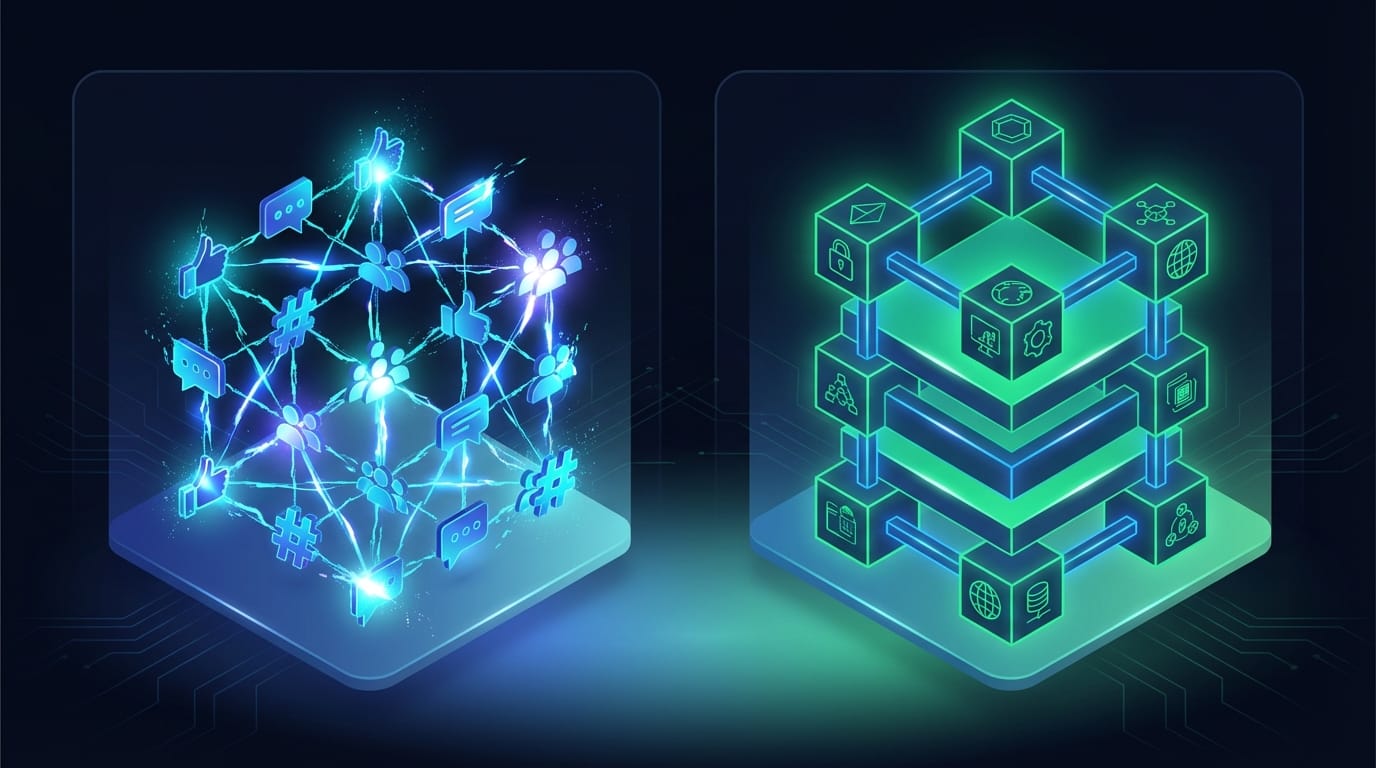
Memecoins are cryptocurrencies that derive their value primarily from internet culture, community hype, and social media sentiment - not from technological utility, underlying cash flows, or economic fundamentals.
That distinction matters enormously from both an investment and a Shariah perspective. Bitcoin was built as a scarce, decentralised store of value with defined issuance mechanics. Ethereum powers a global smart contract ecosystem with thousands of live applications. Memecoins, by contrast, are typically created as jokes, community experiments, or outright speculative vehicles - with price determined almost entirely by how many people are talking about them on a given day.
The gap between memecoins and "utility cryptocurrencies" isn't just philosophical. It's structural. If you want to understand how Bitcoin works as a foundational crypto asset, that context makes the memecoin contrast even starker.
The Four Defining Characteristics of Memecoins
Notable Memecoins: Dogecoin, Shiba Inu, $TRUMP Coin and Beyond
Dogecoin is the original - created in 2013 as an explicit parody of the crypto craze by Billy Markus and Jackson Palmer. Despite its satirical origins, it developed a genuine community with real-world tipping use cases, though its value remains overwhelmingly driven by speculation and Elon Musk's social media activity. According to CoinGecko, Dogecoin's all-time high was $0.7316 in May 2021, representing a peak market cap above $88 billion, before collapsing. For context on why Dogecoin's supply mechanics make extreme price targets mathematically improbable, the Zipmex Dogecoin deep-dive breaks down the math in full.
$TRUMP coin represents a different category of concern entirely: political branding turned into a speculative instrument. Launched days before the US presidential inauguration, it reached an ATH of $75.37 on January 19, 2026, before losing more than 95% of that value within months - a textbook illustration of a hype-driven instrument untethered from fundamental value.
Islamic Shariah Perspective: Are Memecoins Halal or Haram?
This is the core question - and it deserves a rigorous, honest answer rather than a quick ruling in either direction.
The classical Shariah framework for evaluating any financial transaction rests on several foundational conditions. The Shafi'i scholar Imam Ibn Roslan, in Matan Az-Zubad, outlined five conditions for a valid sale: the asset must be pure, it must be beneficial (manfa'ah), it must be deliverable, it must be owned, and it must have been seen. The emphasis on manfa'ah - genuine benefit and utility - is not incidental. It's the core of how Islamic law distinguishes productive economic activity from exploitation.
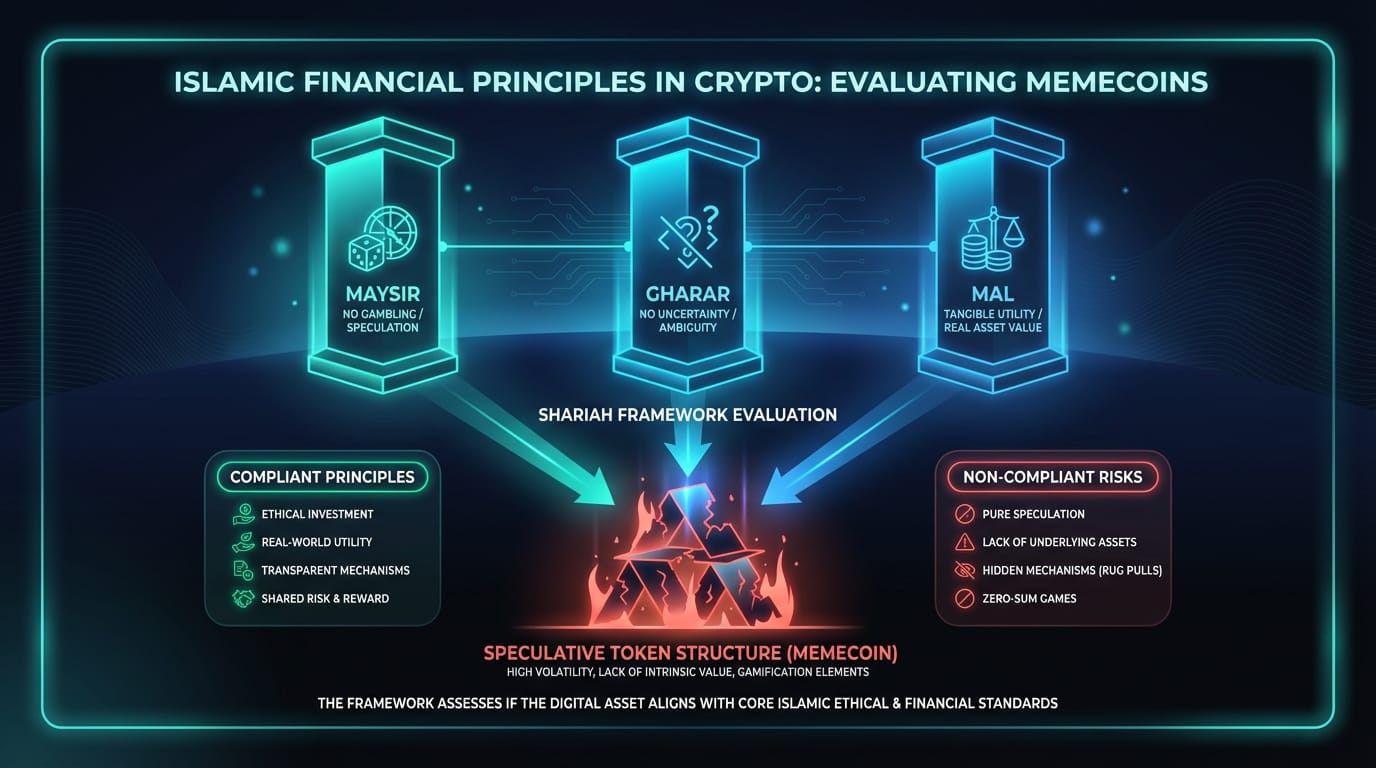
When you apply this framework to memecoins, three core concerns emerge immediately:
⚡ The Three Core Shariah Concerns with Memecoins
- Maysir - gambling-like speculation where gains depend on chance rather than productive activity
- Gharar - excessive uncertainty so fundamental that the transaction becomes inherently unfair
- Absence of Mal (valid wealth) - the asset fails the Shariah test for legitimate property because it lacks genuine utility
The Core Shariah Problem: Maysir (Gambling) and Memecoins
Maysir - gambling or prohibited speculation - is one of the most clearly defined prohibitions in Islamic finance. Its defining characteristic is that one party's gain comes directly at another's expense, without any productive value creation in between.
Memecoin trading mirrors this structure almost exactly. Prices don't respond to revenue growth, technology development, or utility adoption. They respond to viral momentum - and that momentum is almost always manufactured. When a well-connected group of insiders accumulates a position and then orchestrates hype across social media, the price surges. Retail buyers arrive late, buying near the peak. The insiders sell. The price collapses. The late buyer's loss is the early entrant's profit. No economic value was created.
Mufti Faraz Adam, Chief Shariah Officer at Amanah Advisors, draws this connection explicitly. When asset value is driven by short-term hype and emotional reaction rather than legitimate economic merit, the trading activity shares the essential structure of maysir - regardless of whether it occurs on a blockchain or at a casino table.
Sheikh Taha Karaan has stated the same principle more directly: transactions rooted in pure chance and momentum speculation share more with gambling than investing, regardless of their technical form.
Gharar and the Absence of Mal - Why Memecoins Fail the Shariah Asset Test
Gharar - excessive uncertainty - is often confused with normal market risk, but the distinction is critical. Normal risk (not knowing whether a business will succeed) is acceptable in Islamic finance. Gharar refers to uncertainty so fundamental to the transaction itself that it becomes inherently unfair.
Memecoins are a textbook case of gharar. Their price trajectory is disconnected from any model. Their developers are often anonymous, with no legal accountability. Their "roadmaps," where they exist at all, are meaningless marketing documents. There is no cash flow to discount, no utility adoption curve to analyse, no fundamental value floor.
Beyond gharar, there is the question of Mal - whether a memecoin even qualifies as legitimate Islamic property at all. All four classical schools of jurisprudence require that valid property must possess genuine utility and benefit. The Hanafi position (Ibn Nujaym), Maliki position (Ibn al-Arabi), Shafi'i position (Imam al-Zarkashi), and Hanbali position (Imam al-Mardawi) are consistent: an asset that serves no productive purpose is on very shaky ground as legitimate Mal under any of the four madhabs.
⚠ Classical Fiqhi Principle
دَرْءُ الْمَفَاسِدِ أَوْلَى مِنْ جَلْبِ الْمَصَالِحِ
"Preventing harm takes precedence over acquiring benefits." - This principle appears repeatedly in scholarly discussions of memecoins. The potential for profit exists, but so does the near-certainty of harm to individual investors, market integrity, and the broader ideal of productive economic activity that Islamic finance is built around.
The Nuanced View - When Could a Memecoin Become Permissible?
Not every scholar takes an absolute position. Islamic Finance Guru (IFG) explicitly states they do not consider memecoins categorically haram. Their house view: memecoins are "deeply problematic and not barakah-linked" - which is meaningfully different from a blanket prohibition.
Their reasoning: once a memecoin has genuinely transcended its speculative origins and developed a real, functioning community with actual use cases - like tipping, payments, or community governance - the Shariah analysis may shift. Dogecoin, which has been used for genuine peer-to-peer tipping and accepted as payment by some companies, sits in this grey zone. That said, this is a minority position and not widely endorsed. The scholarly weight trends strongly toward avoidance.
Scholarly Opinions on Memecoins - What Prominent Scholars Say
The scholarly weight here is significant. Four out of five named authorities - from different regions, different madhabs, and different institutional backgrounds - converge on the same conclusion: memecoins are either impermissible or so deeply problematic that Muslims should avoid them.
The IFG nuanced position is the outlier, and even it doesn't advocate for memecoins - it simply resists a blanket prohibition while acknowledging the serious concerns.
For Muslim investors looking for practical guidance, the scholarly consensus is unusually clear by Islamic finance standards: the default position is avoidance.
Are Memecoins a Good Investment for Muslim Investors?
Setting the Shariah question aside entirely for a moment - are memecoins financially sound? The data is unforgiving.
Research across speculative crypto trading consistently shows that the vast majority of retail traders lose money in these markets. The structural dynamics explain why: by the time most retail investors hear about a memecoin surge, early buyers - often insiders, influencers, and coordinated groups - are already positioned and waiting for exactly that retail influx to sell into. To understand how funding rates and perpetual market mechanics work in crypto derivatives, and why market structure systematically disadvantages late entrants, that guide covers the mechanics in depth.
⚠ Key Risks of Memecoin Investment
- Speculative-only value → No revenue, no utility, no cash flow - price depends entirely on sustained hype
- Extreme volatility → $TRUMP coin fell from an ATH of $75.37 to under $3 within months of launch
- Pump-and-dump exposure → Retail investors almost always arrive late, after insiders are already positioned to exit
- No regulatory protection → Self-custody means no recourse if you're defrauded; most memecoins operate outside any regulatory framework
- Liquidity illusions → High market cap doesn't guarantee you can exit - thin order books mean large positions can't be unwound without crashing the price
Dogecoin's collapse from its 2021 peak, wiping out billions in late-investor wealth, is the canonical case study. According to CoinGecko, Dogecoin's ATH of $0.7316 in May 2021 was followed by a decline of over 85% within months. $TRUMP coin's 96% drop from ATH in under a year is the most recent data point. These aren't anomalies - they're the expected outcome for the majority of participants.
If you choose to engage despite these warnings, the only defensible approach is to treat any memecoin position as "entertainment spending" - money you've already mentally written off. Never deploy savings, emergency funds, or serious investment capital.

Halal Alternatives to Memecoins for Muslim Investors
The more productive question isn't whether memecoins are halal - it's where Muslim investors who want crypto exposure can direct their capital more responsibly.
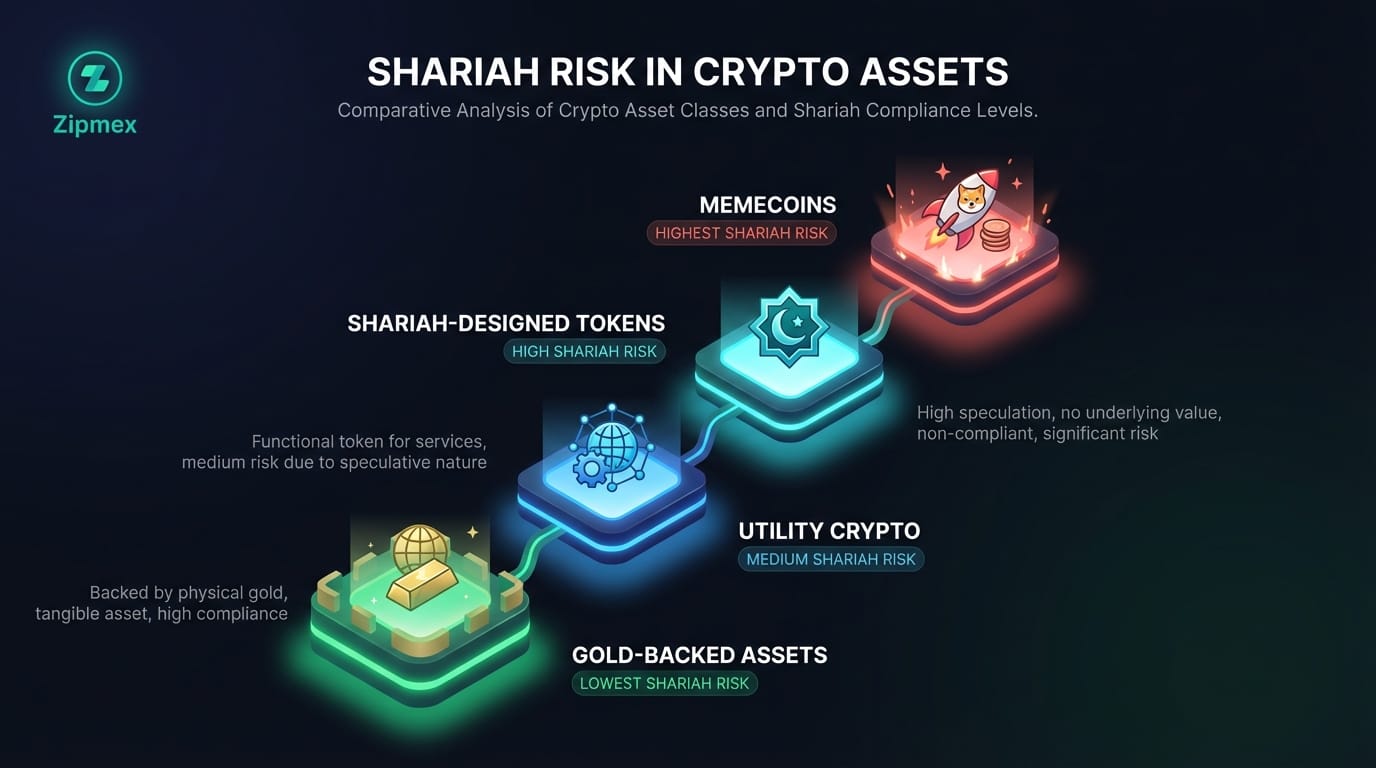
Bitcoin and Ethereum occupy a more defensible position under Shariah than memecoins - not because they're automatically halal, but because they possess genuine utility. Bitcoin functions as a decentralised store of value with a fixed maximum supply of 21 million BTC, and Ethereum powers a global smart contract economy with real-world DeFi applications.
Islamic Coin (ISLM) represents a different model entirely - the HAQQ blockchain was built from the ground up with Shariah compliance as a design principle, developed in consultation with Islamic scholars. A portion of each newly minted ISLM is designated for charitable causes (Sadaqah), building Shariah compliance directly into the token economics.
Gold-backed tokens like PAX Gold bring the classical Islamic preference for asset-backed wealth into the blockchain context. When each token represents a verified 1:1 claim on physical gold, the Mal question is resolved - you own a fractional claim on something with clear, tangible utility.
For Muslim investors interested in higher-risk, higher-reward opportunities that align with Islamic values, early-stage halal startup investing via venture capital structures offers a compelling alternative. Unlike memecoins, VC investments in productive technology companies fund innovation, generate employment, and grow genuine businesses - fully consistent with Islamic principles around productive economic participation.
Red Flags and Scams: Protecting Muslim Investors in the Memecoin Space
The memecoin market is not just Islamically problematic - it's an active hunting ground for fraud. Understanding the specific mechanics helps Muslim investors protect themselves.
From a Shariah perspective, these schemes involve zulm - injustice and oppression - which is categorically prohibited regardless of whether the victim consents to participation. Creating a financial instrument designed to exploit the uninformed violates the Islamic obligation to engage in honest, fair transactions.
⚠ Memecoin Red Flags - Check Before You Invest
- Anonymous or unverifiable team - No real names, no legal accountability, no recourse if developers disappear
- No credible whitepaper or roadmap - "It's just a meme" is not a value proposition; absence of documentation signals zero long-term intent
- Concentrated token ownership - If 20-30% of supply sits in a handful of wallets, those holders can crash the price at any time
- Celebrity endorsements as primary marketing - Paid shilling almost always signals a distribution event; the celebrity gets paid, retail buyers get left holding
- Pump.fun or similar no-vetting launch - Hundreds of scam tokens launch on such platforms daily; due diligence falls entirely on the buyer
- Liquidity locked for very short periods - Legitimate projects lock liquidity for years; short locks (30-90 days) signal a team preparing an exit
- Aggressive urgency language - "Don't miss the next 100x" and "last chance to get in early" are FOMO triggers, not investment analysis
- No smart contract audit - Unaudited contracts can contain built-in "rug pull" functions that let developers drain the liquidity pool instantly
The Islamic legal concept of zulm applies here in full force. Designing a financial product to transfer wealth from the uninformed to the informed through manufactured excitement isn't just risky - it's a fundamental violation of the Islamic prohibition on oppression and exploitation.
Conclusion - So, Are Memecoins Halal?
After working through the Shariah framework, the scholarly opinions, and the financial realities, here's an honest verdict.
The dominant scholarly position: Memecoins are highly problematic under Islamic law. The combination of maysir, gharar, and the failure to qualify as legitimate Mal creates a Shariah case against memecoins that is unusually consistent across scholars from different regions and madhabs. The principle of dār' al-mafāsid counsels strongly toward avoidance.
The nuanced minority position: Not categorically haram, but deeply problematic and not barakah-linked. IFG's position allows that a memecoin which has genuinely developed community utility might be evaluated differently. Dogecoin is the clearest case where this argument has some traction.
The practical verdict: Even setting aside the religious question entirely, the financial case for memecoin investing is unfavourable for most retail participants. The structural dynamics favour early insiders. Volatility is extreme. Regulatory protection is absent.
SHOULD I INVEST IN MEMECOINS? - DECISION FRAMEWORK
Step 1
Do you accept the Shariah concerns documented above?
→ No → Avoid memecoins entirely. Explore halal alternatives such as Bitcoin, Ethereum, or ISLM.
Step 2
Yes, I understand and accept the risk - can you afford to lose 100% of this allocation?
→ No → Do not invest. This is not suitable capital for memecoins.
Step 3
Yes, it's money I can fully lose → Treat it as entertainment only. Limit allocation to ≤1-2% of total portfolio. Never increase this allocation based on early gains.
For Muslim investors seeking the most defensible path: conservative investors should avoid memecoins entirely and redirect to halal alternatives. Risk-tolerant investors seeking crypto exposure should consider Bitcoin and Ethereum for long-term holding, verifying Shariah screening via platforms like Sharlife or IFG's halal crypto list. Those seeking high-risk, high-reward opportunities aligned with Islamic values should explore early-stage halal startup investing - which creates genuine economic value rather than redistributing wealth through manufactured excitement.
For personalised guidance on whether a specific asset aligns with your circumstances and values, consult a qualified Islamic finance scholar. The XRP investment analysis on Zipmex shows how to apply rigorous on-chain fundamentals analysis to assess any crypto asset's investment thesis - the same analytical discipline applies here.
Crypto trading involves substantial risk of loss. Leveraged positions amplify both gains and losses. This content is for educational purposes only and does not constitute financial advice. Past market performance does not indicate future results.
Last updated: March 2026.
Frequently Asked Questions
Are memecoins halal or haram in Islam?
The dominant scholarly position classifies memecoins as highly problematic under Shariah, and most Islamic finance scholars advise avoidance. The core concerns are maysir (gambling-like speculation where gains depend on hype rather than productive activity), gharar (excessive uncertainty), and the failure to qualify as legitimate Mal - valid property under Islamic law must possess genuine utility. A minority nuanced view, articulated by Islamic Finance Guru, holds that memecoins are not categorically haram but are deeply problematic and not barakah-linked. The weight of scholarly opinion, from Mufti Faraz Adam to Sheikh Haitham al-Haddad, strongly favours avoidance for most Muslim investors.
What is maysir, and why does it apply to memecoins?
Maysir is the Islamic term for gambling or prohibited speculation - any transaction where one party gains at another's direct expense without creating productive economic value. It's explicitly prohibited in the Quran (5:90). Memecoins trigger maysir concerns because their prices don't respond to revenue or utility - they respond to viral momentum. When insiders accumulate a position, manufacture hype, and sell to retail buyers near the peak, the late buyer's loss is the insider's profit with no value created. This structural dynamic mirrors gambling more than legitimate investment, which is why scholars like Sheikh Haitham al-Haddad and Mufti Faraz Adam draw this connection explicitly.
What is gharar, and how does it relate to memecoin investing?
Gharar means excessive uncertainty so fundamental to a transaction that it becomes inherently unfair - distinct from normal market risk, which Islamic finance permits. Memecoins embody gharar in multiple layers: anonymous developers with no legal accountability, absent or meaningless roadmaps, prices completely disconnected from any fundamental analysis, and no regulatory framework providing accountability. You genuinely cannot assess what you're purchasing or what might sustain its value. Classical scholars across all four madhabs - Hanafi, Maliki, Shafi'i, and Hanbali - identify gharar of this degree as grounds for a transaction's invalidity under Shariah.
Is $TRUMP coin halal or haram?
$TRUMP coin is considered one of the most problematic memecoins from a Shariah perspective. Launched on January 17, 2026 just before the US presidential inauguration, it reached an all-time high of $75.37 before losing over 95% of that value within months. Beyond the standard memecoin Shariah concerns of maysir and gharar, $TRUMP coin raises additional issues: political branding used to drive speculation, significant token concentration in Trump-affiliated entities (creating manipulation concerns), and what many scholars would classify as an exploitation of public trust for financial gain - touching on the Islamic prohibition of zulm (oppression/injustice).
What is the Islamic Finance Guru's view on memecoins?
Islamic Finance Guru (IFG), founded by Ibrahim Khan, holds a nuanced position: memecoins are not viewed as categorically haram, but are considered "deeply problematic and not barakah-linked." Their reasoning is that once a memecoin has genuinely transcended its speculative origins and developed real community utility - as Dogecoin arguably has in limited ways - its Shariah assessment may shift. Practically, IFG still strongly recommends against treating memecoins as serious investment capital and directs investors toward more defensible halal alternatives. This is a minority scholarly position; the majority of Islamic finance scholars are more restrictive.
Is Dogecoin halal in Islam?
Dogecoin occupies a contested grey zone compared to most memecoins. Created in 2013 as a parody cryptocurrency, it has since developed genuine real-world use cases - tipping, peer-to-peer payments, and acceptance by some merchants as payment. IFG's nuanced position suggests that Dogecoin's evolution may make it evaluable on its own merits rather than purely as a "meme coin." However, its value remains overwhelmingly driven by speculative sentiment and Elon Musk's social media activity rather than utility fundamentals. Most scholars still advise caution. Its inflationary unlimited supply also presents long-term value sustainability concerns distinct from the Shariah analysis.
What makes a cryptocurrency Shariah-compliant?
Shariah compliance for a cryptocurrency rests on several cumulative tests: the asset must possess genuine utility and benefit (manfa'ah) - it must do something productive in the real world; its underlying activity must not involve prohibited sectors such as gambling, adult content, or interest-based finance; trading must avoid maysir and gharar; there must be no riba component embedded in the asset's economics; and the asset must be capable of qualifying as legitimate Mal - property Islamic law recognises as valid for trade. Assets meeting all five criteria can generally be held and traded in ways consistent with Islamic principles. Bitcoin and Ethereum are the two most commonly screened and conditionally permitted assets, particularly for long-term holding.