BakerySwap was one of the first protocols to prove that Binance Smart Chain could support a complete DeFi ecosystem - not just cheap token swaps, but yield farming, NFT trading, governance, and project launches all in a single platform. Powered by BAKE coin, it's been running since September 2020, and this bakery swap guide covers everything from AMM mechanics to liquidity farming to avoiding scam tokens lurking on its DEX.
⚡ Key Takeaways
- BakerySwap is a BSC-native AMM+DEX+NFT platform launched in September 2020
- BAKE is a BEP-20 governance and reward token - no presale, no team token reserve
- Trading fee: 0.30% - 0.25% goes to liquidity providers, 0.05% to BAKE holders
- Liquidity providers receive BLP tokens representing their pool share
- Platform risk includes impermanent loss, smart contract exposure, and market volatility
What Is BakerySwap? The BSC-Native AMM and NFT Platform Explained
BakerySwap is a decentralised exchange (DEX) built on Binance Smart Chain that operates on an automated market maker model - meaning trades happen against shared liquidity pools, not between individual buyers and sellers. It launched in September 2020 by an anonymous team operating under a DAO (decentralised autonomous organisation) structure and quickly distinguished itself as the first open-source AMM on BSC to integrate an NFT marketplace alongside yield farming.
The BSC choice was deliberate. Ethereum's gas fees were running $15-100 per transaction during peak DeFi seasons, pricing out retail users entirely. BSC offered near-instant transaction processing at fractions of a cent - making it viable for frequent LP management, small-scale farming, and NFT trading that would be economically absurd on Ethereum mainnet.
Compared to Uniswap, which pioneered the AMM model on Ethereum, BakerySwap operates the same orderbook-free mechanism but adds layers Uniswap doesn't have: native NFT trading, a curated Bakery Gallery for premium digital art, and an IDO launchpad that issues NFTs rather than utility tokens. That combination - AMM + NFT-Fi - is what makes it distinct on BSC.
How the AMM Model Works on BakerySwap
The core mechanic is straightforward once you see it clearly. Instead of matching a buyer with a seller, BakerySwap uses the constant product formula - x . y = k - where x and y represent the quantities of two tokens in a pool, and k is a constant. When you swap token A for token B, you add token A and remove token B. The price adjusts automatically based on the new ratio in the pool.
Here's what that looks like in practice:
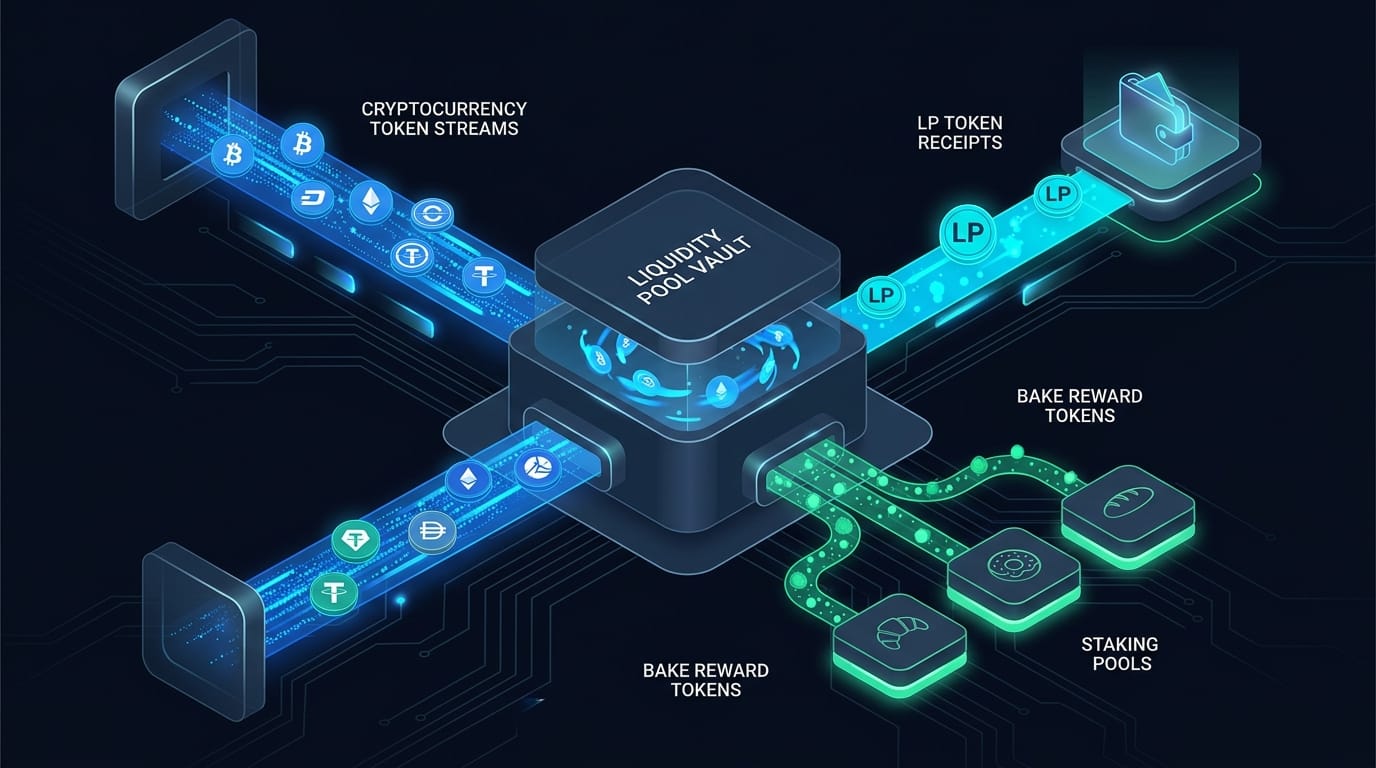
Liquidity providers deposit both tokens in equal value. They receive BLP tokens (BakerySwap Liquidity Provider tokens) proportional to their share of the pool. These BLP tokens are redeemable at any time for the underlying assets plus accumulated trading fees.
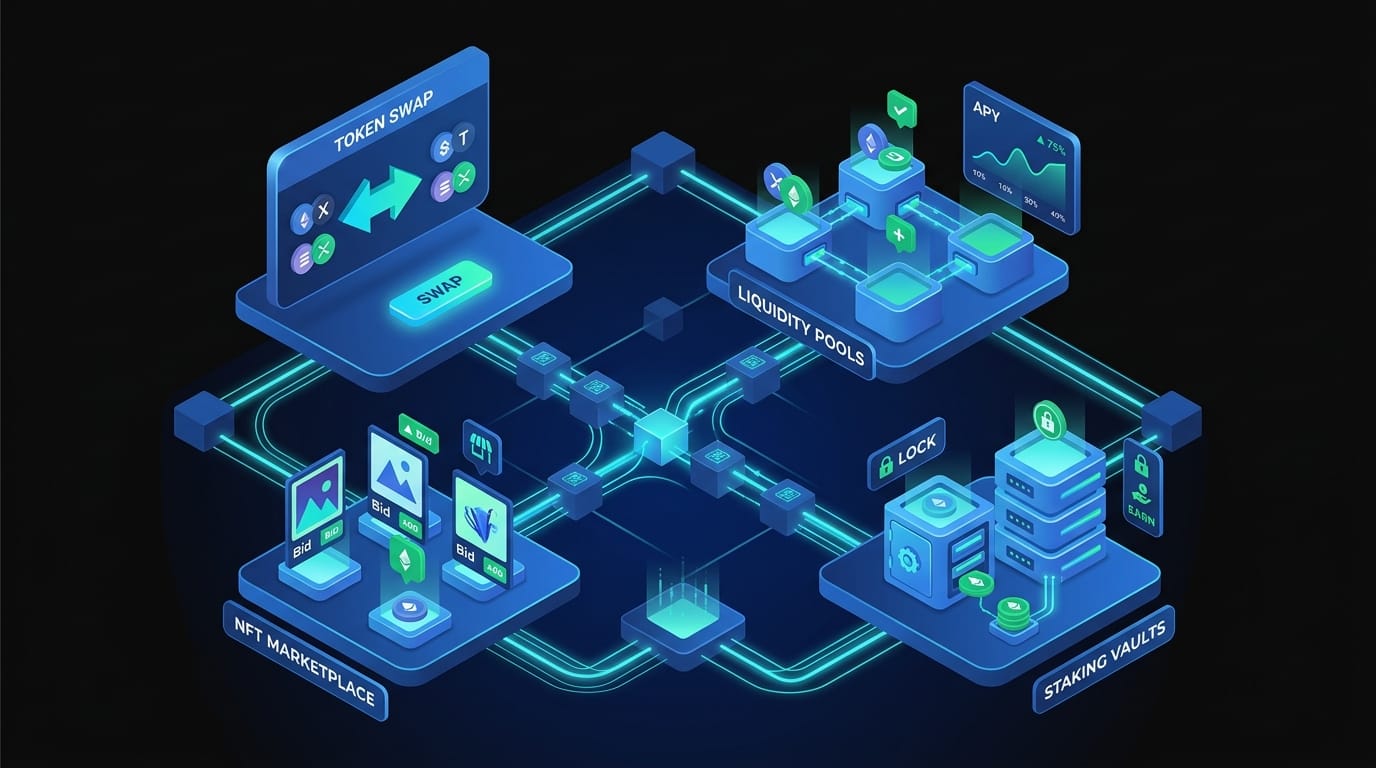
BakerySwap Core Features at a Glance
The food-themed naming - Doughnut, Waffle, Rolls, Croissant, Latte pools - is more than aesthetic. Each pool name represents a different LP pairing with its own APY multiplier, and the staking interface is designed to feel approachable rather than intimidating for newer DeFi users.
BAKE Coin Explained - Tokenomics, Utility, and Distribution
BAKE is the native BEP-20 token that powers every part of the BakerySwap ecosystem. Four distinct use cases define its utility: governance voting on protocol upgrades and parameter changes, liquidity mining rewards for LP providers, trading fee dividends (0.05% of every swap flows to BAKE holders proportionally), and payment currency throughout the NFT Supermarket.
What makes BAKE's launch credentials credible is what didn't happen. There was no presale. No team token reserve. The developer team operates entirely on a 1% share of farmed BAKE - for every 100 BAKE tokens farmed on the platform, the devs receive 1. That's a genuinely low developer allocation relative to most DeFi projects and aligns the team's incentives directly with farming activity rather than front-loaded token dumps.
The current circulating supply sits at approximately 290 million BAKE, with the remaining supply to be released via block rewards over a ~24-year emission schedule. That gradual release is designed to prevent sudden supply shocks while sustaining LP incentives over time.
How to Earn BAKE - Farming, Staking, and Fee Dividends
1. Yield Farming via BLP Token Staking
Deposit two tokens (e.g., BNB + BAKE) into a liquidity pool in equal value. You receive BLP tokens representing your share. Navigate to the Earning section, select the matching pool (e.g., Doughnut for BNB/BAKE), stake your BLP tokens, and BAKE rewards begin accumulating. Different pools carry different multipliers - higher multipliers mean more BAKE emissions directed to that pool, translating to higher APY during periods of strong platform activity.
2. BAKE Bread Staking (Single-Asset)
Stake BAKE directly to earn more BAKE. No token pair required, no impermanent loss exposure. The Bread staking pool is the lowest-complexity path to earning on BakerySwap - ideal for users who hold BAKE but don't want to manage a two-asset LP position.
3. Passive Fee Dividends
Hold BAKE in your wallet. Every time a swap executes on BakerySwap, 0.05% of that trading volume is distributed to BAKE holders. No action required beyond holding. Returns are proportional to your share of the total BAKE supply and scale with platform trading volume - making this a genuine passive income mechanism tied directly to platform usage, not token emissions.
The 0.25% / 0.05% fee split is an important detail that separates BakerySwap from protocols that direct all fees to LPs. BAKE holders capture a slice of every trade regardless of whether they're actively providing liquidity.
BAKE Inflation, Burns, and the Path to Deflationary Tokenomics
BakerySwap currently runs an inflationary model. BAKE is minted per block as farming rewards - that's a standard approach for bootstrapping liquidity in early DeFi protocols. PancakeSwap and SushiSwap (from which BakerySwap forked) both launched with the same inflationary mechanism for the same reason: you need to attract liquidity providers, and high early APYs are the most reliable tool.
Three counter-mechanisms slow the inflation:
- Buyback and burn: 0.05% of all trading fees is used to buy BAKE from the open market and burn it, permanently reducing circulating supply
- Tapered emission schedule: Block rewards decrease over the ~24-year emission timeline - earlier blocks produce more BAKE than later ones
- Governance-adjustable rates: BAKE holders can vote to modify emission parameters, giving the community a direct lever on token supply growth
The team's stated goal is net deflation - a state where burns and reduced emissions outpace new minting. That transition hasn't been achieved yet, and honest assessment requires acknowledging it's a target rather than a current reality. PancakeSwap navigated a similar path by introducing a hard supply cap and aggressive CAKE burning mechanisms. BakerySwap's tokenomic evolution is still in progress, which is a consideration for long-term holders.

How to Use BakerySwap - Step-by-Step Setup Guide
BakerySwap is non-custodial by design - your private keys stay with you, every transaction settles on-chain, and the platform never takes custody of your assets. That self-custodial structure is a genuine security advantage over centralised exchanges, but it also means full responsibility sits with you. There's no support team to recover a lost wallet or reverse a mistaken transaction.
📋 Before You Start: 3 Prerequisites
- A compatible wallet configured for Binance Smart Chain (MetaMask or WalletConnect recommended)
- BNB in your wallet to pay for BSC gas fees (a few dollars' worth covers hundreds of transactions)
- The tokens you intend to swap or deposit - held as BEP-20 standard tokens in your wallet
Configuring MetaMask for Binance Smart Chain
MetaMask defaults to Ethereum mainnet, but adding BSC takes under two minutes. For a full guide to BSC-compatible wallets, see Zipmex's ranking of top BEP-20 wallets.
WalletConnect works as a direct alternative for mobile users - connect your phone wallet by scanning the QR code on the BakerySwap interface. The process is identical regardless of which BSC-compatible wallet you use.
Executing Your First Swap on BakerySwap
The 0.30% trading fee is deducted automatically from the input amount - no separate action required. You're swapping peer-to-contract, not through an intermediary, which means on-chain settlement and full transaction verifiability on BscScan.
⚠ Token Safety Check
- Before swapping an unfamiliar token → verify its contract address on BscScan. Scam tokens often mimic legitimate names - the contract address is the only reliable identifier.
Adding Liquidity and Starting Yield Farming
Step-by-step LP setup:
- Click Exchange → Pool → Add Liquidity
- Select your token pair - for example, BNB and BAKE
- Enter an amount for either token; the platform calculates the required amount of the second token to maintain equal value
- Confirm both tokens in MetaMask (you may need to approve each token separately the first time)
- Receive BLP tokens in your wallet - these represent your proportional share of the pool
- Navigate to Earning → find the pool that matches your BLP tokens (e.g., Doughnut for BNB/BAKE)
- Click Stake → enter your BLP token amount → confirm → BAKE rewards begin accumulating immediately
Different pools carry different multipliers. A pool with a 20x multiplier attracts 20 times more BAKE emissions than a 1x pool - which typically translates to higher APY when farming is active. Check the live platform for current multipliers before deciding which pool to enter.
⚠ Impermanent Loss Warning: What It Means for Liquidity Providers
Impermanent loss (IL) occurs when the price ratio of your deposited tokens changes after you enter the pool. If BNB doubles in price relative to BAKE while you're providing liquidity, you end up with less BNB and more BAKE than you started with - worth less overall than if you'd simply held both tokens. The loss is "impermanent" because it reverses if prices return to their original ratio, but it becomes permanent when you withdraw liquidity. BAKE farming rewards can offset IL during high-APY periods, but they don't eliminate the risk. Pairs where both tokens move together (e.g., BNB/ETH) carry lower IL risk than volatile pairs.
BakerySwap NFT Marketplace and Bakery Gallery - A Full Overview
The NFT integration is what separates BakerySwap from generic BSC AMMs. When it launched in 2020, it was the first DeFi platform on BSC to embed an NFT marketplace directly into the protocol - not as a separate product, but as a BAKE-powered ecosystem component. If you're new to NFT creation, Zipmex's guide to free NFT minting covers the broader minting landscape across platforms.
The Supermarket hosts over a million items, filterable by media type (images, audio, GIFs, video), sortable by time, price, or vote count, and organised into categories including Featured Artists, Partner Stores, and Game Assets. The sheer volume can be noisy, but the filter system makes discovery workable once you know what you're looking for.
The original NFT Combos deserve mention for historical context. At launch, users could mint random NFT "combo meals" by depositing BAKE - these existed in four tiers based on the BAKE amount committed:
- Basic: 10,000 - 20,000 BAKE
- Regular: 20,000 - 50,000 BAKE
- Luxury: 50,000 - 100,000 BAKE
- Supreme: 100,000+ BAKE
New Combo minting is no longer available, but existing Combos still trade on the Supermarket and retain their original staking utility. The IDO Launchpad operates differently from Binance Launchpad - where Binance launches utility tokens, BakerySwap's Launchpad issues NFTs for new BSC projects, making every IDO an NFT-based event rather than a traditional token sale.
All NFT transactions across every section use BAKE as the payment currency. That constant demand for BAKE across the platform's NFT activity is a meaningful utility driver for the token - every NFT purchase, minting fee, and IDO participation absorbs BAKE from the market.
Evaluating BakerySwap - How It Compares to PancakeSwap, Uniswap, and SushiSwap
BakerySwap occupies a specific niche in the BSC DEX landscape: it's the NFT-DeFi hybrid platform, with a fair-launch token structure and a tighter community focus. Understanding where it genuinely excels versus where it falls short of larger competitors requires honest analysis.
BakerySwap vs PancakeSwap - Key Differences
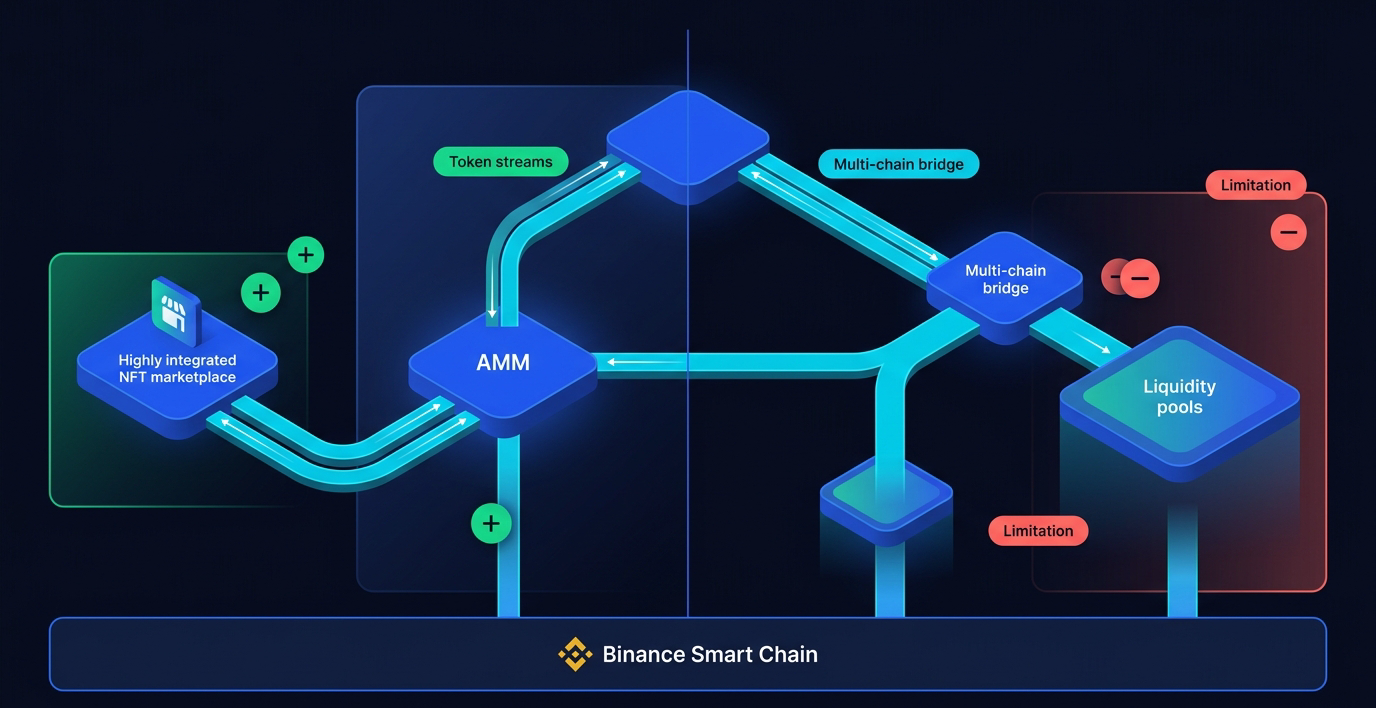
PancakeSwap is the dominant BSC DEX by almost every metric - total value locked, daily trading volume, token pair availability, and cross-chain reach. That's the honest starting point.
Where PancakeSwap wins:
- Significantly deeper liquidity, meaning lower slippage on large trades
- Multi-chain bridges extending to Ethereum, Arbitrum, zkSync, and others
- More advanced trading products: perpetual futures, prediction markets, limit orders
- CAKE has undergone multiple deflationary pivots including a hard supply cap - its tokenomics are more mature
Where BakerySwap holds its own:
- First-mover NFT integration on BSC - still the more NFT-native platform
- Gamified staking mechanics (food-themed pools) with a more community-oriented feel
- No presale, no team token reserve - the fairest launch model of the two
- Lower profile means less front-running risk on smaller, niche BSC token pairs
The use-case split is clear: if you need high-volume token swaps or access to wide BSC liquidity, PancakeSwap is the practical choice. If you're building an NFT collection, farming niche BSC token pairs in a community-driven environment, or prioritise the no-presale credentialing, BakerySwap is the more appropriate home.
For TVL figures and live liquidity comparisons, DeFiLlama provides current on-chain data - any specific numbers here would be outdated within days.
Free vs Paid vs AI-Based DeFi Tools - Business Model Comparison
BakerySwap works on its own, but pairing it with the right external tools can meaningfully improve outcomes - whether you're optimising yield, verifying token safety, or tracking portfolio performance.
Free tools are the foundation. BscScan for transaction verification, DeFiLlama for TVL monitoring, and TokenSniffer or PooCoin for new token safety checks cost nothing and should be standard practice for any BSC user. Paid yield aggregators like Beefy Finance add genuine value for active farmers - auto-compounding restakes your BAKE rewards automatically, boosting effective APY through compounding frequency without requiring manual harvesting. The trade-off is additional smart contract exposure: your funds interact with Beefy's contracts on top of BakerySwap's contracts. Evaluate audits and TVL before committing significant capital to any aggregator.
BakerySwap Risks and Red Flags - What Every User Should Know
⚠ 5 Key Risks to Know Before Using BakerySwap
- Impermanent Loss → providing liquidity to volatile pairs can reduce your net position vs. holding
- Smart Contract Risk → even audited code can contain vulnerabilities; no DeFi protocol is immune
- Market Volatility → BAKE reached an ATH of ~$8.42 in May 2021; it now trades below $0.002
- Anonymous Team Risk → governance accountability depends on DAO participation; no named leadership
- Regulatory Uncertainty → BSC-based DeFi operates in a shifting regulatory environment across jurisdictions
The price history of BAKE is the most visceral illustration of crypto volatility risk. May 2021's all-time high of approximately $8.42 versus the current sub-$0.002 trading range represents a greater than 99.9% decline from peak. That's not exceptional for altcoins in the DeFi space, but it contextualises what holding BAKE through a full market cycle can look like. Farming rewards can compound during bull markets, but they don't protect against extended bear market drawdowns in the underlying token value.
Smart contract risk is real even on a protocol that has been operating since 2020 without a major exploit. The codebase is open-source and has undergone security monitoring, but the DeFi landscape has produced exploits on audited, established protocols. Limiting exposure in any single protocol and prioritising audited pools over new unverified ones is standard risk hygiene.
The anonymous team adds a layer of governance uncertainty. There's no named developer or organisation to hold accountable for protocol decisions. The DAO structure distributes governance to BAKE holders, which is the intended design, but it also means that coordinated governance attacks or low voter participation can shift protocol parameters in ways individual holders don't anticipate.
Identifying DeFi Red Flags - Scam and Rug Pull Warning Signs
BSC's low fees and permissionless token creation make it attractive for scammers. BakerySwap's DEX lists tokens created by anyone - which includes honeypot contracts, rug pulls, and copycat scams. The protocol itself has nothing to do with these tokens, but they appear on the same interface.
⚠ 5 Red Flag Checks Before Interacting with a New Token on BakerySwap
- Verify the contract on BscScan → token name and symbol are easily faked; the contract address is unique
- Run a honeypot check → use TokenSniffer or PooCoin to test whether the token can be sold after purchase
- Assess APY realism → multi-thousand percent yields on anonymous tokens with zero audit history are almost always extraction mechanisms
- Check for a smart contract audit → reputable firms include CertiK, Hacken, and PeckShield; absence of any audit raises the risk profile meaningfully
- Watch for social pressure tactics → FUD-driven urgency, anonymous Telegram admins, or celebrity-named tokens are consistent scam patterns
BakerySwap's core protocol (the DEX, farming pools, and NFT marketplace for established collections) has demonstrated stability since 2020. The third-party token risk on its open DEX is a separate issue - it's not a BakerySwap problem, it's a permissionless blockchain problem. Treat any new BSC token with the same skepticism you'd apply to a stranger's investment tip.
DeFi Strategies for BakerySwap - Maximising Your BAKE Earnings
Getting onto BakerySwap is straightforward. Getting the most out of it requires matching your strategy to your actual risk tolerance and time commitment. Three levels frame the approach:
Popular Yield Strategies for BakerySwap Users
BAKE Bread Staking is the entry point. Stake BAKE, earn BAKE, no impermanent loss. The downside is that your returns depend entirely on BAKE's token price - if the token depreciates, so does the nominal value of your accumulated rewards regardless of APY percentage. This strategy suits users who are already holding BAKE and want to put it to work without managing a two-asset position.
Stable LP pairs - pairing stablecoins against each other (e.g., BUSD/USDT if available) - minimise impermanent loss almost to zero because both assets track $1. APY is lower, but capital preservation is significantly better. This is the rational choice for users whose primary goal is yield without taking directional risk on volatile assets.
Major asset LP pairs like BNB/BAKE or BNB/ETH offer higher APY multipliers at the cost of meaningful IL exposure when BNB diverges significantly from its paired token. During sideways or mildly trending markets, fee income plus BAKE rewards can produce solid returns. During sharp price movements in either direction, IL can eliminate or exceed those gains.
BSC's low gas fees create an advantage that's genuinely underappreciated: manually harvesting and restaking BAKE every few days is economically viable here. On Ethereum mainnet, the same operation would cost $10-50 in gas - making frequent compounding uneconomical at small scales. On BSC, harvesting a $100 farming position costs cents and meaningfully improves effective APY through compound frequency.
Risk Management Fundamentals for BakerySwap Users
⚠ 5 Risk Management Rules for DeFi Liquidity Providers
- Size positions appropriately → allocate to any single LP pair only what you can sustain through a 50-80% drawdown in the underlying tokens
- Diversify across risk tiers → spread capital across stable pairs (low risk), major pairs (medium risk), and farm pools (higher risk)
- Calculate your IL breakeven point → free tools at dailydefi.org let you input entry prices and current prices to see exactly how much IL you've accumulated vs. fees earned
- Stick to audited, established pools → BakerySwap's core pools have been running since 2020; new unverified pools with aggressive APYs warrant extreme caution
- Maintain an exit plan → define the price level or time horizon at which you'll remove liquidity before entering a position, not after it moves against you
Impermanent loss calculators are an underutilised tool. The general rule: if two tokens in your LP pair diverge by 50% from their entry price ratio, you've lost approximately 5.7% of your position value to IL versus holding. At 100% divergence, that grows to ~25%. These numbers are concrete - not vague risk warnings - and should inform which pairs you enter.
Crypto trading and liquidity provision involve substantial risk of loss. Nothing in this section constitutes financial advice - these are general DeFi mechanics, not recommendations for any specific action.
How to Add and Exit Liquidity - Step-by-Step Execution
Removing liquidity is the part most beginner guides skip. Here's the complete exit process:
One critical point: any impermanent loss that existed in your position becomes permanently realised when you remove liquidity. If you entered at a 50/50 BNB/BAKE split and BNB has appreciated significantly since then, your exit will give you less BNB and more BAKE than you deposited - worth less in total than holding would have been.
BakerySwap Alternatives - Other BSC and Multi-Chain DeFi Options
Not every use case is a perfect fit for BakerySwap. Understanding where the alternatives are stronger helps you use each platform for what it actually does best.
The right answer isn't "use BakerySwap instead of these alternatives" or vice versa - it's using each where its design fits the task.
Conclusion - Is BakerySwap Right for You? A Guide Summary
BakerySwap remains a functioning, relevant DeFi protocol in 2026 with a clear identity: the NFT-integrated AMM on BSC, built on fair-launch principles, with a community-governed token and genuine utility across swapping, farming, staking, and NFT trading.
The competition has intensified since 2020. PancakeSwap has captured a larger share of BSC liquidity, and multi-chain protocols have expanded the competitive set beyond BSC entirely. BakerySwap's response has been to lean into what it does better than most: NFT-DeFi integration, fair tokenomics, and a platform that's been running reliably since its launch.
For active farming, check current pool multipliers and APYs directly at bakeryswap.org - those numbers move with market conditions and any figure printed here would be stale within days. For current BAKE tokenomics and circulating supply data, CoinGecko and CoinMarketCap maintain live on-chain feeds.
Platforms that prioritise on-chain verifiability - where every trade, every farming reward, and every governance vote is publicly visible and independently auditable - represent where DeFi's credibility actually comes from. That principle applies to any protocol you choose to use, BakerySwap included.
Crypto trading and DeFi participation involve substantial risk of loss. Leveraged positions, liquidity provision, and token purchases can result in partial or total loss of capital. This guide is for informational purposes only and does not constitute financial advice. Always conduct your own research before interacting with any DeFi protocol.
Last updated: March 2026.
Frequently Asked Questions
What is BakerySwap?
BakerySwap is a decentralised exchange (DEX) and DeFi protocol built on Binance Smart Chain (BNB Chain) that uses an automated market maker (AMM) model. Launched in September 2020, it allows users to swap BEP-20 tokens without a centralised intermediary, provide liquidity to earn trading fees and BAKE rewards, stake BAKE for additional returns, and buy or mint NFTs in its integrated marketplace. It was the first AMM on BSC to combine DeFi functionality with a native NFT marketplace, which remains its primary differentiator from other BSC DEXs.
What is BAKE coin and what is it used for?
BAKE is the native BEP-20 governance and reward token of BakerySwap. It serves four main functions: rewarding liquidity providers through yield farming, enabling governance voting on protocol parameters, distributing 0.05% of all platform trading fees to BAKE holders proportionally, and acting as the payment currency across the BakerySwap NFT Supermarket and Bakery Gallery. BAKE had no presale and no team token reserve at launch - the developer team receives only 1 BAKE per 100 BAKE farmed, making it one of the fairer-launch governance tokens in the BSC DeFi ecosystem.
What is impermanent loss and does it affect BakerySwap users?
Impermanent loss (IL) is the difference between the value of your LP position and what you would have had if you'd simply held both tokens separately. It occurs when the price ratio of your deposited tokens changes after you enter the pool. For example, if BNB rises 100% against BAKE while you're an LP, you end up with proportionally more BAKE and less BNB than you started with - a net loss versus holding. At 100% price divergence, IL is approximately 25% of your position value. It's called "impermanent" because it reverses if prices return to their entry ratio, but it becomes permanent when you withdraw. BAKE farming rewards can offset IL, but they don't eliminate it.
What is the difference between BakerySwap and PancakeSwap?
Both are BSC-based AMM DEXs forked from the same SushiSwap codebase, but they've diverged significantly. PancakeSwap has substantially higher trading volume, deeper liquidity, multi-chain support, and more advanced products including perpetual futures and prediction markets. BakerySwap has a stronger NFT-native identity - it was the first NFT marketplace on BSC - and a fairer token launch model with no presale or team allocation. For high-volume token trading and cross-chain access, PancakeSwap is the practical choice. For NFT-DeFi integration and community-focused BSC farming, BakerySwap is better positioned.
What are the biggest risks of using BakerySwap?
The primary risks fall into five categories: impermanent loss from liquidity provision (particularly in volatile pairs), smart contract vulnerabilities despite the protocol's operational track record, BAKE token price volatility (the ATH-to-current decline illustrates the range), anonymous team governance accountability risk, and regulatory uncertainty affecting BSC-based DeFi across different jurisdictions. Additionally, BakerySwap's open DEX lists tokens created by anyone - including scam tokens, honeypot contracts, and rug pulls. Always verify token contracts on BscScan and run safety checks via TokenSniffer before interacting with unfamiliar tokens.
How does BAKE combat inflation?
BakerySwap uses three mechanisms to manage BAKE's inflationary block emission. First, a buyback-and-burn programme: 0.05% of all platform trading fees is used to purchase BAKE from the open market and permanently burn it, reducing circulating supply. Second, a tapering emission schedule: block rewards decrease over the ~24-year emission timeline, so earlier blocks produce more BAKE than later ones. Third, governance-adjustable emission rates: BAKE holders can vote to modify the emission parameters directly. The team's goal is eventual net deflation, but the current state is managed inflation rather than true deflation.
Can I use BakerySwap without KYC?
Yes. BakerySwap is a permissionless, non-custodial DEX that requires no registration, no email address, and no identity verification. You connect your BSC wallet directly and interact with the protocol's smart contracts - there's no account to create and no KYC process to complete. This is one of DeFi's core design principles: trustless, permissionless access for anyone with a compatible wallet and BSC tokens. Note that while BakerySwap itself has no KYC, the centralised exchanges where you might purchase BNB or BAKE before using the platform typically do require identity verification.