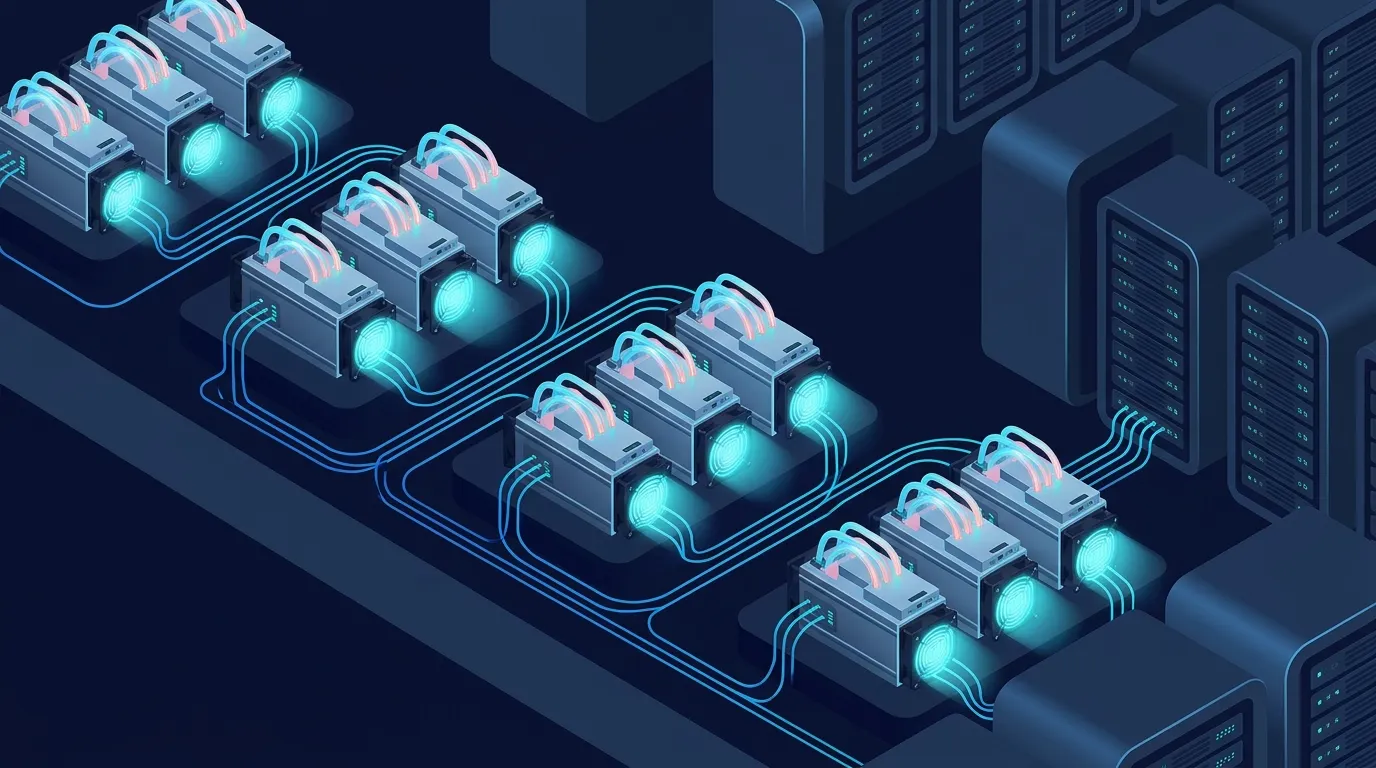
Bitcoin Mining Hardware: ASIC Guide 2026

ยท By Zipmex ยท 12 min read

Bitcoin mining hardware has changed beyond recognition since 2009. What started with a laptop and a spare afternoon now demands purpose-built silicon, industrial cooling, and a serious electricity contract. If you're wondering which hardware actually makes money in 2026 - this guide cuts through the noise.


This structural shift from consumer-grade laptops to application-specific integrated circuits underscores the rapid evolution of digital tokens from an experimental cryptography project into a globally recognized financial asset class. As algorithmic tokenomics continue to reshape international commerce, understanding the core relationship between network security, mining difficulty, and digital scarcity is essential for any modern investor. For a complete foundational breakdown of popular digital tokens and market terms, read our handbook on what is cryptocurrency and how it works.


โšก Quick Answer

Bitcoin mining hardware in 2026 means one thing: ASIC miners. CPU and GPU mining of Bitcoin is economically dead - a single modern ASIC like the Antminer S21 Pro (234 TH/s) outpaces thousands of graphics cards on SHA-256. Profitable setups require electricity below $0.10/kWh and hardware in the sub-15 J/TH efficiency range. Entry-level ASIC rigs start around $4,500; top-tier hydro-cooled machines exceed $16,500.

What Is Bitcoin Mining Hardware?

Bitcoin mining hardware is the physical equipment used to compute SHA-256 hashes at scale, competing to find valid block solutions and earn the current block reward of 3.125 BTC per block. Every ten minutes on average, one miner - or mining pool - wins that reward. The more computational power (hashrate) your hardware contributes relative to the total network, the higher your statistical share of rewards.

The Bitcoin network's hashrate as of May 2026 sits at approximately 935 EH/s - 935 quintillion hash computations per second, from machines running around the clock in data centers worldwide. Your hardware's role is to contribute a slice of that and earn proportionally.

Mining hardware is not just a processor - it's a complete system. A functioning bitcoin mining hardware setup includes:

  • The ASIC chip(s) - the core that performs SHA-256 hashing
  • Hash boards - PCBs housing multiple ASIC chips
  • Control board - coordinates hashing and manages pool connectivity
  • Power supply unit (PSU) - converts AC power; most modern ASICs require 220V+
  • Cooling system - fans (air), liquid loops (hydro), or immersion tanks
  • Mining software - connects hardware to your chosen mining pool

๐Ÿ’ก Pro Tip

Your mining hardware's efficiency rating - measured in Joules per Terahash (J/TH) - is more important than raw hashrate. A lower J/TH number means less electricity burned per unit of Bitcoin mined. At industrial scale, a 1 J/TH improvement across 100 machines saves thousands of dollars per year in electricity.

To fully grasp why this highly specialized computing equipment must continuously execute billions of cryptographic hash calculations per second, it is vital to understand the immutable network structure it is designed to secure. Mining hardware essentially functions as a competitive validator that groups on-chain transactions into permanent data blocks, preventing retroactive tampering across the network. To discover how these distributed ledgers verify updates chronologically without central oversight, see our expert analysis on what are blockchains and how do they work.

Types of Bitcoin Mining Hardware: CPU, GPU, ASIC Compared

Bitcoin mining hardware has evolved through four distinct eras. Understanding this history clarifies why ASICs are the only rational choice for BTC in 2026.

CPU Mining (2009-2010): The Laptop Era

When Satoshi Nakamoto mined the genesis block in January 2009, any standard desktop CPU could participate. Difficulty was negligible and the network ran in kilohashes per second. By mid-2010, as more miners joined and difficulty climbed, CPUs became economically obsolete for Bitcoin - though they persist for certain CPU-mineable altcoins today.

GPU Mining (2010-2013): The Graphics Card Gold Rush

Miners discovered that graphics cards (GPUs) could compute SHA-256 hashes 50-100 times faster than CPUs while drawing comparable power. GPU mining farms proliferated. By 2013, rising difficulty and the emergence of ASICs had rendered GPU-based Bitcoin mining unprofitable. In 2026, you cannot profitably mine Bitcoin with any GPU - the efficiency gap versus modern ASICs is measured in orders of magnitude (roughly 1 million-fold in hashpower per unit).

FPGA (2011-2013): The Bridge Technology

Field-Programmable Gate Arrays offered 2-5. better energy efficiency than GPUs by stripping away unnecessary logic and implementing only the SHA-256 pipeline. FPGAs had a brief moment in Bitcoin mining history before ASICs made them obsolete virtually overnight in 2013.

ASIC Miners (2013-Present): The Only Option for Bitcoin

Application-Specific Integrated Circuits (ASICs) are chips engineered for one task only: computing SHA-256 hashes. The result is extreme efficiency that no general-purpose hardware can match. A modern ASIC achieves ~13-15 joules per terahash. A GPU attempting the same work would consume roughly 50,000 joules per terahash - that's a 3,000. energy penalty.

Hardware Type Era BTC Mining 2026? Efficiency
CPU 2009-2010 โœ— Impossible ~1,000. worse than ASIC
GPU 2010-2013 โœ— Not profitable ~1,000,000. worse than ASIC
FPGA 2011-2013 โœ— Obsolete Far behind modern ASICs
ASIC 2013-Present โœ“ Only viable option 13-15 J/TH (best models)

Best Bitcoin Mining Hardware in 2026

The 2026 ASIC landscape is dominated by three manufacturers: Bitmain (Antminer series), MicroBT (WhatsMiner series), and Canaan (Avalon series). Models are stratified by cooling type: air-cooled, hydro-cooled, and immersion-cooled.

ASIC Cooling Types Explained

Air-Cooled ASICs use high-speed fans to push hot air away from hash boards. They're the simplest to deploy - no plumbing, no coolant loops. Noise levels run 70-80 dB (loud vacuum cleaner territory), requiring a dedicated space. Air-cooled machines are ideal for small-to-medium operations without specialized infrastructure.

Hydro-Cooled ASICs circulate liquid coolant through integrated heat exchangers directly bonded to the hash boards. Efficiency improves dramatically - hydro units typically operate 20-30% cooler than equivalent air-cooled hardware, enabling higher sustained clockspeeds. They require three-phase industrial power and coolant loop infrastructure, adding $150-300 per machine in setup costs.

Immersion-Cooled ASICs submerge entire hash boards in dielectric fluid tanks. This approach enables the densest deployments at the lowest operating temperatures but demands significant upfront infrastructure. Best suited for 1 MW+ operations.

Top ASIC Miners by Tier (May 2026)

โ› Bitcoin Mining Hardware Comparison - May 2026

Model Hashrate Efficiency Est. Price Cooling
Antminer S23 Hyd 560 TH/s ~11 J/TH $16,500+ Hydro
Antminer U3S23H Hydro 1,160 TH/s 9.5 J/TH ~$30/TH Hydro
Antminer S21 XP (Air) 270 TH/s 13.5 J/TH ~$4,500 Air
Antminer S21 Pro (Air) 234 TH/s 15 J/TH Secondary market Air
Antminer S23 (Air) 270 TH/s ~14.5 J/TH New flagship Air
WhatsMiner M66S Immersion 298 TH/s 18.5 J/TH ~$14/TH Immersion

Trade perps with just a wallet

ZEXO is a no-KYC DEX for leveraged trading. Connect, trade, withdraw - no paperwork.

Start on ZEXO โ†’

Given the massive capital expenditure required to purchase next-generation ASIC miners and secure industrial power contracts, retail hobbyists often seek alternative, zero-cost pathways to participate in block rewards. While owning physical hardware remains the most profitable route for enterprise setups, managed web platforms and cloud infrastructure allow beginners to accumulate fractional satoshis without upfront overhead. You can evaluate these entry-level methods in our practical review of free BTC mining websites and cloud platforms.

How to Choose the Right Bitcoin Mining Hardware

Selecting the right ASIC is a function of four variables: your electricity rate, available capital, infrastructure, and operational timeline. Getting one wrong makes the others irrelevant.

Step 1: Know Your Electricity Cost

Electricity is the single largest ongoing expense in any bitcoin mining operation. The breakeven line in 2026 sits around $0.10/kWh for current-generation S21-class hardware. Here's what the numbers look like across common power tiers:

1

Under $0.06/kWh - Industrial-Grade Profitability

This is the sweet spot. Any current-gen ASIC generates positive daily cash flow. Hydro-cooled premium machines like the S23 Hyd deliver ~$12-16/day net, making large-scale operations highly viable.

2

$0.07/kWh - Standard Co-location Rate

The benchmark used by most profitability calculators. An S21 Pro nets approximately $4-5/day. The S23 Air targets $6-8/day at this rate.

3

$0.10-$0.12/kWh - The Danger Zone

Margins compress sharply. Only the most efficient hardware (sub-13 J/TH) generates meaningful profit. Many home miners at residential rates of $0.12+/kWh are operating at a loss in 2026.

4

Above $0.15/kWh - Residential Power

Bitcoin mining at typical household electricity prices is unprofitable with virtually any hardware on the market in 2026. The math simply doesn't work.

Step 2: Match Hardware to Your Infrastructure

For home miners - air-cooled units like the Antminer S21 XP (270 TH/s, 13.5 J/TH) are the most practical entry point, provided your electricity rate qualifies and you have a dedicated space for the noise (~75 dB). Budget $4,500-$6,000.

For small farms (10-50 units) - the Antminer S23 Air is the natural 2026 choice. At ~14.5 J/TH it delivers strong efficiency without hydro infrastructure. ROI at $0.07/kWh is estimated at 16-20 months.

For industrial operations (100+ units) - hydro-cooled ASICs like the S23 Hyd (560 TH/s, 11 J/TH) offer the best long-term economics. Infrastructure costs of $150-300 per unit pay back within 14-18 months through electricity savings at scale.

Step 3: Factor in Network Difficulty

Bitcoin network difficulty currently sits at approximately 136T (May 2026), following a series of downward adjustments in early 2026 driven by post-halving revenue compression. Any machine above ~22 J/TH is effectively obsolete for paid-power operations - the efficiency gap is too wide to bridge at realistic electricity rates.

โš  Risk Warning

Old S19-generation hardware has seen its resale value collapse in 2026. Machines with efficiency ratings above 22 J/TH are generating negative cash flow at standard co-location power rates. If you're evaluating second-hand hardware, verify the J/TH spec against current profitability calculators before buying.

Bitcoin Mining Hardware Profitability: Real Numbers

Let's work through the actual economics of bitcoin mining hardware in 2026, using verifiable data.

The Bitcoin Mining Hardware Cost Formula

Every miner's daily profit follows a simple formula: (Daily BTC revenue . BTC price) - Daily electricity cost = Net profit

For an Antminer S21 XP (270 TH/s, 3,645W) at $0.07/kWh:

  • Daily electricity cost: 3.645 kW . 24h . $0.07 = $6.12/day
  • At current network difficulty (~136T) and BTC price, gross daily revenue varies; net margins are narrow but positive at this rate.

For the Antminer S23 Hyd (560 TH/s, ~6.2 kW) at $0.07/kWh:

  • Daily electricity cost: 6.2 kW . 24h . $0.07 = $10.42/day
  • Estimated net profit: approximately $12-16/day (assuming ~$85,000 BTC price)

ROI Timelines by Hardware Tier (2026)

๐ŸŽฏ Key Takeaways - Bitcoin Mining Hardware ROI

  • Industrial operations with power below $0.06/kWh and current-gen hardware run 20-50% profit margins in 2026.
  • The S23 Air-cooled flagship targets a 16-20 month ROI at $0.07/kWh - among the best in air-cooled segment.
  • S21 Pro secondary market machines still generate positive cash flow at co-location rates - approx. $4-5/day net.
  • Home miners on residential power ($0.12+/kWh) are generally operating at a loss regardless of hardware choice.
  • The April 2024 halving cut the block reward to 3.125 BTC per block - hardware efficiency has never mattered more.

Hidden Costs of Bitcoin Mining Hardware

Beyond the machine price and electricity, profitable operations must account for:

  • Hosting / co-location fees - facilities charge all-in rates of $0.07-$0.12/kWh including cooling and space
  • Hardware maintenance - budget 5-10% of annual revenue for repairs, fan replacements, hash board fixes
  • Mining pool fees - most major pools (Foundry USA, AntPool, F2Pool) charge 1-2.5% of earnings
  • Connectivity - stable internet and redundant power circuits are non-negotiable for 24/7 uptime
  • Depreciation - ASIC generations turn over every 18-24 months; your hardware loses value consistently

Is Bitcoin Mining Hardware Worth It in 2026?

This depends entirely on your electricity rate, not your enthusiasm.

๐Ÿ“ˆ Bitcoin Mining Hardware: Who It Works For

  • Industrial operators with $0.05-$0.07/kWh power locked in - current-gen hardware generates strong, consistent returns.
  • Miners with access to stranded or curtailed energy (flare gas, hydro overflow, behind-the-meter solar) - can operate profitably even on older hardware.
  • Self-hosted miners with cheap electricity and technical skills - air-cooled S21 XP or S23 in a garage setup can produce positive returns with strict cost management.

๐Ÿ“‰ Bitcoin Mining Hardware: Who Should Think Twice

  • Home miners on residential electricity ($0.12+/kWh) - the math is negative with virtually all current hardware.
  • Anyone buying S19-generation hardware second-hand - machines above 22 J/TH are at or below breakeven at standard rates.
  • Investors without a 2+ year horizon - network difficulty fluctuations and BTC price volatility make short-term ROI projections unreliable.

Not interested in running hardware but want exposure to the crypto market? Compare staking as an alternative - it offers 3-8% APY on major assets with zero hardware overhead.

Frequently Asked Questions

What is the best bitcoin mining hardware in 2026?

The best bitcoin mining hardware in 2026 depends on your setup. For industrial operations with hydro infrastructure, the Bitmain Antminer S23 Hyd (560 TH/s, ~11 J/TH) leads on efficiency and daily revenue. For air-cooled deployments, the Antminer S23 (~14.5 J/TH) and S21 XP (270 TH/s, 13.5 J/TH) offer the strongest economics without specialized cooling requirements.

Can I mine Bitcoin with a GPU in 2026?

No. Bitcoin mining with a GPU is not profitable in 2026. The efficiency gap between a modern ASIC and any graphics card is roughly one million-fold on SHA-256 hashing. A single Antminer S21 Pro outperforms thousands of RTX 4090s combined. GPU mining persists for altcoins using ASIC-resistant algorithms, but Bitcoin is exclusively ASIC territory.

How much does bitcoin mining hardware cost?

Entry-level current-generation ASICs start around $4,500 (Antminer S21 XP). Mid-range machines like the S23 Air are priced competitively as new inventory. Top-tier hydro-cooled machines like the Antminer S23 Hyd exceed $16,500. Budget an additional 5-15% for infrastructure, PSU, and setup costs.

What electricity cost do I need to profit from bitcoin mining hardware?

The general breakeven threshold in 2026 is approximately $0.10/kWh for current-generation S21-class hardware. Operators at $0.07/kWh see consistent daily profit. Below $0.06/kWh, margins expand significantly. At residential rates of $0.12+/kWh, most mining setups operate at a net loss after electricity.

Is bitcoin mining hardware still worth buying in 2026?

For industrial-scale operations with access to cheap power (under $0.08/kWh) and a 2-3 year deployment horizon, yes - current-generation ASIC hardware generates positive returns at today's BTC prices and network difficulty. For home miners on residential electricity, the economics are challenging without a specific power advantage.

Conclusion

Bitcoin mining hardware in 2026 is a mature, industrial business where the hardware choice matters less than the electricity rate. ASICs have completely displaced every prior technology for SHA-256 mining - and within the ASIC category, the gap between efficient (11-13 J/TH hydro-cooled) and aging (22+ J/TH) hardware determines whether you make money or burn it. Run the numbers on your specific electricity cost before committing capital. The hardware guides your upside; the power bill determines your floor.

Stop depositing. Start trading.

ZEXO perps execute straight from your wallet. No deposits, no withdrawals, no waiting.

Open ZEXO โ†’

โš  Disclaimer: The information provided in this article is not intended to provide investment or financial advice. Investment decisions should be based on the individual's financial needs, objectives, and risk profile. We encourage readers to understand the assets and risks before making any investment entirely. Cryptocurrency investments are subject to high market risk. Past performance does not guarantee future results.

Updated on May 16, 2026