
In crypto, "decentralized" means that no single company, person or server controls the system. Many independent machines run it, many separate parties operate those machines, and the rules are enforced by software and consensus rather than by an intermediary. The Bitcoin white paper (31 October 2008) puts the goal directly: a "purely peer-to-peer version of electronic cash" that lets payments go "directly from one party to another without going through a financial institution." Decentralization is a spectrum, though, not a yes-or-no label. A network can be decentralized in one respect and centralized in another, so the useful question is always: decentralized in what way, and how much?
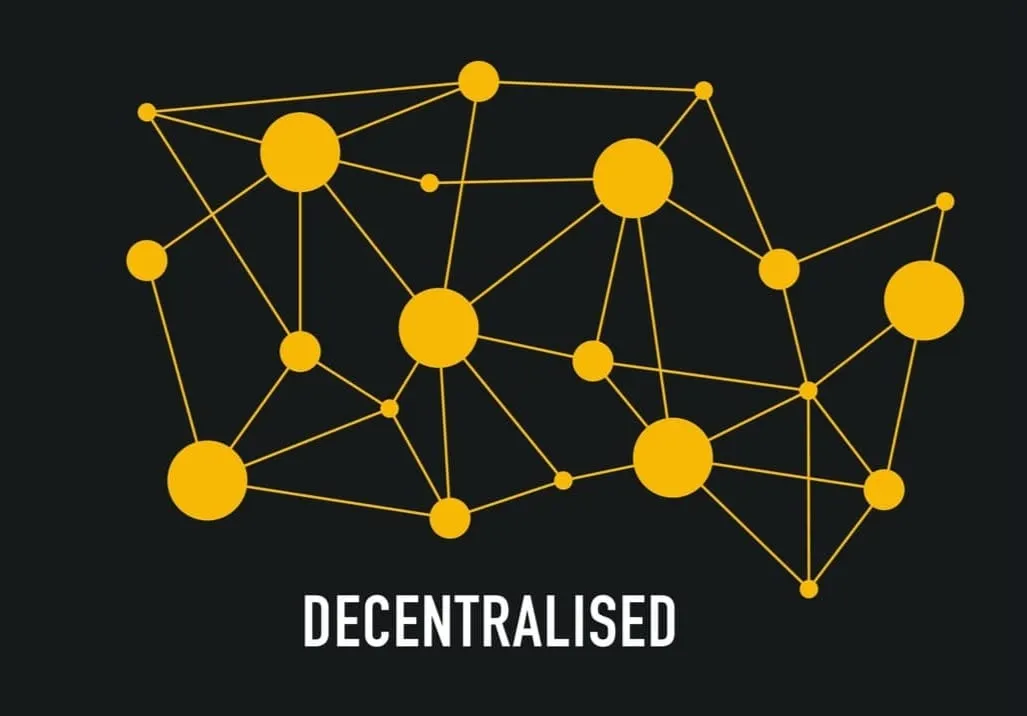
Three ways a system can be decentralized
In his February 2017 essay "The Meaning of Decentralization", Ethereum co-founder Vitalik Buterin splits the idea into three largely independent axes:
- Architectural: "how many physical computers is a system made up of?" This also covers how many of those computers can fail at once without the system stopping.
- Political: "how many individuals or organizations ultimately control the computers that the system is made up of?"
- Logical: whether the system looks "more like a single monolithic object, or an amorphous swarm?"
By this framework, blockchains are architecturally decentralized (many computers) and politically decentralized ("no one controls them"). They are logically centralized, because "there is one commonly agreed state and the system behaves like a single computer."
Buterin gives three reasons the property matters:
| Reason | What it means |
|---|---|
| Fault tolerance | "decentralized systems are less likely to fail accidentally" |
| Attack resistance | "decentralized systems are more expensive to attack and destroy or manipulate" |
| Collusion resistance | "it is much harder for participants in decentralized systems to collude" |
How Bitcoin removes the trusted third party
The white paper starts from a problem with online payments. Commerce on the internet "has come to rely almost exclusively on financial institutions serving as trusted third parties." Digital signatures solve part of that, but "the main benefits are lost if a trusted third party is still required to prevent double-spending."
Bitcoin replaces that third party with three mechanisms:
- Proof-of-work as voting. "Proof-of-work is essentially one-CPU-one-vote." The chain with the most accumulated work is the accepted history.
- An honest-majority assumption. "The system is secure as long as honest nodes collectively control more CPU power than any cooperating group of attacker nodes." The security claim depends on this condition. It is not a promise that the system cannot be attacked.
- Incentives. The first transaction in each block, the generation transaction, is "a special transaction that starts a new coin owned by the creator of the block." This rewards participants for supplying computing power.
Decentralization also shapes privacy. Every transaction is announced publicly, so the paper says privacy comes from "keeping public keys anonymous". In other words, Bitcoin is pseudonymous, not anonymous.
Measuring decentralization: the Nakamoto coefficient
"Decentralized" is easy to claim and hard to check, so there have been attempts to put a number on it. In "Quantifying Decentralization" (28 July 2017), Balaji S. Srinivasan and Leland Lee proposed the minimum Nakamoto coefficient. The method has three steps:
- List the essential subsystems of a network, such as mining or validation, client software, developers and token ownership.
- For each subsystem, count how many entities would need to be compromised to control it.
- Take the smallest of those counts as the system's score.
A higher number means a more decentralized system. For example, if five mining pools together hold more than half of a network's hashrate, the coefficient for mining is five. The weakest subsystem sets the score, so a network with thousands of nodes can still score low if a few entities control block production.
The metric has critics. Bitcoin developer David A. Harding objected to naming it after Satoshi Nakamoto, and any single number simplifies a multi-axis property.
How decentralized is the project in front of you?
Answer four questions from the article's checklist to see where a project that calls itself decentralized keeps a central point of control.
Who holds the funds when you use it?
- A smart contract settles the trade from my own wallet → next question
- A company or custodian holds my deposit first → Custody is centralized
- I hold a wrapped or bridged version of an asset from another chain → next question
What secures the original asset behind the wrapped token?
- A bridge or custodian holds the original asset → Only as decentralized as its backing
- I don't know → The claim is unchecked
Can one team change the code, hold upgrade keys or pause the contracts?
- Yes, one team holds upgrade or pause keys → Open code, central control
- No, the live contract cannot be altered → next question
- I can't find out → The claim is unchecked
How many independent parties would have to collude to control the infrastructure, such as block production?
- A few, for example five mining pools holding more than half the hashrate → Low score on its weakest subsystem
- Many independent parties, with no small group in control → Decentralized on these axes, not risk-free
You deposit funds and trust the operator to look after them, so the operator is a trusted third party. It can fail through mismanagement or a hack of its systems, however many machines run the platform.
A wrapped token depends on the bridge or custodian holding the original asset, and versions issued on other blockchains may have different security properties. Chainalysis reported $2 billion stolen across 13 cross-chain bridge hacks as of 2 August 2022.
Public code does not make a project decentralized if one team can upgrade or pause it. The article treats this as one way a project can be decentralized in one respect and centralized in another.
If you cannot find who controls the code or what backs the asset, you cannot check how decentralized the project is. The checklist questions stay open until you can.
Under the Nakamoto coefficient the weakest subsystem sets the score. If five pools together hold more than half the hashrate, the mining score is five, even if the network has thousands of nodes.
Funds stay in your wallet, the contract cannot be altered and control is spread out. Contracts can still have bugs and exploits, fees still follow demand for block space, and public ledgers are pseudonymous, not anonymous.
This sorts your own answers about custody, control and operators: it does not score any specific network or product, check the code or measure the risk, and it is not investment advice.
Decentralized exchanges: what actually changes for the user
A decentralized exchange (DEX) lets users trade tokens through smart contracts instead of through a company that holds their funds. Ethereum.org describes decentralized finance as services that "don't need intermediaries" and says DEXs "let you trade different tokens whenever you want."
Custody
The main practical difference is who holds the assets. On a centralized platform, you deposit funds first and trust the operator to look after them. With DeFi, ethereum.org says, "most products will never take custody of your funds" and "you never give up control of your assets." The trade is settled from your own wallet, by a contract.
Rules in public code
Ethereum.org defines a smart contract as an account that "can hold funds and can send/refund them based on certain conditions." Contract code is public, and "no one can alter that smart contract when it's live." Anyone can inspect it. In practice, most users rely on the people who can read the code.
Fees are not automatically small
A common claim is that decentralized systems always charge tiny fees. That is not accurate. On Ethereum, the fee is the gas used multiplied by the price per unit of gas. A simple ETH transfer uses 21,000 gas units, and complex contract calls, including swaps, use more. When demand is high, "users must offer higher tip amounts" to get their transactions included. The protocol-set base fee is burned, and the tip goes to the validator. Costs depend on the network and on how busy it is at that moment.
Risk moves from a company to code
Removing an intermediary does not remove risk. It moves the risk. Ethereum.org says plainly that "Ethereum products, like any software, can suffer from bugs and exploits." A centralized platform can fail through mismanagement or a hack of its systems. A decentralized protocol can fail through a contract flaw that anyone can exploit.
Wrapped tokens and bridges
To use an asset on a chain it was not built for, users often hold a wrapped version of it. Ethereum's own example is wrapped ether (WETH). You deposit ETH into a smart contract, it mints the same amount of WETH as an ERC-20 token, and when you redeem the WETH it is burned and you get the ETH back. Gas is still paid in native ETH.
Wrapped assets that come from other blockchains depend on a bridge or custodian holding the original asset. Ethereum.org warns that WETH versions issued on other blockchains "may behave differently or have different security properties." Bridges have been some of the most attacked parts of the system. Chainalysis reported on 2 August 2022 that $2 billion had been stolen across 13 separate cross-chain bridge hacks, which was "69% of total funds stolen in 2022 so far." A wrapped token can only be as decentralized as the mechanism that backs it.
What decentralization does not guarantee
- It does not mean unhackable. Bitcoin's security rests on an honest majority of computing power, and smart contracts can contain bugs.
- It does not mean anonymous. Public ledgers record every transaction. Bitcoin's privacy model relies on unlinked public keys.
- It does not mean cheap. Fees follow demand for block space.
- It is not all-or-nothing. A project can have many nodes but few operators, or open code but one team holding upgrade keys.
Questions to ask when a project calls itself decentralized
- How many independent parties run the infrastructure, and how many would have to collude to control it?
- Who can change the code or pause the contracts?
- Who holds the user funds: a contract, a custodian or the user's own wallet?
- If the token is wrapped or bridged, what secures the underlying asset?
Limitations: this is a general explainer drawn from foundational papers and official documentation, not an assessment of any specific network or product, and it is not investment advice.
