
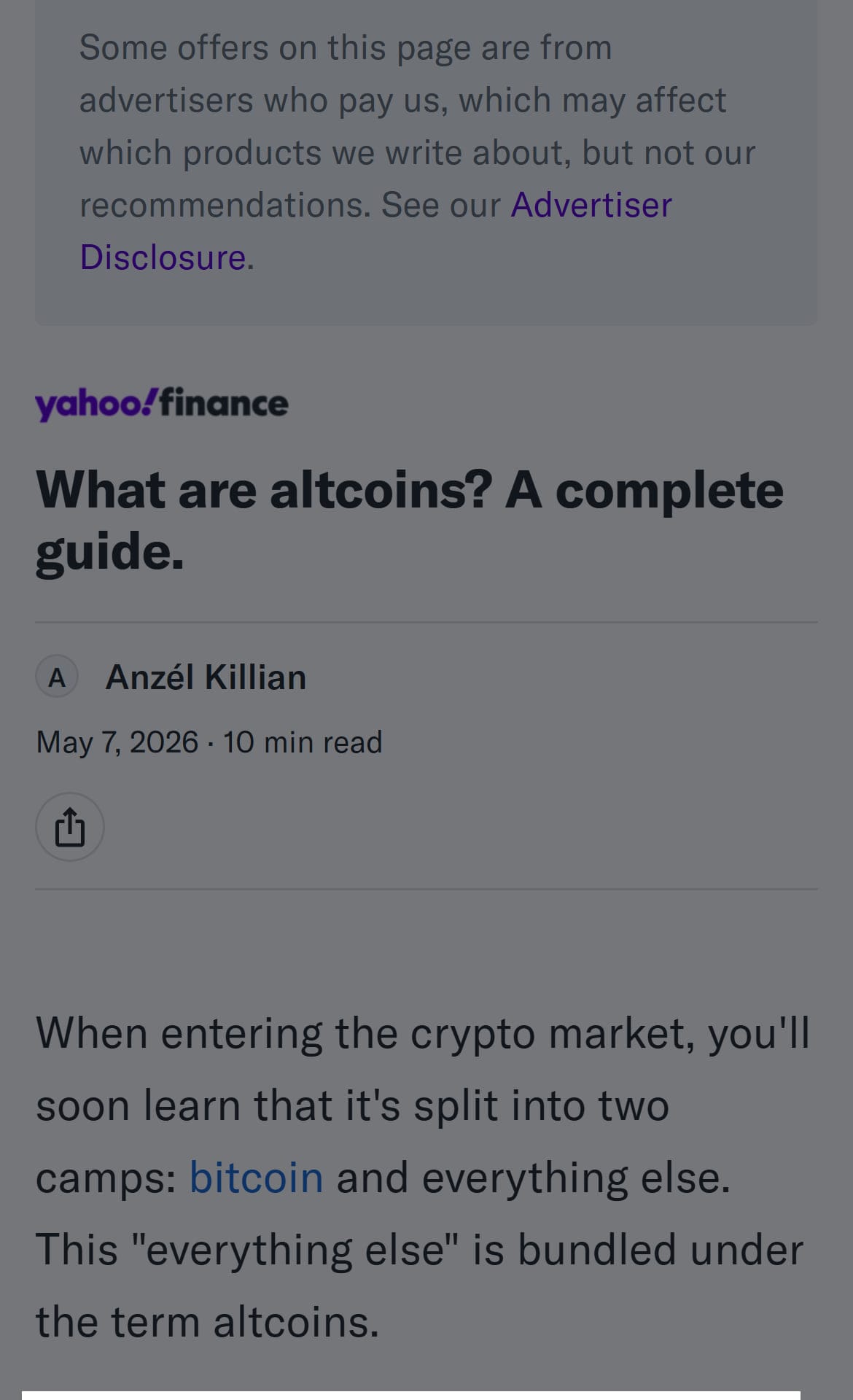
In a guide published May 7, 2026, Yahoo Finance defines an altcoin as any cryptocurrency other than bitcoin, and explainers from Banxa and Finder describe what the label covers. The word is a shortening of "alternative coin." Banxa sorts altcoins into five rough groups. Finder names volatility as the main risk for anyone investing in them.
Key facts from the three guides
- Definition (Yahoo Finance): Any cryptocurrency other than bitcoin. The name comes from "alternative coin."
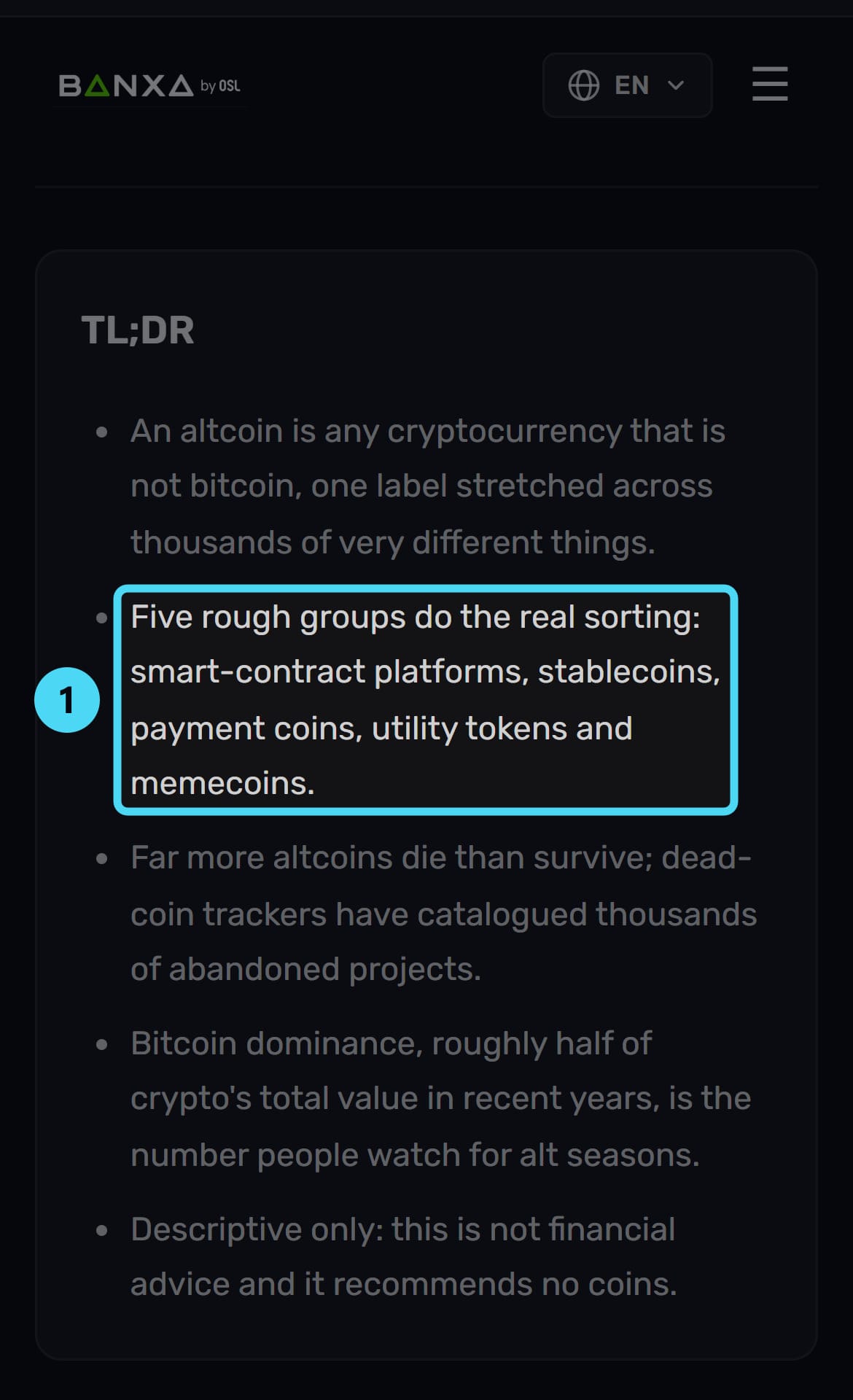
- Groups (Banxa): Smart-contract platforms, stablecoins, payment coins, utility tokens and memecoins.
- Main risk (Finder): Volatility, with the chance of large losses in a short time.
How altcoins differ from bitcoin
Yahoo Finance says the alternatives to bitcoin were created to improve on its limitations. Some altcoins aim for faster transaction speeds. Others aim for lower energy consumption. These are stated goals of particular projects, not features every altcoin shares.
One label, many kinds of asset
Banxa, in a guide published July 14, 2026, sorts altcoins into five rough groups. They are smart-contract platforms, stablecoins, payment coins, utility tokens and memecoins. Stablecoins are an awkward fit in that list. USDT and USDC are designed to follow the value of the US dollar. That makes them "behave nothing like the rest of the list," it says. Most stablecoins are also tokens issued on other chains, rather than on a blockchain of their own.
Coin or token: a separate question
Yahoo Finance draws a second line, between coins and tokens. A coin is the native asset of its own blockchain, such as ether on the Ethereum network. A token is a digital asset built on an existing blockchain. This split asks where an asset is issued, not whether it is bitcoin. That also explains how Banxa can count most stablecoins as altcoins and still call them tokens.

Placing an asset on both lines
Ether shows how the two labels combine. By Yahoo Finance's definition it is an altcoin, because it is not bitcoin. It is also a coin, as the native asset of the Ethereum network. Stablecoins combine the labels differently. They count as altcoins, but in Banxa's description most of them are tokens on other chains. Bitcoin itself is outside the altcoin label by definition. An asset whose home network has not been established stays unclassified on the second question. Two questions are enough to place an asset on both lines.
Is it an altcoin, a coin or a token?
Answer two questions about a crypto asset to see which labels the guides' definitions give it.
Is the asset bitcoin?
- Yes → Not an altcoin
- No → next question
- Not sure → Not classified yet
Is it the native asset of its own blockchain, or was it created on a blockchain that already exists?
- Native asset of its own blockchain → An altcoin and a coin
- Created on an existing blockchain → An altcoin and a token
- Not established → An altcoin, type not established
By Yahoo Finance's definition, the altcoin label covers every cryptocurrency except bitcoin, so bitcoin itself is outside it.
Source: Yahoo Finance, May 7, 2026The asset is not bitcoin, so it is an altcoin. As the native asset of its own blockchain, it is a coin, like ether on the Ethereum network.
Source: Yahoo Finance, May 7, 2026The asset is not bitcoin, so it is an altcoin. Because it was created on an existing blockchain, it is a token. Banxa describes most stablecoins this way.
Source: Yahoo Finance, May 7, 2026 · What Is an Altcoin? Meaning, Types and Survival Odds (banxa.com), Jul 14, 2026It is an altcoin because it is not bitcoin. Whether it is a coin or a token depends on where it was issued, and that is not yet established.
Source: Yahoo Finance, May 7, 2026The altcoin label depends only on whether the asset is bitcoin. Confirm that first before applying either label.
Source: Yahoo Finance, May 7, 2026The result applies publisher definitions to the answers given and does not verify any asset's current design or status.
Risks the guides flag
Finder names volatility as the main risk to weigh before investing in altcoins. It says cryptocurrencies have "a well-earned reputation for violent price swings." Those swings can bring big profits. They can also bring heavy losses in a short time.
Banxa points to a second risk: projects that are abandoned. It says trackers of dead coins have listed thousands of such projects. The real number is "anyone's guess," it adds, because "a coin rarely announces its own death."
What the guides report and what remains uncertain
Each point comes from a single secondary guide and has not been independently corroborated. Yahoo Finance gives the definition and the split between coins and tokens. Banxa gives the five groups, the place of stablecoins and the count of abandoned projects. Finder gives the volatility warning. The real number of dead coins remains uncertain. No guide gives a precise figure.
Analysis: what the label tells you and what it leaves open
The altcoin label answers one narrow question: is this asset bitcoin? It does not say what the asset is for. A stablecoin and a memecoin both get the label, yet Banxa puts them in separate groups. The label also does not separate an active project from an abandoned one. The aims Yahoo Finance lists, such as faster transactions, describe intentions rather than results. Finder's volatility warning applies across the category. So does the count of dead projects. A sounder first step is to place an asset in a group. The next is to settle whether it is a coin or a token. Then look at the project's own record.
Next step
These guides explain categories and do not check any asset's current design, condition or market. A separate explainer covers how altcoin dominance compares with bitcoin dominance and what each share measures.
Sources: Yahoo Finance, May 7, 2026 · What Is an Altcoin? Meaning, Types and Survival Odds (banxa.com), Jul 14, 2026 · What is an altcoin? (finder.com), Nov 25, 2017
ZIPMEX promotes trading on trade.zipmex.com. Promotions are labelled and kept separate from news coverage, which is selected and checked without regard to them. Perpetual futures are leveraged derivatives. Prices can move fast and you can lose all of your margin. Not available in every jurisdiction. Not investment advice.
