How to Navigate Crypto in 2026: Expert Strategies for Building Wealth in the New Cycle
With Bitcoin trading near $95,000 after hitting an all-time high of $126,000 in October 2025, and up to $8 trillion in liquidity expected to flow into markets this year, 2026 presents a defining moment for crypto investors. But massive opportunity comes with equally massive risk-and the strategies that worked in previous cycles may not apply anymore.
⚡ Quick Answer
Successfully navigating crypto in 2026 requires holding quality assets long-term, using dollar-cost averaging (DCA) instead of trying to time the market, and maintaining a diversified portfolio anchored by Bitcoin and Ethereum. Top analysts predict Bitcoin could range from $75,000 to $225,000 this year, with the cycle expected to peak in late 2026. The key: avoid leverage, stay consistent, and let institutional adoption carry you forward.
Whether you're an experienced investor looking to optimize your strategy or someone building their first serious crypto portfolio, this comprehensive guide breaks down exactly how to position yourself for 2026's opportunities while protecting against its very real risks.

Understanding the 2026 Crypto Landscape
The crypto market in 2026 looks fundamentally different from previous cycles. Institutional adoption has reached unprecedented levels, stablecoin legislation has passed, and the asset class has firmly integrated with traditional finance. This isn't the speculative wild west of 2017 or even the DeFi summer of 2020-it's crypto's institutional era.
The Macro Picture: Why 2026 Could Be Transformational
According to macro investor Raoul Pal, founder of Real Vision and co-founder of Exponential Age Asset Management (EXPAAM), the current crypto market cycle is on track to peak in late 2026-driven primarily by macroeconomic liquidity rather than Bitcoin halving events alone.
"The crypto market is still in its infancy-we're only 3% of the way to a potential $100 trillion market cap. The key to success in 2026 is holding the right assets and sticking to your beliefs, rather than relying on others' opinions."
- Raoul Pal, CEO of Real Vision & EXPAAM
Here's what's driving the 2026 opportunity:
Massive Liquidity Injection: Pal estimates $7-8 trillion will be needed just to pay interest on existing government debt in 2026. Combined with potential regulatory changes and fiscal stimulus, total liquidity could reach $8 trillion-creating favorable conditions for risk assets like cryptocurrency.
Extended Cycle Timeline: While traditional Bitcoin cycles run approximately four years, Pal has extended his framework to five years. This means the peak many expected in 2025 may arrive in late 2026 instead.
Institutional Capital Going Vertical: Corporate adoption is accelerating at unprecedented speed. Venture capital investment in US crypto companies rebounded sharply in 2025, with investors deploying $7.9 billion-a 44% increase from 2024, according to Silicon Valley Bank analysis.
Current Market Snapshot: January 2026
🔢 Market Statistics (January 2026)
Bitcoin Price
~$95,400
BTC All-Time High
$126,000 (Oct 2025)
BTC Market Cap
$1.9T
Total Crypto Market
$3.2T+
ETF Net Inflows (Cumulative)
$56.6B+
VC Investment (2025)
$7.9B (+44% YoY)
What Experts Predict for Bitcoin in 2026
Industry executives and analysts offer a wide range of price predictions, reflecting the inherent uncertainty in crypto markets:
📊 2026 Bitcoin Price Predictions
Note: Predictions are speculative. Markets are volatile-do your own research.
"2026 is too chaotic to predict with risk remaining to the downside in the near term. Focus on building positions you can hold through volatility rather than trying to time the exact top."
- Galaxy Research, January 2026

The Institutional Revolution: 2026's New Market Structure
Understanding how institutional capital flows now dominate crypto is essential for any 2026 strategy. The market structure has fundamentally changed-and your approach must change with it.
ETFs and Digital Asset Treasuries: The New Price Drivers
A significant driver of Bitcoin's price discovery now flows through institutional vehicles. In 2025 alone, US-listed Bitcoin ETFs (like BlackRock's IBIT) and digital asset treasury companies (like Strategy, formerly MicroStrategy) collectively represented nearly $44 billion of net spot demand for Bitcoin.
Yet price performance disappointed relative to expectations, underscoring how supply dynamics have quietly shifted. According to Kraken's analysis, the likeliest source of marketable supply is coming from long-term holders capitalizing on performance.
The M&A Gold Rush
Why build when you can buy? Crypto-native companies are using acquisitions to vertically integrate at record pace.
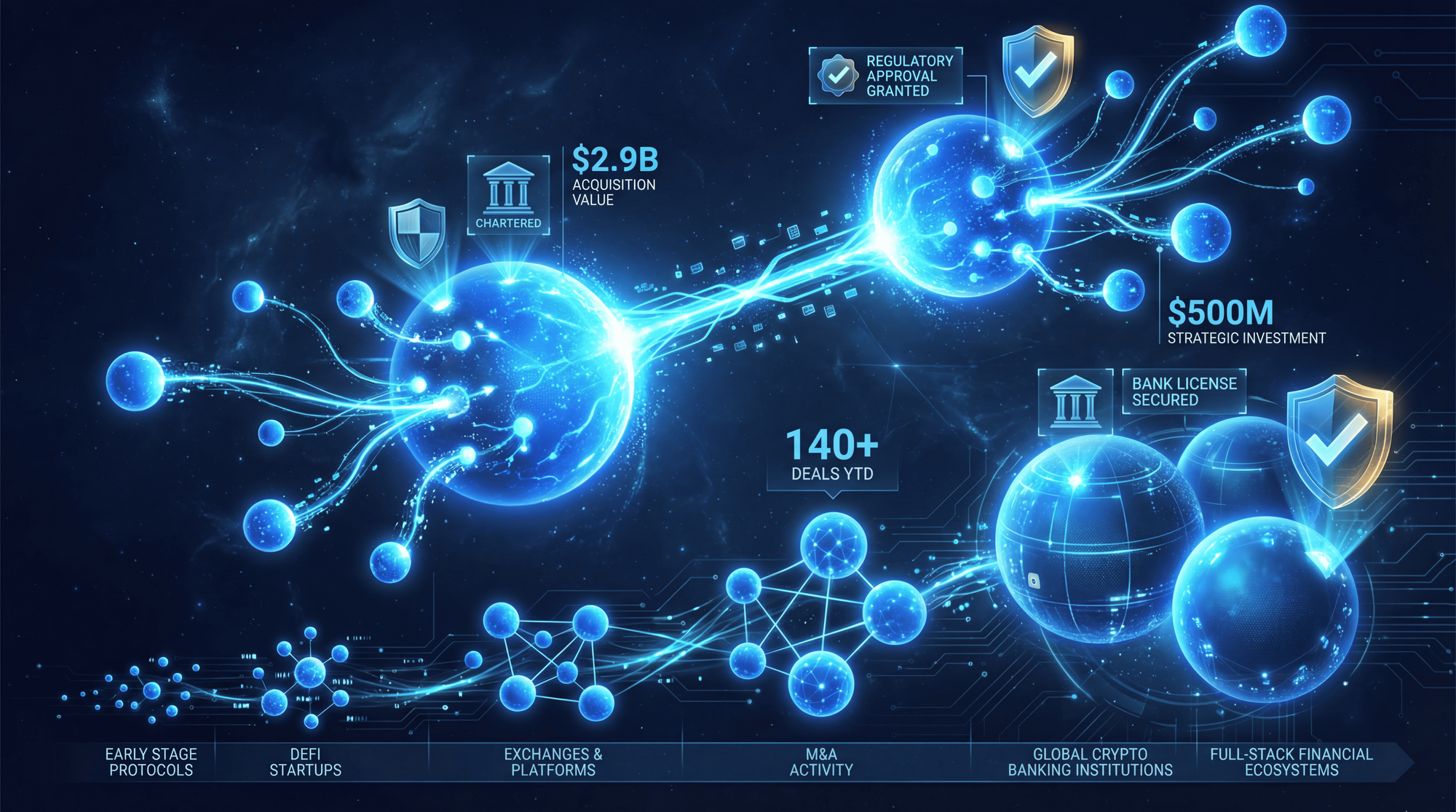
According to Silicon Valley Bank, M&A activity hit an all-time high in 2025: more than 140 VC-backed crypto companies were acquired, a 59% year-over-year increase. Notable deals include:
- Coinbase acquired derivatives exchange Deribit for $2.9 billion
- Kraken paid $1.5 billion for futures trading platform NinjaTrader
- Ripple acquired seven startups in two years, vaulting to a $40 billion valuation
Additionally, 18 companies filed new charter applications with the Office of the Comptroller of the Currency (OCC) in 2025-more than the prior four years combined. In December 2025, the OCC granted conditional approval for five national trust bank charters: BitGo, Circle, Fidelity Digital Assets, Paxos, and Ripple.
What This Means for Your Strategy
The institutional era changes everything:
- Reduced Volatility: Institutional capital tends to smooth price action, but large moves still occur during narrative shifts
- New Liquidity Sources: ETF inflows and corporate treasury purchases create sustained demand floors
- Professional Competition: You're now trading alongside sophisticated institutional traders with superior tools
- Quality Premium: Institutional money flows to established assets first-Bitcoin and Ethereum benefit most
⚠ Watch This Risk
Fed Chair Jerome Powell's term expires in May 2026. Markets may face a policy transition that introduces uncertainty around liquidity management. A new chairman-likely more dovish-could be a catalyst, but markets will wait for clarity before repricing risk assets decisively.
Strategy #1: The Power of Dollar-Cost Averaging (DCA)
If there's one strategy that separates successful crypto investors from those who lose money, it's dollar-cost averaging. In a market where Bitcoin can swing 20% in a single day, trying to time perfect entries is a recipe for disaster.
Why DCA Beats "Buying the Dip"
The classic "buy the dip" strategy sounds smart in theory-wait for prices to fall, then buy at a discount. In practice, it often fails because:
- Nobody can predict the bottom: What looks like a dip could turn into a prolonged downtrend
- Emotional decision-making: Fear during crashes often prevents buying when you should
- Cash management issues: Keeping large cash reserves waiting for dips means missing rallies
- Opportunity cost: Money sitting idle doesn't compound
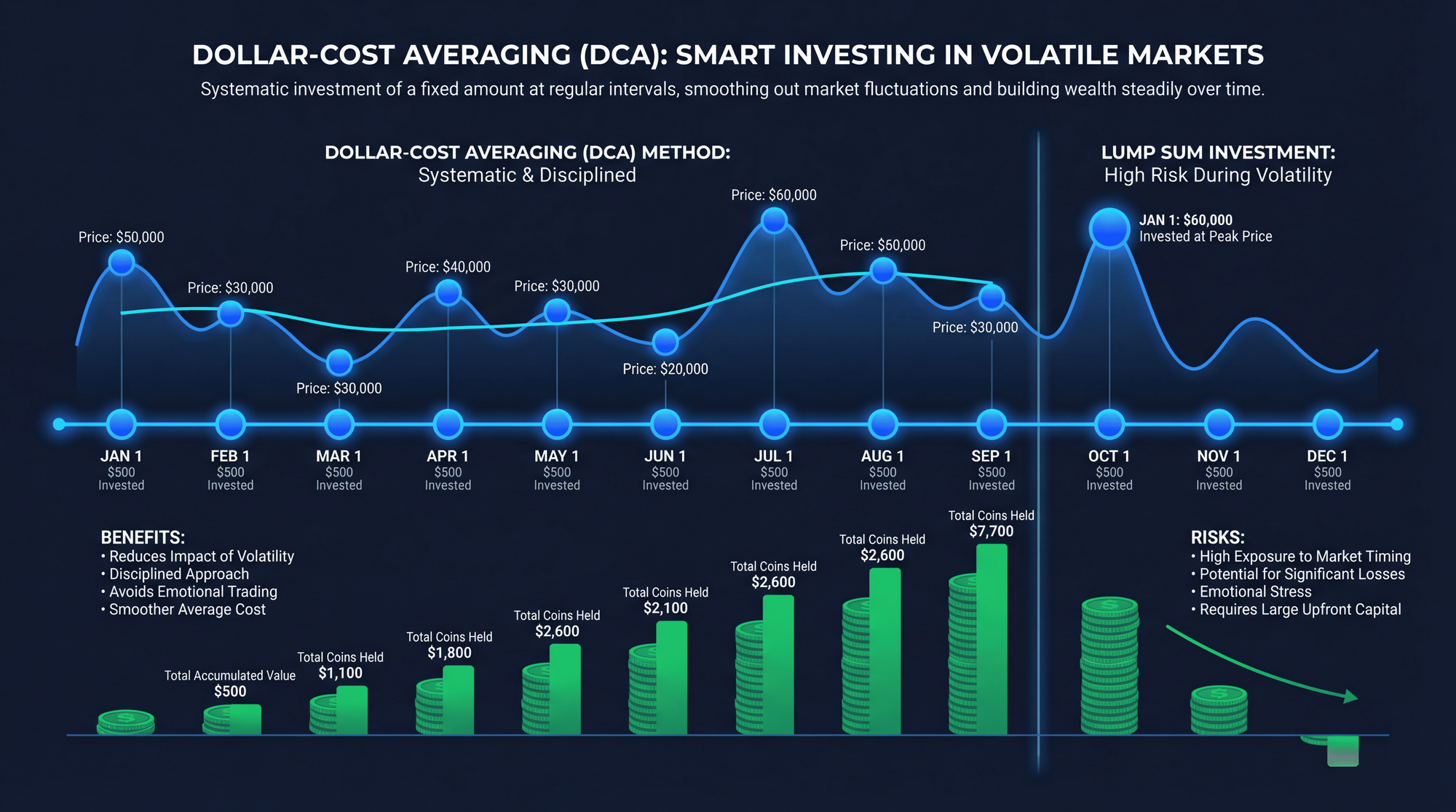
DCA works by investing a fixed amount at regular intervals regardless of price. When prices are high, your fixed amount buys fewer coins. When prices drop, it buys more. Over time, this smooths your average entry price and removes emotion from the equation.
How to Implement DCA for Crypto in 2026
Step 1: Determine Your Total Allocation
Decide what percentage of your portfolio should be in crypto. For most investors, 1-5% is appropriate. Aggressive investors might go to 10%, but only with high risk tolerance.
Step 2: Choose Your Interval
Weekly or bi-weekly purchases work well for most investors. Monthly is acceptable but reduces the smoothing effect of averaging.
Step 3: Automate Everything
Most exchanges offer recurring purchase features. Set it and forget it-the goal is consistency without emotional interference.
Step 4: Stick to the Plan
The hardest part isn't starting DCA-it's maintaining discipline during 40%+ drawdowns. Remember: these are the moments your strategy is working hardest for you.
📈 DCA Example: $500/Month into Bitcoin
Month 1: BTC at $95,000 → Buy 0.00526 BTC
Month 2: BTC drops to $80,000 → Buy 0.00625 BTC (more coins!)
Month 3: BTC rises to $110,000 → Buy 0.00454 BTC
Average cost: ~$93,750 per BTC (vs. timing risk)
What If the Market Dips Further After You Buy?
This happens constantly in crypto. When it does, you have three options:
- Wait for recovery: Your DCA continues buying at lower prices
- Add extra buys: Some investors boost their regular amount during significant corrections
- Stay consistent: Trust the long-term process rather than reacting to short-term noise
The key insight from Pal's framework: "People's anger often stems from mismatched time expectations and reality." DCA helps align your expectations with crypto's actual behavior-volatile in the short term, but historically rewarding for patient investors.
Strategy #2: Building a Diversified Crypto Portfolio for 2026
Diversification isn't just about owning multiple coins-it's about strategic allocation across different risk levels and use cases. Here's how institutional investors and successful retail traders are approaching portfolio construction this year.
The 2026 Portfolio Framework
According to research from multiple institutional sources including Silicon Valley Bank and a16z crypto, a well-balanced crypto portfolio typically follows this structure:
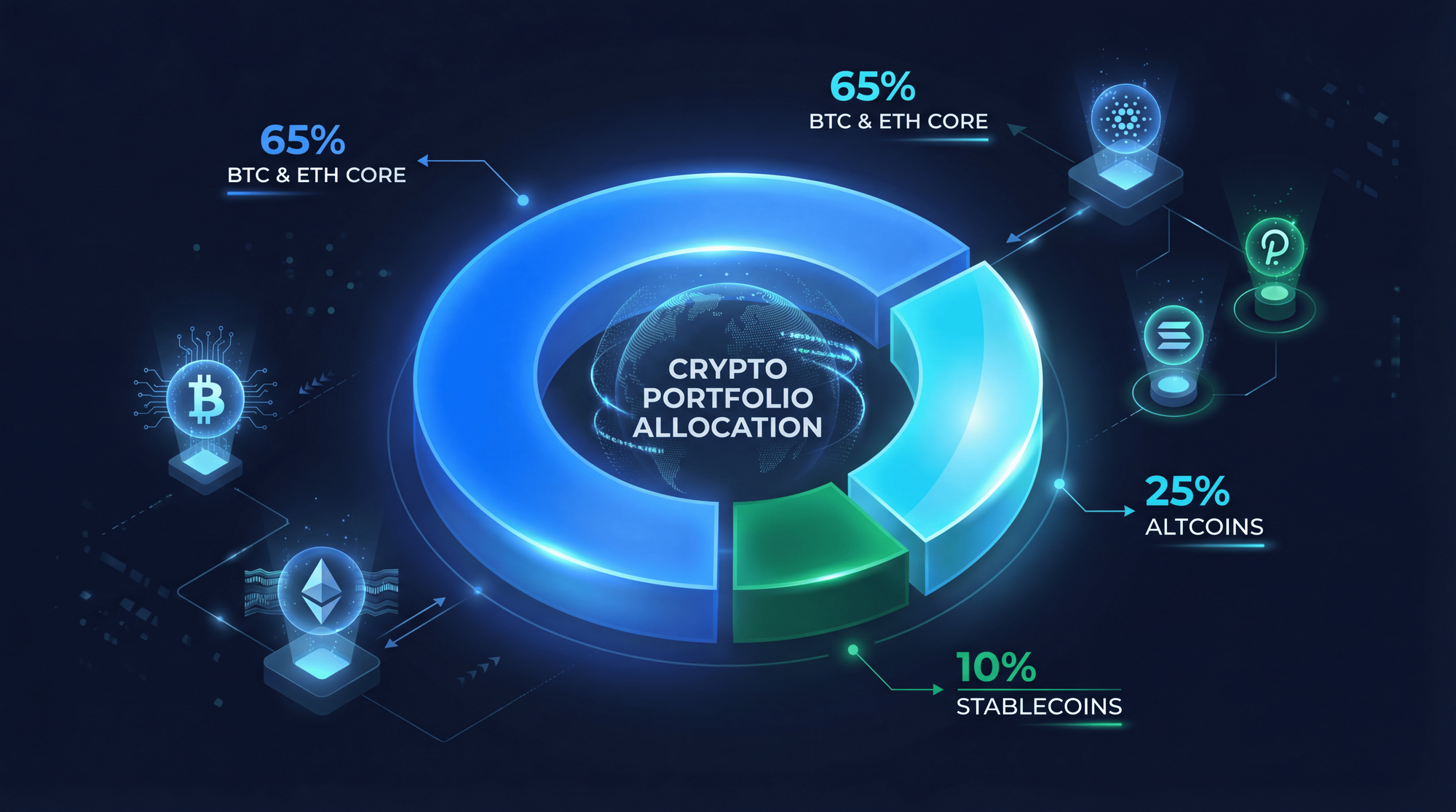
🎯 Recommended Portfolio Allocation
- 60-70% Core Holdings (BTC + ETH): The foundation of your portfolio-maximum liquidity, institutional adoption, and proven resilience
- 20-30% Altcoins: Layer-1 protocols, DeFi tokens, infrastructure plays with clear utility and adoption
- 5-10% Stablecoins: Your "dry powder" for buying opportunities during corrections
Why Bitcoin and Ethereum Remain Core
Despite the explosion of alternative cryptocurrencies, Bitcoin and Ethereum continue to serve as portfolio anchors for good reasons:
Bitcoin (BTC)
- Largest, most liquid crypto asset with $1.9T market cap
- Institutional gateway (ETFs hold over $56 billion cumulative inflows)
- Digital gold narrative strengthening as dollar concerns grow
- In 10 of the past 13 years, Bitcoin has been the top-performing asset class globally
- Long-term holders control more than 70% of circulating supply
Ethereum (ETH)
- Foundation for DeFi, NFTs, and smart contracts
- Holds roughly 75% of total value locked in DeFi
- Layer-2 scaling solutions reducing fees and increasing throughput
- Institutional tokenization experiments primarily happening on Ethereum
- Staking capabilities provide yield opportunities
The Role of Stablecoins in 2026
Many investors underestimate stablecoins as a strategic tool. Here's why keeping 5-10% in stablecoins matters:
- Buying opportunities: When significant dips occur, you have capital ready to deploy immediately
- Risk management: During extreme market stress, rotating into stablecoins protects gains
- Yield opportunities: Lending stablecoins can generate 3-8% APY on various platforms
- The new savings account: DeFi tools like Morpho Vaults automatically allocate to best risk-adjusted yields
Think of stablecoins as your portfolio's defensive anchor-they don't generate explosive returns, but they provide stability and optionality when you need it most.
What About Altcoins?
Your altcoin allocation depends heavily on your risk tolerance and research capabilities. For 2026, several sectors show particular promise:
AI + Crypto Tokens: Projects like Bittensor (TAO), Fetch.ai (FET), and Render (RNDR) sit at the intersection of two transformative technologies.
Real-World Asset (RWA) Tokenization: Tokenized financial assets grew from roughly $5.6 billion to nearly $19 billion in a single year, expanding beyond Treasury funds into commodities, private credit, and public equities.
Layer-2 Solutions: Solana, Polygon, Arbitrum, and other scaling solutions are where most transaction activity now occurs.
⚠ Risk Warning
Over 70% of altcoins historically fail. Raoul Pal warns that "many tokens will still cause investors to lose money even with increased liquidity because they are inherently bad investments." Stick to projects with genuine utility and avoid chasing hype.
Strategy #3: The "Minimum Regret" Portfolio Approach
One of the most practical frameworks for 2026 comes from Raoul Pal's concept of the "minimum regret portfolio"-designed so that when you look back at your investments, you won't regret hasty decisions.
What Is Minimum Regret Investing?
The principle is simple: make investment decisions you can live with regardless of outcome. This means:
- Avoiding overexposure: Don't bet so heavily that a 50% drawdown destroys your financial life
- Avoiding underexposure: Don't be so conservative that you miss substantial gains entirely
- Staying consistent: Don't panic sell at bottoms or FOMO buy at tops
🎯 Key Takeaways: Minimum Regret Framework
- Only invest what you can afford to lose completely without lifestyle impact
- Anchor your portfolio with proven assets (BTC, ETH) rather than speculative bets
- Avoid leverage entirely-crypto futures traders lost over $150 billion in 2025
- Take profits systematically rather than holding through entire cycles
The Anti-Leverage Imperative
If there's one critical lesson from recent market history, it's this: avoid leverage in crypto.
In 2025, estimated leverage ratios reached record highs just before major liquidation cascades. Retail traders operating at 50x-100x leverage faced total account wipeouts during what were, in hindsight, normal market corrections.
The math is brutal: at 10x leverage, a 10% adverse move wipes out your position entirely. At 50x, a 2% move does the same.
"The truly successful crypto traders in 2026 share a common characteristic: they either avoided leverage entirely, focusing on patient spot accumulation and long-term value, or they treated leverage with the same rigorous risk management that professional institutional traders employ."
- MEXC Analysis Report, January 2026
What Pal's "Don't F*ck This Up" Thesis Teaches Us
Pal's colorful advice boils down to avoiding self-sabotage through:
- No leverage: Spot holdings only
- No excessive altcoin exposure: Keep speculative bets small
- Majors first: Anchor with Bitcoin, Ethereum, and potentially Solana
- Patience: The cycle extends into late 2026-don't rush
This framework acknowledges that this cycle has already seen seven 20%+ pullbacks while delivering 600%+ returns from the low. Volatility is the price of admission, not a bug to be fixed.

Stablecoins: The Internet's New Dollar
One of the most significant developments shaping crypto in 2026 is the rise of stablecoins as serious financial infrastructure. This isn't just about trading pairs anymore-stablecoins are becoming the backbone of digital money.
The Stablecoin Revolution
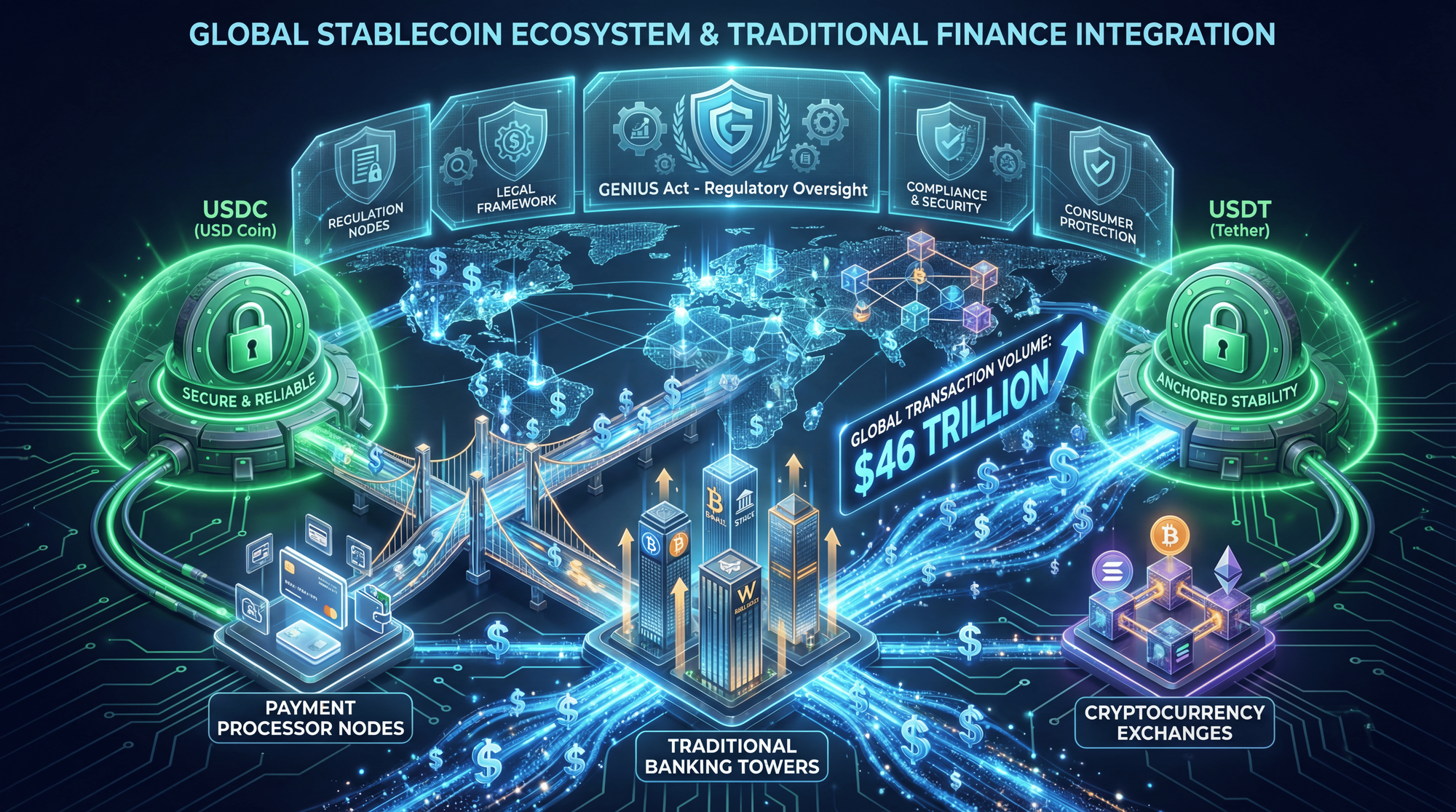
Stablecoins accounted for an estimated $46 trillion in transaction volume last year-more than 20x the volume of PayPal, close to 3x the volume of Visa, and rapidly approaching the volume of ACH, the electronic network for financial transactions in the United States.
Global stablecoin supply is expanding as banks and fintechs issue tokens for remittances, B2B payments, and card settlement:
- Circle completed its IPO, establishing valuation benchmarks for the sector
- JPMorgan extended JPM Coin functionality to public blockchains
- Société Générale launched EUR CoinVertible
- A consortium of US banks including PNC, Citi, and Wells Fargo is exploring a joint stablecoin initiative
The GENIUS Act: Regulatory Clarity Arrives
The GENIUS (Guiding and Establishing National Innovation for U.S. Stablecoins) Act passed in July 2025, establishing consistent federal standards for stablecoin issuance. Key provisions:
- Only permitted entities (licensed depository institutions or OCC/state-approved nonbanks) can issue stablecoins
- 1:1 backing required in short-term treasuries or currency
- Monthly reserve disclosure requirements
- KYC/AML compliance mandatory
Why This Matters for Your Portfolio
The stablecoin revolution has several portfolio implications:
- Yield Opportunities: DeFi tools like Morpho Vaults automatically allocate assets into lending markets with the best risk-adjusted yield
- Stablecoin Infrastructure Plays: Companies building "Stablecoin-as-a-Service" infrastructure attracted over $1.5 billion in VC investment in 2025
- Dollar Alternatives: For non-US investors, stablecoins provide easy access to dollar-denominated assets
- Payment Network Exposure: As stablecoins replace traditional payment rails, the networks supporting them gain value
2026 Crypto Trends to Watch
Beyond core strategy, understanding emerging trends helps position your portfolio for asymmetric opportunities.
AI Agents & The New Digital Economy
Artificial intelligence and blockchain are converging to create a new infrastructure layer for digital commerce. This isn't hype-it's already happening.
🤖 AI + Crypto Convergence
- AI Agent Wallets: Autonomous agents that can hold, move, and manage digital assets on-chain
- Know Your Agent (KYA): New identity frameworks for non-human entities transacting in financial systems
- Decentralized Compute: Networks like Akash and io.net providing GPU power for AI workloads
- AI-Powered Trading: 89% of 2025 trading volume was AI-assisted
According to a16z crypto, "non-human identities" in financial services now outnumber human employees 96-to-1-yet these identities remain largely unbanked. The infrastructure to enable AI agents to transact, verify identity, and coordinate economic activity represents one of the most significant opportunities of this cycle.
Projects to research: Bittensor (TAO), Fetch.ai (FET), Render (RNDR), Near Protocol (NEAR).
Real-World Asset Tokenization Goes Mainstream
Tokenization is moving from pilot experiments to production-scale financial infrastructure. Tokenized financial assets grew from roughly $5.6 billion to nearly $19 billion in 2025 alone.
Key developments:
- BlackRock's BUIDL fund surpassed $500 million within months of launching
- Franklin Templeton's tokenized funds scaled past $400 million
- Polymarket reached $3.7 billion in monthly trading volume, valued at $8 billion
- DTCC plans to tokenize all securities by end of 2026
"In the future, people won't keep stocks and bonds in one portfolio and crypto in another. Assets of all kinds could one day be bought, sold, and held through a single digital wallet."
- Larry Fink & Rob Goldstein, BlackRock, December 2025
Privacy as Competitive Moat
Privacy is emerging as a critical differentiator for blockchain networks. According to a16z crypto's Ali Yahya, "Privacy by itself is sufficiently compelling to differentiate a chain from all the rest."
The key insight: bridging tokens between chains is easy, but bridging secrets is hard. Once users join a private blockchain, they're less likely to move and risk exposure. This creates powerful network effects that could result in a winner-take-most dynamic for privacy-focused chains.
The CLARITY Act: What's Next for Regulation
Beyond stablecoins, the crypto industry awaits the CLARITY Act-legislation that would create a framework for regulating digital assets and exchanges. If passed, this would:
- Provide clear definitions for digital commodities
- Establish oversight standards for exchanges
- Accelerate capital formation
- Solidify the US as the crypto capital of the world

Essential Risk Management for 2026
No crypto strategy is complete without robust risk management. The 2025 crash-which saw Bitcoin drop from $126,000 to below $90,000, and Ethereum fall over 40%-demonstrated that even bull markets contain devastating corrections.
Understanding the Risks
🔻 Bearish Factors & Risks
- Market Volatility: Even in bull markets, 20-40% corrections occur regularly
- Fed Policy Risk: Powell's term ends May 2026-transition creates uncertainty
- Token Failure Rate: Over 70% of altcoins fail regardless of market conditions
- Macro Correlation: Crypto increasingly trades as a risk asset correlated with tech stocks
- Security Threats: Hacks and scams remain prevalent-losses hit $76M in December 2025 alone
- Long-term Holder Rotation: Legacy holders selling into institutional demand creates supply pressure
10 Rules for Protecting Your Crypto
Based on analysis of common investor mistakes, here are essential security and risk management practices:
- Never invest more than you can lose: Your crypto allocation should not affect your ability to meet financial obligations
- Use hardware wallets for long-term holdings: Exchange hacks remain common; cold storage eliminates this risk
- Enable two-factor authentication everywhere: And use authenticator apps, not SMS
- Never share seed phrases or private keys: No legitimate platform will ever ask for these
- Bookmark exchange websites: Avoid clicking links in emails-phishing attacks are sophisticated
- Verify before sending: Double-check addresses; crypto transactions are irreversible
- Be skeptical of guaranteed returns: If yields sound too good to be true, they are
- Diversify across wallets and platforms: Don't keep everything in one place
- Track your cost basis: Proper records simplify tax compliance as reporting requirements tighten
- Stay educated: Scams evolve constantly; following reliable crypto tips helps recognize new patterns
Bullish Factors Supporting the 2026 Outlook
Despite risks, powerful tailwinds support the market:
📈 Bullish Factors
- Institutional Adoption: $7.9B VC investment in 2025, $56B+ ETF inflows, M&A at all-time high
- Liquidity Expansion: Up to $8T expected to enter markets this year
- Regulatory Clarity: GENIUS Act passed, CLARITY Act pending
- Corporate Treasury Adoption: Strategy and others continue accumulating BTC
- Tokenization Growth: $19B in RWAs on-chain, DTCC planning full securities tokenization
- Stablecoin Adoption: $46T transaction volume, projected $1T circulation by late 2026

Frequently Asked Questions
How much should I invest in crypto in 2026?
The general consensus among financial advisors is 1-5% of your overall investment portfolio for moderate risk tolerance. Some aggressive investors allocate up to 10%, but this requires high risk tolerance and long time horizons. The most important rule: only invest what you can afford to lose completely without affecting your lifestyle or financial stability.
What will Bitcoin be worth in 2026?
Expert predictions vary widely. University of Sussex's Carol Alexander forecasts $75,000-$150,000, CoinShares' James Butterfill expects $120,000-$170,000, while Cardano's Charles Hoskinson sees potential for $250,000. Galaxy Research notes 2026 is "too chaotic to predict"-focus on building positions rather than targeting specific prices.
What's the best crypto to buy right now?
Bitcoin remains the safest entry point for new investors due to its liquidity, institutional adoption, and proven track record. Ethereum offers exposure to smart contract innovation and DeFi. Beyond these two, focus on projects with genuine utility, active development, and clear use cases rather than chasing trending tokens or meme coins.
Is crypto regulated in 2026?
Yes, significantly more than before. The GENIUS Act (passed July 2025) established federal stablecoin standards, and the CLARITY Act is pending to regulate digital commodities and exchanges. The US joins regions like the EU (MiCA), UK, Singapore, and UAE with explicit frameworks. Regulatory clarity is now a tailwind rather than headwind.
Should I buy the dip or dollar-cost average?
Dollar-cost averaging is generally superior for most investors. Studies consistently show that trying to time market bottoms leads to worse outcomes than systematic regular purchases. DCA removes emotion from the equation, ensures you're always accumulating, and turns volatility into an advantage rather than a source of anxiety.
Is crypto still a good investment in 2026?
Crypto offers significant opportunity in 2026, but it's not for everyone. The market remains highly volatile, and substantial losses are possible even for quality assets. If you have a long time horizon (5+ years), can tolerate drawdowns of 50%+, and have already established traditional financial foundations (emergency fund, retirement accounts), crypto exposure may make sense as part of a diversified portfolio.
What happened to Bitcoin's all-time high?
Bitcoin reached an all-time high of approximately $126,000 in October 2025, driven by institutional ETF inflows and pro-crypto policy expectations. It subsequently corrected about 25-30%, which is normal cycle behavior-this cycle has already seen seven 20%+ pullbacks while delivering 600%+ returns from the low.
What crypto should I avoid?
Avoid projects with: guaranteed returns or unrealistic APYs, anonymous teams with no accountability, no clear utility beyond speculation, heavy influencer promotion without substance, and missing security audits. Also avoid leverage trading-crypto futures traders lost over $150 billion in 2025 due to excessive leverage.
When will the crypto bull market end?
According to macro analyst Raoul Pal, the current cycle is expected to peak in late 2026, driven by liquidity dynamics rather than Bitcoin halving events alone. However, predictions are inherently uncertain-Galaxy Research notes 2026 is "too chaotic to predict." Focus on building positions you can hold through volatility.
How do I keep my crypto safe?
Use hardware wallets (cold storage) for long-term holdings, enable two-factor authentication on all accounts, never share seed phrases or private keys, verify website URLs before entering credentials, diversify across multiple wallets and platforms, and stay educated about evolving scam tactics. When in doubt, slow down-most crypto losses come from rushing decisions.
Conclusion: Your 2026 Crypto Action Plan
Navigating crypto in 2026 doesn't require predicting the future or timing markets perfectly. It requires discipline, patience, and a clear strategy anchored in proven principles.
Here's your action plan:
Month 1: Foundation
- Determine your total crypto allocation (1-5% of portfolio for most)
- Set up secure storage (hardware wallet for holdings, trusted exchange for trading)
- Establish your DCA schedule and automate purchases
Ongoing: Execution
- Maintain consistent DCA regardless of market conditions
- Allocate 60-70% to BTC/ETH core, 20-30% to quality altcoins, 5-10% to stablecoins
- Rebalance quarterly or when allocations drift significantly
Throughout 2026: Discipline
- Avoid leverage entirely
- Don't chase memes or guaranteed yield schemes
- Take partial profits systematically as targets are reached
- Stay informed but don't let daily news drive decisions
The market will test your resolve with both fear-inducing crashes and FOMO-inducing rallies. The investors who succeed are those who build sustainable systems and stick to them.
As Raoul Pal reminds us: we're only 3% of the way to crypto's potential. The opportunity is immense, but capturing it requires showing up consistently-not perfectly.
Ready to Start Building Your Crypto Portfolio?
Join thousands of investors using Zipmex to buy, sell, and earn with cryptocurrency.
Start Trading Now →⚠ Disclaimer: The information provided in this article is not intended to provide investment or financial advice. Investment decisions should be based on the individual's financial needs, objectives, and risk profile. We encourage readers to understand the assets and risks before making any investment entirely. Cryptocurrency investments are subject to high market risk. Past performance does not guarantee future results.