To start investing, follow three steps in order. First, keep money you may need soon in a savings account. Second, pay off high-interest debt. Third, invest a fixed amount on a regular schedule, spread across diversified funds, using only money you can leave alone for years. U.S. regulators repeat this sequence across Investor.gov, the investor education site of the Securities and Exchange Commission (SEC). On October 5, 2026, the SEC and five other U.S. regulators issued a joint World Investor Week bulletin. It focused on staying resilient in changing economic conditions and on avoiding investment scams.
The newest guidance: World Investor Week 2026
The SEC announced the bulletin on October 5, 2026 (press release 2026-101). It was issued jointly with the Commodity Futures Trading Commission, the Financial Industry Regulatory Authority, the Securities Investor Protection Corporation, the National Futures Association and the North American Securities Administrators Association. The release names two themes: staying resilient in changing economic conditions, and watching for relationship investment scams and impersonation scams, which it describes as rising. SEC Chairman Paul S. Atkins urged investors to "remain vigilant against potential scams" and to "take advantage of the resources on the SEC's Investor.gov website."
The steps below follow that guidance.
Step 1: Keep money you need soon in savings
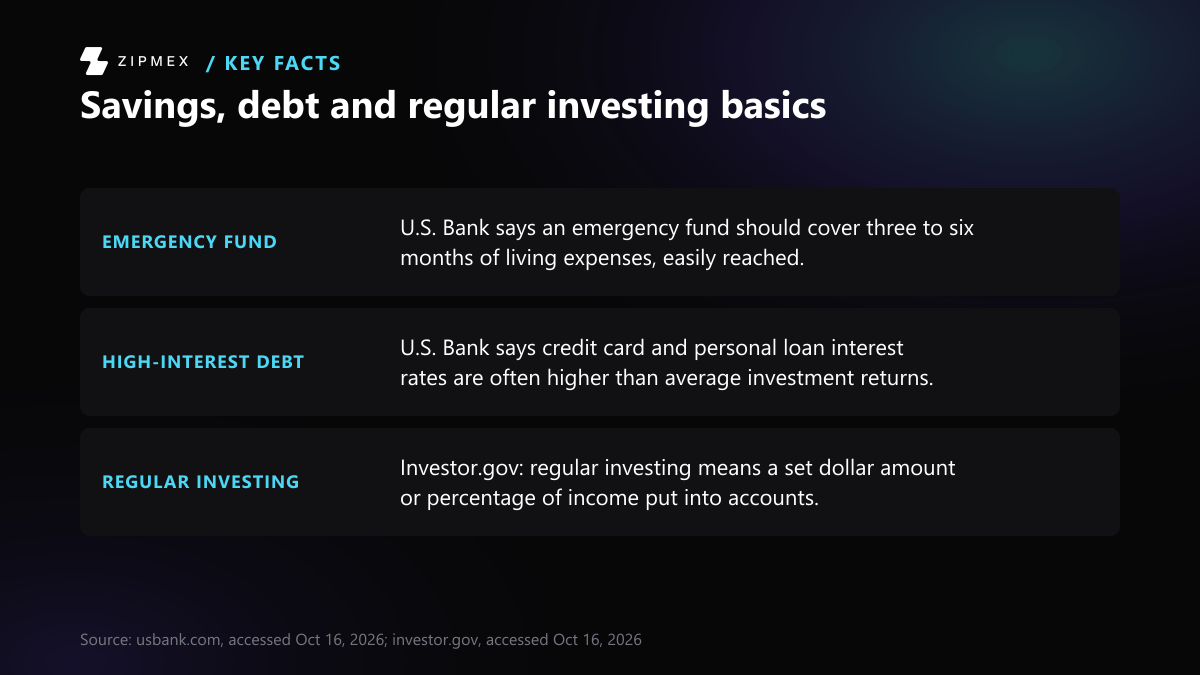
Investor.gov suggests a savings account for short-term goals and for an emergency fund. The money stays easy to reach, and deposits at a bank or credit union are typically federally insured. Investor.gov bulletins suggest an emergency fund of three to six months of living expenses, built with automatic deposits from each paycheck. U.S. Bank's beginner guide gives the same range: enough "to cover three to six months of your living expenses," kept in an easily accessible account.
The reason is practical. All investments carry risk. If you have to sell during a downturn to pay an unexpected bill, a temporary loss becomes a permanent one.
Step 2: Pay off high-interest debt
Investor.gov's page on credit card and high-interest debt says that if you carry balances on several cards, you should first pay down the card that charges the highest rate. Keep making the minimum payments on the others. It applies the same reasoning to other high-interest debt, which it puts at about 8% or above, and says virtually no investment will give you returns to match an 18% interest rate on a credit card. U.S. Bank makes the same point: credit cards and personal loans "often carry interest rates that are higher than average investment returns."
Step 3: Invest a set amount on a schedule
Investor.gov suggests investing regularly over time. That could be a percentage of your income, such as 5% or 10%, or a fixed amount you can afford each pay period. If you have a workplace retirement plan such as a 401(k), Investor.gov says contributions give you a tax break and your employer may match them up to a certain amount. Check whether your employer does.
Navy Federal Credit Union's guide, dated April 22, 2026, says "many people aim to invest around 10%-15% of their income." It suggests setting up recurring transfers so money moves to your investment account automatically. This approach is called dollar-cost averaging: investing "the same amount of money on a regular schedule, regardless of market conditions."
What it takes to open an account
- U.S.: Navy Federal says some accounts have "a minimum investment requirement of just $1." U.S. Bank says robo-advisors "generally have an investment minimum of $500."
- UK: J.P. Morgan Personal Investing's UK guide, updated June 22, 2026, says "most mainstream platforms typically require between £100 to £500 to open an account and start investing."
- Costs: Before choosing a provider, U.S. Bank advises checking "management fees, sales commission fees, and other costs."
What regular monthly investing could grow to
Enter a monthly amount, a number of years and an assumed annual return to see the estimated balance.
| Monthly amount | Years invested | Assumed annual return | Estimated balance after regular contributions |
|---|---|---|---|
| 200 USD | 15 years | 7 % | 63,392 USD |
| 100 USD | 15 years | 7 % | 31,696 USD |
| 500 USD | 15 years | 10 % | 207,235 USD |
- Contributions are made at the end of each month and compound monthly.
- The 7% to 10% range is the estimate some experts consider useful for long-term diversified investments in U.S. stocks, based on historic averages.
- Investing has no set rate of return, so the result is not a promised outcome.
This is arithmetic on an assumed return, not a forecast, and it leaves out fees, taxes and inflation.
Step 4: Spread your money out
Diversification means spreading your money across and within asset classes, so that a loss in one holding may be offset by others. Investor.gov's asset allocation pages describe it as a way to reduce risk. Navy Federal says "index funds, mutual funds, money market funds and exchange-traded funds (ETFs) are a great starting point" for beginners, because each fund holds many securities.
How compounding works, and what it cannot promise
Compound growth means you earn returns on your money and also on the returns it has already earned. Investor.gov says investing has no set rate of return. It adds that some experts consider a 7–10% annual return a useful estimate for long-term diversified investments in U.S. stocks, based on historic averages.
Below is the arithmetic for monthly contributions made at the end of each month, compounded monthly. It is not a forecast, and it leaves out fees, taxes and inflation.
| Monthly amount | Years | Assumed annual return | Total contributed | Estimated balance |
|---|---|---|---|---|
| $100 | 15 | 7% | $18,000 | about $31,700 |
| $200 | 15 | 7% | $36,000 | about $63,400 |
| $500 | 15 | 10% | $90,000 | about $207,200 |
What losing years look like
Investor.gov's stocks FAQ says investors who held stocks for long periods, such as 15 years, have generally been rewarded with strong, positive returns. Its beginners' guide to asset allocation also says large company stocks as a group have lost money in roughly one out of every three years, and sometimes the losses have been dramatic. Neither page gives the period or method behind that figure. Navy Federal adds that "investments with higher potential returns also come with higher potential losses" and that "past performance is not a guarantee of future results."
So the order matters. Savings and debt repayment come first so that you are not forced to sell in one of those losing years. Only money you can leave invested for a long time should go into stocks.
Watch for scams
The October 2026 bulletin points to relationship investment scams and impersonation scams as rising threats. Before you send money, check that the person and the firm are registered. Treat any promise of guaranteed or unusually high returns as a warning sign.
This is general education based mainly on U.S. and UK sources, not personal financial advice.