
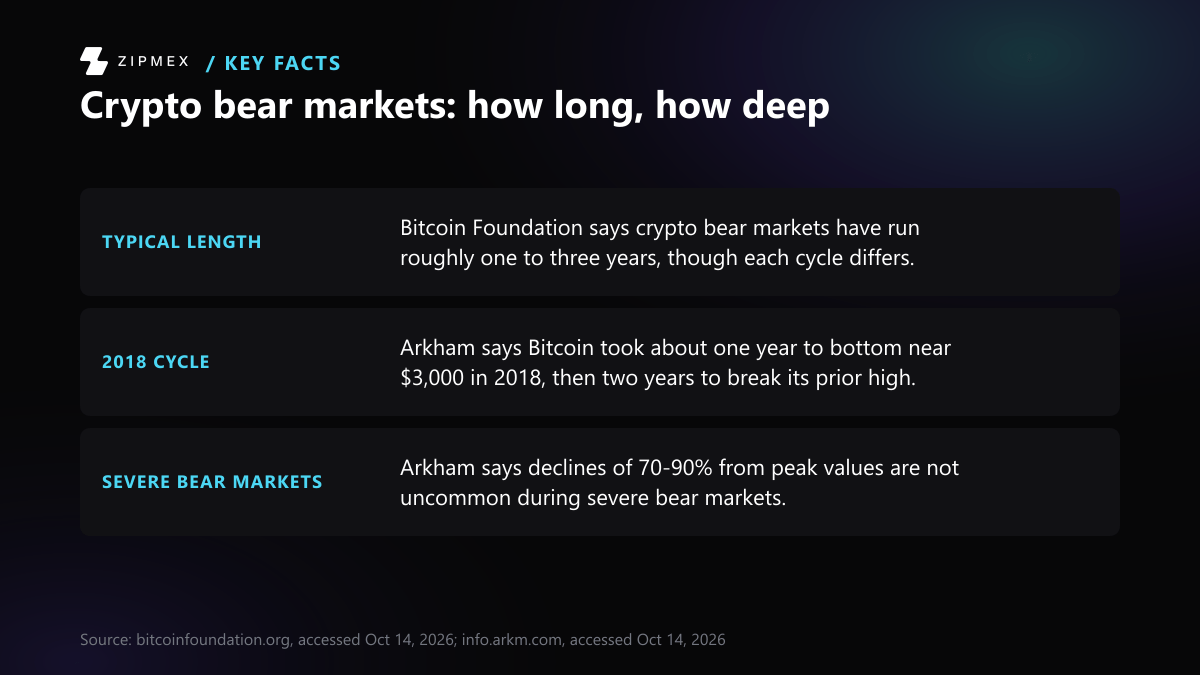
A bear market is a period when prices in a major market or asset class keep falling. The usual rule of thumb comes from traditional finance: a market is in a bear phase once prices are down 20% or more from a recent high. Some definitions also require prices to stay below that high for at least two months. Crypto bear markets usually go much further than 20%. The Bitcoin Foundation says crypto has fallen "50, 70 or even 80 percent before a bottom is found". It also says crypto bear markets have lasted "roughly one to three years, although each cycle is different."

The definition, and where the 20% line comes from
The 20% line is a convention, not a law or a formal market rule. Different sources word it in slightly different ways:
- Bitcoin Foundation (7 April 2026, updated 14 June 2026): a bear market is "a time when prices keep going down in a major market or a class of assets." Its rule of thumb is a drop of "20% or more from its recent high" that "stays below it for at least two months."
- Arkham Research (30 June 2026): "a period when asset prices decline by 20% or more from recent highs." It sets no minimum period.
- Vidhura S. Tennekoon, economist at Indiana University Indianapolis, writing in The Conversation (17 June 2022): in the stock market, a bear market is "a period of at least two months when a broad market – measured by an index such as the S&P 500 – falls by 20% or more."
Bear market vs correction
A smaller fall has its own name. In The Conversation article, Tennekoon writes: "During a correction, prices drop by 10% to 20% from the previous peak." A fall of 20% or more counts as a bear market.
Bear market vs crypto winter
The Bitcoin Foundation calls "crypto winter" "an informal term for a long bear market, usually one that lasts more than a year." Every crypto winter is a bear market, but a bear market that ends sooner does not count as a crypto winter.
How far crypto falls in a bear market
In crypto, 20% is only where a bear market begins. Past crypto bear markets have gone much deeper:
| Measure | Figure | Source |
|---|---|---|
| Traditional bear-market threshold | 20% or more from a recent high | Bitcoin Foundation; Arkham |
| Crypto falls before a bottom | 50, 70 or even 80% | Bitcoin Foundation |
| Severe crypto bear markets | 70-90% from peak "not uncommon" | Arkham |
| Bitcoin, November 2021 to December 2022 | 76% fall | Arkham |
According to the Bitcoin Foundation, altcoins usually rise faster than Bitcoin in bull phases, but "they also end up falling even harder during the bear phases."
How long crypto bear markets last
The Bitcoin Foundation puts crypto bear markets at roughly one to three years. Arkham's account of the 2018 cycle shows two separate phases. Bitcoin "took about one year to bottom out at ~$3,000." It then needed about two more years to break its previous all-time high. The recovery took about twice as long as the fall.
Arkham's dates for the 2022 decline run from November 2021 to December 2022, a fall of about a year. These duration figures come from only a few past cycles, so they describe history and do not predict the next cycle.
The 20% line next to crypto's past falls
Sort by the upper fall figure each outlet states to rank the stock-market threshold against crypto's past falls.
| Measure | Fall from peak, upper figure stated (%) | As the outlet states it | Outlet | Source |
|---|---|---|---|---|
| Stock-market bear threshold | 20 | Bear phase once a decline reaches 20 percent | Bitcoin Foundation | Source: What Is a Bear Market and Why Is Crypto Crashing? - Bitcoin Foundation (bitcoinfoundation.org), accessed Oct 14, 2026 |
| Crypto falls before a bottom | 80 | Falls of 50, 70 or even 80 percent | Bitcoin Foundation | Source: What Is a Bear Market and Why Is Crypto Crashing? - Bitcoin Foundation (bitcoinfoundation.org), accessed Oct 14, 2026 |
| Severe crypto bear markets | 90 | Declines of 70-90% from peak not uncommon | Arkham | Source: Trading Strategies for a Bear Market (info.arkm.com), accessed Oct 14, 2026 |
| Bitcoin, 2022 bear market | 76 | From November 2021 to December 2022 | Arkham | Source: Trading Strategies for a Bear Market (info.arkm.com), accessed Oct 14, 2026 |
The fall column shows the upper figure of each stated range, so the 80 and 90 rows stand for ranges that start lower.
The normal rule of thumb, taken from traditional finance, is that if the price drops by 20% or more from its recent high and stays below it for at least two months, the market is in a bear phase.
What a bear market looks like on a chart
Arkham describes a bear market by its price structure: "lower highs and lower lows dominate price action, creating a clear downtrend across the majority of timeframes." It also notes that "trading volumes frequently decline during bear markets," as participants close positions or wait. A separate explainer covers how to tell if crypto is overbought and where that test falls short.
When a bear market ends
The common rule mirrors the starting rule. Arkham says "many analysts consider a bear market over when prices rally 20% from their lows and maintain that level," and adds that the definition "varies across different markets and investors." The Bitcoin Foundation says: "No one has figured out a reliable way to predict when a bear market would end."
Both rules have limits. A 20% fall tells you a decline has started, not how deep it will go. A 20% rally from the low tells you the price has bounced, not that it has recovered. After a 76% fall like Bitcoin's in 2022, a 20% rise from the bottom would still leave the price about 71% below its old peak (0.24 × 1.2 = 0.288 of the peak).
What the labels do and do not tell you
- The 20% threshold is shared across sources. The two-month condition is not: the Bitcoin Foundation and the stock-market definition include it, and Arkham does not.
- The labels describe what has already happened to the price. They do not forecast the bottom, the length or the recovery.
