Everyone wants to buy before the rocket leaves the launchpad. A bull market is that launchpad - the stretch when prices climb, confidence builds, and fortunes are made (and, for the unprepared, lost at the top). Knowing exactly what a bull market is, how to recognise one, and how to position yourself can be the difference between riding the wave and chasing it.
⚡ Quick Answer
A bull market is a sustained period when asset prices rise - typically defined as a gain of 20% or more from recent lows, backed by optimism and strong demand. In crypto, bull markets are far more extreme: Bitcoin has surged anywhere from 700% to over 1,900% in past cycles before correcting. They are a natural phase of the market cycle and never last forever.
What Is a Bull Market? 🐂
A bull market is a prolonged stretch in which the prices of assets rise consistently over time, driven by investor optimism, strong demand, and improving fundamentals. The simplest bull market definition used by analysts is a rise of 20% or more from recent lows across a broad market index. The term applies to stocks, bonds, commodities, and real estate - but it has become especially associated with the fast-moving world of cryptocurrency.
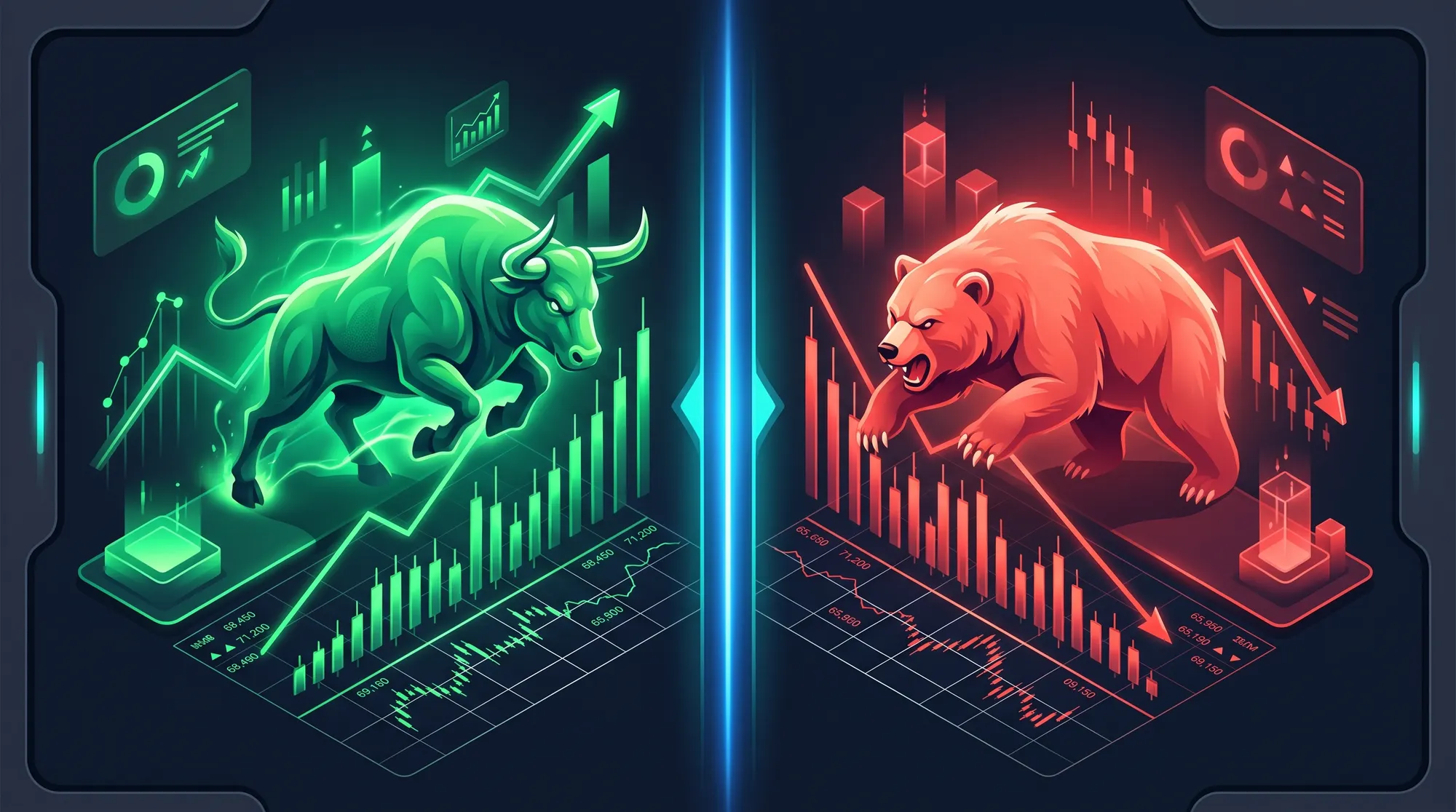
The name comes from the way a bull attacks: it thrusts its horns upward, mirroring the upward direction of prices. Its opposite, the bear, swipes its paws downward.
In crypto, the bar is set higher than in traditional finance. A 20% move can happen in a single week, so a true crypto bull market is recognised by a sustained, multi-month uptrend across Bitcoin and altcoins - not a brief spike. During these phases, investor sentiment turns euphoric, trading volume swells, and new all-time highs become routine.
Among the defining bull market characteristics you'll typically see:
- Prices rising 20% or more from a cycle bottom, sustained over months.
- Strong demand outpacing supply, pushing valuations higher.
- Rising trading volume and liquidity across exchanges.
- Optimistic sentiment, with the Fear and Greed Index parked in "Greed" territory.
- Mainstream media coverage and a flood of new retail participants.
What Causes a Bull Market? 🔍
Bull markets don't appear by accident. They are usually the product of several forces lining up at once, each feeding investor confidence and risk appetite.
📈 Common Bull Market Drivers
- Easy monetary policy: Low interest rates and abundant liquidity push money into risk assets like crypto.
- Economic strength: Growing GDP, low unemployment, and rising corporate earnings lift overall confidence.
- Institutional adoption: ETFs, corporate treasuries, and regulated products bring fresh, sticky capital.
- Supply shocks: In Bitcoin's case, the four-year halving cuts new coin issuance and tightens supply.
- Positive sentiment & FOMO: As prices climb, fear of missing out pulls in waves of new buyers.
In crypto specifically, the Bitcoin halving is a recurring catalyst. The most recent halving, between April 19 and 20, 2024, cut the block reward from 6.25 BTC to 3.125 BTC, reducing the flow of new supply just as demand from spot ETFs accelerated. Historically, major bull runs have begun 6-12 months after a halving and peaked roughly 500-550 days later - though every cycle differs.
Tracking the behavior of these institutional vehicles is essential for predicting market longevity. By monitoring Bitcoin ETF outflows, investors can gauge whether Wall Street is accumulating for a sustained bull run or taking early profits during a price rally.
The Phases of a Bull Market 📅
A bull market rarely rises in a straight line. Analysts generally break it into three or four recognisable phases. Understanding where you are in this sequence is one of the most useful skills an investor can develop.
📅 The Bull Market Cycle
Phase 1 - Accumulation
Sentiment is still gloomy after a bear market. Smart money and long-term holders quietly buy undervalued assets while the crowd remains fearful.
Phase 2 - Public Participation
The longest, most rewarding phase. Confidence returns, volume surges, media coverage intensifies, and retail investors pile in as prices trend steadily higher.
Phase 3 - Distribution / Euphoria
Prices peak and may become overvalued. Early buyers take profits, optimism turns to mania, and volatility rises - often the prelude to a transition into a bear market.
When the euphoria suddenly breaks, cascading liquidations and panic selling can wipe out months of steady growth in a matter of days. Understanding the systemic catalysts that trigger these violent reversals is crucial; explore the underlying mechanics in our analysis on why is crypto crashing.

Bull Market vs Bear Market: What's the Difference? 🐂🐻
The clearest way to understand a bull market is to set it against its opposite. A bull market and a bear market are the two halves of the natural crypto market cycle - one driven by greed, the other by fear.
Neither phase lasts forever. If you want the other side of the coin, our companion guide explains exactly what a bear market is and how to survive one. Markets also spend long stretches going nowhere - that's a sideways market, a third condition every trader eventually meets.
Crypto Bull Market History: What the Data Shows 📊
The clearest lesson from Bitcoin bull run history is that each cycle has delivered explosive gains followed by a deep correction - and each new peak has been higher than the last.
📅 Bitcoin's Major Bull Runs
2013
BTC climbed from around $145 to over $1,200 - roughly a 730% surge that put crypto on the public's radar for the first time.
2017
A roughly 1,900% rally drove BTC from about $1,000 to nearly $20,000, fuelled by the ICO boom and retail mania.
2020-2021
Institutional adoption pushed BTC from around $8,000 to over $64,000 (a ~700% jump), before peaking near $69,000 in November 2021.
2024-2025
Spot Bitcoin ETFs and the 2024 halving drove BTC to an all-time high near $126,200 in October 2025.
The numbers behind these runs are well documented. According to KuCoin's history of Bitcoin bull runs, the 2020-2021 cycle delivered roughly a 700% gain, while earlier cycles produced even larger percentage moves from a lower base. Bitcoin's all-time high of $126,198.07 was reached on October 6, 2025. In traditional markets, bull runs can last far longer - the post-2008 stock market bull stretched for over a decade.
A consistent pattern emerges: percentage returns have shrunk as the market matured, but every completed bull market has carried Bitcoin to a new record high. Past performance never guarantees future results, but it does explain why long-term holders treat each cycle as part of a bigger picture.

How to Invest in a Bull Market 💰
A bull market is the easiest time to make money - and the easiest time to give it all back. Rising prices forgive mistakes on the way up and punish them brutally at the top. Here are the strategies experienced investors lean on.
Establishing strict stop-loss parameters and protecting your capital should be your primary focus before chasing any euphoric rally. To ensure you survive sudden market corrections and preserve your bull market gains, read our expert guide on how to manage risk in crypto trading.
Strategy 1: Buy and Hold
The simplest approach is also one of the most effective. Buying quality assets and holding through the cycle avoids the trap of selling winners too early. Bitcoin and Ethereum have historically led every recovery - our breakdown of the best crypto to buy in 2026 covers how to think about quality versus speculation.
Strategy 2: Dollar-Cost Averaging (DCA)
Even in a bull market, prices don't rise in a straight line. Investing a fixed amount at regular intervals smooths out volatility and removes the pressure of perfect timing. DCA is especially powerful when started early, during the accumulation phase before the crowd arrives.
Strategy 3: Take Profits on the Way Up
The hardest discipline in a bull market is selling into strength. Setting staged profit targets - trimming a portion of your position as prices rise - locks in gains before euphoria reverses. Many investors plan their exit during the bull market precisely because the next downturn is never far away.
Strategy 4: Put Idle Assets to Work
Holding through a bull run doesn't mean your assets have to sit still. Crypto staking lets you earn yield on coins you already plan to hold, compounding returns during the uptrend.
⚠ Risk Warning
Bull markets breed overconfidence. FOMO drives investors into overvalued, low-quality tokens that collapse hardest in the next correction. Never invest more than you can afford to lose, avoid chasing parabolic pumps, and remember that leverage amplifies losses as fast as gains.
🎯 Key Takeaways
- A bull market means prices rising 20%+ over a sustained period, backed by optimism and demand.
- Crypto bull runs are far more extreme than stocks, with Bitcoin gaining hundreds to thousands of percent per cycle.
- Bull markets move through accumulation, public participation, and distribution phases.
- Best strategies: buy quality, DCA, take profits on strength, and manage risk actively.
- No bull market lasts forever - plan your exit before euphoria peaks.
Are We in a Crypto Bull Market in 2026? 📉📈
As of late May 2026, the honest answer is: not right now. Bitcoin is trading around $76,600 with a market cap near $1.54 trillion - roughly 39% below its October 2025 all-time high of $126,198. By the standard 20% rule, a drop of that size places the market in correction-to-bear territory rather than a bull phase.
That said, the picture is far from one-sided. Technical momentum has been improving, with Bitcoin's RSI recovering toward neutral levels and price holding above key moving averages. Many analysts frame the crypto bull market 2026 debate around whether the post-halving cycle has one more leg higher or has already peaked. Watching on-chain accumulation and the Fear and Greed Index is the most reliable way to gauge whether the next bull phase is forming.
How long do bull markets last? In crypto, roughly one to two years on average - but the only certainty is that they always end, and they are always followed by recovery.
One of the most closely watched moving average events by technical analysts is when short-term trends cross above long-term trends, often signaling a massive macro shift. You can learn how to spot these definitive bullish confirmations in our technical breakdown of what is a golden cross.
Frequently Asked Questions
What is a bull market in simple terms?
A bull market is a sustained period when asset prices rise - usually defined as a gain of 20% or more from recent lows - driven by optimism and strong demand. In crypto, bull markets are more dramatic than in stocks, with Bitcoin historically gaining anywhere from hundreds to thousands of percent before correcting.
How long does a crypto bull market last?
Crypto bull markets typically last around one to two years, though there's no fixed pattern. The 2020-2021 bull run stretched from late 2020 to Bitcoin's peak in November 2021. A bull market's end is usually only clear in hindsight, once it has flipped into a bear phase.
What causes a bull market?
Bull markets are driven by a mix of low interest rates, economic growth, institutional adoption, and positive sentiment. In crypto, the four-year Bitcoin halving acts as a recurring catalyst by tightening new supply, and spot ETFs have added a powerful new source of demand.
What is the difference between a bull market and a bear market?
A bull market is a sustained rise of 20%+ with optimistic sentiment and high demand. A bear market is a sustained decline of 20%+ with pessimism and weak demand. They are the two opposite halves of the same market cycle, and both are temporary.
Is a bull market a good time to buy crypto?
A bull market can be profitable, but buying near the top is risky because prices may already be overvalued. Disciplined approaches like dollar-cost averaging and buying quality assets early in the cycle tend to outperform chasing parabolic pumps in the euphoria phase.
Are we in a crypto bull market right now?
As of late May 2026, no. Bitcoin is trading around $76,600 - roughly 39% below its October 2025 all-time high of $126,198 - which places the market in correction territory rather than a confirmed bull phase, though momentum signals have been improving.
What should I avoid doing in a bull market?
Avoid FOMO buying at the top, going all-in on speculative low-quality tokens, and using heavy leverage. The biggest mistake retail investors make is entering during the euphoria phase and refusing to take any profits before the cycle turns.
Conclusion
A bull market is one of the most exciting phases in any market - a stretch of rising prices, growing confidence, and real opportunity to build wealth. But the same optimism that drives gains can also trap the unprepared at the top. Understanding what a bull market is, recognising its phases, and applying disciplined strategies like buying quality, dollar-cost averaging, and taking profits on strength is what separates investors who keep their gains from those who give them back.
Every bull market in Bitcoin's history has eventually ended - and every one has been followed by a new cycle and, in time, a new all-time high. Use that perspective. Whether the next leg of the cycle starts soon or after more consolidation, the investors who prepare during the quiet are the ones who profit when the bull charges again.
⚠ Disclaimer: The information provided in this article is not intended to provide investment or financial advice. Investment decisions should be based on the individual's financial needs, objectives, and risk profile. We encourage readers to understand the assets and risks before making any investment entirely. Cryptocurrency investments are subject to high market risk. Past performance does not guarantee future results.
ZIPMEX promotes trading on trade.zipmex.com. Promotions are labelled and kept separate from news coverage, which is selected and checked without regard to them. Perpetual futures are leveraged derivatives. Prices can move fast and you can lose all of your margin. Not available in every jurisdiction. Not investment advice.