⚡ Quick Answer
Crypto staking is the process of locking up your cryptocurrency on a Proof-of-Stake (PoS) blockchain to help validate transactions and earn rewards. Think of it like earning interest on a savings account - except instead of a bank, the blockchain network itself pays you for keeping it secure. In 2026, major PoS networks like Ethereum, Solana, and Cardano offer staking APYs ranging from 3% to 8% annually.
You've probably heard the phrase "your crypto can work for you while you sleep." Crypto staking is exactly that. Instead of letting your coins sit idle in a wallet, staking puts them to work - you earn more crypto simply by holding and contributing to a blockchain network.
In this guide, we cover everything you need to know about crypto staking: how it works, what types exist, which coins you can stake, realistic rewards you can expect in 2026, and the risks involved.
What Is Crypto Staking?
Crypto staking is the process of locking a certain amount of cryptocurrency in a blockchain network to support its operations - specifically, to validate transactions and produce new blocks. In return for this contribution, the network pays you staking rewards in the form of additional cryptocurrency.
This mechanism serves as a decentralized alternative to traditional transaction validation, replacing energy-intensive mining rigs with a consensus model based on asset ownership. By locking up native assets, participants directly support the network's consensus protocol to verify new entries securely and maintain chronological data distribution. To gain a foundational understanding of how these decentralized ledgers operate across multiple global nodes, explore our definitive guide on what are blockchains and how they work.
Staking is only available on blockchains that use the Proof of Stake (PoS) consensus mechanism. Unlike Bitcoin's Proof of Work, which requires miners to solve complex math puzzles using powerful hardware, PoS relies on economic participation. You "stake" your coins as collateral, and the network selects validators based on how much is staked.
A useful analogy: think of staking like putting money in a savings account. The bank uses your deposit to operate - and pays you interest. With staking, the blockchain uses your coins to secure the network - and pays you rewards.
🔑 Key Takeaways
- Staking = locking crypto to support a PoS blockchain and earn rewards
- It only works on PoS blockchains (e.g., Ethereum, Solana, Cardano)
- Bitcoin and other Proof of Work coins cannot be staked
- Rewards are variable - not guaranteed - and depend on network conditions
How Does Crypto Staking Work?
To understand staking, you need to understand how Proof of Stake blockchains maintain consensus - that is, how they agree on which transactions are valid.
Mechanically, the allocation of your assets and the calculation of subsequent payouts are governed entirely by autonomous, self-executing cryptographic agreements. These on-chain protocols ensure that neither the individual validators nor the token delegators can disrupt or modify the network's reward logic during execution. You can study how these tamper-proof transactional applications power the decentralized web by reading our explainer on how do Ethereum smart contracts work.
Here's the step-by-step process:
You lock up your crypto
You commit a chosen amount of cryptocurrency to a staking program - this is called "bonding" your assets. Some networks require a minimum amount. Most have a bonding period before rewards begin.
The network selects validators
Validators are chosen based on factors including how much they have staked, how long they've been staking, and sometimes randomness. The more you stake, the higher your chances of being selected.
Transactions are validated
The selected validator checks and confirms pending transactions, groups them into a block, and adds the block to the chain. Other validators cross-check the block for accuracy.
You earn staking rewards
For each block validated, the network issues new cryptocurrency as a reward. Rewards are proportional to your stake and paid in the same token you staked. This cycle repeats continuously.
What is slashing? If a validator acts maliciously - or simply goes offline for too long - the network can "slash" a portion of their staked funds as a penalty. This is the economic mechanism that keeps validators honest.
Types of Crypto Staking
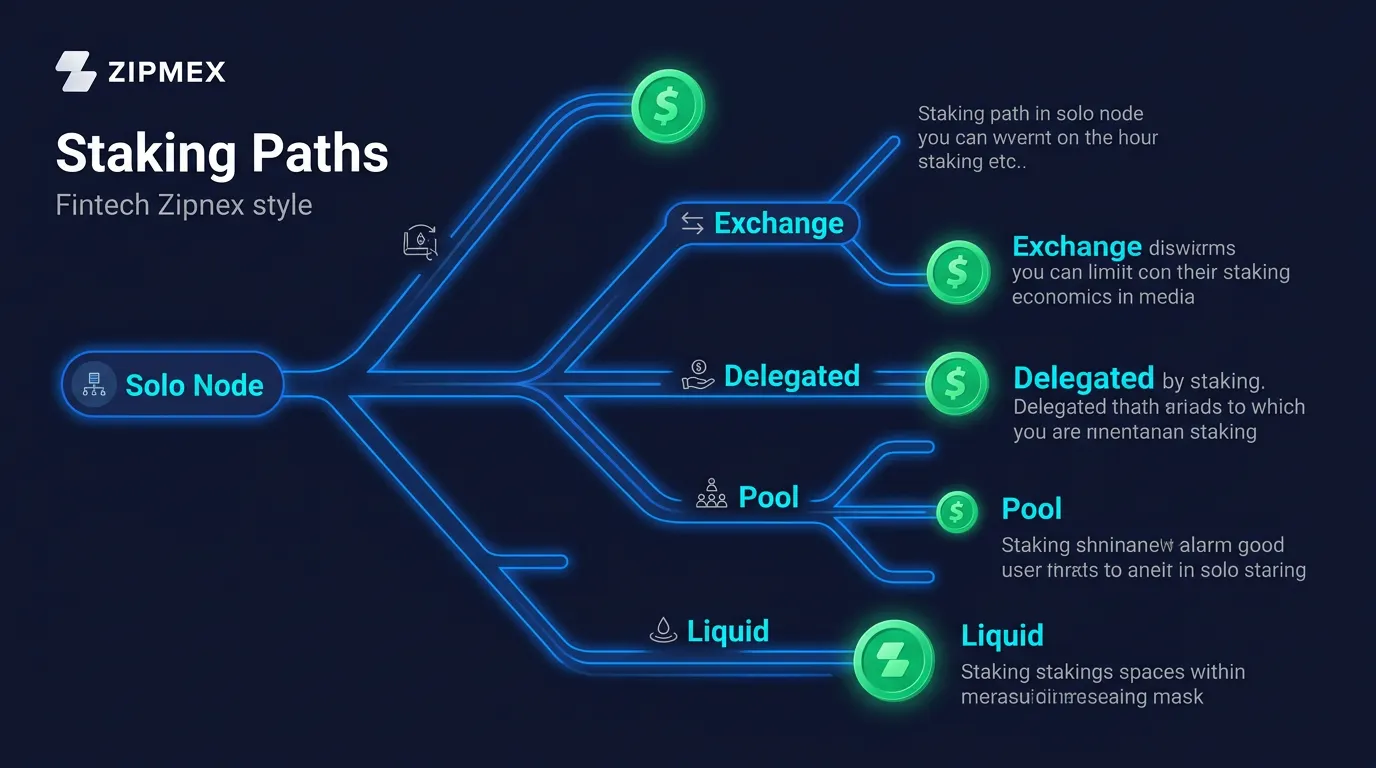
There is no single way to stake. The right method depends on your technical knowledge, how much capital you have, and how much control you want.
Liquid staking has become especially popular with the growth of DeFi. Protocols like Lido let you stake ETH and receive stETH - a token representing your staked position - which you can then use in other DeFi applications while still earning staking rewards.
What Cryptocurrencies Can You Stake?
Only cryptocurrencies built on Proof of Stake (or related mechanisms) support staking. Bitcoin, for instance, uses Proof of Work and cannot be staked. Here are the most widely staked assets in 2026:
🪙 Top Stakeable Cryptocurrencies (2026)
Ethereum (ETH)
~3-5% APY
35.86M ETH staked (28.9% of supply)
Solana (SOL)
~5-6.3% APY
Fast transactions, large delegator ecosystem
Cardano (ADA)
~4-6% APY
No lock-up period, rewards every ~5 days
Cosmos (ATOM)
~15-18% APY
High yield; 21-day unbonding period
Polkadot (DOT)
~12-14% APY
28-day unbonding period
Avalanche (AVAX)
~8-9% APY
Short lock-up, competitive rewards
Note: Higher APY figures on newer or smaller networks often reflect higher token inflation rates. Always consider inflation-adjusted real returns, not just nominal APY.
Crypto Staking Rewards: How Much Can You Earn?
Staking rewards are expressed as an Annual Percentage Yield (APR or APY) and are not fixed - they fluctuate based on network conditions. Here's what determines your returns:
- Total staked supply: More people staking = lower individual rewards per token
- How long you've staked: Some networks reward longer commitments
- Validator commission: Validators take a fee (typically 3-20%) before passing rewards to delegators
- Slashing events: Penalties reduce returns if your validator misbehaves
Keep in mind that claiming your accumulated rewards or unstaking your assets are active on-chain operations that require a network processing fee paid directly to validators. During times of high transaction volume or extreme market volatility, these computational tolls can increase rapidly, potentially eating into the net returns of smaller staking positions. To optimize your transaction timing and prevent overpaying for ledger computations, consult our expert guide on what gas fees are and how blockchain transaction costs are calculated.
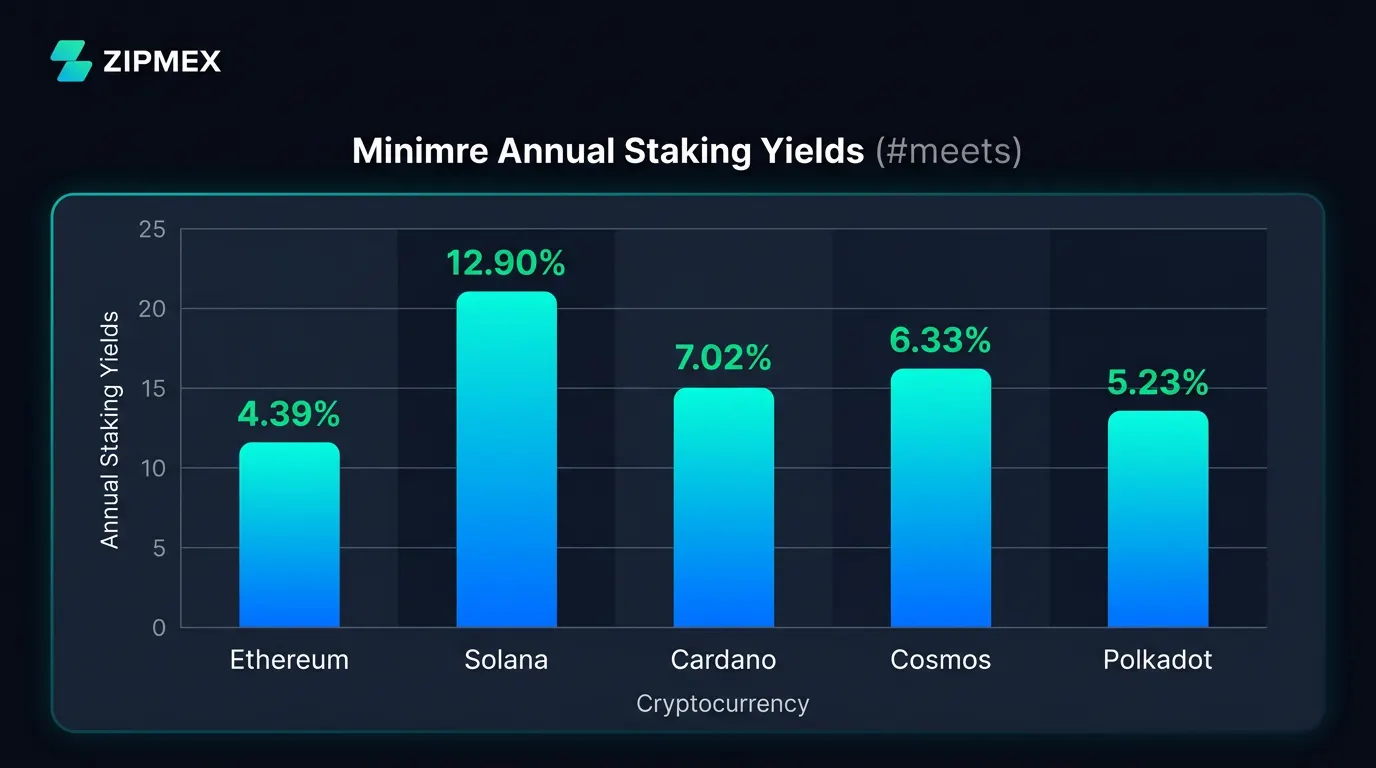
According to data compiled by Cobo as of January 2026, approximately 35.86M ETH is staked (28.9% of total supply), generating an average APY of around 3.3%. Solana staking, meanwhile, yields around 5-6.3% APY on average, with actual returns varying by validator performance.
💡 Pro Tip
For Ethereum solo staking, the Pectra upgrade (May 7, 2025) raised the maximum stake per validator from 32 ETH to 2,048 ETH - a 64. increase. Previously, large institutional stakers had to manage hundreds of separate validator nodes. Pectra made large-scale staking dramatically simpler, but for most retail users, the change has minimal practical impact.
Unbonding periods matter. When you decide to unstake, you usually cannot access your funds immediately:
- Ethereum: No fixed period, but there may be a withdrawal queue
- Cardano: No unbonding period - instant liquidity
- Cosmos (ATOM): 21 days
- Polkadot (DOT): 28 days
- Solana: 2-3 days (one epoch)
Planning around unbonding periods is essential if you might need access to your capital quickly.
Staking vs Holding: Is Crypto Staking Worth It?
If you're a long-term holder of a PoS cryptocurrency, staking is almost always preferable to simply holding - assuming you're comfortable with the lock-up period and associated risks.
While securing a nominal yield offers an excellent buffering strategy against short-term price drops, it does not completely shield an investor from structural macro market downturns. If the fiat value of your staked utility coin declines dramatically during a prolonged industry-wide selloff, the absolute capital depreciation can easily outpace any interest you accumulate. For advanced risk management frameworks and protective positioning strategies during severe market downturns, check our comprehensive survival manual for a crypto winter 2026.
Who should stake: Long-term crypto holders planning to hold anyway, users comfortable with unbonding periods, and those who want to contribute to network security.
Who should think twice: Traders who need instant liquidity, users on small budgets where exchange fees erode returns, and anyone without a clear understanding of the risks.
Risks of Crypto Staking
Staking is not risk-free. Before locking up your assets, make sure you understand these key risks:
⚠ Key Staking Risks
- Market volatility: If your staked token's price drops sharply during the lock-up period, rewards may not offset the loss in fiat value.
- Slashing: Validators who behave maliciously or go offline can lose a portion of staked funds - including those delegated by other users.
- Liquidity risk: During unbonding (up to 28 days on some networks), you cannot sell or move your assets, even in a market crash.
- Smart contract risk: Liquid staking protocols introduce smart contract vulnerabilities. A bug could put staked assets at risk.
- Third-party risk: Staking through exchanges or staking-as-a-service providers means trusting that platform with your funds.
- Centralization risk: If a small number of validators control most of a network's stake, it can threaten decentralization and security.
From wallet to 100x in 30 seconds
ZIPMEX is the fastest way into leveraged trading. No signup, no KYC, no deposit queue.
Open ZIPMEX →How to Start Staking Crypto
Ready to stake? Here's a beginner-friendly path to your first staking rewards:
Choose a PoS cryptocurrency
Pick a coin you believe in long-term. Ethereum, Cardano, and Solana are the most established options for beginners. Research the staking requirements and lock-up periods for each.
Decide on a staking method
For most beginners, exchange staking (via Coinbase, Kraken, Binance) or delegated staking (via your native wallet) is the easiest entry point. Solo staking requires 32 ETH and technical expertise for Ethereum.
Set up your wallet or account
For on-chain staking, you'll need a compatible wallet (MetaMask for Ethereum, Phantom for Solana, Daedalus or Yoroi for Cardano). For exchange staking, simply hold eligible assets on the platform.
Start staking and monitor your rewards
Follow the network's or platform's instructions to stake. Most platforms show your estimated APY and accumulated rewards. Keep track of unbonding periods and validator performance if delegating.
💡 Pro Tip
If you want to avoid lock-up periods while still earning staking rewards, explore liquid staking via protocols like Lido (stETH) or Rocket Pool (rETH). You stake your ETH and receive a liquid token in return - which you can trade or use in DeFi while still accruing rewards.
Frequently Asked Questions
What is crypto staking in simple terms?
Crypto staking means locking up your cryptocurrency to help a blockchain network validate transactions. In return, the network pays you rewards - similar to earning interest on a savings account. It only works with coins that use Proof of Stake, such as Ethereum, Solana, and Cardano.
Is staking crypto safe?
Staking carries several risks: market volatility can make token values drop during lock-up periods; validator issues can trigger slashing penalties; and smart contract bugs can put liquid-staked assets at risk. Staking on established, audited networks with reputable validators reduces - but does not eliminate - these risks.
How much can you earn staking crypto?
In 2026, typical staking APYs range from 3-5% for Ethereum, 5-6.3% for Solana, and 4-6% for Cardano. Higher-yielding networks like Cosmos (~15-18%) exist but often carry higher inflation, which can offset nominal returns. Rewards are variable, not guaranteed.
Can I unstake my crypto at any time?
It depends on the network and method. Cardano has no lock-up period. Ethereum has no fixed unbonding window but may involve a queue. Cosmos requires 21 days and Polkadot requires 28 days before you can access your funds after initiating a withdrawal. During this period you also stop earning rewards.
What is the difference between staking and liquid staking?
Traditional staking locks your assets for a period, making them inaccessible. Liquid staking protocols issue you a derivative token (e.g., stETH, rETH) representing your staked position, which you can trade or use in DeFi - giving you both staking rewards and liquidity simultaneously.
Why can't you stake Bitcoin?
Bitcoin uses Proof of Work, not Proof of Stake. In PoW, miners compete using computational power to validate transactions - there is no staking mechanism. Only PoS-based cryptocurrencies support staking.
Conclusion
Crypto staking is one of the most accessible ways for long-term crypto holders to put their assets to work. By locking up coins on a Proof of Stake network, you can earn passive income - typically 3-8% APY on major networks in 2026 - while contributing to the security and decentralization of the blockchain.
That said, staking isn't without trade-offs. Lock-up periods, slashing risk, market volatility, and third-party risk are all real considerations. The best approach is to start with established networks like Ethereum, Solana, or Cardano; choose reputable validators or trusted platforms; and only stake assets you're comfortable holding long-term regardless of price movements.
⚠ Disclaimer: The information provided in this article is not intended to provide investment or financial advice. Investment decisions should be based on the individual's financial needs, objectives, and risk profile. We encourage readers to understand the assets and risks before making any investment entirely. Cryptocurrency investments are subject to high market risk. Past performance does not guarantee future results.
ZIPMEX promotes trading on trade.zipmex.com. Promotions are labelled and kept separate from news coverage, which is selected and checked without regard to them. Perpetual futures are leveraged derivatives. Prices can move fast and you can lose all of your margin. Not available in every jurisdiction. Not investment advice.