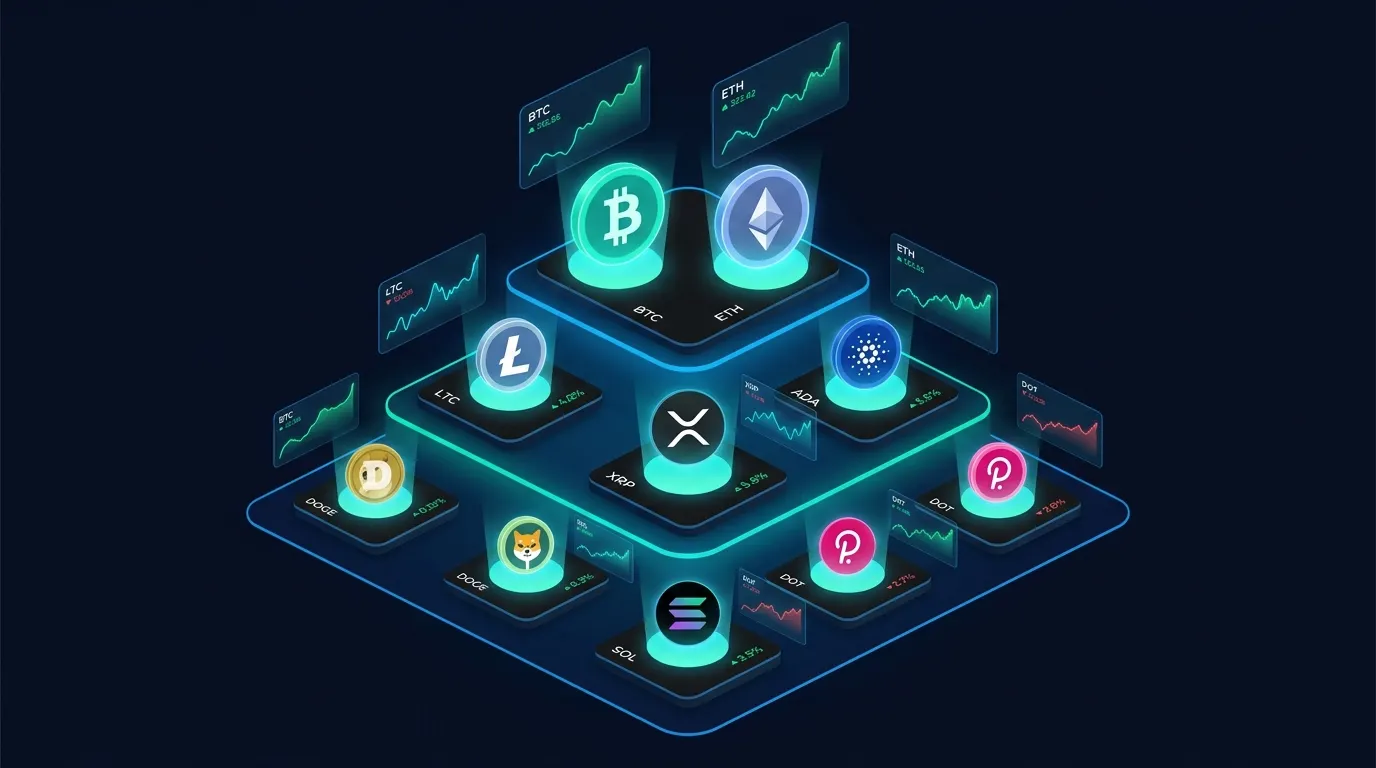
The best crypto to buy in 2026 isn't one coin - it's a risk-tiered selection that matches your investment goals. Bitcoin and Ethereum anchor any serious portfolio. Solana and XRP offer higher upside with proven ecosystems. Chainlink, Cardano, Sui, and Bittensor round out the high-conviction altcoin layer.
⚡ Quick Answer
The best crypto to buy in 2026 depends on your risk tolerance. For safety: Bitcoin (BTC) and Ethereum (ETH). For upside: Solana (SOL) and XRP. For high-conviction bets: Chainlink, Cardano, Sui, and Bittensor. The optimal allocation: 50% blue-chips, 30% majors, 20% altcoins.
The crypto market in May 2026 sits at a crossroads. CoinMarketCap reports a total market cap of $2.67 trillion with Bitcoin dominance at 60.65% - a level that historically precedes altcoin season rotations. Bitcoin ETFs recorded $629 million in net inflows on May 1 alone, with BlackRock contributing $284 million and Fidelity adding $213 million. The institutional floor is real.
This guide ranks the 8 best cryptocurrencies to buy in 2026 by risk tier, with current data, analyst targets, and a practical allocation framework. No hype, no presale shilling - only assets with track records, real utility, and verifiable market data.
Why 2026 Is a Critical Entry Window for Crypto
The question isn't whether crypto will recover - it's whether you'll be positioned when it does. Every major Bitcoin cycle has followed the same pattern: halving → institutional accumulation → retail FOMO → new ATH. The 2024 halving already happened. Institutional accumulation through ETFs is confirmed. The retail wave hasn't arrived yet.
Here's why right now matters:
- Bitcoin ETF inflows: $2.44 billion in April 2026 alone, the strongest ETF month on record, per Coinpedia
- Regulatory clarity: Congress passed stablecoin legislation in 2025; the SEC faces 91 pending crypto ETF applications covering 24 tokens
- Market cycle timing: Analyst Raoul Pal's extended cycle framework places the potential cycle peak in late 2026, not 2025
- Macro tailwinds: Incoming Fed Chair Kevin Warsh is expected to push for earlier rate cuts - historically a strong catalyst for risk assets like crypto
Tier 1: The Foundation (BTC + ETH)
These are the bedrock of any crypto portfolio in 2026. Both have ETF products, institutional backing, and proven track records through multiple market cycles. If you can only own two assets, make it these.
Bitcoin (BTC) - The Institutional-Grade Store of Value
Bitcoin remains the benchmark for the entire crypto market. Its capped supply of 21 million coins, combined with the 2024 halving that tightened new issuance to 450 BTC/day, creates structural supply pressure. Spot Bitcoin ETFs have attracted over $56 billion in cumulative net inflows as of January 2026, with total ETF assets representing roughly 6.47% of Bitcoin's market cap.
BTC is currently trading near the $68,000-$79,000 range, down from its late-2025 ATH. Long-term holders control more than 70% of circulating supply. Analyst price targets for 2026 range from $80,000 (conservative) to $185,000 (bull case), depending on macro conditions and ETF demand continuation.
Who it's for: Conservative investors who want crypto exposure with the lowest risk of permanent loss. Also the best entry for anyone building their first crypto position.
Ethereum (ETH) - The Programmable Backbone of DeFi
Ethereum is the most beaten-down blue-chip in the current cycle. Trading around $1,900-$2,330, it sits 61-80% below its 2025 all-time high of approximately $4,891-$4,946. That drawdown is painful - but it also creates one of the most asymmetric risk-reward setups in the market. As Charles Schwab noted, ETH at this level represents deep value by historical standards.
Ethereum anchors the vast majority of DeFi's total value locked ($80B+ ecosystem), hosts the largest Layer-2 scaling ecosystem (Arbitrum, Base, Optimism), and benefits from EIP-1559's deflationary burn mechanism. With approximately 28% of supply now staked, liquid circulating supply is meaningfully constrained.
Spot Ethereum ETFs are recording strong institutional interest in 2026, with Solana ETFs logging 12+ consecutive days of inflows in early 2026 - a signal that traditional finance is broadening its crypto exposure beyond Bitcoin.
Who it's for: Investors with a 6-12 month horizon who want programmable blockchain exposure with blue-chip risk characteristics.
Tier 2: High-Upside Majors (SOL + XRP)
These are established, large-cap assets with proven ecosystems - but they carry more volatility than BTC and ETH. They tend to fall harder in crashes and recover faster in rallies. At current discounts from their all-time highs, they represent compelling risk-adjusted opportunities for investors with a moderate risk tolerance.
Solana (SOL) - The High-Performance Layer-1
Solana trades near $82-84, down approximately 72% from its January 2025 ATH of $294. That's a brutal decline - but it also means SOL is priced at levels last seen before its 2025 breakout. Solana's circulating supply sits at 620.8 million tokens, and its proof-of-history mechanism continues to give it a genuine technological edge in throughput.
The Solana network processed over 65 billion transactions in 2026 so far. Developer activity is climbing. Multiple new DeFi projects launched on the chain in April 2026. The Alpenglow consensus upgrade - developed by Anza - would replace the current Proof of History and Tower BFT systems with Votor (100-150ms block finalization) and Rotor, dramatically improving speed and reliability.
Analyst base case: $150-$200 for SOL by end of 2026 if broader market recovery holds.
Who it's for: Investors comfortable with higher volatility who believe in the continued growth of high-throughput Layer-1 blockchains and want maximum upside exposure in the large-cap tier.
XRP (Ripple) - Institutional Payments, Regulatory Clarity
XRP trades around $1.36-$2.00 with a market cap near $83 billion - down 46-65% from its ATH of $3.84. The five-year legal battle between Ripple and the SEC concluded in August 2025 with a landmark settlement, removing the single biggest overhang on the asset. XRP Ledger processes transactions in 3-5 seconds at approximately $0.0002 per transaction, making it one of the most efficient blockchain networks for institutional payments.
Key catalysts for 2026: spot XRP ETF approvals, expanded RippleNet banking partnerships, and RLUSD stablecoin adoption. CoinCodex forecasts XRP in a range of $1.86-$3.00 by end-2026, while Changelly projects an average of $3.26 and Standard Chartered presents a bull case of $8.50 if
ETF inflows continue and RippleNet secures additional bank partnerships.
Who it's for: Investors who want institutional-grade exposure to cross-border payments infrastructure with a defined catalyst roadmap.
The intersection of entertainment and decentralized finance has moved beyond simple speculation, with millions of users now generating real-world value through on-chain activity. If you're interested in assets that offer more than just passive price appreciation, exploring established gaming ecosystems is a strategic move. You can find detailed reviews of the top play-to-earn crypto games that are currently providing sustainable rewards for their active player base.
Tier 3: High-Conviction Altcoins (LINK, ADA, SUI, TAO)
These assets carry more risk but offer the highest potential returns in a bull cycle. Each has a specific investment thesis backed by real network activity. Limit this tier to 20% or less of your crypto allocation.
While identifying high-cap winners is essential for stability, the immersive digital economy offers some of the most explosive growth opportunities in this cycle. As global brands establish permanent presences in virtual worlds, certain protocols are emerging as the preferred infrastructure for decentralized commerce. To refine your exposure to this specific niche, check out our curated list of the top metaverse coins to buy in 2026 and their ecosystem fundamentals.
Chainlink (LINK) - The Data Infrastructure Play
Chainlink is the leading decentralized oracle provider, connecting blockchains to real-world data. Its Cross-Chain Interoperability Protocol (CCIP) positions LINK as a backbone for tokenization, DeFi, and real-world asset (RWA) markets. According to Coincub, the disconnect between Chainlink's critical infrastructure role and its currently discounted price creates a compelling asymmetric opportunity if DeFi activity recovers - which Aave's recent $1 trillion in cumulative lending volume suggests is already underway.
Cardano (ADA) - The Engineer's Blockchain
Cardano emphasizes energy efficiency, formal verification, and a methodical development cadence. Its proof-of-stake model and clear supply ceiling attract a dedicated developer community. The key risk: smart-contract ecosystem growth has been slower than competitors like Solana and Ethereum's L2 stack. For ADA, the investment thesis is a bet on deliberate, institutional-grade blockchain infrastructure eventually capturing mainstream adoption.
Sui (SUI) - The Next-Gen Layer-1
Sui trades near $0.89, down significantly from pre-crash highs, with a market cap of $3.4 billion. Its object-centric architecture and rising total value locked (TVL) make it one of the highest-upside Layer-1 bets in the current cycle. SUI frequently decouples from Bitcoin's movements, showing significant relative strength - and when SOL recovers, SUI historically follows with more aggressive percentage gains due to its smaller market cap.
Bittensor (TAO) - The AI Crypto Thesis
Bittensor holds a $3.44 billion market cap and leads the AI crypto sector. The protocol operates a decentralized network where independent ML models compete for computational services, rewarded through TAO tokens based on performance quality. TAO is up approximately 47% in 2026 against a broader market that remains 20%+ down for the year - a remarkable show of relative strength. Its subnet architecture (now supporting up to 128 specialized AI task markets) and Bitcoin-like scarcity model (21 million max supply) make it the strongest pure-play on the AI x Blockchain narrative.
How to Build Your Crypto Portfolio in 2026
Knowing which assets to buy is only half the answer. How you allocate and when you deploy capital matters just as much.
Define Your Allocation Split
The balanced framework recommended by most analysts: 50% BTC + ETH (blue-chips), 30% high-upside majors (SOL, XRP), 20% category altcoins (LINK, ADA, SUI, TAO). According to Morgan Stanley's Global Investment Committee, even a 6% total crypto allocation nearly doubles overall portfolio volatility - size your position accordingly.
Deploy via DCA (Not Lump Sum)
Divide your total budget into 4-6 equal tranches. Deploy one tranche every 1-2 weeks. This removes the pressure of timing the bottom and ensures you capture an average entry price across the consolidation. Read more about this in our bear market strategy guide.
Keep 5-10% in Stablecoins
Stablecoins are your portfolio's defensive anchor. When dips occur, you have capital ready to deploy immediately. They also generate 3-8% APY on various DeFi platforms, turning idle reserve into yield.
Define Your Exit Strategy Before You Enter
Predetermine your profit-taking targets for each asset. Having defined targets prevents the two most common emotional mistakes: panic-selling at the bottom and greed-holding through the next cycle peak. For on-chain analytics to help time these decisions, see our on-chain analytics guide.

Key Risks to Understand Before You Buy
⚠ Risk Warning
Crypto assets are highly volatile. BTC fell 48% from peak in early 2026. Altcoins regularly decline 70-90% from highs. Never invest more than you can afford to lose entirely. A good rule of thumb: limit crypto to 5-10% of your total investment portfolio, 20% maximum for aggressive investors. Avoid leverage during volatile market conditions - over 1.6 million trader accounts were liquidated on October 10, 2026 in a single cascade event.
📈 Bullish Factors for 2026
- ETF Institutional Floor: $56B+ cumulative Bitcoin ETF inflows create sustained demand that didn't exist in prior cycles
- Regulatory Clarity: Stablecoin legislation passed, XRP lawsuit resolved, 91 pending ETF applications signal policy maturing
- Rate Cut Catalyst: Incoming Fed Chair expected to cut rates sooner, historically strong for risk assets
- RWA Tokenization: Total tokenized real-world assets have tripled since 2025 to $19.3B, driving new on-chain capital
📉 Bearish Risks
- Macro Shock: Tariff escalations and hawkish macro surprises can cascade into crypto liquidations (Feb 2026: $2.56B liquidated)
- Altcoin Failure Rate: Over 70% of altcoins historically fail to recover to prior ATHs after major drawdowns
- Leverage Cascades: The October 2026 crash liquidated $19.16B in under 24 hours - record single-day wipeout
- Regulatory Reversal: Policy changes in major jurisdictions can create sudden, severe price pressure
🎯 Key Takeaways
- The best crypto to buy in 2026 starts with BTC and ETH - they anchor any responsible portfolio
- SOL and XRP offer the best risk-adjusted upside among large-cap altcoins at current discount levels
- Limit high-risk altcoins (LINK, ADA, SUI, TAO) to 20% of your crypto allocation maximum
- DCA over 4-6 weeks beats trying to time the bottom
- Never allocate more to crypto than you can afford to lose entirely
Conclusion
The best crypto to buy in 2026 isn't a secret - it's a disciplined framework applied to a market full of asymmetric opportunities. Bitcoin and Ethereum form the foundation because they have institutional backing, regulatory clarity, and proven recovery patterns across every cycle. Solana and XRP add meaningful upside for investors willing to accept higher volatility. Chainlink, Cardano, Sui, and Bittensor are category bets for those who've done their research and sized their positions appropriately.
Selecting the right assets is only half the battle; knowing when to take profits and how to protect your capital during market shifts is what defines long-term success. Even the most promising coins can be subject to extreme volatility driven by shifting narratives and global liquidity. To build a more resilient investment plan, we recommend following our expert strategies on how to navigate the crypto market in 2026 to better manage your risk-to-reward ratio.
The market has already confirmed the institutional floor is real - $2.44 billion in Bitcoin ETF inflows in April 2026 alone proves that. The question is whether you'll be positioned to benefit from the next phase.
Frequently Asked Questions
What is the best crypto to buy in 2026 for beginners?
For beginners, Bitcoin (BTC) is the best starting point in 2026. It has the most liquidity, the strongest institutional backing (over $56B in ETF inflows), and the lowest risk of permanent loss among crypto assets. Once you're comfortable, allocate a small portion to Ethereum (ETH) for programmable blockchain exposure.
Is it too late to buy crypto in 2026?
No. Bitcoin is still trading 40-50% below its late-2025 ATH, and most altcoins are 60-80% down from their peaks. Historical cycle data shows that patient buyers who accumulated during fear periods captured the strongest returns. The institutional infrastructure from ETFs creates a demand floor that didn't exist in prior cycles.
How much should I invest in crypto in 2026?
A conservative rule: limit crypto to 5-10% of your total investment portfolio, with a maximum of 20% for aggressive investors. According to Morgan Stanley's Global Investment Committee, even a 6% crypto allocation nearly doubles overall portfolio volatility - size accordingly and never invest more than you can afford to lose entirely.
Which altcoins have the best upside in 2026?
By analyst consensus, Solana (SOL) and XRP show the strongest risk-adjusted upside among large-caps, with SOL targets of $150-$200 and XRP targets of $2.50-$8.50 for 2026. For higher-risk positions, Bittensor (TAO) leads the AI crypto sector with 47% YTD gains even in a down market, and Sui (SUI) offers the highest beta play on Layer-1 recovery.
What is the safest crypto to buy right now?
Bitcoin (BTC) remains the safest crypto asset in 2026. It has the longest track record, the deepest liquidity, the most institutional adoption, and a fixed supply schedule. Ethereum (ETH) is the second safest choice for its established ecosystem and ETF product availability.
⚠ Disclaimer: The information provided in this article is not intended to provide investment or financial advice. Investment decisions should be based on the individual's financial needs, objectives, and risk profile. We encourage readers to understand the assets and risks before making any investment entirely. Cryptocurrency investments are subject to high market risk. Past performance does not guarantee future results.
ZIPMEX promotes trading on trade.zipmex.com. Promotions are labelled and kept separate from news coverage, which is selected and checked without regard to them. Perpetual futures are leveraged derivatives. Prices can move fast and you can lose all of your margin. Not available in every jurisdiction. Not investment advice.