
Apple Machine Learning Research on Oct. 13 published a study on language models short on training text. It tests two fixes: aggressive hyperparameter tuning, or mixing in data from a high-resource language. The paper, titled "Mix, Don't Tune," uses Arabic as the target language and English as the helper. Its authors report that mixing in English beat tuning on validation loss. Mixing also beat tuning on downstream task accuracy. The gap grew with model size.
Key facts from the study
- Target and helper: Arabic as the low-resource target, English as the high-resource auxiliary.
- Model sizes: Four scales, from 150M to 1.43B parameters.
- Scale of testing: About 1,000 pre-training runs.
- Main result: Mixing gave larger improvements than tuning on validation loss and downstream task accuracy.
- Gain on validation loss: Equivalent to 2 to 3 times the unique target data.
- Gain on task accuracy: Equivalent to 2 to 13 times the unique target data.

Why most languages need a fix
For most of the world's languages, the authors write, pre-training has too little text. Models must repeat their training data many times. That repetition degrades generalization. One remedy is aggressive hyperparameter tuning, such as high weight decay. The other remedy mixes in data from a high-resource language to help the low-resource target.
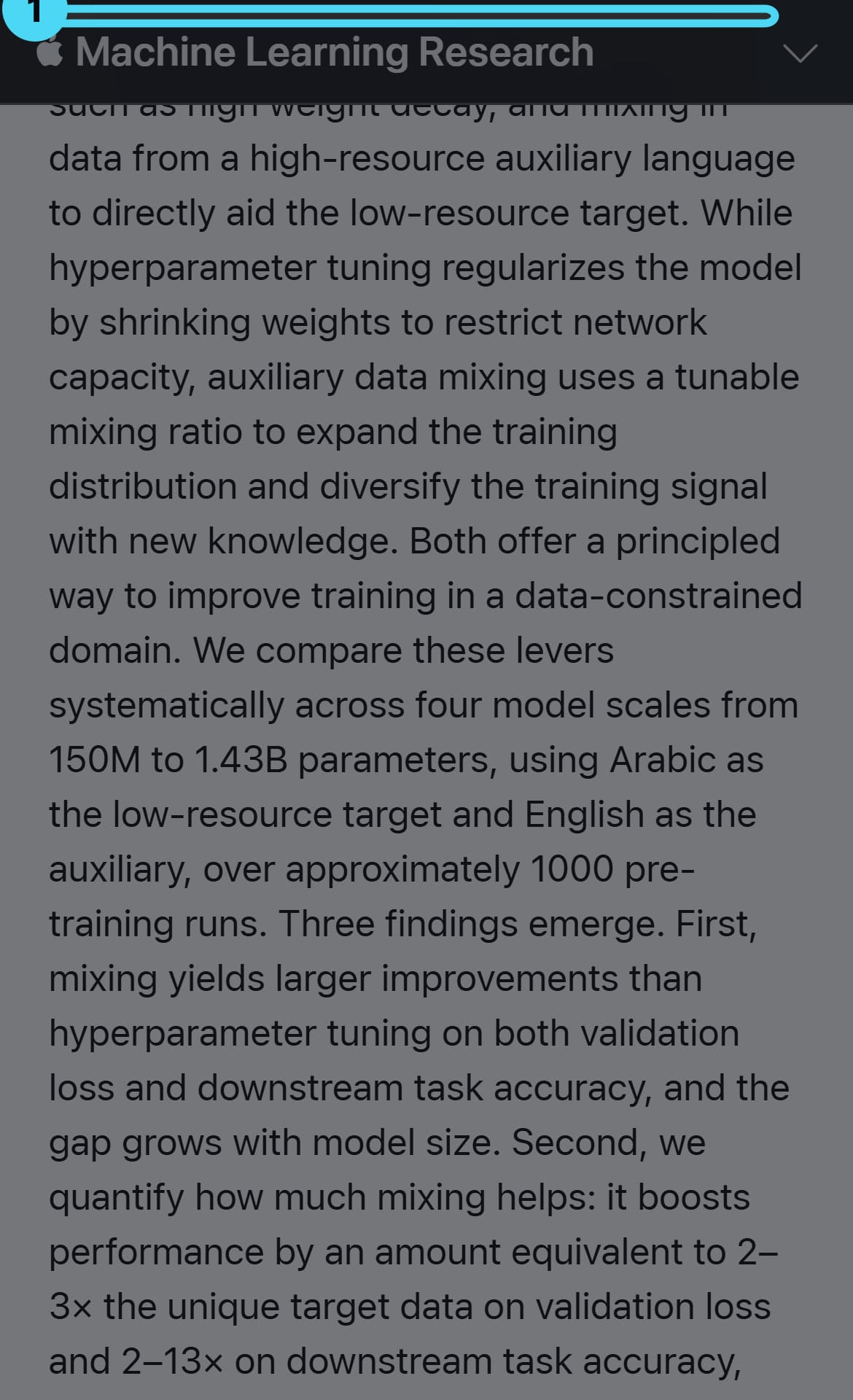
Mixing beat tuning, and the lead grew with size
The authors report that the gap widened as models got bigger. The gain from mixing scaled steeply with model size.
How big the authors say the gain is
The authors put the benefit of mixing in terms of extra data. On validation loss, the boost is equivalent to 2 to 3 times the unique target data. On downstream task accuracy, the equivalent range is 2 to 13 times. Each figure belongs to its own measure. The narrower range describes validation loss only. The wider range describes task accuracy only.
Mixing vs tuning for Arabic pre-training, as the authors report
How did mixing English data and aggressive hyperparameter tuning compare on each measure the authors report?
| Measure | Mixing in English data | Aggressive hyperparameter tuning | Source |
|---|---|---|---|
| Validation loss | Larger improvement; equivalent to 2–3× the unique target data | Smaller improvement than mixing | Source: Apple Machine Learning Research, Oct 13, 2026 |
| Downstream task accuracy | Larger improvement; equivalent to 2–13× the unique target data | Smaller improvement than mixing | Source: Apple Machine Learning Research, Oct 13, 2026 |
| Model size, 150M to 1.43B parameters | Gain scales steeply with model size | Gap behind mixing grows with model size | Source: Apple Machine Learning Research, Oct 13, 2026 |
Cells restate the authors' summary findings; per-size and per-task scores are not given in that summary.
Analysis: why the gain is counted in extra data
A data-constrained language lacks unique target data. Stating the gain from mixing as an amount of that data uses the units a team is short of. That makes the 2 to 3 and 2 to 13 times figures easy to weigh. A change in loss alone would be harder to read.
Analysis: why the size trend matters
Within the tested range, bigger models showed a bigger lead for mixing over tuning. That suggests the choice of remedy matters more as models grow, at least up to 1.43B parameters. Teams planning bigger runs in a language with little text face exactly this choice. For them, the mixing ratio looks like the first setting to get right.
Why validation loss may understate mixing
The authors argue that target-language validation loss systematically underestimates the value of mixing. Mixing does two things. It regularizes the model by diversifying the training signal. It also contributes knowledge the repeated Arabic corpus cannot supply. Validation loss captures only the first effect.
Analysis: a possible reason the accuracy range is wider
The authors argue that validation loss captures only the regularizing effect of mixing. Extending that point to task accuracy goes beyond what they state. If validation loss misses the knowledge that mixing adds, another measure may pick up more of it. Downstream task accuracy could be such a measure. That would fit the wider 2 to 13 times range reported for accuracy.
What the authors recommend
The authors' recommendations
- First: Mix in a high-resource language.
- Second: Prioritize the mixing ratio over hyperparameter tuning.
- Third: Transfer hyperparameters from a small proxy model via μP.
Analysis: the title is narrower than the advice
The title says "Mix, Don't Tune," but tuning stays in the recipe. The advice is an order of priorities, not a ban. The mixing ratio comes first. Hyperparameters still matter, and the recommendation is to transfer them from a small proxy model. The main finding, that mixing gave larger improvements than tuning, supports putting the ratio first.
What the study leaves open
The published summary of the study gives no methods or result tables. It does not list the mixing ratios tested. It does not explain how the 2 to 3 and 2 to 13 times figures were calculated. The results cover one language pair, Arabic with English, and models up to 1.43B parameters. The full paper, which this summary does not include, is where to check how the 2 to 3 and 2 to 13 times figures were calculated.
Sources: Apple Machine Learning Research, Oct 13, 2026
ZIPMEX promotes trading on trade.zipmex.com. Promotions are labelled and kept separate from news coverage, which is selected and checked without regard to them. Perpetual futures are leveraged derivatives. Prices can move fast and you can lose all of your margin. Not available in every jurisdiction. Not investment advice.
