When Solana launched in March 2020, the crypto community had a straightforward question: can a blockchain actually be fast and cheap and decentralized at the same time? Six years later, the answer is complicated - and fascinating. The Solana blockchain ecosystem has grown into one of the most active networks in crypto, hosting billions in DeFi liquidity, the largest NFT marketplace outside Ethereum, institutional stablecoin settlement infrastructure, and a memecoin culture that onboarded a generation of retail users. In this guide, we'll break down exactly how Solana works, what powers its ecosystem, where its real limitations lie, and how different types of participants can engage with it effectively.
⚡ Key Takeaways
- Solana uses a hybrid Proof of History (PoH) + Proof of Stake (PoS) consensus model that enables sub-second finality and transaction fees consistently under $0.001
- The network is built on eight interlocking technical components, each handling a distinct stage of the transaction lifecycle - no Layer-2 required
- The Solana ecosystem spans DeFi, NFTs, Web3 gaming, memecoins, and institutional payment infrastructure, with over $8 billion in total value locked as of early 2026
- Network outages and validator concentration remain real, unresolved challenges - understanding them is essential before committing capital
What Is the Solana Blockchain? Origins, Vision, and Core Design
Solana is an open-source, high-performance blockchain built to handle the kind of transaction volume that legacy networks like Ethereum simply weren't designed for. The ambition wasn't just speed - it was solving one of the most persistent problems in blockchain architecture at the base layer, without routing around it through Layer-2 add-ons.
Anatoly Yakovenko and the Founding of Solana Labs
The origin story matters here because it explains the architecture. Anatoly Yakovenko wasn't a crypto native - he was an engineer at Qualcomm, deep in distributed operating systems, where synchronizing time across thousands of devices was a solved problem. When he looked at legacy blockchains in 2017, he saw the same bottleneck everywhere: validators couldn't agree on transaction ordering without constant back-and-forth communication, and that coordination overhead was killing throughput.
His solution was Proof of History - a cryptographic clock that creates a verifiable record of when each event occurred, independent of validator communication. The 2017 whitepaper introduced this concept as a pre-consensus ordering mechanism, and it was novel enough to attract serious co-founders. Yakovenko teamed up with Raj Gokal and Greg Fitzgerald to build Solana Labs, launching the mainnet beta in March 2020 after a series of testnet releases. To understand how this stacks up against older consensus models, our guide on Proof of Work vs. Proof of Stake provides useful foundational context.
The timing was almost too perfect. The 2021 DeFi and NFT boom hit shortly after launch, and Solana's combination of speed and sub-cent fees made it an obvious destination for developers priced out of Ethereum mainnet. SOL's price surged, the ecosystem exploded, and the "Ethereum Killer" framing entered the mainstream conversation.
Solving the Blockchain Trilemma: Solana's Base-Layer Philosophy
Every major blockchain eventually confronts the trilemma: you can have scalability, security, and decentralization - but not all three simultaneously. Most networks pick two and compromise on the third. Ethereum chose security and decentralization, then outsourced scalability to a growing ecosystem of Layer-2 rollups. Bitcoin chose security and decentralization and left scalability largely unsolved.
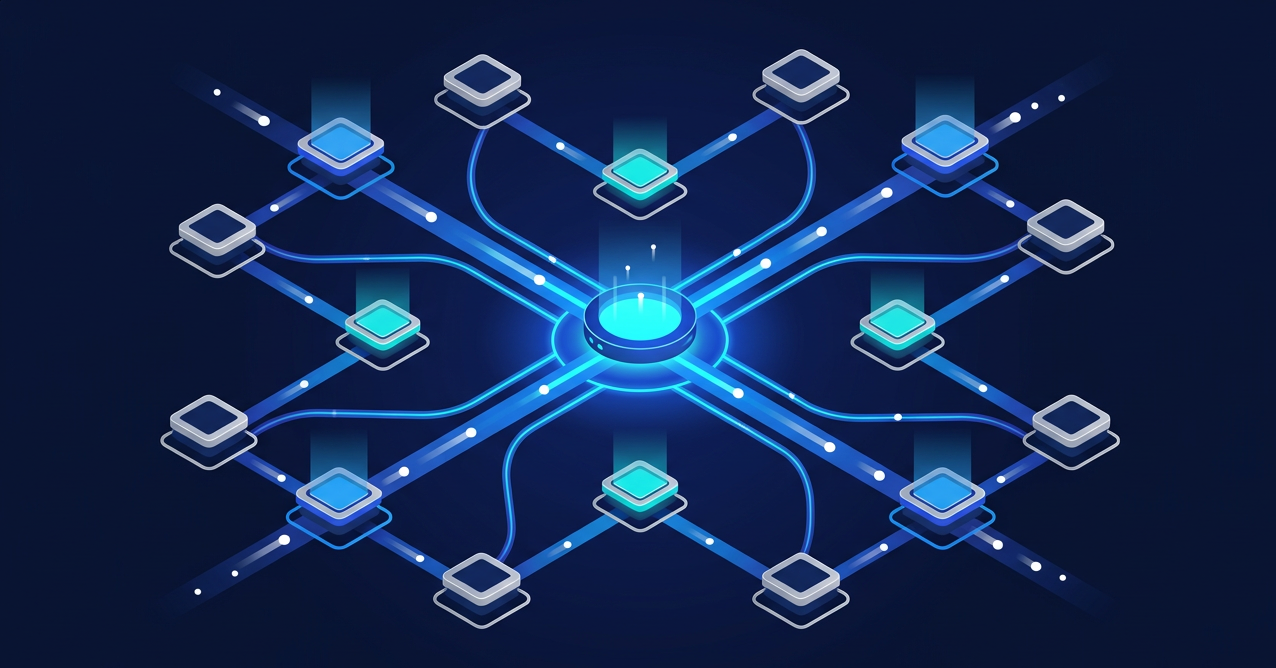
Solana's thesis is different. The goal is to hit all three at Layer 1, without sharding or off-chain execution layers. This isn't just philosophical - it's architectural. The entire eight-component technical stack is engineered to achieve maximum throughput while keeping validation logic on-chain and verification accessible to anyone. Whether it fully delivers on that trilemma promise is a legitimate debate (more on that in the risks section), but the design intent is clear and coherent in a way most blockchains aren't.
How the Solana Blockchain Works: The 8-Component Architecture
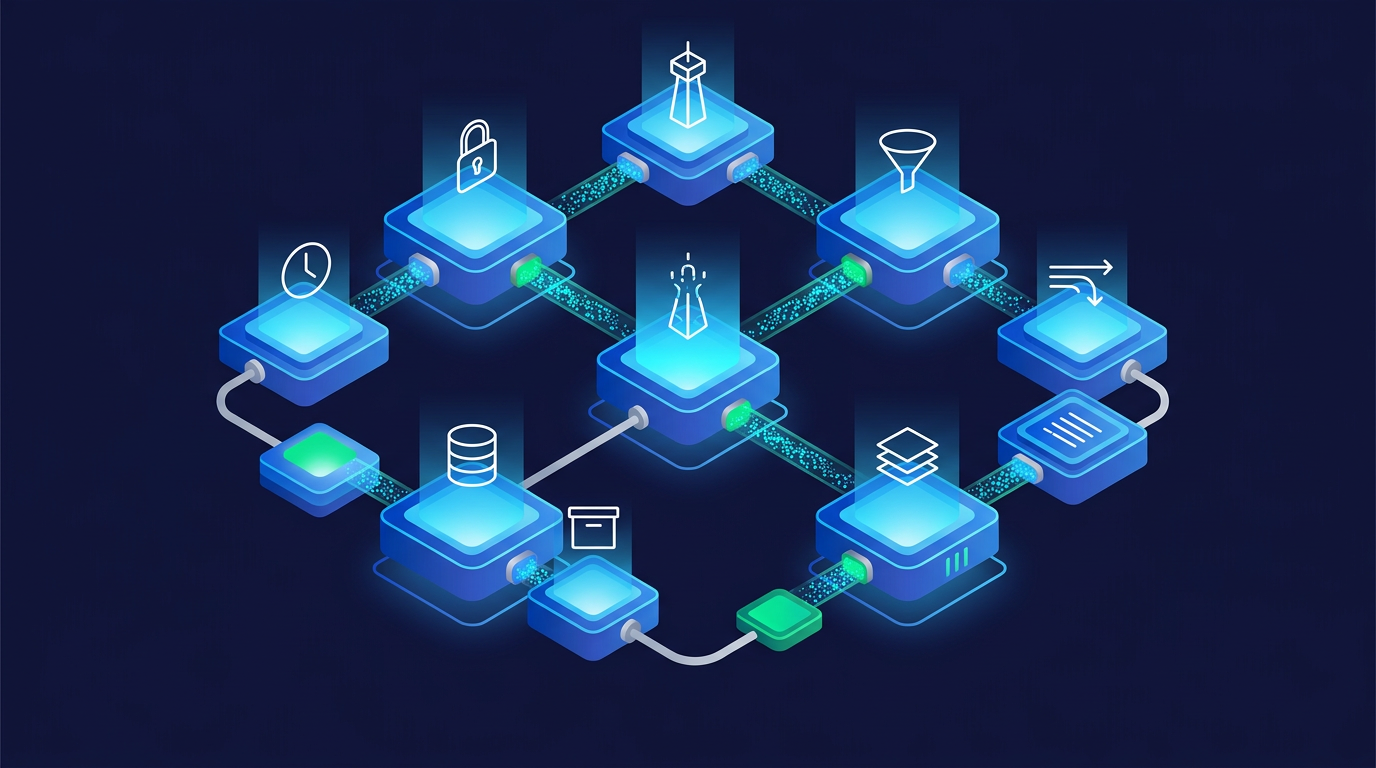
Understanding Solana's performance edge requires understanding that it isn't one clever innovation - it's eight interlocking components, each optimized for a specific stage of the transaction pipeline. Here's the full stack:
Proof of History and Proof of Stake: The Hybrid Consensus Model
Think of PoH as a cryptographic clock built into the blockchain itself. Before transactions even reach the consensus layer, PoH generates a verifiable timestamp sequence - a continuous, tamper-evident record showing the order in which events occurred. Validators don't need to check in with each other to confirm timing; the clock's output is mathematically provable. That eliminates the coordination overhead that throttles throughput on networks like Bitcoin and Ethereum. Our deeper look at Proof of Stake explains how the security layer complements this mechanism.
PoS handles the security layer. Validators stake SOL tokens to participate in block production and earn rewards. The higher the stake, the higher the probability of being selected as the next block leader. Validators who act maliciously - publishing invalid blocks or going offline - face slashing, where a portion of their staked SOL is confiscated by protocol.
The combination produces real numbers: according to Solana's official documentation, the theoretical ceiling is around 65,000 transactions per second. Real-world throughput under typical conditions ranges from 2,000 to 4,000 TPS, including validator votes. That honest range matters - claiming 65,000 TPS as a live benchmark would be misleading. But even 2,000-4,000 TPS is orders of magnitude beyond Ethereum's mainnet baseline of approximately 15-20 TPS. Transaction fees run consistently below $0.001 regardless of network activity.
Tower BFT, Turbine, and Block Propagation
Once PoH orders transactions and PoS validators reach consensus, Tower Byzantine Fault Tolerance drives finality. Tower BFT is Solana's custom implementation of the classic BFT consensus algorithm, but optimized to use PoH's timestamps as a shared reference point - dramatically reducing the inter-validator messaging required for standard BFT. The result is deterministic finality within seconds, not minutes.
Turbine handles the propagation challenge. Getting a confirmed block out to every validator in a large network is non-trivial - broadcasting to thousands of nodes simultaneously would create massive bandwidth overhead. Turbine solves this by splitting each block into smaller pieces called shreds, then distributing them through cascading groups of validators. Each group forwards its shreds to the next until full network propagation is achieved. The cascade structure means total propagation time scales logarithmically with network size, not linearly.
Gulf Stream, Sealevel, and Parallel Transaction Processing
Most blockchains use a mempool - a waiting room where unconfirmed transactions queue before being picked up by block producers. Mempools are a natural congestion point: when transaction demand spikes, the queue backs up, fees rise, and confirmation times stretch. Solana replaces this with Gulf Stream, a mechanism that pushes transactions forward to the expected next block leader before they're even requested. The mempool bottleneck is bypassed entirely, and unprocessed transaction backlogs become structurally rare.
Sealevel is what makes Solana's DeFi and gaming ecosystem genuinely viable. It's the parallel transaction execution engine - and its core insight is simple but powerful. Most smart contract VMs, including Ethereum's EVM, process transactions sequentially: one at a time, in order. Sealevel identifies transactions that don't conflict with each other (don't access the same state) and executes them simultaneously across multiple CPU cores. The practical effect is that a DEX trade on Raydium doesn't have to wait behind a Mango Markets liquidation - they run concurrently.
Sequential vs. Parallel: Why It Matters for DeFi
Cloudbreak, Pipelining, and Archivers - The Infrastructure Layer
Pipelining breaks transaction validation into distinct hardware-assigned stages - fetch, decode, execute, write - and runs them as overlapping pipeline stages rather than sequentially per transaction. No CPU core sits idle waiting for another stage to finish. It's the same principle behind modern processor design, applied to blockchain validation.
Cloudbreak is Solana's horizontally scaled account database. Instead of storing all state data in a single database that becomes a bottleneck at high volumes, Cloudbreak distributes data across multiple SSDs and enables simultaneous read/write access. This is what allows Solana to scale with hardware improvements without requiring architectural changes to the protocol.
Archivers are the least glamorous but operationally important: lightweight nodes that handle long-term storage of historical ledger data. At Solana's transaction throughput, the raw data generated is massive. If validators were required to store the full historical ledger indefinitely, hardware requirements would become prohibitive. Archivers offload this burden, keeping validator requirements manageable.
Solana vs. Ethereum vs. Bitcoin: Blockchain Performance Comparison
Real-world TPS figures vary significantly with network load. Fee data reflects network averages and fluctuates with demand.
Getting Started with Solana: SOL Token, Wallets, and Staking
The SOL token is the fuel for everything on this network. Understanding its mechanics is the first step before interacting with any part of the ecosystem.
SOL's core utility functions:
- Transaction fees - every on-chain action burns a small SOL amount (consistently below $0.001)
- Staking - delegating SOL to validators earns rewards; the network uses stake weight to select block producers
- Governance - SOL holders can vote on network upgrade proposals
- DeFi collateral - SOL is accepted as collateral across lending protocols, liquidity pools, and margin trading platforms
- dApp interactions - most Solana ecosystem applications require SOL for gas, even if denominated in SPL tokens
Getting started - the five-step path:
- Create an exchange account - Binance, Coinbase, Kraken, and most major centralized exchanges list SOL
- Complete KYC verification - standard identity verification to enable fiat-to-crypto purchasing
- Buy SOL - market or limit order; according to CoinGecko, the current circulating supply sits above 570 million tokens
- Set up a self-custody wallet - Phantom is the dominant Solana wallet and covers staking, DeFi, and NFT interactions from a single interface; Solflare and Backpack are solid alternatives; hardware wallets (Ledger) support Solana for maximum security
- Stake SOL or explore dApps - delegated staking can begin directly from Phantom; DeFi access requires connecting to individual protocol interfaces
On tokenomics: Solana has a maximum supply cap of 511 million SOL, with current circulating supply already exceeding 570 million (inflated by initial distribution). A percentage of every transaction fee is burned, creating a mild deflationary pressure. Staking yields have historically ranged from 5% to 8% APY depending on network conditions - verify current rates at Validators.app before committing.
With SOL in hand, users gain access to one of the most diverse blockchain ecosystems in crypto.
SOL Staking Strategies and Validator Selection
Delegated staking is the default path for most SOL holders - you don't need to run your own validator, just choose one to delegate to via Phantom or Solflare. Your SOL remains in your custody; you're assigning your voting weight to an operator, not transferring funds.
Selecting a validator is worth doing carefully. Five criteria matter:
- Commission rate - typically 0-10%; validators charging above 8% require strong justification in uptime and reliability
- Historical uptime - validators that go offline lose delegator rewards during the downtime period
- Self-stake - validators staking their own SOL alongside delegator funds have skin in the game
- Community transparency - active Discord/Twitter presence, published performance data
- Infrastructure provider - validators running on diverse, high-availability cloud infrastructure are lower risk
Validators.app and Solana Beach provide free, real-time performance monitoring across the full validator set.
Before entering any liquidity pool, understand impermanent loss. When you provide liquidity to a SOL-USDC pool, you're essentially agreeing to automatically sell SOL as its price rises (and buy as it falls). If SOL makes a significant directional move, you may underperform simply holding SOL outright. This isn't a reason to avoid liquidity provision - it's a reason to understand the position you're actually taking.
Smart contract risk is the other dimension. Solana DeFi protocols have been exploited. The Mango Markets manipulation attack in 2022 demonstrated that on-chain verifiability of outcomes doesn't prevent economic attacks on poorly designed mechanisms. Audit history and protocol maturity matter. Understanding how locked liquidity works is also essential before depositing into any new protocol.
All DeFi participation carries substantial risk of loss, including total loss of deposited capital. Position sizing should reflect your risk tolerance.
The Solana Ecosystem: DeFi, NFTs, Web3, and Institutional Adoption
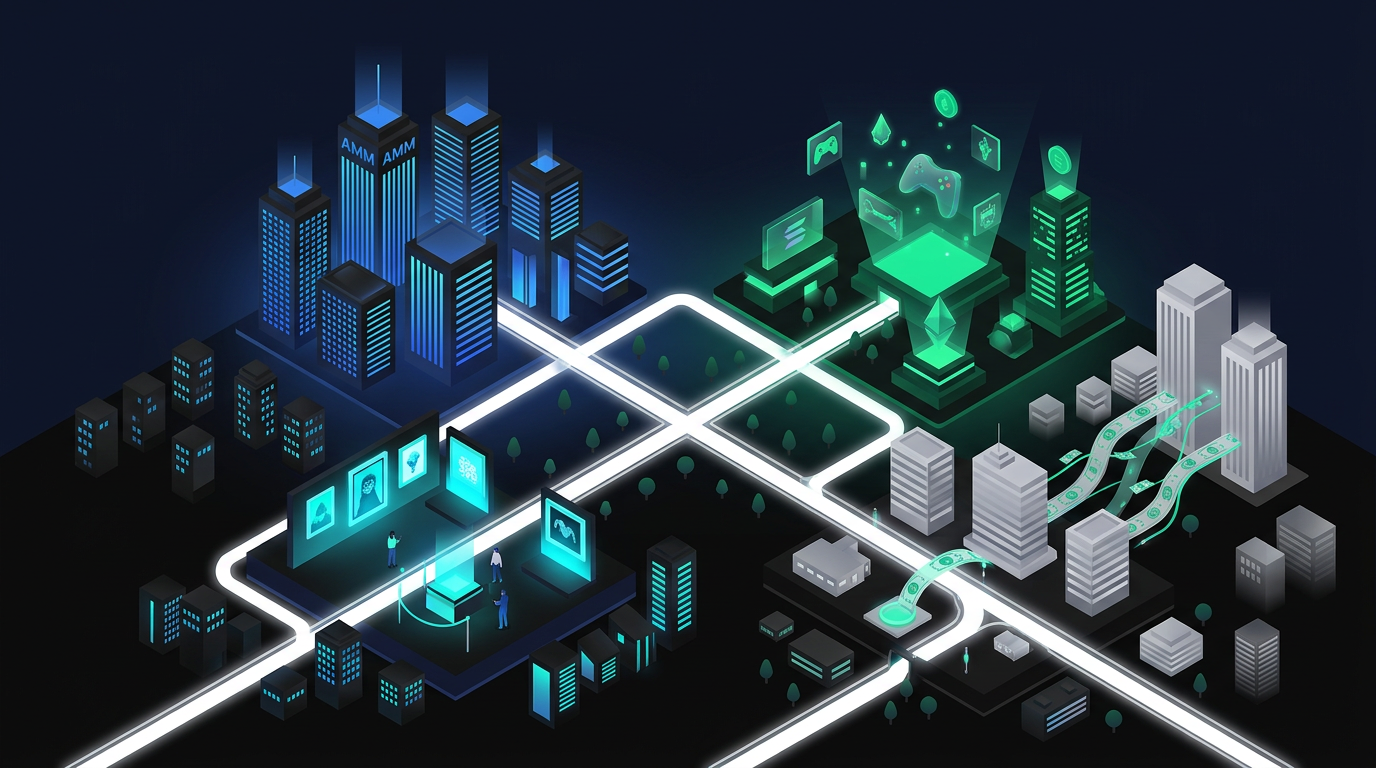
The architecture is impressive on paper. The ecosystem is where it proves its value in practice.
DeFi on Solana: Exchanges, Lending, and Yield Farming
The DeFi ecosystem on Solana surpassed $8 billion in total value locked by early 2026 according to DefiLlama, making it one of the top-3 DeFi chains by TVL. The reason isn't just technology - it's economics. On Ethereum mainnet, providing $500 of liquidity to a pool generates fees, but gas costs on entry, exit, and rebalancing can eat the majority of small-position returns. On Solana, those same operations cost fractions of a cent.
A note on ecosystem history: the 2022 FTX collapse hit Solana's DeFi ecosystem hard - the Serum DEX, which was closely tied to FTX, was effectively abandoned. The ecosystem's recovery since then, rebuilding TVL and attracting new protocols, is one of the more underappreciated resilience stories in DeFi. That context matters when assessing current platform stability.
NFTs, Gaming, and the Cultural Layer of the Solana Ecosystem
Magic Eden built its position as the dominant Solana NFT marketplace by solving the user experience problem that plagued early NFT trading: high fees and slow confirmations made flip trading expensive and frustrating. On Solana, minting and trading costs run under a cent, and confirmations settle in under a second. That UX shift attracted a generation of collectors and creators priced out of Ethereum OpenSea. For a broader look at where Solana fits in the overall NFT landscape, see our overview of the top NFT marketplaces in 2026.
The gaming vertical is still maturing, but Star Atlas and Aurory represent legitimate experiments in full on-chain game economies - something Ethereum's fees make structurally unviable for most players.
The memecoin layer deserves specific mention because it drove an enormous amount of retail user acquisition. BONK (launched December 2022 as an airdrop to the Solana community post-FTX crash) and WIF (a dog-in-a-hat token that reached a multi-billion dollar market cap in 2024 per CoinGecko) created viral on-chain engagement that onboarded tens of thousands of new Solana wallets. Whatever one's views on memecoin fundamentals, the user acquisition data was real.
Stablecoins, Payments, and Institutional Adoption on Solana
This is where the ecosystem story shifts from speculative to structural. Visa's 2023 announcement that it would pilot stablecoin settlement via Solana wasn't marketing - it was a production test of whether a public blockchain could handle institutional payment volume. It passed. Western Union followed with stablecoin issuance activities. PayPal's PYUSD launched on Solana in 2024 alongside its Ethereum deployment.
The stablecoin infrastructure on Solana today includes USDC (Circle), USDT (Tether), and PYUSD (PayPal), all operating at network fees that make microtransactions economically viable for the first time in institutional contexts.
The Solana Program Library (SPL) token standard underpins all of this - it's the equivalent of Ethereum's ERC-20 standard, providing the technical framework for compliant institutional token issuance on Solana. The 2023 token extension update added compliance-relevant features including transfer fees, confidential transfers, and interest-bearing token mechanics per Solana's official SPL documentation. When Circle or PayPal deploys a stablecoin on Solana, they're using SPL. That standardization is what makes Solana a credible institutional infrastructure option, not just a DeFi playground.
Solana Blockchain Risks, Limitations, and Criticisms
The ecosystem is real. So are the problems. Skipping this section would be dishonest.
Network Outages and the Reliability Problem
Solana has gone down. Not once - multiple times, across multiple years. The most notable outages:
SOLANA MAJOR NETWORK OUTAGES
September 2021
A flood of bot transactions during an IDO caused the validator network to halt for approximately 17 hours - the first major production failure. Transaction volume reportedly hit 400,000+ TPS from bots alone.
January 2022
A separate botnet attack generated 400,000 transactions per second, overloading the network for several hours and exposing continued vulnerabilities in transaction spam resistance.
February 2023
A bug in the validator client caused a roughly 20-hour outage - one of the longest in the network's history. The root cause traced to an edge case in transaction processing logic, highlighting the danger of single-client dominance.
These aren't just operational embarrassments - they represent real financial exposure for anyone running active positions when the network goes dark.
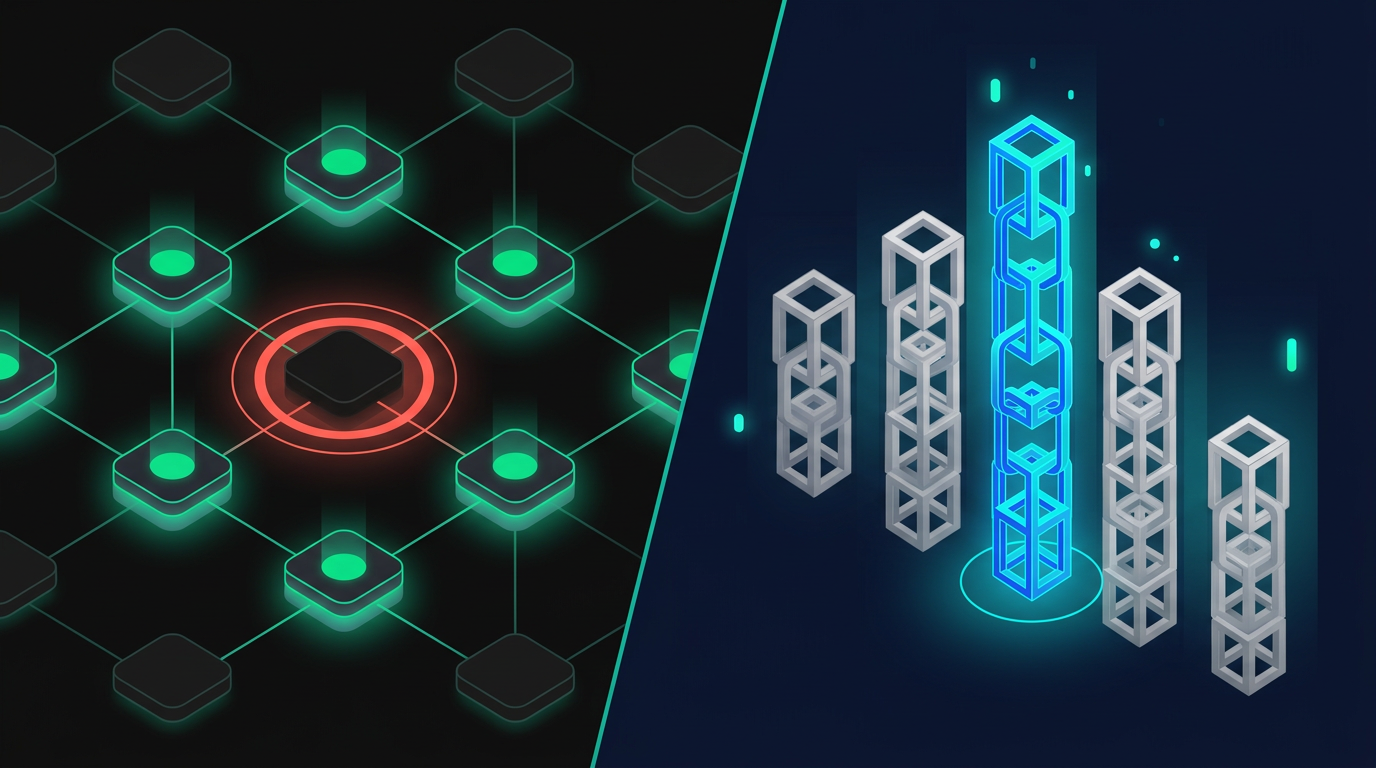
The primary mitigation in progress is Firedancer, a second validator client developed by Jump Crypto, designed to run independently of the main Solana Labs client. Currently, essentially all validators run the same codebase - meaning a single bug can theoretically take down the entire network. Firedancer adds client diversity, which is the same reason Ethereum's multi-client model is considered a security feature. Its mainnet deployment trajectory should be tracked closely; it's arguably the most important infrastructure upgrade in Solana's pipeline.
The QUIC protocol upgrade (replacing UDP for transaction propagation) already improved the network's spam resistance. But Firedancer is the structural fix.
Centralization, Validator Economics, and the Decentralization Debate
Here's a number that deserves context: Solana operates with approximately 1,900 active validators per Validators.app. Ethereum runs with over 1 million. The gap is substantial.
Solana's low validator count isn't just a governance concern - it's a practical resilience question. A smaller validator set means fewer independent parties who would need to collude (or fail simultaneously) to disrupt the network. The high hardware requirements for running a competitive validator create real barriers to entry that the Ethereum validator model, despite its higher ETH requirement, doesn't face in the same way.
The Solana Foundation's stake pool program and ongoing work to reduce hardware requirements are meaningful steps. But this remains an unresolved trade-off in the network's current architecture.
Alternatives to Solana: High-Performance Blockchains Worth Knowing
Solana isn't the only network making a serious claim on high-throughput, low-cost transactions.
Ethereum's Layer-2 ecosystem (Arbitrum, Optimism, Base) gives it a scale path, but it fragments liquidity and adds UX complexity. Avalanche's subnet model is powerful for custom chains but creates siloed ecosystems. Aptos and Sui are technically ambitious but lack the application density and institutional relationships Solana has accumulated.
The right blockchain depends entirely on the use case. For developers building high-throughput, cost-sensitive applications with access to mature tooling and deep liquidity, Solana remains one of the most compelling options in 2026.
The Future of the Solana Blockchain Ecosystem: 2026 and Beyond
The Solana blockchain ecosystem in 2026 stands at an inflection point. It's no longer an experimental high-throughput network - it's production infrastructure for payment companies, institutional stablecoin issuers, and DeFi protocols with billions in user deposits. That transition brings both opportunity and pressure.
Five trajectories worth tracking:
1. Firedancer and network stability - Firedancer's mainnet rollout is the single most important near-term development for Solana's institutional viability. Client diversity transforms the network's resilience profile. Track its deployment progress closely.
2. Institutional adoption acceleration - Visa, Western Union, and PayPal's presence on Solana isn't a marketing partnership; it's production infrastructure. More institutional settlement activity drives fee revenue, TVL, and SOL demand without requiring speculative retail participation.
3. DeFi TVL vs. Ethereum L2 competition - The real competition isn't Solana vs. Ethereum mainnet anymore; it's Solana vs. Ethereum + Arbitrum/Base as an integrated L1+L2 stack. Solana's base-layer simplicity is an advantage; Ethereum's ecosystem breadth is a countervailing force.
4. Developer ecosystem maturation - The Anchor framework, SPL token extensions, and Foundation grant programs are building a developer base that didn't exist in 2020. Application quality in DeFi, gaming, and infrastructure is visibly improving.
5. Regulatory environment - High-throughput, low-fee networks attract both legitimate activity and regulatory scrutiny. How global crypto regulation evolves through 2026-2027 will shape whether institutional adoption accelerates or faces headwinds.
For different participant types:
For developers: Solana is a compelling build environment in 2026 - mature tooling, deep DeFi liquidity for app integrations, institutional-grade token standards, and an active grants program. The main caution is Rust's steep learning curve compared to Solidity.
For DeFi participants: The fee economics remain the strongest argument for Solana over Ethereum mainnet. Sub-cent transactions change what's economically viable at every position size. Offset that advantage against smart contract risk and the outage history - position sizes should reflect both the opportunity and the exposure.
For long-term SOL holders: Institutional validation is underway. The Visa and PayPal integrations represent the kind of adoption signal that takes years to accumulate. The network's ongoing challenges - outages, validator concentration - are real risks that cap the confidence level of any long-term thesis.
Crypto trading and DeFi participation involve substantial risk of loss. Nothing in this article constitutes financial advice. Position sizes should reflect individual risk tolerance, and leveraged positions carry the risk of total loss of deposited capital.
Last updated: March 2026.
Frequently Asked Questions
What is the Solana blockchain ecosystem?
The Solana blockchain ecosystem refers to the entire network of applications, protocols, tokens, and participants built on or interacting with the Solana blockchain. At its core, Solana is a high-performance Layer-1 blockchain using a hybrid Proof of History and Proof of Stake consensus model to achieve thousands of transactions per second at fees below $0.001. The ecosystem built on top includes DeFi protocols managing billions in liquidity, NFT marketplaces, Web3 gaming, memecoin markets, and institutional stablecoin settlement infrastructure from major payment networks like Visa and PayPal.
How does Proof of History (PoH) work on Solana?
Proof of History is a cryptographic mechanism that creates a verifiable timestamp for each event on the blockchain before it reaches the consensus layer. A designated validator continuously runs a sequential hashing function - each output is fed back as the next input - creating a provable chain of time. Any node can verify the output and confirm approximately how much time elapsed between events. This eliminates the need for validators to communicate with each other to agree on transaction ordering, dramatically reducing coordination overhead and enabling parallel processing.
What is the difference between Proof of History and Proof of Stake on Solana?
PoH and PoS serve completely different functions. PoH is a pre-consensus ordering mechanism - a cryptographic clock that establishes when transactions occurred and in what sequence, without requiring validator communication. PoS is the security layer - validators stake SOL tokens to earn the right to produce and confirm blocks, with the threat of slashing discouraging malicious behavior. PoH makes the network fast; PoS makes it secure. The two operate in combination: PoH orders events, then PoS validators confirm blocks using that ordering as a shared reference.
How many transactions per second can Solana actually process?
Solana's theoretical ceiling is approximately 65,000 TPS under ideal conditions per Solana's official documentation. In real-world operation, the network typically processes 2,000 to 4,000 TPS, including validator vote transactions. The gap between theoretical and actual throughput reflects realistic network conditions - validator hardware variance, geographic distribution, and transaction complexity. Even at 2,000-4,000 TPS, Solana significantly outperforms Ethereum mainnet's ~15-20 TPS. Firedancer, the second validator client in development, may push real-world throughput substantially higher upon mainnet deployment.
What is SOL and what is it used for?
SOL is the native token of the Solana blockchain, serving as the network's utility currency. It covers transaction fees, fuels smart contract execution, and serves as the staking mechanism for the PoS security layer. SOL holders can delegate their tokens to validators to earn staking rewards. Within the DeFi ecosystem, SOL functions as collateral for lending, margin trading, and liquidity provision. Governance rights - voting on network protocol upgrades - are also denominated in SOL stake weight.
What caused Solana's network outages?
Solana's multiple network outages since 2020 have had different root causes, but a common pattern runs through most of them: transaction spam at scale exposing architectural weaknesses in the validator client. The September 2021 outage was triggered by bot transactions during an IDO. The February 2023 outage (~20 hours) traced to a bug in the validator client software. The fundamental vulnerability is single validator client dominance - nearly all validators run the same Solana Labs codebase, meaning one bug can take down the entire network. Firedancer's multi-client architecture directly addresses this.
Is Solana more centralized than Ethereum?
By validator count, yes - significantly. Solana has approximately 1,900 active validators compared to Ethereum's 1 million+. Solana's high hardware requirements ($50,000+ for competitive validator infrastructure) restrict participation to well-capitalized operators. Solana is working toward lower hardware requirements and has an active Foundation stake pool program. But at current validator counts, Ethereum has a meaningful structural advantage in validator distribution.
What are the best DeFi protocols currently on Solana?
The core Solana DeFi stack includes Raydium (AMM with concentrated liquidity and order book integration), Orca (user-friendly AMM with Whirlpools concentrated liquidity), Kamino Finance (automated yield strategies, lending, and leveraged staking), and Mango Markets (decentralized perpetuals and margin trading with an on-chain order book). Protocol selection should consider audit history, TVL depth, and fee structure. All DeFi protocols carry smart contract risk; diversifying across multiple protocols reduces single-point-of-failure exposure.
What is Firedancer and how will it improve Solana?
Firedancer is a second, independent validator client for Solana developed by Jump Crypto, currently in testnet and gradually rolling toward mainnet deployment. Its primary significance is architectural: today, essentially every Solana validator runs the same codebase from Solana Labs, meaning a single critical bug can (and has) halted the entire network. Firedancer introduces client diversity - validators can choose between two independent implementations, so a bug in one won't automatically affect validators running the other.
Ready to Start on Solana?
Explore the Solana ecosystem, trade SOL, and access DeFi - all from one platform with low fees and deep liquidity.
Get Started on Zipmex