The VET price prediction question has never been more loaded: VET is trading near multi-year lows around $0.007, yet the same token once reached $0.2782 and powers blockchain infrastructure used by Walmart, BMW, and DNV across real supply chains. This guide breaks down year-by-year forecasts from 2026 to 2050, the technical signals shaping short-term price action, the fundamental drivers behind long-term scenarios, and - critically - an honest, math-based answer to whether $1 VET is ever realistically achievable.
⚡ Key Takeaways
- 2026 forecast: $0.006-$0.088 depending on model (bearish consolidation vs. narrative recovery)
- 2030 forecast: $0.15-$0.45 in bull scenarios; conservative algorithmic models project below $0.01
- 2040 bull case: $0.85-$1.20 if enterprise blockchain adoption sustains double-digit CAGR
- $1 VET requires ~130x growth from current levels - implying a ~$86.7B market cap, comparable to top-10 crypto territory
- Key catalysts: Hayabusa Mainnet upgrade, Wanchain cross-chain expansion, EU Digital Product Passport mandate, Bitcoin halving cycles
Before diving into year-by-year forecasts, here's what you need to know about VeChain's technology and tokenomics.
What Is VeChain (VET)? Overview, Tokenomics & Key Metrics
VeChain is not a general-purpose blockchain. Founded in 2015 by Sunny Lu, it was purpose-built to solve enterprise-grade data challenges - primarily in supply chain management, product authentication, and ESG compliance. Unlike most Layer 1 blockchains competing for DeFi dominance, VeChain targets a specific industrial niche where blockchain's value is less about decentralized finance and more about verified, tamper-proof data.
The platform launched its public mainnet, VeChainThor, in 2018. That same year, the original ERC-20 token VEN was converted to VET at a 1:100 ratio, creating the current token structure. Sunny Lu's vision - enterprise blockchain with real-world utility - has held consistent since inception, which distinguishes VeChain from projects that pivot to follow market narratives.
How VeChain's Dual-Token Model Works
VeChain runs on a dual-token model that separates value storage from transaction costs - a design decision with direct implications for price dynamics.
VET is the primary token: it transfers value across the VeChainThor network and, critically, generates VTHO passively just by being held. The generation rate is currently set at approximately 0.000432 VTHO per VET per day. Hold 10,000 VET and you generate roughly 4.32 VTHO daily without any staking action required.
VTHO (VeChainThor Energy) is the gas token. Every transaction on VeChainThor - whether a supply chain verification, a smart contract call, or a data upload - consumes VTHO, which is then burned. Consider an enterprise running 1,000 supply chain verification transactions per day: that activity burns VTHO continuously, creating persistent demand for the token. Since VTHO can only be sourced by holding VET (or purchasing it on-market), increased enterprise activity creates indirect buy pressure on VET itself.
VECHAIN DUAL-TOKEN FLOW
Step 1
Hold VET → Generate VTHO passively
Step 2
VTHO burned on-chain per transaction
Step 3
Higher enterprise usage = more VTHO burn
Result
Sustained VTHO demand supports VET value
VeChain uses Proof of Authority (PoA) consensus, where validators are known entities who stake their identity and reputation - not just capital. This makes the network highly efficient for enterprise use cases that require compliance, accountability, and throughput without the energy overhead of Proof of Work.
VeChain Key Metrics at a Glance
VET currently sits outside the top 50 by market cap, a significant decline from its 2021 peak position. The circulating supply of approximately 85.98B VET sits close to the maximum supply of 86.71B - meaning token inflation is minimal, a structural positive for long-term holders. The all-time high of $0.2782 (April 2021) sits roughly 40x above current prices, framing both the scale of the previous bull run and the distance any recovery must cover.
Data as of March 2026. Always verify live figures on CoinMarketCap or CoinGecko before making any decisions.
VeChain (VET) Price History: From $0.001 to ATH and Back
VeChain's price chart tells the story of crypto cycles better than almost any other altcoin. Understanding these phases isn't nostalgia - it's the analytical foundation for every forecast below.
2018-2019: Launch into a bear market. VeChainThor mainnet launched in June 2018 at the tail end of the 2017 bull run. The broader market was already collapsing, and VET entered its trading life during one of crypto's worst bear markets. By the end of 2018, VET was trading near $0.004. A $6.5 million foundation hack in December 2019 compounded the pain, closing the year around $0.0056. Enterprise progress - real partnerships, real deployments - went almost entirely unpriced.
2020: Slow rebuild. VET began recovering in mid-2020, breaking above $0.022 by July. This wasn't speculation-driven - VeChain was signing enterprise contracts throughout this period. The token ended 2020 at $0.022, doubling its year-open price. The Bitcoin halving in May 2020 set the stage for what came next.
2021: The bull run that defined VET. The post-halving altcoin season arrived with full force. VET surged from $0.02 in January to an all-time high of $0.2782 in April 2021 - a roughly 13x gain in four months. This wasn't a fluke: it coincided with major enterprise announcements and peak retail crypto interest. Three separate bullish waves hit VET in 2021, though the coin closed the year in a declining trend at around $0.09.
2022: Collapse. The TerraLUNA collapse in May 2022 wasn't just a sector-specific event - it triggered a cascade of liquidations, exchange failures, and institutional withdrawals that crushed the entire market. VET fell to roughly $0.015 by year-end. The bearish market cycle that followed 2021's peak was brutal and thorough.
2023-2024: Partial recovery, then hope. VET recovered approximately 42% in 2023, closing near $0.035. By March 2024, Bitcoin's spot ETF approval in the US drove broad market optimism, and VET briefly touched $0.048. The post-US election rally in November 2024 pushed VET toward $0.067, its strongest level in two years. But the resistance held, and by early 2026 VET has retreated into bearish consolidation near $0.006-$0.007.
The Bitcoin halving cycle is the clearest structural pattern across VET's price history: the 2020 halving preceded the 2021 ATH, and the 2024 halving sets the stage for the forecasts below. Understanding these cycles is essential for contextualizing every number in the predictions that follow.
VET PRICE HISTORY TIMELINE
2018-2019
VeChainThor mainnet launches into a bear market. VET trades near $0.004 by end of 2018. Foundation hack in Dec 2019 compounds pain.
2020
Slow rebuild. VET breaks $0.022 by July. Bitcoin's May 2020 halving sets the stage for the bull run ahead.
April 2021 - ALL-TIME HIGH
VET reaches $0.2782 - a ~13x gain from January 2021. Peak retail interest and major enterprise announcements align.
May 2022 - TerraLUNA Collapse
Market-wide liquidation cascade. VET falls to ~$0.015 by year-end. Contagion with no relation to VeChain fundamentals.
2023-2024
VET recovers ~42% in 2023. Bitcoin spot ETF approval drives optimism. Post-election rally pushes VET to $0.067 in Nov 2024.
Early 2026
Bearish consolidation. VET retreats to $0.006-$0.007. RSI near 45. 200-day SMA at ~$0.014 as key overhead resistance.
VET Price Prediction 2026-2030: Year-by-Year Forecast
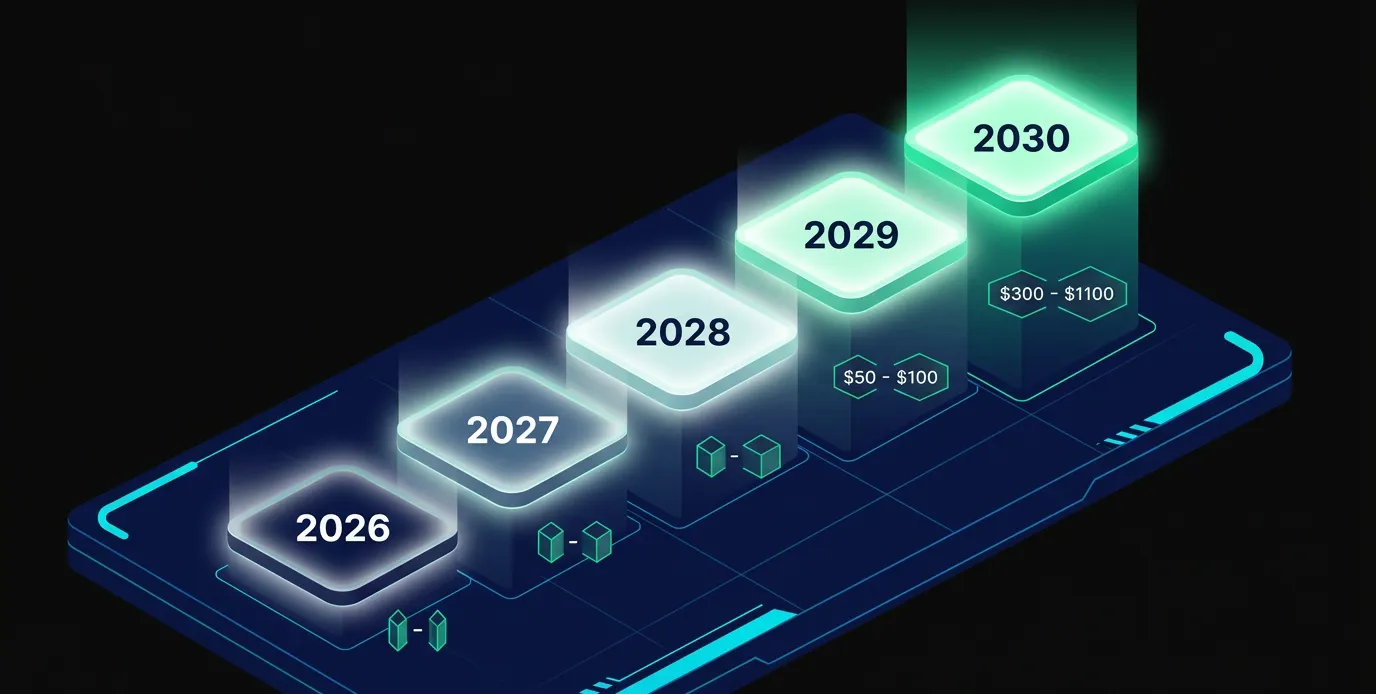
Two types of models dominate VET price forecasting, and they produce dramatically different outputs. Algorithmic models - which extrapolate current momentum and technical signals - project VET in the $0.006-$0.021 range for 2026. Narrative/fundamental models - which incorporate enterprise adoption milestones, Bitcoin halving cycles, and macro crypto sentiment - project $0.035-$0.088 for the same period. Both approaches have merit, and that divergence itself is information worth understanding.
The Hayabusa Mainnet upgrade, which improved EVM compatibility and throughput on VeChainThor, represents the most significant technical catalyst of the current cycle. Its effects on developer adoption and enterprise onboarding could take 12-24 months to fully materialize in price.
These ranges represent the consensus spread across multiple analyst models. Conservative algorithmic models (momentum extrapolation) sit at the low end. Fundamental/narrative models (which factor in adoption milestones) sit at the high end. Neither is "correct" - treat them as scenario boundaries.
VET Price Prediction 2026
The 2026 outlook is genuinely split, and any analyst presenting a single confident number is oversimplifying. Algorithmic models projecting from current momentum show VET essentially flat or slightly declining in 2026 - some put end-of-year at $0.006-$0.007, reflecting the current bearish consolidation phase.
Narrative models tell a different story. If the 2024 Bitcoin halving follows the historical 12-18 month lag pattern, an altcoin rotation cycle could materialize in mid-to-late 2026. In that scenario, VET's key technical triggers are: RSI recovering above 50 (currently in the low-40s, signaling weak momentum), and price reclaiming the 200-day SMA (currently acting as meaningful resistance above $0.014). A clean break above $0.020-$0.025 would be the first credible signal of trend reversal.
🐻 BEAR CASE 2026
$0.006-$0.012 - Consolidation continues, BTC dominance suppresses altcoins. No meaningful reversal signal develops.
🐂 BULL CASE 2026
$0.055-$0.088 - Altcoin season arrives, Hayabusa drives developer activity, RSI recovers above 50 with volume confirmation.
VET Price Prediction 2027
By 2027, the divergence between model types narrows somewhat. MACD signals, which lag price but confirm trend direction, should provide clearer guidance as the chart structure develops through 2026. If VET is in a genuine recovery by late 2026, the MACD bullish crossover that follows typically signals sustained upward momentum - not a brief spike.
Fundamental analysts see 2027 as a potential accumulation-to-bull-run transition year. Enterprise adoption momentum, new cross-chain integrations via Wanchain (connecting VeChainThor to 42 external blockchains), and any new major brand partnerships could establish a higher price floor. The $0.055-$0.14 range reflects scenarios where altcoin season has arrived and VET's industrial utility story regains market attention.
VET Price Prediction 2028-2030
The 2028 Bitcoin halving is the single most important structural event in this window. History shows altcoins typically perform best 12-24 months after a Bitcoin halving, as newly minted BTC holders rotate into higher-risk assets seeking amplified returns. VET has twice shown it can produce 10x+ moves during these windows - the question is the starting price and market conditions entering the cycle.
Fibonacci Retracement levels from VET's 2021 ATH to 2022 lows place key resistance targets at approximately $0.072 (23.6%), $0.11 (38.2%), and $0.165 (50%). Breaking each successive Fibonacci level is typically the process through which a recovering asset rebuilds price structure. The moving average alignment - specifically the 50-week SMA crossing above the 200-week SMA - would confirm a multi-year bull trend is re-established.
For 2030, the blockchain supply chain market is projected to reach $192.93 billion - up from roughly $4B in 2023. Even a modest capture of that growth translates to exponentially more enterprise transactions on VeChainThor, VTHO burns, and demand pressure on VET.
📊 Will VET Reach $1 by 2030?
Almost certainly not under current models. Most fundamental analyses place $1 as a post-2035 scenario at best, and only under sustained bull market conditions with multiple halving cycles, institutional capital inflows, and ESG mandates driving VeChainThor transaction volumes. See the full analysis below.
Beyond 2030, predictions become more speculative but no less compelling for long-term holders.

VET Price Prediction 2030-2050: Long-Term Scenarios
Long-term VET price prediction analysis requires shifting from momentum models to scenario analysis. The variables over a 10-25 year horizon - regulatory frameworks, competing technology, macro crypto adoption, VeChain's own evolution - are too uncertain for point estimates. What's more useful is mapping the conditions that produce each scenario.
Bull case conditions: Sustained enterprise adoption with VeChain powering significant portions of EU and Asian supply chains; ESG regulations mandating blockchain traceability (the EU's Digital Product Passport framework is a real and advancing policy); institutional tokenization use cases expanding (Franklin Templeton's tokenization of U.S. Government Money Fund shares on VeChainThor is a concrete precedent); Bitcoin reaching new all-time highs and triggering broad altcoin seasons.
Bear case conditions: Ethereum Layer 2 solutions successfully capture enterprise clients with better developer tooling; IBM Blockchain or Hyperledger frameworks remain dominant in regulated industries; VeChain fails to maintain narrative relevance as crypto capital cycles toward AI tokens, DeFi, and memecoins; regulatory classification of VET as a security in major jurisdictions.
Base case: VeChain retains its niche as the dominant supply chain blockchain, grows steadily with enterprise contracts, and participates modestly in each Bitcoin halving cycle - but never becomes a top-10 asset.
Will VET Ever Reach $1? Honest Assessment
$1 VET is theoretically possible. Whether it's probable depends entirely on the timeline and conditions.
The math is non-negotiable: with 86.71 billion VET in maximum supply, a $1 price implies an $86.7 billion market cap. For context, that's roughly the scale of current Solana or Avalanche at their peak valuations - well inside the top-10. Getting there requires VeChain to become one of the most valuable crypto networks in existence.
Most conservative models never see $1. Most bullish fundamental models place $1 as a 2040-2050 event, contingent on institutional adoption, ESG mandate tailwinds, and a sustained multi-year bull market. The preconditions - not just for $1, but for the $0.50 step before it - require VeChain to attract institutional capital at a scale it hasn't yet demonstrated.
The honest answer: $1 is within the realm of possibility, not within the realm of probability in any near-term horizon. Long-term holders should be targeting realistic milestones - $0.10, $0.20, $0.27 (retesting ATH) - as sequential checkpoints, not treating $1 as the base case.
VeChain Technical Analysis: What Chart Indicators Say About VET
Charts won't tell you whether VeChain's enterprise strategy succeeds - but they do tell you whether buyers or sellers are in control right now, and where the likely inflection points are.
Live readings vary - always pull current data from TradingView before trading.
The RSI sitting near 45 reflects a market that hasn't capitulated into extreme fear (below 30) but hasn't recovered conviction either. Historically, VET has produced its most explosive moves when RSI breaks back above 50 from this neutral zone - it's the signal that buyers are regaining control, not just bouncing.
MACD deserves close attention here. The line is compressing near the signal line - a setup that precedes a directional break in either direction. A bullish crossover (MACD line crossing above the signal line) combined with RSI clearing 50 would be the strongest technical confirmation of a trend reversal available on this timeframe.
Bollinger Bands are currently showing VET in a contraction phase - the bands are narrowing, which typically precedes a volatility expansion. The direction of that expansion is the key question. When price is near the lower Bollinger Band and RSI is neutral-to-recovering, the setup historically favors bullish breakouts in VET's case.
The falling wedge pattern is worth flagging specifically because of precedent. In October 2024, VET broke out of a nearly identical falling wedge structure - a pattern characterized by lower highs and lower lows converging toward a breakout point. That October 2024 breakout preceded a 300%+ rally to $0.067 over the following two months. The current chart structure shows a similar wedge forming on the weekly timeframe. VWAP (Volume Weighted Average Price) from the 2024 high sits near $0.018-$0.020, marking the institutional benchmark that sustained buying must reclaim.
Support zones to watch: $0.005-$0.006 (major demand floor, two-year accumulation zone). Resistance zones: $0.014 (200-day SMA), $0.020-$0.025 (prior support turned resistance), $0.035 (Fibonacci 23.6% retracement).
Technical signals tell us where VET might go based on chart patterns - but fundamental factors determine whether those moves are sustained.
Key Factors Driving VeChain (VET) Price
No single factor drives VET's price - it's a combination of macro crypto cycles, enterprise adoption milestones, and competitive dynamics. Here's the full picture.
The Hayabusa Mainnet upgrade is the most technically significant catalyst of the current period. By adding full EVM compatibility to VeChainThor, it dramatically lowered the barrier for Ethereum developers to deploy on VeChain - expanding the addressable developer ecosystem from VeChain-native specialists to the entire Solidity developer community. Combined with Wanchain's cross-chain bridge connecting VeChain to 42 external blockchains, the network's interoperability profile looks materially stronger than it did two years ago.
On the regulatory front, the EU's Digital Product Passport regulation - requiring physical products sold in Europe to carry a digital record of their composition, origin, and sustainability data - is a structural tailwind. VeChain is already deployed in exactly this use case. As enforcement timelines approach (currently targeting 2027-2030 for broad product categories), the demand for VeChainThor's traceability infrastructure could increase substantially.
Understanding these drivers helps evaluate not just if VET will rise, but when and under what market conditions.
Enterprise Use Cases: Who Actually Uses VeChain?
The question "who actually uses VeChain?" matters because it's the difference between a token with speculative value and one with utility-backed demand. To understand comparable enterprise blockchain alternatives, see how Hedera (HBAR) compares as a competing DLT platform.
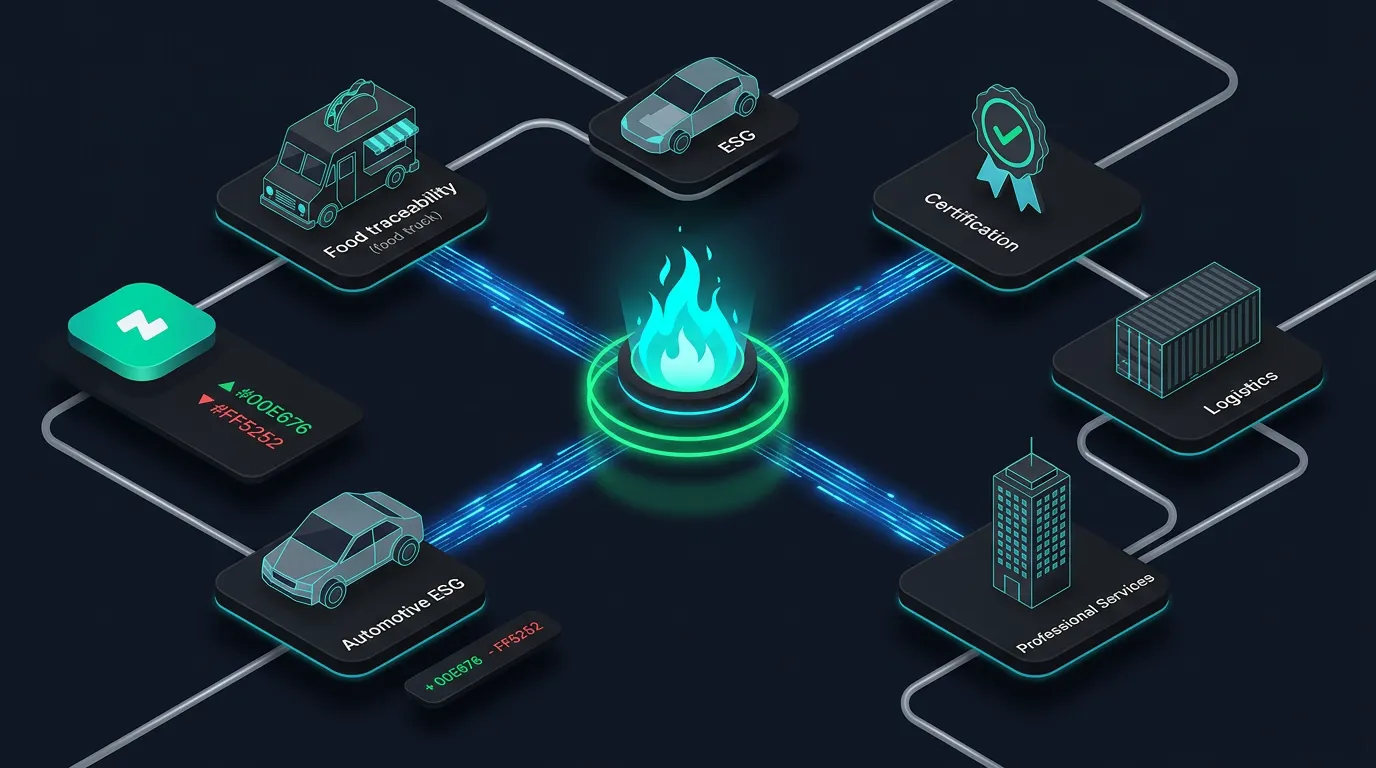
The VTHO consumption column is the critical insight most analyses miss. Each of these enterprise deployments doesn't just represent brand validation - it represents sustained, predictable VTHO burning on VeChainThor. Walmart China alone processes millions of food traceability events annually. Each event consumes VTHO. Each unit of VTHO burned must be regenerated - which means someone, somewhere, needs to hold VET.
This is the fundamental demand mechanism that separates VET from pure speculative tokens: real enterprise activity creates real token consumption that connects to VET's value.

How to Buy VET: Getting Started in 2026
Buying VET is straightforward on most major exchanges, but where and how you store it after purchase has direct implications for your returns through VTHO generation. For a deeper look at safe crypto storage options, including hardware wallet comparisons, Zipmex has a dedicated 2026 guide.
- Choose a regulated exchange - VET is listed on Binance, Bitget, Coinbase, KuCoin, and Bybit. Check regional availability, as some platforms restrict certain jurisdictions. Compare trading fees and withdrawal options before committing.
- Complete KYC verification - All regulated exchanges require identity verification (passport or national ID, proof of address). This typically takes 10 minutes to 24 hours depending on the platform.
- Deposit funds - Transfer fiat via bank transfer or card, or deposit USDT/BTC from an existing wallet to fund your purchase.
- Buy VET - Search for VET/USDT or VET/BTC trading pair. Use a limit order if you have a target price; a market order if you want immediate execution.
- Consider self-custody for VTHO generation - This is where VET differs from most tokens. Storing VET in a self-custodial hardware wallet (Ledger, Trezor with VeChain support, or the official VeChain Thor Wallet) means you receive VTHO directly. Some centralized exchanges do not distribute VTHO to users, meaning you forfeit passive generation by leaving VET on-platform. At 10,000 VET, that's approximately 4.32 VTHO per day - at current VTHO prices, not enormous, but it compounds meaningfully over years.
- Track your VTHO balance - Use VeChainStats.com or the VeChain Thor Wallet to monitor your holdings and accumulated VTHO.
Buying VET involves significant market risk. This is not financial advice - always do your own research before committing capital.
VET is one of several enterprise blockchain tokens worth considering. Here's how it compares to alternatives.
VeChain vs Competitors: How VET Stacks Up
VeChain occupies a specific niche - enterprise supply chain and ESG compliance - that is contested by several different types of platforms. Understanding the competitive landscape objectively helps assess whether VET's current valuation is appropriate.
VeChain's advantage over IBM Blockchain and Hyperledger is that it combines enterprise-grade infrastructure with a public, investable token - giving it a value capture mechanism the permissioned alternatives lack entirely. Its advantage over Ethereum is specialization: lower, predictable fees, higher throughput for the specific transaction types supply chain applications generate, and identity-layer features built into PoA consensus.
VET Price Prediction Tools: Free vs Paid vs AI-Based
Not all prediction tools are created equal - and understanding which type suits your needs prevents misplaced confidence in any single model.
The honest approach is to use algorithmic models for near-term timing and entry signals, while anchoring your conviction in fundamental analysis of enterprise traction and macro crypto cycles.
Investment Risks: What Could Prevent VET from Reaching Its Targets
Every price target above assumes favorable conditions. Here's what could prevent them - and these risks deserve as much attention as the bull cases.
⚠ Key Investment Risks
- Regulatory Risk → VET classified as utility token now, but MiCA in Europe creates compliance obligations. US security classification would restrict institutional participation.
- Competition Risk → Ethereum Layer 2 solutions (Polygon, Arbitrum) actively targeting supply chain and ESG compliance markets.
- Narrative Risk → Crypto capital flows to AI, memecoins, DeFi. Supply chain blockchain repeatedly struggles to compete for speculative attention.
- Technical Risk → Smart contract exploits or protocol failures could damage enterprise trust. The 2019 foundation hack demonstrated this vulnerability.
- Liquidity Risk → Declining market cap rank reduces institutional visibility, widens spreads, and reduces ability to absorb large buy orders.
This content is for informational purposes only and does not constitute financial advice. Crypto assets involve substantial risk of loss. Past performance is not indicative of future results.
Conclusion: Is VET Worth Holding in 2026 and Beyond?
The VET investment case depends entirely on your time horizon and risk tolerance. There's no single answer - but there are segment-specific answers that are genuinely useful.
For short-term traders: The current technical setup is not yet a buy signal. RSI near 45 and MACD flat means the trend hasn't reversed - it's pausing. Wait for RSI to break above 50 with volume confirmation, or for a MACD bullish crossover on the weekly chart. For broader crypto market context, see Zipmex's Bitcoin price prediction analysis.
For medium-term investors: The 2024 Bitcoin halving has historically set up the strongest altcoin cycle 12-24 months later. VET entering that cycle with the Hayabusa upgrade live, Wanchain cross-chain active, and growing EU regulatory tailwinds gives it a better fundamental story entering 2026-2028 than it had entering 2021. The risk is that narrative dynamics route capital elsewhere even if fundamentals improve.
For long-term holders: VeChain's VTHO generation mechanic means holding VET isn't purely passive speculation - it's a position that generates a utility token through chain usage. If the $192.93B blockchain supply chain market projection materializes even partially, VeChain's on-chain activity (and VTHO burn rate) should increase substantially, supporting VET value through a mechanism that doesn't depend on retail sentiment.
VeChain is a platform built on transparency and on-chain verifiability - its strengths are the same qualities that make thorough, honest analysis of its price trajectory both necessary and possible. The forecasts above reflect that reality: wide ranges, scenario-based thinking, and explicit acknowledgment of what we don't know.
Crypto trading involves substantial risk of loss and is not suitable for all investors. The information in this article is for educational and informational purposes only and should not be construed as financial or investment advice. Always conduct your own research and consider your personal financial situation before making any investment decisions.
Last updated: March 2026.
Frequently Asked Questions
What is the current price of VeChain (VET)?
As of March 2026, VeChain (VET) is trading in the $0.006-$0.008 range following a period of sustained bearish consolidation. The current price represents roughly a 97% decline from the April 2021 all-time high of $0.2782. VET's market cap sits approximately in the $600 million range, placing it outside the top 60 by market capitalization. Always check CoinMarketCap or CoinGecko for the most current VET price before making any decisions.
What is the VET price prediction for 2026?
The VET price prediction for 2026 spans a wide range depending on the model. Conservative algorithmic models project VET staying near $0.006-$0.012 through most of 2026, extrapolating current bearish momentum. Narrative and fundamental models project $0.035-$0.088 if an altcoin rotation cycle materializes following the 2024 Bitcoin halving. The key technical triggers to watch: RSI recovering above 50 and VET closing above the 200-day SMA (~$0.014). Without those confirmations, the conservative case is more likely to play out.
What is the VeChain price prediction for 2030?
VeChain price prediction models for 2030 range from below $0.010 (conservative algorithmic) to $0.15-$0.45 (fundamental/narrative analysis). The bull case for 2030 is anchored by the blockchain supply chain market's projected growth to $192.93 billion - if VeChain captures even a small share of that market, VTHO burn rates increase substantially. The 2028 Bitcoin halving is also a key structural catalyst for the 2029-2030 window, historically the strongest period for altcoin outperformance.
Will VeChain (VET) ever reach $1?
$1 VET requires approximately 130x growth from current levels, implying a market capitalization of roughly $86.7 billion - comparable to top-10 crypto asset territory. Most conservative models never reach $1 for VET. Bullish fundamental models place $1 as a 2040-2050 scenario, contingent on sustained enterprise adoption, multiple Bitcoin halving cycles, institutional capital inflows, and ESG regulatory mandates driving VeChainThor transaction volumes. The sequential milestones - $0.10, $0.27 (ATH retest), $0.50 - must each be achieved first. $1 is theoretically possible, not near-term probable.
What is the VeChain price prediction for 2040?
Long-term VET price prediction for 2040 spans $0.005-$1.20 in scenario analysis. The base case sits around $0.30-$0.60 if VeChain maintains its enterprise blockchain positioning and benefits from multiple Bitcoin halving cycles. The bull case of $0.85-$1.20 requires institutional adoption at significant scale - Franklin Templeton's tokenization of money market fund shares on VeChainThor is an early indicator of this potential pathway. The bear case reflects displacement by Ethereum L2 solutions or regulatory barriers.
What is the difference between VET and VTHO?
VET and VTHO are two distinct tokens serving different functions in the VeChain ecosystem. VET is the primary investment token - it transfers value across the VeChainThor network and passively generates VTHO simply by being held. VTHO (VeChainThor Energy) is the gas token - it's consumed to pay for every transaction on VeChainThor and is burned in the process. Think of VET as your investment position and VTHO as the operating fuel the network runs on. The relationship creates a mechanism where higher enterprise usage increases VTHO demand, which indirectly supports VET value.
Is VeChain (VET) a good investment in 2026?
Whether VeChain is a good investment in 2026 depends on your time horizon and risk profile. The current technical setup - RSI below 50, price below the 200-day SMA, bearish consolidation - does not signal an immediate bullish reversal. However, VeChain's fundamental case remains intact: live enterprise deployments, the Hayabusa upgrade improving the network's technical capabilities, and the EU Digital Product Passport regulation creating structural demand. Investors with a 2-4 year horizon who can tolerate extended consolidation have a more compelling case than those seeking near-term returns. This is not financial advice - assess your own situation carefully.
What are the biggest risks of investing in VeChain?
The five primary risks for VET investors are: regulatory reclassification as a security in major jurisdictions; competition from Ethereum Layer 2 solutions and Hedera targeting enterprise supply chain use cases; narrative risk, where crypto capital continues flowing to DeFi and AI tokens; technical risk from smart contract vulnerabilities or protocol failures; and liquidity risk from VET's declining market cap rank reducing institutional visibility. Any honest VET investment thesis must account for all five - the bull case is not guaranteed simply because the technology has genuine utility.
What is the Hayabusa Mainnet upgrade and how does it affect VET price?
The Hayabusa Mainnet upgrade introduced full EVM (Ethereum Virtual Machine) compatibility to VeChainThor, along with increased throughput and reduced gas overhead. EVM compatibility means any developer who can write Ethereum smart contracts can now deploy on VeChainThor - dramatically expanding the addressable developer ecosystem. For VET price, the Hayabusa upgrade's impact is likely to materialize over 12-24 months as new applications and enterprise integrations deploy on the upgraded network, increasing VTHO consumption and supporting demand for VET.
What should I look for before buying VET in 2026?
Before buying VET in 2026, monitor these specific signals: technical confirmation (RSI above 50, price above the 200-day SMA of approximately $0.014, MACD bullish crossover on weekly chart), fundamental catalysts (new enterprise partnership announcements, EU Digital Product Passport timeline progress, Hayabusa-driven developer activity metrics), and macro conditions (Bitcoin holding above key support levels, altcoin market capitalization recovering). Also verify that no major regulatory actions against VET or VeChain Foundation are pending, and confirm that exchange liquidity for VET/USDT pairs is healthy before establishing a position. For a broader view of how to evaluate crypto assets, see Zipmex's cryptocurrency predictions guide.
ZIPMEX promotes trading on trade.zipmex.com. Promotions are labelled and kept separate from news coverage, which is selected and checked without regard to them. Perpetual futures are leveraged derivatives. Prices can move fast and you can lose all of your margin. Not available in every jurisdiction. Not investment advice.