Automated market makers have quietly become the most consequential piece of infrastructure in DeFi - and most traders still don't fully understand how they work. An automated market maker (AMM) is an algorithmic trading protocol that replaces the traditional buyer/seller order book with pooled liquidity priced by a mathematical formula. Instead of waiting for a counterparty to match your trade, you swap tokens directly against a pool of reserves, and a smart contract handles everything: pricing, execution, settlement.
No intermediaries. No approvals. No market hours. Just math and code running on-chain, 24/7.
⚡ Key Takeaways
- AMMs use liquidity pools instead of order books - you trade against pooled reserves, not other users
- Prices are set by the constant product formula: x . y = k
- Anyone can become a liquidity provider and earn a share of trading fees
- Impermanent loss is the principal risk for liquidity providers - understand it before depositing
- The dominant AMM protocols in 2026 are Uniswap, Curve, and Balancer, each optimized for different asset types
To understand why AMMs changed DeFi permanently, it helps to start with what they replaced.
What Is an Automated Market Maker (AMM)?
An automated market maker is a permissionless, self-executing trading system deployed as smart contracts on public blockchains like Ethereum. Traditional exchanges run on order books: buyers post bids, sellers post asks, and a trade executes when the two sides agree on a price. AMMs abandon that model entirely. There's no counterparty on the other side of your swap - you're trading against a pool of tokens whose price adjusts automatically based on a coded formula.
Ethereum founder Vitalik Buterin first articulated the concept in a 2017 research post calling for on-chain market makers. What followed was a wave of protocols - Uniswap, Curve, Balancer - that turned that idea into a trillion-dollar trading infrastructure. The permissionlessness is critical: no central entity controls an AMM, and no one can be denied access.
The mechanics become clear once you understand how a liquidity pool is structured.
How Does an AMM Work? Step-by-Step
Every AMM trade follows the same sequence:
- Connect a self-custody wallet (e.g., MetaMask) to a DEX front end
- Select your token pair - the token you're selling and the one you want to receive
- The smart contract checks pool reserves - it reads the current balance of both tokens in the pool
- The constant product formula calculates the output amount - based on the current reserve ratio and your trade size
- The trade executes on-chain - your input token enters the pool, output token exits to your wallet
- A trading fee (typically 0.01-1%) is collected and distributed proportionally to the pool's liquidity providers
The entire process settles in a single blockchain transaction. No order matching, no partial fills, no waiting. Trade at 3 AM or during peak volatility - the pool is always there.
AMM vs. Traditional Order Book: Key Differences
The custody difference matters enormously. On a centralized exchange, you're trusting a third party with your assets. With an AMM, the smart contract holds the pool reserves - your wallet holds your funds until the moment of the swap.
Liquidity Pools and Liquidity Providers
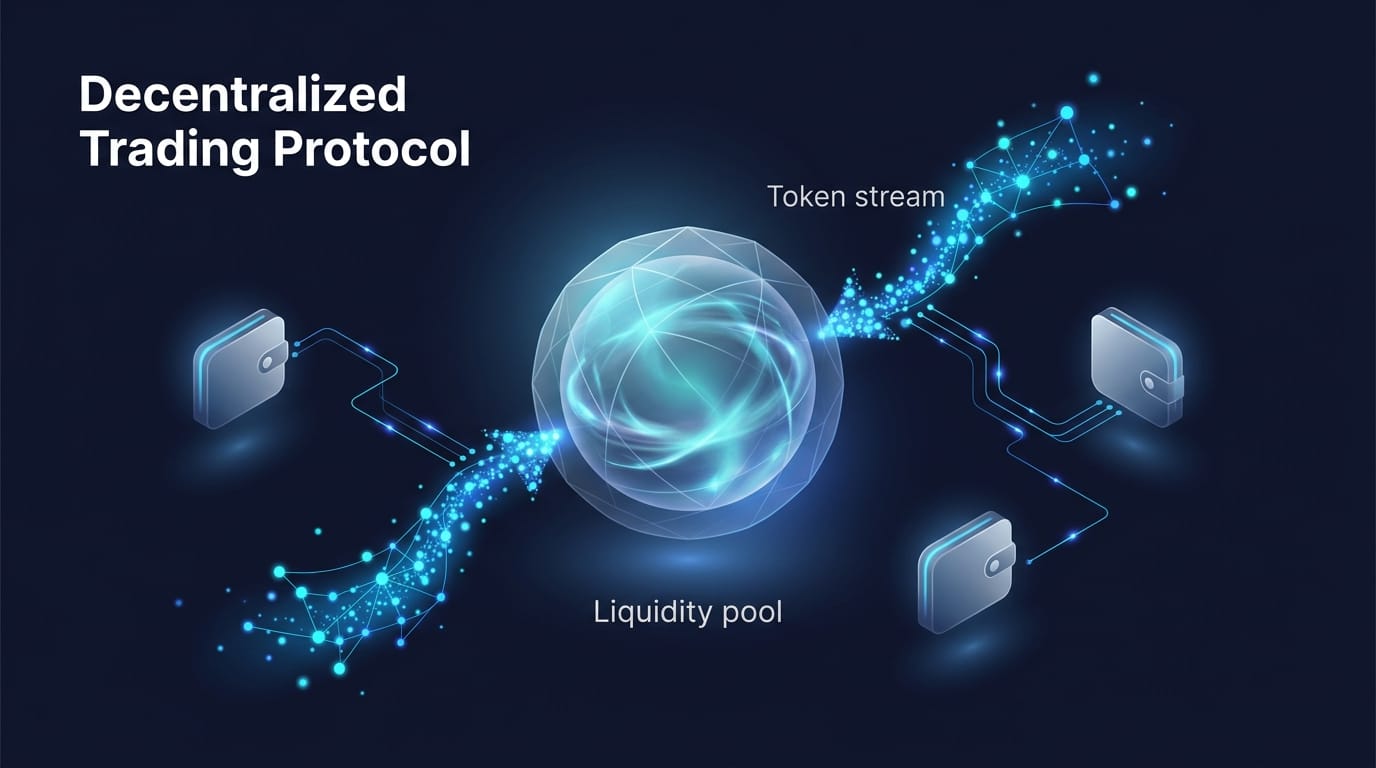
Every AMM depends on a supply of tokens held in reserve - this is the liquidity pool. A pool is a smart contract holding two different tokens in approximately equal value (for example, ETH and USDC). When a trader swaps ETH for USDC, they're pulling USDC out of the pool and depositing ETH in. The pool always holds both assets; the ratio between them shifts with every trade.
Liquidity providers (LPs) are the people who fund these pools. Anyone with crypto can become an LP - deposit equal values of both tokens into a pool, and the protocol issues you LP tokens as proof of your stake. No application, no minimum deposit threshold, no counterparty risk from the exchange itself.
How Liquidity Providers Earn Fees (and Yield)
Every swap charges a fee, and that fee goes to the pool's LPs. The fee tier varies by protocol and pool type. Uniswap v3, for example, offers four fee tiers - 0.01%, 0.05%, 0.30%, and 1.00% - with stablecoin pairs typically at the lower end and volatile or exotic pairs at the higher end. These tiers are documented in Uniswap's official fee documentation.
Fees accumulate in the pool and are claimable when the LP withdraws their position. In high-volume pools, these fees can be substantial. Some protocols also distribute governance token rewards on top of trading fees - commonly called yield farming - though I'd treat those separately from base fee income, since governance token prices fluctuate and those rewards can be dilutive.
The base fee income from trading volume is the real, sustainable yield. Governance rewards are a bonus, not a certainty.
LP Tokens: Proof of Pool Ownership
When you deposit into a pool, the AMM mints LP tokens and sends them to your wallet. These tokens represent your proportional claim on the pool's total reserves plus any accrued fees. Redeeming LP tokens burns them and returns your share of the pool at current prices.
On protocols like XRPL's AMM, LP tokens also carry governance rights - holders can vote on fee parameters, weighted by their share of the pool. The practical formula is straightforward:
Hang on to those LP tokens. Losing them means losing your claim on the pool.
Understanding LP tokens is essential before exploring the math that governs pool pricing.
The Constant Product Formula: How AMMs Price Assets
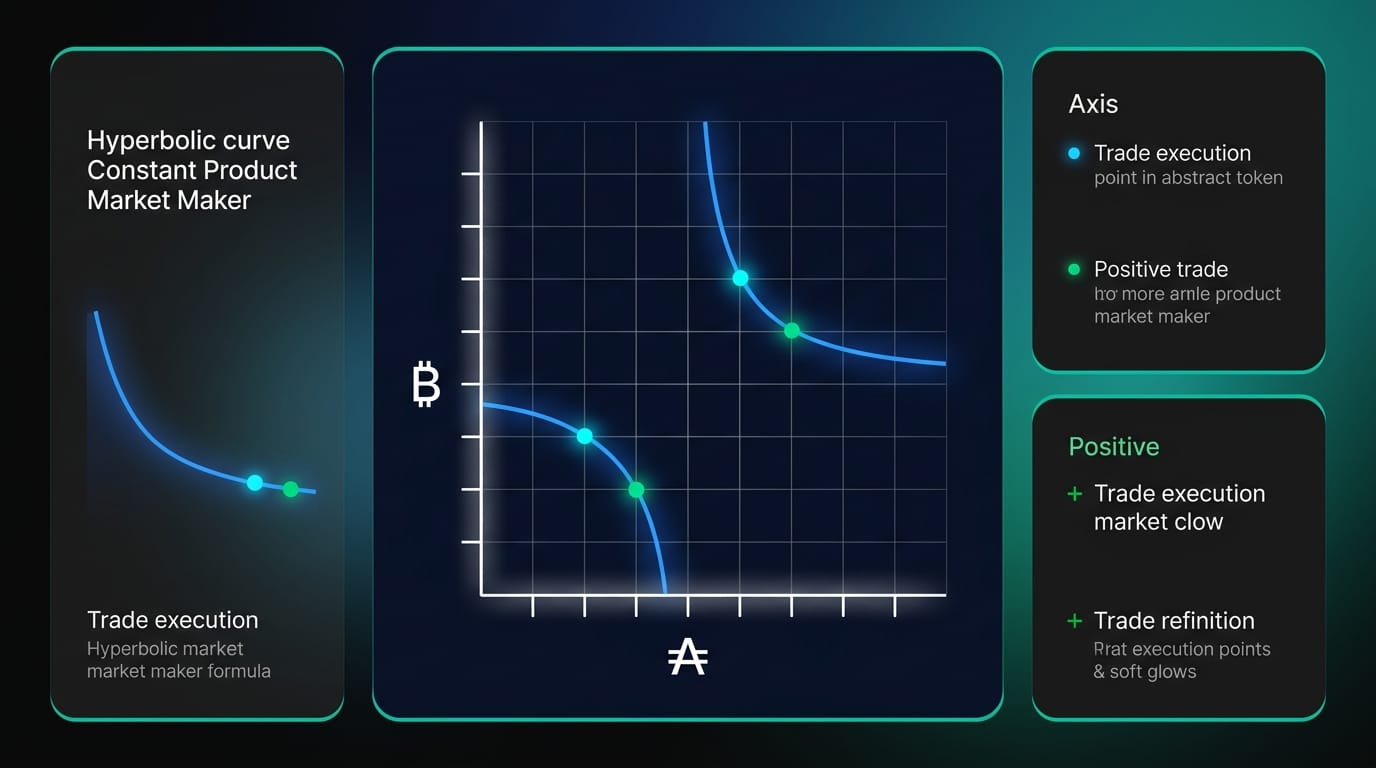
The pricing rule underpinning most AMMs is elegantly simple. Vitalik Buterin's original formulation, later popularized by Uniswap, expresses price discovery as:
Every swap adjusts x and y, but their product always equals k. This forces price to update dynamically with every single trade - no price feed, no oracle, no human intervention required.
A worked example makes the formula intuitive.
x.y=k in Action: A Worked Swap Example
Starting pool: 10 ETH and 20,000 USDC, as described in Uniswap's protocol documentation.
The buyer paid 11.1% above the pre-trade price. That gap is slippage - and it's entirely predictable from the formula. Larger pools reduce slippage because any single trade shifts the reserve ratio less dramatically. A 10,000 ETH pool would deliver near-zero slippage on a 1 ETH buy.
Slippage, Price Impact, and Pool Depth
Slippage is the difference between the price you expect to pay and the price you actually pay. Two forces drive it: price impact (the mechanical consequence of your trade on the pool's reserve ratio) and market movement (the block-confirmation delay on a live network).
AMM interfaces let you set a slippage tolerance - a maximum acceptable deviation, typically 0.1% to 1%. If the executed price would exceed your tolerance, the transaction reverts. Tight tolerances protect you from sandwich attacks and price spikes; overly tight tolerances on illiquid pools will result in constant failed transactions.
The bottom line: deeper pools mean less slippage. Always check pool TVL on DeFi Llama before executing large swaps.
Understanding the pricing formula also makes it easier to evaluate the main types of AMMs.

How to Start Trading on an AMM (Step-by-Step)
None of the major AMM explainers out there actually walk you through your first trade - so here's the practical onboarding process. Gas fees on Ethereum mainnet vary with network congestion; using Layer 2 networks dramatically reduces this cost.
- Set up a self-custody wallet - MetaMask is the most widely supported option for EVM chains. Write down your seed phrase and store it offline.
- Fund the wallet with the base asset - on Ethereum-based DEXs, you'll need ETH to cover gas fees. On other chains (Solana, Arbitrum, Base), you'll need the native token of that chain.
- Navigate to a DEX front end - Uniswap is the reference implementation and the most liquid. PancakeSwap, Curve, and Aerodrome serve specific chains or asset types.
- Connect your wallet - click "Connect Wallet," select your wallet provider, and approve the connection request.
- Select your token pair and review parameters - input token, output token, slippage tolerance, and the current gas fee estimate. If slippage is too high, the pool may be too shallow for your trade size.
- Confirm the swap - approve the transaction in your wallet. The swap settles in one block (seconds on L2s, 12-15 seconds on Ethereum mainnet).
Gas fees vary significantly by network. On Ethereum mainnet during congestion, a simple swap can cost $5-$30. On Layer 2 networks like Arbitrum or Base, the same swap typically costs under $0.10. For small trades, the chain you use matters almost as much as the pool you trade on. If you're new to passive income opportunities in DeFi, understanding crypto staking is a useful complement to understanding LP fee mechanics.
Types of AMMs: Uniswap, Curve, Balancer, and Beyond
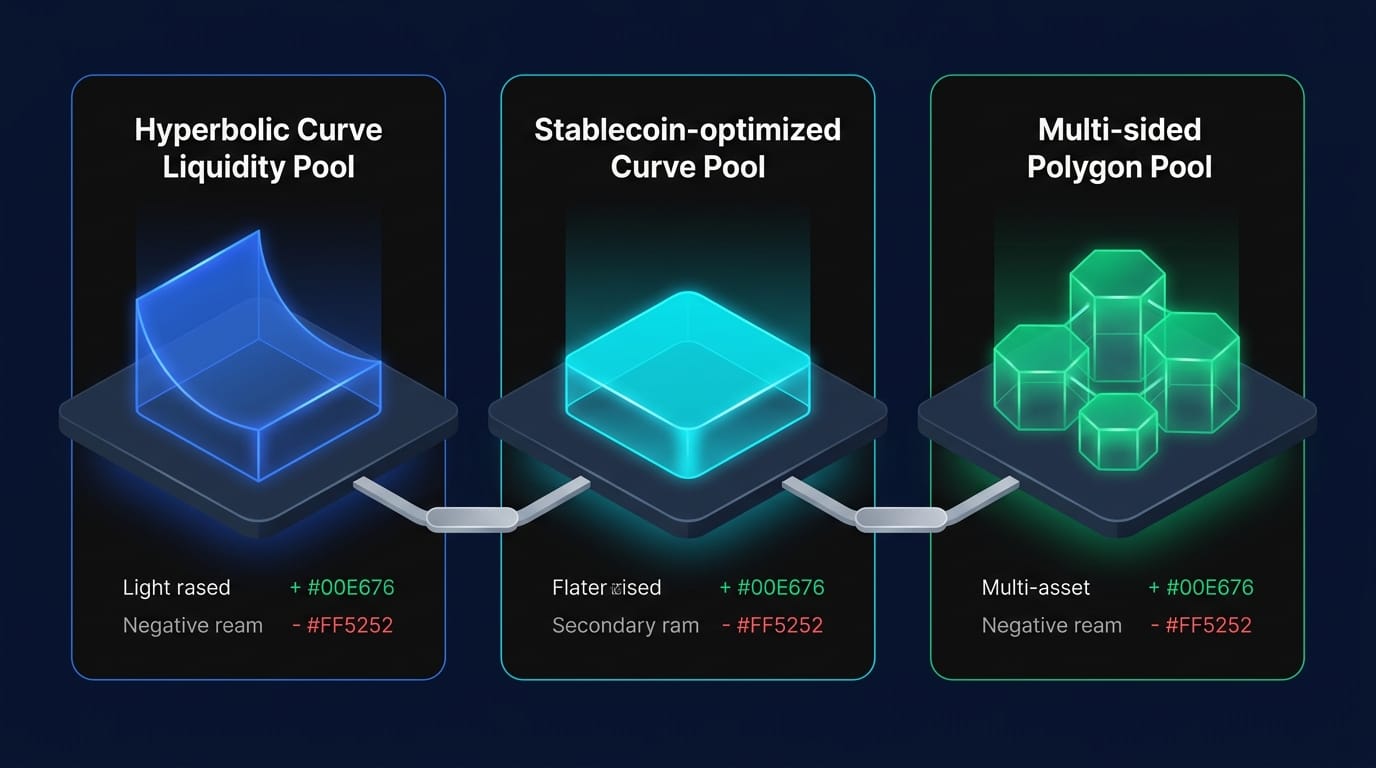
The constant product formula is only one AMM design. DeFi's evolution has produced specialized variants, each optimized for a different use case. All three dominant models are live and actively used in 2026, as tracked by DeFi Llama's protocol rankings.
Uniswap pioneered the constant product model and remains the most liquid DEX by volume. Curve dominates stablecoin trading because its specialized formula dramatically reduces slippage between like-kind assets. Balancer extends the model by allowing pools with up to eight tokens at arbitrary weighting ratios, enabling something close to on-chain index funds.
Each AMM model carries its own risk profile - which leads to an important question.
Risks and Limitations of Automated Market Makers
AMMs are non-custodial - but non-custodial doesn't mean risk-free. There are three distinct risk categories every DeFi participant should understand before depositing: economic (impermanent loss), execution (slippage and gas costs), and technical (smart contract vulnerabilities). Of these, impermanent loss is the one most unique to AMM-based liquidity provision.
Impermanent Loss: The Hidden Cost of Providing Liquidity
Impermanent loss is the paper loss an LP incurs when the price ratio of their deposited tokens diverges from the ratio at the time of deposit. It's a direct consequence of the constant product formula rebalancing the pool. For a full breakdown with a calculator, see Zipmex's dedicated guide on what is impermanent loss.
Here's a concrete example. Suppose you deposit into a 50/50 ETH/USDC pool when ETH is priced at $2,000. You deposit 1 ETH and 2,000 USDC - total value: $4,000.
Now ETH doubles to $4,000. Arbitrageurs have already bought ETH from your pool, rebalancing it to approximately 0.707 ETH and 2,828 USDC. Your pool position is now worth approximately $5,656. If you had simply held 1 ETH and 2,000 USDC, you'd have $6,000.
The ~$344 difference is your impermanent loss. It's "impermanent" because if ETH returns to $2,000, the loss disappears. It becomes permanent the moment you withdraw during a price divergence.
The key question for any LP: do accumulated trading fees outweigh the impermanent loss? That depends on pool volume, fee tier, and how much the asset prices diverge. Stablecoin pools on Curve have minimal impermanent loss because the assets don't diverge - which is exactly why they dominate LP strategies for yield-focused participants.
Smart Contract Risks, Gas Fees, and Token Diligence
Three additional risks deserve specific attention:
Smart contract risk. AMM code has been audited - but audits reduce risk, they don't eliminate it. Historical DeFi exploits have drained liquidity pools through reentrancy bugs, oracle manipulation, and logic errors. Stick to battle-tested protocols with multiple independent audits and substantial TVL history.
Gas fees. On Ethereum mainnet, gas costs scale with network congestion and can make small swaps economically irrational. A $50 swap costing $25 in gas is a 50% haircut before the trade even executes. Layer 2 networks solve this - but introduce their own bridge risks.
Token diligence. AMMs are fully permissionless - anyone can create a pool for any token, including fraudulent ones. Before every swap, verify the token's contract address against official sources.
⚠ 3 Checks Before Every AMM Swap
- Verify the token contract address → Cross-reference the project's official site or a trusted aggregator before swapping
- Check pool TVL and depth → Shallow pools mean high slippage and increased fraud exposure
- Review the gas fee estimate → If it exceeds ~5% of your trade value, consider a Layer 2 alternative
Despite these risks, AMMs have proven to be one of the most transformative financial primitives of the blockchain era.
Conclusion: AMMs as the Backbone of DeFi
AMMs replaced the order book with an elegant mathematical primitive - and that shift unlocked something that wasn't previously possible: 24/7 permissionless trading for any token pair, without intermediaries, without custody risk, and without minimum account sizes. The DeFi sector exists largely because AMMs solved the liquidity problem for decentralized exchanges.
The innovation hasn't stopped. Uniswap v3 introduced concentrated liquidity, allowing LPs to deploy capital within specific price ranges rather than across the entire price curve - dramatically improving capital efficiency. Intent-based trading systems and cross-chain AMMs are now pushing the model further.
Who should use AMMs:
- Traders - AMMs give you access to thousands of token pairs instantly, no account required. Understand slippage before executing large swaps, and prefer deep pools or Layer 2 networks for cost efficiency.
- Liquidity providers - fee income is real and can be substantial in high-volume pools, but impermanent loss is a genuine cost that needs to be modeled before depositing. Start with stablecoin pools if you want lower-risk fee exposure.
- Protocol builders - AMMs are composable DeFi primitives. Their open, on-chain architecture - every trade verifiable, every pool balance transparent - is the standard that the broader DeFi ecosystem is building toward.
Platforms like Zipmex are part of this same trajectory: on-chain verifiability, self-custody, and real yield generated from actual platform activity rather than token emissions. That design philosophy directly reflects where the market is heading.
Crypto trading and DeFi participation involve substantial risk of loss. Leveraged trading, liquidity provision, and on-chain gaming are not suitable for all users. This article is for informational purposes only and does not constitute financial advice. Always conduct your own research and assess your risk tolerance before participating in any DeFi protocol.
Last updated: March 2026.
Frequently Asked Questions
What is an automated market maker (AMM) in simple terms?
An automated market maker is a type of decentralized exchange that uses a mathematical formula - not buyers and sellers - to set token prices and execute trades. Instead of matching you with a counterparty, an AMM holds a pool of two tokens in a smart contract. When you swap, the contract calculates how much output you receive based on the pool's current reserve ratio, takes a small fee, and settles the trade on-chain in seconds. No account, no approval, and no waiting for a matching order are required.
How is an AMM different from a traditional exchange?
The core difference is how prices are discovered and how trades settle. A traditional order book exchange relies on buyers posting bids and sellers posting asks - a trade only executes when both sides agree on a price. An AMM eliminates that entirely: prices are calculated automatically from a formula based on pool reserves. The other structural differences are significant - AMMs are non-custodial (you keep your keys), fully permissionless (no KYC or account approval), and always available (no market hours, no downtime, no counterparty liquidity requirements).
What is a liquidity pool in crypto?
A liquidity pool is a smart contract holding two tokens in reserve - for example, ETH and USDC - that traders can swap against directly. The pool always maintains both assets; every swap shifts the ratio between them, which adjusts the price. Liquidity providers fund these pools by depositing equal values of both tokens and receive LP tokens as proof of their stake. In return, they earn a proportional share of every trading fee generated by the pool. The deeper the pool's total value locked (TVL), the less slippage traders experience.
What is the constant product formula (x.y=k) in an AMM?
The constant product formula is the pricing rule most AMMs use. It states that the product of the two token reserves in a pool must always equal a constant k: x . y = k. Every swap updates x and y while keeping k fixed, which forces the price to adjust based on supply and demand within the pool. If someone buys ETH from an ETH/USDC pool, the ETH supply decreases and its price rises - automatically, without any human intervention. This simple equation is what makes 24/7 decentralized trading mechanically possible.
What is impermanent loss in DeFi?
Impermanent loss is the economic loss an LP experiences when the price ratio of their deposited tokens diverges from the ratio at the time of deposit. It happens because the constant product formula continuously rebalances the pool - when one asset's price rises, arbitrageurs buy it from the pool, leaving the LP with more of the cheaper asset and less of the appreciating one. The loss is "impermanent" because it disappears if prices revert to their original ratio. It becomes permanent upon withdrawal. Stablecoin pools experience minimal impermanent loss because the assets stay at a fixed peg; volatile pairs carry higher exposure.
What is slippage in an AMM and how do I reduce it?
Slippage is the difference between the price you expect when initiating a swap and the price you actually receive when the transaction settles. In AMMs, slippage has two sources: price impact (your trade shifts the pool's reserve ratio, mechanically moving the price) and market movement (prices change in the time between submitting and confirming a transaction). Reducing slippage comes down to three tactics: trade in pools with higher TVL, reduce your trade size relative to the pool, or use a Layer 2 network where faster block confirmation minimizes market-movement slippage. Most AMM interfaces let you set a slippage tolerance - 0.5% is a reasonable default for liquid pools.
How do I start using an AMM for the first time?
Start with a self-custody wallet - MetaMask is the most widely supported for Ethereum and EVM-compatible chains. Fund it with ETH (for mainnet) or the native token of whatever Layer 2 you plan to use. Navigate to a DEX front end like Uniswap, connect your wallet, select your token pair, and review the slippage estimate and gas fee before confirming. For your first swap, use a Layer 2 like Arbitrum or Base - gas fees are typically under $0.10 compared to $5-$30 on Ethereum mainnet. Always verify the token contract address before swapping to avoid interacting with fraudulent token clones.