
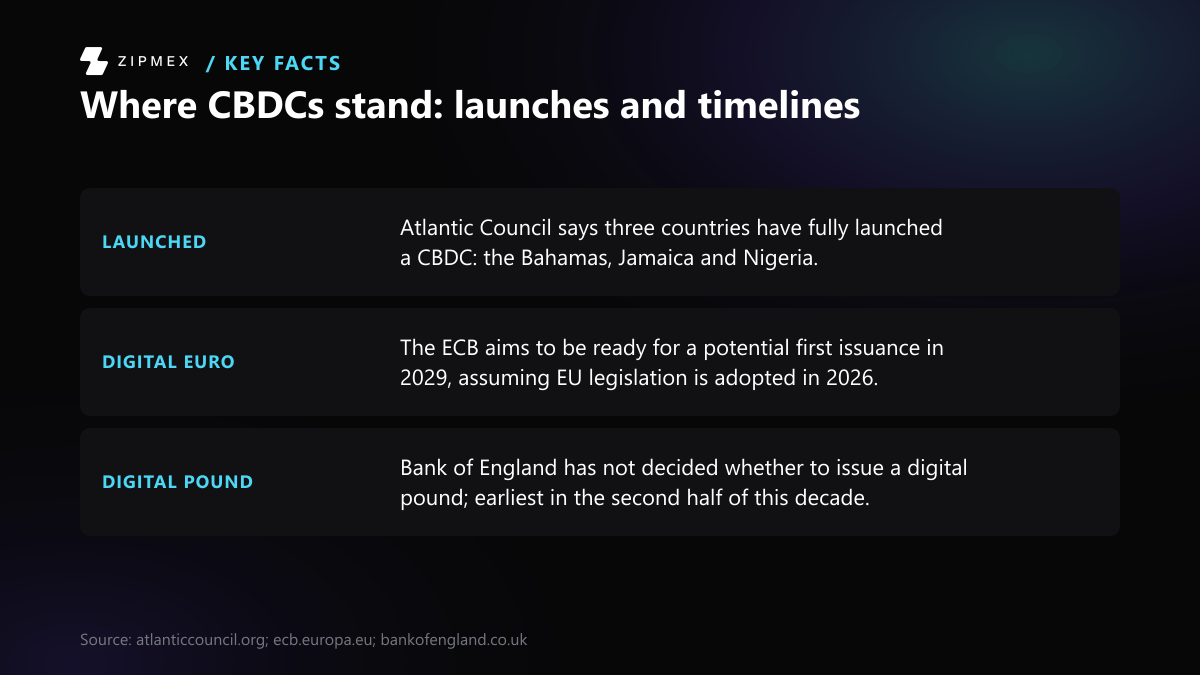
A central bank digital currency (CBDC) is money in a country's own currency unit that exists only in digital form and is a direct liability of the central bank. In plain terms, it is a debt the central bank owes to you, not one owed by a commercial bank or a private company. That is the definition used by the Bank for International Settlements (BIS) and in a US executive order of January 23, 2025. As of the Atlantic Council's May 2026 update, three countries had fully launched one: the Bahamas, Jamaica and Nigeria. Neither the euro area nor the UK has decided to issue one, but the digital euro moved forward in 2026. The European Parliament agreed to open negotiations with EU governments on July 9, 2026, and the European Central Bank (ECB) opened a call on September 15, 2026 for merchants to join a pilot planned for 2027.

What makes a CBDC different from the money you already use
Most money people use digitally today is already electronic, but it is not central bank money. A balance in a bank account is a claim on that commercial bank. Banknotes are the only central bank money most people can hold. The BIS describes a retail CBDC as "a digital form of cash": a direct claim on the central bank that differs from cards, credit transfers and e-money, which are liabilities of private firms.
Three things a CBDC is not
- It is not a bank deposit. A deposit is owed by your bank. A CBDC would be owed by the central bank, even if a bank or other intermediary runs the account or app you use.
- It is not a cryptocurrency. The ECB says that because the digital euro "would be backed by a central bank, it would not be a crypto-asset." The Bank of England says "the digital pound would not be a cryptocurrency or cryptoasset."
- It is not a stablecoin. A stablecoin is issued by a private company and is a claim on that company. A CBDC is issued by the state's central bank in the national unit of account.
Retail and wholesale CBDCs
The BIS separates two types by who can use them:
- Retail CBDC: for households and businesses making everyday payments. The digital euro and the digital pound are retail designs.
- Wholesale CBDC: limited to financial institutions. The BIS says it serves as a settlement asset in transactions between banks, central banks and other financial institutions, much like today's central bank reserves and settlement accounts. It could also allow conditional payments that settle only when another payment or asset is delivered.
The design rules central banks set for themselves
In an October 9, 2020 joint report, the Bank of Canada, ECB, Bank of Japan, Sveriges Riksbank, Swiss National Bank, Bank of England, US Federal Reserve Board and the BIS set out foundational principles. Issuance should not compromise monetary or financial stability. A CBDC should coexist with and complement existing forms of money. It should promote innovation and efficiency.
How many countries have one
The Atlantic Council's CBDC Tracker, last updated in May 2026, reports:
- Launched: three countries (the Bahamas, Jamaica and Nigeria).
- Exploring: 146 countries and currency unions, representing over 98% of global GDP. In May 2022 the figure was 87.
- Pilots: 41 CBDC pilot projects.
- Advanced stage: 77 countries in development, pilot or launch combined.
- Cross-border wholesale projects: 13, including mBridge.
According to the tracker, China's retail e-CNY had processed more than 3.4 billion transactions, worth about 16.7 trillion renminbi, by December 2025.
The gap between 146 exploring and three launched is the main point. Research and pilots are common. Full public issuance is still rare.
The digital euro: legislation now in negotiation
Where the legislation stands
The European Parliament's Economic and Monetary Affairs Committee (ECON) adopted its report on June 23, 2026, by 43 votes to 14 with one abstention, and decided to open negotiations. Parliament endorsed that decision in plenary on July 9, 2026. The EU Council agreed its own position on December 19, 2025. Parliament's legislative tracker, updated September 20, 2026, shows the file in interinstitutional negotiations, with no final regulation adopted. The tracker also says holding limits have "still not [been] discussed at political level". The Council's mandate proposes that the ECB set holding limits within a ceiling defined by the Council.
The ECB's timetable
On October 30, 2025, the ECB Governing Council decided to move the project to its next phase, after a preparation phase that began in November 2023. The ECB says that if the regulation is adopted in the course of 2026, a pilot and initial transactions could start in mid-2027, and the Eurosystem should be ready for a potential first issuance during 2029. It adds that the decision on whether to issue, and on what date, "will only be taken once the legislation has been adopted." It estimates development costs at about €1.3 billion up to first issuance, of which about €265 million is external, and operating costs at about €320 million a year from 2029.
Recent ECB steps in 2026
The ECB's digital euro page lists these steps:
- July 2026: version 0.91 of the draft scheme rulebook, which takes in feedback from a market consultation held from June to October 2025.
- September 15, 2026: a call for online and mobile merchants to take part in the digital euro pilot planned for 2027.
- September 28, 2026: a call for expressions of interest in a new wave of innovation platform work.
What the ECB says it would be like to use
- A digital form of cash, issued by the central bank and available to everyone in the euro area, that would complement banknotes and coins.
- Payable online or offline, with a phone or a card.
- Free of charge for anyone to use as a basic means of payment.
- The ECB and the Eurosystem "would not be able to identify who you are" from the payment data they receive.
- Holding limits are named as a design safeguard against financial stability risks. No amount has been set.
Digital euro: from preparation to a possible first issue
Step through the dated milestones to see what has been decided on the digital euro and what still depends on EU legislation.
- November 2023Preparation phase beginsdone
The ECB starts a preparation phase for the digital euro project.
- October 30, 2025ECB moves to the next phasedone
The ECB Governing Council decides to move the project to its next phase. It estimates development costs at about €1.3 billion up to first issuance and operating costs at about €320 million a year from 2029.
- December 19, 2025EU Council agrees its positiondone
The Council's mandate proposes that the ECB set holding limits within a ceiling defined by the Council.
- June 23, 2026Parliament committee adopts its reportdone
ECON adopts its report by 43 votes to 14 with one abstention and decides to open negotiations.
- July 9, 2026Parliament endorses negotiationsdone
The plenary endorses opening negotiations with EU governments. In the same month the ECB publishes version 0.91 of the draft scheme rulebook.
- September 15, 2026Merchant pilot call opensdone
The ECB calls for online and mobile merchants to take part in the pilot planned for 2027.
- 2026Negotiations aim to finishpending
Parliament's tracker, updated September 20, 2026, shows the file in interinstitutional negotiations with no final regulation adopted. Holding limits have not been discussed at political level.
- Mid-2027Pilot and initial transactions could startplanned
The ECB says this could happen if the regulation is adopted in the course of 2026.
- 2029Ready for a potential first issuanceplanned
The Eurosystem aims to be ready during 2029. The decision on whether to issue, and when, will only be taken once the legislation has been adopted.
This shows the digital euro's dated steps only: it does not cover the digital pound, set any holding limit, or show whether a digital euro will be issued, and dates after 2026 are aims, not commitments.
The digital pound: a decision promised in 2026
Where the decision stands
The Bank of England says: "We haven't made a decision on whether we will introduce a digital pound." Its March 2026 progress update states: "We will announce our decision on whether to proceed with a digital pound in 2026." That decision is meant to follow a joint assessment by the Bank and HM Treasury. Any launch would also need further consultation and primary legislation. The Bank is in a design phase covering technology and policy requirements, and a decision on a build phase would come after it.
What the Bank of England says it would be like to use
- "A digital form of cash – a banknote for the digital era", issued directly by the Bank and denominated in sterling.
- "If we introduced it, it would not replace cash."
- The earliest issue would be "the second half of this decade."
- A holding limit would be needed. The Bank has "not yet decided what it would be, but it would be high enough for day-to-day spending."
- "The Bank and the government would not collect any of your personal data," and neither "would be able to program your digital pounds", though users could program their own payments.
Digital euro and digital pound side by side
| Question | Digital euro (ECB) | Digital pound (Bank of England) |
|---|---|---|
| Decision to issue | Not taken; only after EU legislation is adopted | Not taken; decision on whether to proceed due in 2026 |
| Earliest timing | Ready for potential first issuance during 2029, if legislation is adopted in 2026 | Second half of this decade at the earliest |
| Holding limit | A design safeguard; amount not set; not yet discussed at political level in Parliament | Would be needed; amount not set |
| Offline use | Planned (online or offline) | Covered in an October 2025 design note on offline payments |
| Replaces cash? | Would complement banknotes and coins | Would not replace cash |
| Crypto-asset? | No | No |
The United States has ruled one out
Executive Order 14178, signed January 23, 2025, defines a CBDC as digital money in the national unit of account that is "a direct liability of the central bank." Except where the law requires otherwise, it bars federal agencies from acting to "establish, issue, or promote CBDCs" in the US or abroad. It also orders any existing agency plans for a US CBDC to be "immediately terminated."
What it means for you
- Nothing changes yet in the euro area or the UK. Neither currency has a CBDC. Banknotes, bank accounts and cards work as before.
- Watch the holding limit. Both central banks expect a cap on how much one person could hold. That cap decides whether a CBDC is only a payment tool or also a place to keep savings.
- Your account would still sit with an intermediary. The digital pound would be issued directly by the Bank of England, and the digital euro by the Eurosystem. Day-to-day access would come through banks or other payment providers.
- The next dated milestones are the end of the EU trilogue negotiations, which aim to finish in 2026, and the Bank of England's decision, promised for 2026. Both timetables are aims, not commitments.
