
USDC is a dollar stablecoin issued through regulated affiliates of Circle. It holds close to $1 for two reasons. Circle says every token is backed 100% by highly liquid cash and cash-equivalent assets, and that eligible institutions can redeem it 1:1 for US dollars directly with Circle. Circle's site showed $72.0 billion of USDC in circulation as of October 22, 2026. Most of the reserve sits in a government money market fund registered with the SEC, and the rest is in bank cash. The peg has broken once: in March 2023, Circle had $3.3 billion of reserves at Silicon Valley Bank when the bank failed, and USDC fell to $0.88.

How USDC is created and destroyed
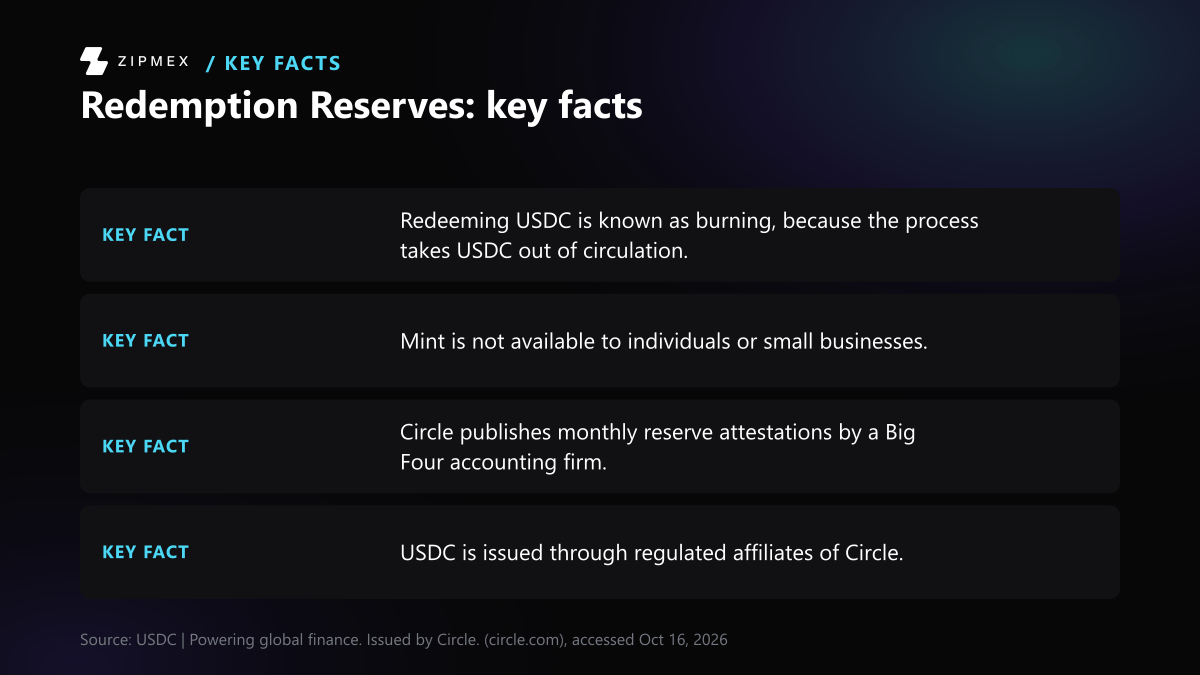
Circle issues new USDC when an eligible business deposits dollars with it. When that business redeems USDC for dollars, the tokens are burned, which removes them from circulation. Supply therefore follows deposits and redemptions instead of being set by an algorithm.
This is what keeps the price near $1. If USDC trades below $1, an institution with redemption access can buy it cheaply and redeem it with Circle for a full dollar. If USDC trades above $1, the same institution can mint new tokens at $1 and sell them. That arbitrage only works while redemptions are honoured and the reserve can pay them.
Who can redeem directly, and who cannot
Circle's direct minting and redemption service is Circle Mint. It serves exchanges, institutional traders, banks and large financial institutions. Circle states plainly: "Mint is not available to individuals or small businesses."
- Individuals get and sell USDC through exchanges, neobanks and digital wallets, according to Circle. The 1:1 redemption sits with Circle, so an individual's price depends on the intermediary they use.
- Startups and small businesses use on- and off-ramp providers in Circle's Alliance Program, Circle says.
In practice, an individual relies on the redemption promise at one remove. It holds the market price near $1, but the individual is not a party to it.
What backs the reserve
According to Circle's transparency page, dated October 22, 2026:
- Most of the reserve is in the Circle Reserve Fund (USDXX), which Circle describes as "an SEC-registered 2a-7 government money market fund." The fund holds cash, short-dated US Treasuries and overnight US Treasury repurchase agreements.
- The rest is cash, held "mostly among a handful of the world's largest banks."
How the reserve is reported
- Daily: Circle says independent third-party reporting on the fund's portfolio is publicly available via BlackRock.
- Weekly: Circle discloses USDC reserve holdings.
- Monthly: Circle says a Big Four accounting firm provides third-party assurance that reserves exceed the USDC in circulation. The most recent monthly report linked on the transparency page covers August 2026.
Separately, Circle names Deloitte & Touche LLP as its independent auditor for Circle's own financial statements since fiscal year 2022. That is an audit of the company, not the monthly reserve report.
March 2023: the one depeg
On March 10, 2023, Silicon Valley Bank failed. Reuters reported the next day that Circle had $3.3 billion of its roughly $40 billion in USDC reserves at the bank, about 8%. On Saturday, March 11, USDC fell as low as $0.88, according to CoinGecko data cited by Reuters. Circle said USDC "will remain redeemable 1 for 1 with the U.S. Dollar" and that it would cover any shortfall from corporate resources and outside capital if needed.
On March 12, 2023, the Treasury, the Federal Reserve and the FDIC said the resolution of Silicon Valley Bank would fully protect all depositors, with access to their money from Monday, March 13. Market data analysts cited in contemporary reports put USDC back at $1 within days.
The episode shows the specific risk of a reserve held partly as bank deposits. The assets were not lost, but for a weekend they could not be reached. The low also varied across venues, with reported figures between about $0.85 and $0.89; the $0.88 figure above is the Reuters/CoinGecko number.
Is your USDC Circle-backed, and who redeems it?
Answer two questions to see what stands behind the USDC you hold and who you would turn to for dollars.
Is the token contract you hold Circle's native USDC contract for that chain? Circle says USDC is natively supported on 38 blockchain networks as of September 16, 2026.
- Yes, it is the native contract → next question
- No, it arrived through a third-party bridge → Bridged USDC: not issued by Circle
- I have not checked → Check the contract first
Which of these describes you? Circle Mint serves exchanges, institutional traders, banks and large financial institutions, and is not available to individuals or small businesses.
- An individual → You rely on 1:1 redemption at one remove
- A startup or small business → You go through an on- and off-ramp provider
- An eligible institution with Circle Mint access → You can mint and redeem 1:1 with Circle
Circle says bridged USDC is not issued by Circle and that only native USDC is fully reserved. A bridged token depends on the bridge that locked the original, not on Circle's reserve.
Tokens labelled USDC can exist on other chains through third-party bridges. Compare the contract address on the chain you use with Circle's native contract for that chain before treating the balance as Circle-backed.
Individuals get and sell USDC through exchanges, neobanks and digital wallets. The 1:1 redemption sits with Circle, so the price you get depends on the intermediary you use. Redemption holds the market price near $1, but you are not a party to it.
Circle says startups and small businesses use on- and off-ramp providers in its Alliance Program. Mint is not available to small businesses, so dollars come through that provider, not directly from Circle.
Eligible institutions can redeem USDC 1:1 for US dollars directly with Circle, and the tokens are burned on redemption. That access is what lets arbitrage pull the price back toward $1.
This sorts readers by the access rules Circle describes; it does not check a specific contract address, verify any intermediary's terms or fees, or say whether redemptions will be honoured in a future stress event.
Native versus bridged USDC
Circle says USDC is natively supported on 38 blockchain networks as of September 16, 2026. Tokens labelled USDC can also exist on other chains through third-party bridges. Circle says "bridged USDC is not issued by Circle" and that "only native USDC is fully reserved." A bridged token depends on the bridge that locked the original. Before you treat a balance as Circle-backed, check that the token contract is Circle's native one for that chain.
Circle's own Cross-Chain Transfer Protocol moves native USDC between chains by burning it on the source chain and minting the same amount on the destination chain. Total supply does not change.
How USDC differs from algorithmic stablecoins
Circle launched USDC on Ethereum in September 2018 and describes it as a fully reserved stablecoin. Circle's education site names TerraUSD (UST) as "an example of a now-defunct algorithmic stablecoin." UST adjusted supply through a mint-and-burn mechanism tied to market conditions and had no cash reserve behind it. USDC's peg rests on assets and redemption. An algorithmic design rests on market incentives alone.
The US rulebook: the GENIUS Act
The GENIUS Act (S. 1582) was signed into law on July 18, 2025, and is Public Law 119-27. According to the White House fact sheet, it requires 100% reserve backing for payment stablecoins in liquid assets such as US dollars or short-term Treasuries, plus monthly public disclosure of reserve composition. A Morrison Foerster summary lists permitted reserves including insured deposits, short-term US Treasuries, repurchase agreements and government money market funds. The same summary says issuers must publish clear redemption procedures and all fees.
The Act takes effect on the earlier of 18 months after enactment (January 18, 2027) or 120 days after the primary federal regulator issues final regulations. The reserve structure Circle describes already falls within those categories.
What to check yourself
- Circulation and reserves: circle.com/transparency, dated on the page.
- Monthly assurance report: the latest linked report on the same page, and the month it covers.
- Which token you hold: native or bridged, by contract address on the chain you use.
- Who you would redeem through: for individuals, the exchange, neobank or wallet, not Circle.
