If you've spent even five minutes in crypto, you've seen USDT or USDC - but what exactly is a stablecoin, and why does the world keep $317 billion locked in them?
⚡ Quick Answer
A stablecoin is a cryptocurrency whose value is pegged to a stable asset - most commonly the US dollar - so it stays worth roughly $1 regardless of what Bitcoin or Ethereum is doing. It combines the speed and programmability of crypto with the predictability of traditional money.
Why Stablecoins Were Created
Cryptocurrencies like Bitcoin are powerful - but their prices can swing 20% in a single day. That volatility makes them impractical for everyday use. You wouldn't want to pay $5 for a coffee with Bitcoin if that $5 worth of BTC might be worth $4 or $6 by the time you walk out.
Stablecoins solve this by tying their value to a reference asset: the US dollar, gold, or even another cryptocurrency. The result is a digital asset that moves at blockchain speed without the price drama.
The first major stablecoin, Tether (USDT), launched in 2014. By early 2026, the total stablecoin market had grown to $317.94 billion - and it keeps expanding.

Types of Stablecoins Explained
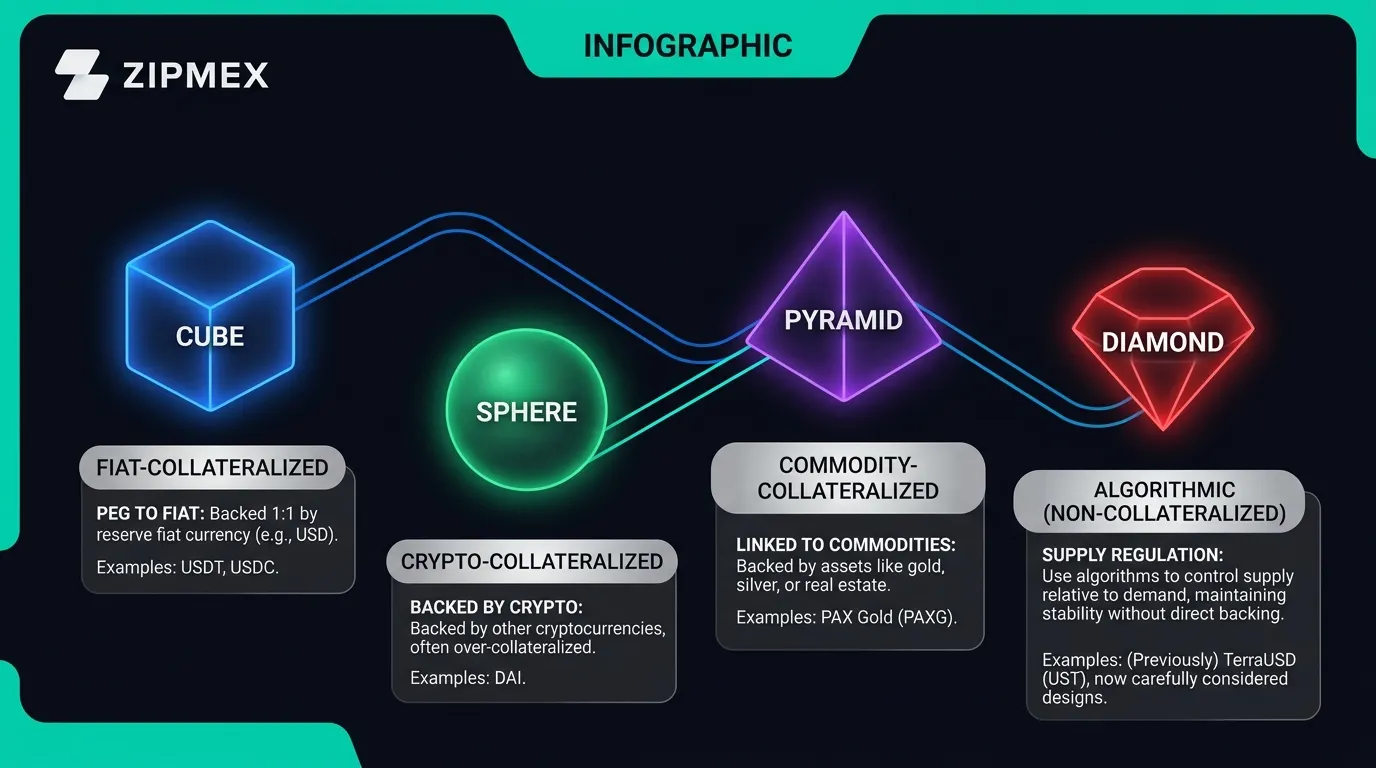
Not all stablecoins work the same way. There are four main types, each using a different method to hold its peg.
Fiat-Collateralized Stablecoins (USDT, USDC)
This is the most common type. A company holds real dollars (or US Treasuries) in a bank account, and issues one token for every dollar in reserve. When you redeem your token, you get a real dollar back.
Examples: Tether (USDT) - the market leader at $187 billion - and USDC by Circle at $75.7 billion. Together they control over 80% of the stablecoin market.
✅ Bullish Case
Fiat-backed stablecoins are the simplest to understand and most liquid. USDC meets GENIUS Act reserve requirements by design, making it the institutional favorite in 2026.
Crypto-Collateralized Stablecoins (DAI / USDS)
These are backed by other cryptocurrencies - but because crypto is volatile, they're over-collateralized. For example, you might lock $150 worth of ETH to mint $100 worth of DAI. The extra collateral acts as a buffer.
Sky Protocol's USDS (formerly MakerDAO's DAI) uses smart contracts and on-chain governance to maintain its $1 peg. If collateral drops below a threshold, smart contracts automatically liquidate to protect the peg. Learn how smart contracts power this system.
Commodity-Backed Stablecoins (PAX Gold, Tether Gold)
Instead of dollars, these are backed by physical commodities - typically gold. PAX Gold (PAXG), for example, represents one troy ounce of gold held in a regulated vault. They trade like crypto but track commodity prices, making them useful as inflation hedges.
Algorithmic Stablecoins
The most ambitious - and riskiest - type. These use smart contract algorithms to expand or contract the token supply and maintain the peg, without (or with minimal) collateral. The 2022 collapse of TerraUSD (UST), which wiped out over $40 billion in value, permanently damaged trust in purely algorithmic designs. Hybrid models (partial collateral + algorithms) like Ethena's USDe have since emerged as a more viable middle ground. Dive deeper in our guide to algorithmic stablecoins.
📊 Stablecoin Types at a Glance
| Type | Backed By | Example | Risk Level |
|---|---|---|---|
| Fiat-backed | USD reserves | USDT, USDC | Low |
| Crypto-backed | Over-collateralized crypto | DAI, USDS | Medium |
| Commodity-backed | Gold / commodities | PAXG, XAUt | Medium |
| Algorithmic | Algorithm / partial collateral | USDe, UST (failed) | High |
How Does a Stablecoin Work?
The mechanics behind stablecoins are simpler than they look. Let's take fiat-backed USDC as the clearest example:
- You deposit $100 USD with Circle (the USDC issuer).
- Circle mints 100 USDC and sends them to your wallet.
- You use USDC for trading, DeFi, or payments - it behaves like $100 on any blockchain.
- You want dollars back: redeem 100 USDC, Circle sends you $100 from reserves.
The peg holds because every USDC in existence is backed by an actual dollar in Circle's accounts. Monthly reserve attestations make this verifiable.
For crypto-collateralized stablecoins like USDS, the mechanism is different: users lock up ETH or other crypto in a smart contract, and the protocol mints stablecoins as overcollateralized debt. If the collateral value falls too far, liquidation kicks in automatically.
💡 Pro Tip
Not all stablecoin pegs are equally safe. Before using a stablecoin, check: (1) Is it regularly audited? (2) What are the reserves? (3) Is the issuer regulated? USDC and USDT both publish regular reserve attestations - always verify before trusting large sums.
Algorithmic stablecoins work differently still: smart contracts automatically mint new tokens when the price rises above $1 (to increase supply and push the price down) and burn tokens when it falls below $1. The problem is that during a market panic, this mechanism can fail catastrophically - as UST demonstrated in May 2022.
Stablecoin Examples and the 2026 Market
The stablecoin market has never been bigger. As of January 2026, total market capitalization reached $317.94 billion, up from roughly $205 billion at the start of 2025. Transaction volume surpassed $1 trillion in a single month for the first time in September 2025.
The major players:
- USDT (Tether): Market cap ~$187 billion, controlling ~60.68% of the market. The dominant liquidity instrument on both centralized and decentralized markets. Average daily trading volume: $100.8 billion.
- USDC (Circle): Market cap ~$75.7 billion, growing 73% in 2025. The institutional favorite thanks to transparent reserves and GENIUS Act alignment.
- USDe (Ethena): A synthetic dollar that grew from under $6B to over $14B in 2025, using a delta-hedging strategy rather than direct fiat reserves.
- DAI / USDS (Sky Protocol): The largest decentralized stablecoin, governed by token holders through a DAO.
J.P. Morgan projects the stablecoin market could reach $500-750 billion in the coming years, driven by cross-border payments, DeFi growth, and institutional adoption.
Stablecoin Use Cases
Why does the world need $317 billion in stablecoins? Here are the practical answers:
1. Crypto Trading: Stablecoins act as the "cash" of crypto exchanges. Instead of converting back to dollars between trades, traders hold USDT or USDC to stay in the market without exposure to volatility.
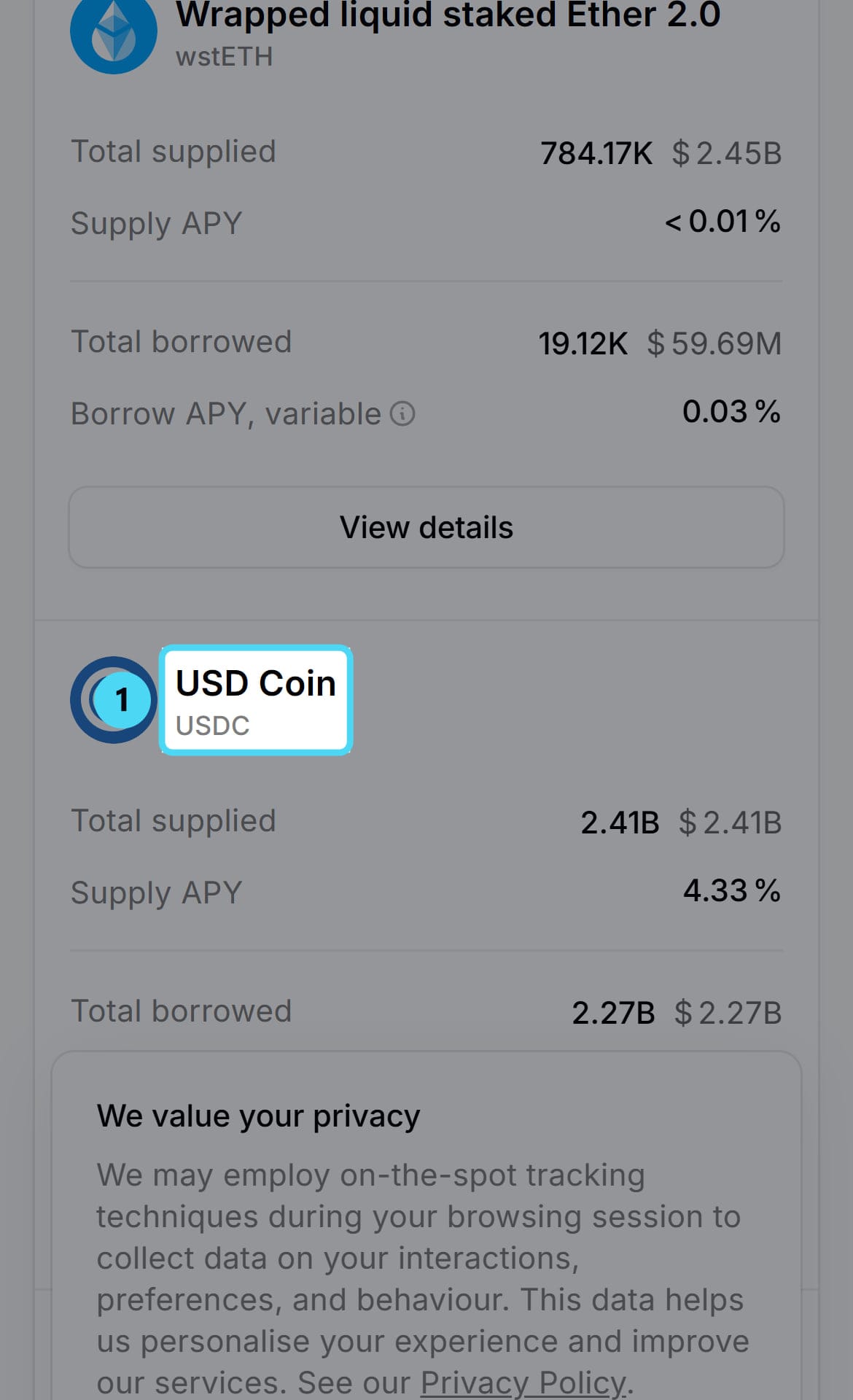
2. DeFi (Decentralized Finance): Stablecoins are the backbone of DeFi lending, borrowing, and yield farming. Deposit USDC on Aave or Compound to earn interest - or borrow against your crypto without selling it.
3. Cross-Border Payments: Send $10,000 USDC to anyone in the world in seconds for cents in fees. No bank accounts, no SWIFT delays, no 3-5 business days. A 2024 Visa survey found that 47% of stablecoin users in Brazil, Turkey, Nigeria, India, and Indonesia cited "saving in US dollars" as a primary reason for use.
4. Emerging Market Savings: In countries with hyperinflation or weak currencies - Argentina, Nigeria, Turkey - stablecoins provide access to the dollar's stability without a foreign bank account.
5. Institutional Settlement: Visa, Mastercard, and BlackRock now use USDC for settlement and treasury operations. Stablecoin issuers are the 7th largest purchasers of US government debt.
🔑 Key Takeaways
- Stablecoins combine crypto speed with dollar stability
- There are 4 types: fiat-backed, crypto-backed, commodity-backed, algorithmic
- USDT and USDC together control 80%+ of the $317B market
- Use cases span trading, DeFi, payments, savings, and institutional finance
- The GENIUS Act (July 2025) created the first US federal framework for stablecoins
Stablecoin Risks and Regulation in 2026
Stablecoins are not risk-free. Here's what every holder should understand:
Key Risks
⚠ Risk Warning
- De-pegging risk: Any stablecoin can lose its peg. USDC briefly de-pegged in March 2023 when Silicon Valley Bank (which held part of Circle's reserves) failed.
- Counterparty risk: Fiat-backed stablecoins depend on the issuer's honesty. If reserves don't actually exist, the peg collapses.
- Algorithmic failure: TerraUSD (UST) lost its peg in May 2022 and never recovered, wiping out over $40 billion.
- Regulatory risk: New laws like the GENIUS Act may restrict access to certain stablecoins in specific jurisdictions.
- Smart contract risk: Decentralized stablecoins depend on audited code. Bugs can be catastrophic.
Stablecoin Regulation in 2026: The GENIUS Act
The regulatory landscape changed permanently in July 2025. The GENIUS Act - Guiding and Establishing National Innovation for U.S. Stablecoins - became the first comprehensive US federal stablecoin law, signed on July 18, 2025 with bipartisan support (68-30 in the Senate, 308-122 in the House).
What the GENIUS Act requires:
- Stablecoins must be backed 1:1 with US dollars or equivalent high-quality assets
- Only licensed issuers (banks, regulated nonbanks) can issue stablecoins for US users
- Monthly reserve attestations and regular independent audits are mandatory
- The Act explicitly states that compliant stablecoins are neither securities nor commodities
Circle's USDC was already positioned for compliance; Tether faces more uncertainty as it currently lacks a US banking license or partnership. The OCC issued implementation guidance in February 2026, with Treasury's FinCEN and OFAC publishing AML/sanctions rules in April 2026.
In Europe, MiCA regulation already applies. The regulatory picture in 2026 is: stablecoins are here to stay, but only compliant issuers will thrive.
Frequently Asked Questions About Stablecoins
What is the most popular stablecoin in 2026?
Tether (USDT) remains the most widely used stablecoin by volume, with a market cap of approximately $187 billion and a 60.68% market share as of early 2026. USDC by Circle is the second largest at $75.7 billion and is growing faster, driven by institutional demand for regulated, transparent stablecoins.
Is a stablecoin the same as a CBDC?
No. A stablecoin is issued by a private company (like Tether or Circle), while a Central Bank Digital Currency (CBDC) is issued directly by a government or central bank. CBDCs are legal tender; stablecoins are not, though they are designed to track the value of legal tender.
Can I earn interest on stablecoins?
Yes. Platforms like Aave, Compound, and centralized exchanges offer yield on stablecoin deposits. Rates vary - typically 2-8% APY on major stablecoins as of 2026, depending on the platform and market conditions. Always research platform risks before depositing.
What happens if a stablecoin loses its peg?
If a stablecoin de-pegs - meaning it trades below or above $1 - holders may lose value if they sell during the instability. Fiat-backed stablecoins (USDT, USDC) typically recover their peg quickly if the issue is resolved. Algorithmic stablecoins have historically been more likely to fail permanently, as TerraUSD demonstrated.
Are stablecoins safe to use in 2026?
Major fiat-backed stablecoins like USDC and USDT are relatively safe for short-term use and trading, especially following GENIUS Act reserve requirements. However, no stablecoin is completely risk-free. Diversifying across multiple stablecoins and platforms, and avoiding purely algorithmic designs, reduces risk significantly.
How are stablecoins taxed?
Tax treatment varies by jurisdiction. In most countries, simply holding a stablecoin is not a taxable event. However, converting stablecoins to fiat, using them for purchases, or earning yield on them may trigger tax obligations. Consult a local tax professional for your specific situation.
What is the GENIUS Act and how does it affect stablecoins?
The GENIUS Act, signed into law on July 18, 2025, is the first US federal law creating a regulatory framework for stablecoins. It requires issuers to hold 1:1 reserves, obtain proper licenses, and publish regular audits. It's designed to protect consumers and strengthen trust in the stablecoin ecosystem.
Conclusion: What Is a Stablecoin and Why Does It Matter?
Stablecoins are one of crypto's most practical inventions. They take the best of blockchain technology - speed, programmability, global access - and strip out the volatility that makes regular cryptocurrencies difficult to use as money.
In 2026, they've become critical infrastructure. A $317 billion market, $1 trillion+ monthly transaction volumes, GENIUS Act regulation in the US, MiCA in Europe, and institutional players like Visa and BlackRock building on top of them. This is no longer a niche experiment - it's a new financial layer.
Whether you want to trade, earn yield in DeFi, send money internationally, or simply park your crypto gains safely during volatile markets, understanding what stablecoins are and how they work is essential.
Ready to use stablecoins?
Trade USDT, USDC, and more on Zipmex - with low fees, deep liquidity, and a platform trusted by over 1 million users.
Get Started on Zipmex →⚠ Investment Disclaimer: This article is for educational purposes only and does not constitute financial or investment advice. Cryptocurrency and stablecoin markets involve substantial risk. The value of digital assets can fall as well as rise. Always conduct your own research and consult a qualified financial advisor before making investment decisions. Past performance is not indicative of future results.
ZIPMEX promotes trading on trade.zipmex.com. Promotions are labelled and kept separate from news coverage, which is selected and checked without regard to them. Perpetual futures are leveraged derivatives. Prices can move fast and you can lose all of your margin. Not available in every jurisdiction. Not investment advice.