Everyone in crypto eventually faces the same question: Bitcoin or Ethereum? In April 2026, with BTC sitting around $78,000 and ETH around $2,330, the stakes behind that choice are very real.
⚡ Quick Answer
Bitcoin is digital gold - a scarce, store-of-value asset with a hard 21M cap, backed by $128B in institutional ETF flows. Ethereum is a programmable platform powering DeFi, NFTs, and smart contracts, currently undergoing its biggest technical upgrade since The Merge. They solve different problems - and the right choice depends on your goals.
This guide cuts through the noise and compares bitcoin vs ethereum across every dimension that matters in 2026: technology, market performance, use cases, risk profiles, and where each fits in a portfolio.

What Is Bitcoin vs Ethereum? The Basics
Before comparing them, you need to understand what each one is actually trying to do - because they were built for completely different purposes.
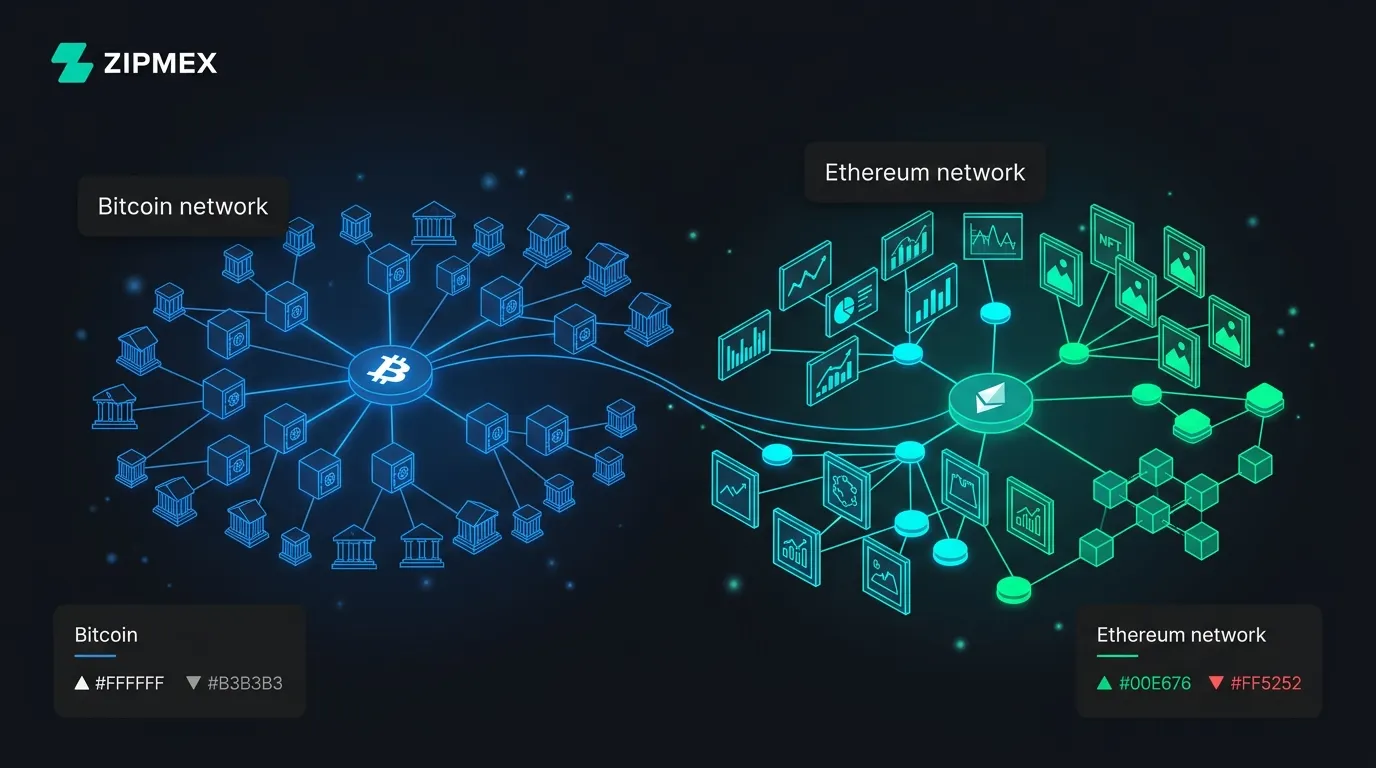
Bitcoin launched in January 2009, created by the pseudonymous Satoshi Nakamoto. Its goal was simple: create a peer-to-peer digital currency that works without banks or governments. No central authority. Fixed supply. Censorship-resistant transactions. Bitcoin's design has barely changed since - that stability is a feature, not a bug.
Ethereum launched in 2015, created by Vitalik Buterin. The vision was bigger: a programmable blockchain where developers could build anything using smart contracts - self-executing code that runs exactly as written with no middlemen. Every DeFi protocol, NFT marketplace, and decentralised app you've heard of runs, directly or indirectly, on Ethereum.
🎯 Key Takeaways
- Bitcoin = digital money / store of value. Ethereum = programmable platform for decentralised applications.
- Bitcoin has a fixed supply of 21 million BTC. Ethereum has no hard cap but burns tokens to manage supply.
- Bitcoin uses energy-intensive Proof-of-Work. Ethereum switched to Proof-of-Stake in September 2022.
- In April 2026, BTC commands 58.2% of total crypto market cap vs. ETH's ~10.5%.
Bitcoin vs Ethereum: Technology Differences
The technology gap between BTC and ETH explains almost everything else about how they behave.
Consensus Mechanism: PoW vs PoS
Bitcoin uses Proof-of-Work, where miners compete to solve complex mathematical puzzles to validate transactions and earn newly minted BTC. This process is energy-intensive by design - the energy expenditure is what makes Bitcoin's history nearly impossible to rewrite. The tradeoff is speed and cost: Bitcoin processes roughly 7 transactions per second with an average fee of $1-5 per transaction in normal conditions.
Ethereum switched to Proof-of-Stake during "The Merge" in September 2022, reducing its energy consumption by over 99%. Instead of miners, the network is secured by validators who lock up (stake) ETH as collateral. If a validator acts dishonestly, their staked ETH can be "slashed" - destroyed as a penalty. Ethereum currently processes 15-30 transactions per second on its base layer, with Layer 2 networks pushing that into the thousands.
Supply Economics: Scarcity vs Burn Mechanics
Bitcoin's supply cap of 21 million BTC is written into its code. It cannot be changed without majority consensus from the entire network - something that has never happened and is effectively impossible to coordinate. As of April 2026, approximately 19.85 million BTC have been mined. The April 2024 halving reduced new BTC issuance to 3.125 BTC per block, cutting the annual inflation rate to roughly 0.83%.
Ethereum has no hard supply cap. Instead, it relies on a deflationary burn mechanism introduced in EIP-1559 (August 2021): a portion of every transaction fee is permanently destroyed. During periods of high network activity, Ethereum becomes deflationary - more ETH is burned than created. Since The Merge, approximately 1.2 million ETH has been burned, partially offsetting new staking issuance of roughly 0.4% annually.
Smart Contracts and Programmability
This is where Ethereum's advantage is clearest. Bitcoin's scripting language is deliberately limited - it can handle time-locked transactions and multi-signature wallets, but it cannot run complex applications natively. Ethereum's Solidity language is Turing-complete, meaning it can execute virtually any program a developer can write. Every interaction on DeFi protocols like Uniswap or Aave, every NFT mint on OpenSea, every token launch - they all rely on Ethereum smart contracts.
Bitcoin developers are working on expanding functionality (Ordinals, Runes, the Lightning Network), but these are layered solutions, not native capability.

Bitcoin vs Ethereum Comparison: Side-by-Side
Bitcoin vs Ethereum Use Cases: What Are They Actually For?
Understanding what each asset is genuinely used for helps cut through the "which is better" debate.
Bitcoin Use Cases in 2026
Bitcoin's dominant role in 2026 is as a macro asset - institutional-grade digital gold. Its finite supply of 21 million and proof-of-work security make it attractive to investors seeking an inflation hedge outside the traditional financial system. The approval of US spot Bitcoin ETFs in January 2024 accelerated this dramatically: by Q1 2026, BlackRock, Fidelity, and other major asset managers collectively hold ~$128 billion in BTC ETF assets, making Bitcoin a standard portfolio allocation tool for institutional investors.
Beyond investment, Bitcoin continues to grow as a payment layer via the Lightning Network, enabling fast and cheap micro-transactions globally. In economies with unstable currencies, BTC serves as a genuine alternative monetary system. The Ordinals and Runes protocols have also brought NFT-like functionality to Bitcoin, though adoption remains limited compared to Ethereum.
Ethereum Use Cases in 2026
Ethereum is the operational backbone of crypto's real economy. Every major DeFi protocol - Uniswap, Aave, Curve, Compound - runs on Ethereum or its Layer 2 networks. Total value locked across Ethereum and its L2s represents hundreds of billions of dollars in on-chain economic activity. Staking yields of 3-5% APY make it attractive as a productive asset, not just a speculative one.
Ethereum is also the home of stablecoins (USDT, USDC on ERC-20), tokenised real-world assets, NFTs, and blockchain gaming. When developers want to build something on-chain, Ethereum remains the first choice by developer count and deployed capital. The upcoming Glamsterdam upgrade, expected in June 2026, targets 10,000 TPS on Layer 1 and a 78% reduction in gas fees - which could significantly expand Ethereum's addressable market.
Bitcoin vs Ethereum Price Performance and Market Data
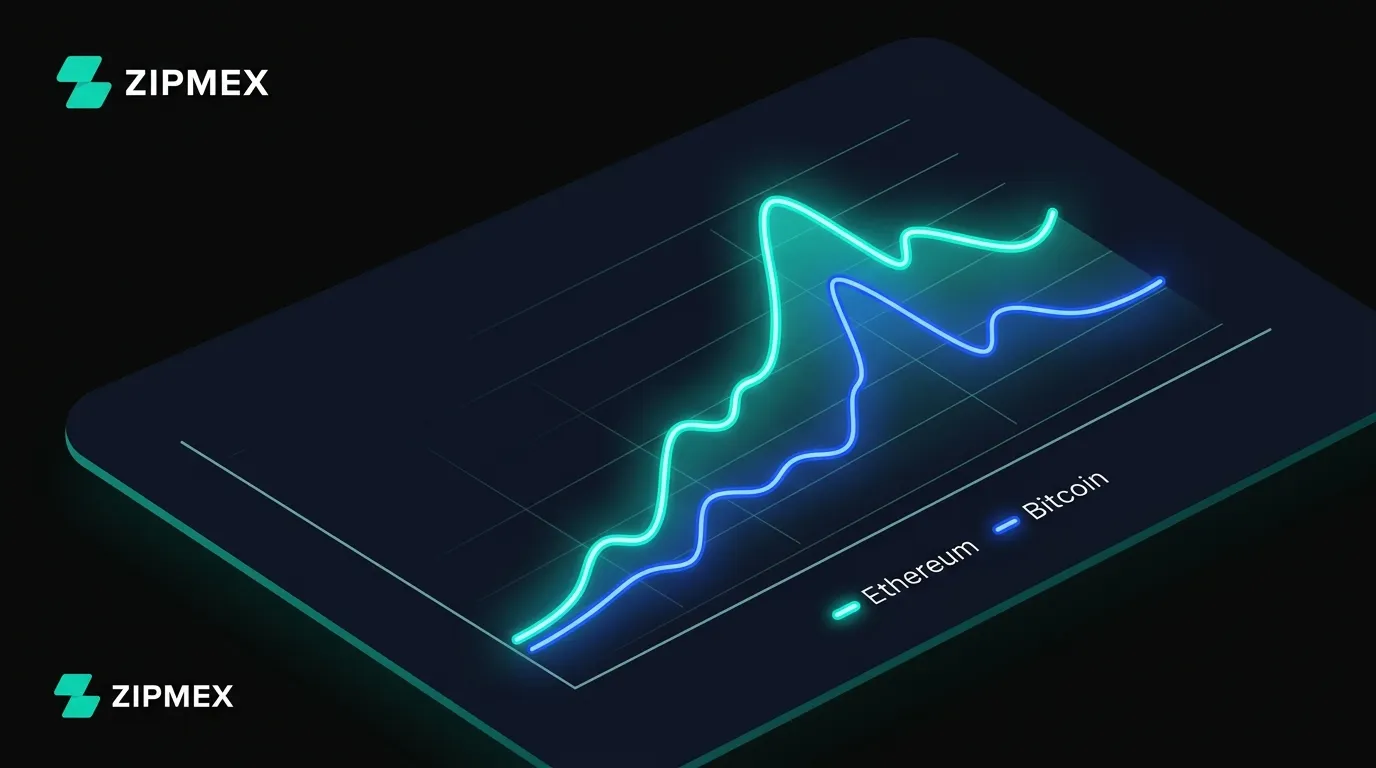
In the bull market of 2024-2025, both assets reached record highs - Bitcoin hit an all-time high of approximately $109,000 in January 2025, driven by spot ETF inflows and post-halving supply dynamics. Ethereum peaked near $4,100 in the same cycle.
By April 2026, both assets have pulled back sharply. Bitcoin sits around $78,000 - roughly a 28% drawdown from its all-time high. Ethereum is around $2,330 - approximately 43% below its peak. That divergence tells an important story.
📈 Bullish Factors - Bitcoin
- ETF institutional flows: ~$128B in US BTC ETF AUM as of Q1 2026, with BlackRock and Fidelity seeing consistent weekly inflows.
- Supply scarcity: The April 2024 halving reduced daily BTC issuance from 900 to 450 BTC. Annual inflation rate now ~0.83%.
- Dominance at multi-year high: BTC market dominance at 58.2% - highest level since 2021.
- Institutional reserve asset: Nation-state and corporate BTC treasuries adding structural long-term demand.
📉 Bearish Factors - Bitcoin
- Macro environment: High Treasury yields and elevated interest rates have dampened risk-asset appetite in 2026.
- No yield: Bitcoin holders earn no native income; all return comes from price appreciation.
- Stablecoin competition: Growing stablecoin adoption reduces Bitcoin's utility as a transaction medium.
📈 Bullish Factors - Ethereum
- Glamsterdam upgrade (June 2026): EIP-7732 and EIP-7928 target 10,000 TPS and 78% gas fee reduction - Ethereum's most significant update since The Merge.
- Staking yield: ~3-5% APY makes ETH a productive asset. Over 34 million ETH (~28% of supply) is currently staked.
- DeFi dominance: Ethereum + L2s remain home to the majority of on-chain DeFi TVL globally.
- Ethereum Foundation staking: EF staked 70,000 ETH (~$163M) in early 2026, reducing sell-side pressure.
📉 Bearish Factors - Ethereum
- Dominance decline: ETH market dominance slipped to ~10.5% from a historical average near 18%.
- Execution risk: Glamsterdam and other upgrades must ship on schedule; delays historically hit ETH price.
- L2 fee cannibalisation: Layer 2s reduce mainnet gas fees and burn rate, compressing ETH's deflationary pressure.
- Institutional lag: ETH ETF AUM (~$13B) is less than 1/10th of BTC ETF AUM (~$128B), reflecting weaker institutional flows.
Is Bitcoin or Ethereum Better for Investment in 2026?
This is the question most readers actually came here to answer. The honest answer: it depends on what you want from your investment.
Risk Profile Comparison
Bitcoin carries lower execution risk. Its investment thesis - digital scarcity, institutional reserve asset, inflation hedge - doesn't require any new software to ship on time. The main risks are macro (interest rates, liquidity cycles) and regulatory. Bitcoin's thesis either works or it doesn't based on adoption.
Ethereum carries higher potential reward alongside higher execution risk. For Ethereum's valuation thesis to play out, the Glamsterdam upgrade must ship on time, ETH ETF inflows must grow, and DeFi activity must continue expanding. More things need to go right. Each item represents genuine upside - and genuine risk.
Which Should You Choose?
Choose Bitcoin if: You want the lowest-risk crypto exposure, you're focused on long-term value preservation, or you're new to the space and want the most widely understood and institutionally supported digital asset.
Choose Ethereum if: You believe in the long-term growth of DeFi and Web3, you want to earn staking yield (3-5% APY) on your holdings, or you're comfortable with higher volatility in exchange for higher potential upside tied to a specific technical roadmap.
Choose both if: You're building a balanced crypto portfolio and want exposure to the two distinct risk/reward profiles that BTC and ETH represent.
How Are Bitcoin and Ethereum Similar?
Despite their differences, the ethereum vs bitcoin debate shouldn't obscure what they share. Both are decentralised - no single company, government, or individual controls them. Both are traded globally on every major exchange and are available via regulated spot ETFs in the United States. Both have multi-year track records of surviving market crashes, regulatory attacks, and exchange collapses.
Both assets are considered "blue chip" crypto - the closest thing the space has to large-cap, relatively established investments. They move with the broader crypto market during risk-on and risk-off cycles, often falling together in bear markets and rising together in bull markets. Their correlation to each other remains high despite their different fundamentals.
Frequently Asked Questions
Is Bitcoin better than Ethereum?
Neither is objectively "better" - they serve different purposes. Bitcoin is the leading store-of-value cryptocurrency with stronger institutional adoption in 2026. Ethereum is the dominant programmable blockchain with a wider range of use cases. Your choice depends on your investment goals, risk tolerance, and belief in each asset's roadmap.
Can Ethereum ever overtake Bitcoin in market cap?
The so-called "Flippening" - Ethereum's market cap surpassing Bitcoin's - has been discussed for years and has not happened as of April 2026. ETH market cap is roughly $280 billion vs BTC's ~$1.54 trillion. It would require either exceptional ETH growth or significant BTC underperformance. Some analysts see it as possible long-term; it is not a near-term base case.
What is the difference between bitcoin and ether?
Bitcoin (BTC) is the native currency of the Bitcoin blockchain. Ether (ETH) is the native currency of the Ethereum blockchain. Beyond that, they are fundamentally different: BTC is primarily held as a store of value, while ETH is used to pay for computation (gas fees) on Ethereum and can be staked to earn yield.
Is Ethereum safer than Bitcoin?
"Safety" in crypto is multi-dimensional. Bitcoin's protocol has operated for 16+ years without a successful attack on its core code - the longest track record in crypto. Ethereum's PoS transition in 2022 is newer but has operated without major issues. Both face smart contract risks at the application layer; Bitcoin has fewer applications and therefore fewer attack surfaces. Neither is "safe" in the traditional financial sense.
Can I buy both Bitcoin and Ethereum?
Yes. Most crypto exchanges offer both BTC and ETH. Regulated spot ETFs for both assets are available through traditional brokerage accounts in the United States. Holding both is a common strategy for investors who want diversified crypto exposure.
What is bitcoin vs ethereum gas fees?
Bitcoin charges transaction fees typically ranging from $1 to $10 depending on network congestion. Ethereum charges "gas fees" that have historically been more variable - ranging from under $1 on Layer 2 networks to $50+ during peak mainnet demand. Post-Dencun upgrade (March 2024) and upcoming Glamsterdam (June 2026), Ethereum fees are expected to decrease significantly.
Which has more upside: Bitcoin or Ethereum in 2026?
According to ARK Invest's Big Ideas 2026 report, Ethereum's market cap could grow at a compound annual rate of 54% through the rest of the decade if its technical roadmap executes successfully. Bitcoin's upside is tied more directly to macro adoption curves and institutional demand. Ethereum is generally considered the higher-risk, higher-reward option in the near term.
Conclusion
The bitcoin vs ethereum comparison is not a competition - it's a choice between two fundamentally different bets on the future of finance. Bitcoin is a bet on digital scarcity becoming a global reserve asset. Ethereum is a bet on programmable blockchains becoming the infrastructure of the decentralised internet.
In April 2026, Bitcoin has the stronger institutional momentum: 58.2% market dominance, $128 billion in ETF AUM, and a simpler thesis that doesn't depend on software delivery. Ethereum has the more complex value proposition - staking yield, DeFi TVL, and an upcoming upgrade cycle that could be transformative. Both have pulled back from 2025 highs, offering more attractive entry points than six months ago.
The most defensible position is a thoughtful allocation to both, sized according to your risk appetite.
⚠ Disclaimer: The information provided in this article is not intended to provide investment or financial advice. Investment decisions should be based on the individual's financial needs, objectives, and risk profile. We encourage readers to understand the assets and risks before making any investment entirely. Cryptocurrency investments are subject to high market risk. Past performance does not guarantee future results.
ZIPMEX promotes trading on trade.zipmex.com. Promotions are labelled and kept separate from news coverage, which is selected and checked without regard to them. Perpetual futures are leveraged derivatives. Prices can move fast and you can lose all of your margin. Not available in every jurisdiction. Not investment advice.