Timing the crypto market consistently is one of the few genuinely impossible tasks in finance. Bitcoin can surge 20% in 48 hours on an ETF announcement, then bleed 30% over three weeks because a whale decided to rebalance. Most traders — including experienced ones — get burned trying to predict these moves.
Dollar-cost averaging is the answer most long-term holders quietly rely on. So what is DCA in crypto, exactly? It's a strategy where you invest a fixed amount at regular intervals, regardless of price — and it removes the single most dangerous variable from crypto investing: your own emotional reactions.
⚡ Key Takeaways
- DCA (Dollar-Cost Averaging) means investing a fixed amount of money into crypto on a regular schedule, whether prices are high, low, or sideways.
- It eliminates timing risk by spreading your entry points across multiple market conditions automatically.
- Best suited for long-term investors, beginners building their first position, and anyone who doesn't want to monitor charts daily.
- This guide covers the full DCA mechanics, types, pros, cons, setup process, platform comparison, advanced strategies, and 30 FAQ answers.
What Is Dollar-Cost Averaging (DCA) in Crypto?
Dollar-cost averaging in crypto means committing a fixed dollar amount — say, $100 — to a specific cryptocurrency on a defined schedule, such as every Monday, regardless of what the price is doing. The amount stays constant. The price moves. That combination means you automatically buy more units when prices are cheaper and fewer units when prices are expensive, producing a lower average cost per coin over time.
Contrast that with lump-sum investing, where you put a large amount in at one moment and your entire position is anchored to whatever price you happened to catch that day. If you bought Bitcoin at $69,000 in November 2021, it took nearly two years to break even. A DCA investor who kept buying through that period averaged their cost down across the entire decline — and was sitting on significant gains by late 2023.
The core principle is simple: instead of trying to find the perfect moment, you replace timing judgment with time itself. For a deeper look at how DCA fits into a broader investment approach, our guide on how to diversify your crypto portfolio covers the full picture.
How DCA Works — Step-by-Step Example
Here's how the math actually plays out. Suppose you invest $200 every Monday into Bitcoin for four weeks at varying prices:
Notice that in weeks when Bitcoin was cheaper, your $200 bought more coins automatically. By week four, your average cost ($84,033) is well below the week-one price of $95,000 — without ever needing to predict when to buy. The same logic applies to Ethereum, Solana, or any other asset you're accumulating long-term.
Types of DCA Strategies
DCA isn't just one approach — there are three main variants depending on how much control you want over the process:
- Standard Fixed DCA — Same amount, same schedule, every time. You invest $100 every Monday and never adjust. This is the purest version: fully automated, zero decisions, maximum discipline. Best for beginners and anyone who wants a truly hands-off system. Complexity: Beginner.
- Value Averaging — Instead of always investing the same amount, you adjust contributions to hit a target portfolio growth rate. If your portfolio grew more than expected this week, you invest less. If it grew less, you invest more. Theoretically optimal but requires active calculation and more attention. Complexity: Intermediate.
- Indicator-Based DCA — You run a base schedule but increase your contribution by 50-100% when specific technical signals fire: RSI(14) dropping below 30 (oversold territory) or the Fear & Greed Index falling below 25 (Extreme Fear). Complexity: Advanced.
Most investors starting with DCA should begin with Standard Fixed DCA and consider the other variants only after running a base strategy successfully for six months or more.
Benefits of DCA in Crypto
The strongest case for DCA isn't mathematical — it's psychological. Most retail investors don't lose money because they chose the wrong strategy. They lose because they panic-sell during crashes and FOMO-buy at peaks. DCA short-circuits that cycle by removing the decision entirely.
Beyond psychology, here's what makes DCA practically useful:
- Reduces timing risk automatically. By spreading purchases across market cycles, you're never fully exposed to buying at a single peak. Your entry price reflects an average across highs and lows — which in a volatile market like crypto, is almost always lower than what a discretionary buyer achieves.
- Eliminates emotional decision-making. When Bitcoin drops 25% in a week, a DCA schedule keeps buying. No panic, no second-guessing, no waiting for "confirmation" that it won't drop further. The system runs regardless of headlines.
- Builds genuine investment discipline. Automating your contributions removes the willpower requirement. You don't need to remember, summon courage, or override fear — the recurring buy executes whether you're watching or not.
- Lowers average cost in volatile markets. Because crypto swings dramatically, fixed-dollar investing naturally accumulates more units during the inevitable corrections that characterize every market cycle.
- Accessible at any budget level. Most major exchanges allow recurring buys starting at $10–25 per purchase, making DCA viable for investors at any stage.
DCA vs. Lump-Sum: Which Performs Better?
The honest answer: it depends on which market you happen to be entering.
In consistently rising bull markets, lump-sum investing outperforms DCA because your capital is fully deployed and appreciating from day one. If you had invested $10,000 into Bitcoin in January 2023 as a lump sum, you'd have outperformed someone who spread that same $10,000 in monthly installments across the year — because the market trended upward nearly the entire time.
In flat, volatile, or declining markets — which describes crypto's baseline behavior — DCA wins. Because you're buying through the inevitable pullbacks, your average cost ends up below where the market eventually stabilizes. Historical data shows lump-sum investing outperforms DCA roughly 65% of the time in traditional markets, but crypto's extreme volatility shifts this balance meaningfully in DCA's favor.
The practical problem with lump-sum investing is that you need to know which regime you're entering — and consistently predicting that correctly is something even professional fund managers fail to do. DCA removes the need to know. That's its real value.
Drawbacks and Risks of DCA in Crypto
DCA is a powerful strategy, but it's not without trade-offs — and understanding them before you commit is part of executing it correctly.
Underperforms lump-sum in strong bull markets. If you start DCA-ing into Bitcoin the week before a 60% run-up, your later purchases buy progressively less coin for the same dollar. Your average cost climbs, and you'd have been better off deploying all your capital at the start. This isn't a flaw in DCA — it's the direct cost of the timing protection it provides.
Transaction fees accumulate with frequent purchases. This one catches a lot of investors off guard. A 1.5% transaction fee on a $100 weekly purchase is only $1.50 per trade — but that's $78 per year, every year. On a $500 weekly DCA schedule, those fees compound to $390 annually before your investments have generated a single dollar of return. Platform selection matters more than most beginners realize.
DCA into a failing asset accelerates losses. Averaging down only works if the underlying asset has long-term value. Buying more Bitcoin at lower prices during a correction makes sense if you believe in Bitcoin's future. Buying more of a low-cap speculative token that's down 80% because the project is failing is a different situation entirely — you're not catching a dip, you're compounding exposure to a bad thesis.
Requires long-term commitment to work. DCA's strongest returns come from years, not months. Investors who start a DCA plan and abandon it during the first bear market miss the period when DCA is most advantageous — the accumulation of cheap coins before the next cycle.
⚠️ Three DCA Mistakes to Avoid
- DCA-ing into speculative low-cap tokens → the averaging effect amplifies losses as readily as gains
- Ignoring cumulative fees → high-fee platforms can silently consume 5–10% of your annual investment before market gains factor in
- Stopping during a bear market → statistically the worst time to quit; bear markets are when DCA accumulates its most valuable units
Crypto trading involves substantial risk of loss. DCA reduces timing risk but does not protect against prolonged market downturns or fundamental declines in the assets you're buying.
How to Start DCA in Crypto — Step-by-Step Setup
Setting up a DCA plan takes less time than most people expect. The decisions involved are straightforward; the discipline to maintain it long-term is what separates successful DCA investors from those who quit when markets get uncomfortable.
Here are the five decisions you need to make before running a single scheduled purchase:
- Choose your asset. DCA works best for assets you have genuine long-term conviction about. Bitcoin and Ethereum are the most common choices — both have established track records, deep liquidity, and are available for automated purchase on virtually every major exchange.
- Decide your investment amount. The standard guidance is 5–20% of monthly disposable income — money you're genuinely comfortable not touching for 1–5 years. If the amount would stress you during a 50% drawdown, size it down. DCA only works if you can sustain it through downturns.
- Choose your interval. Weekly purchases provide more averaging points mathematically, resulting in a cost basis that reflects more price levels. Monthly purchases are psychologically easier to maintain and typically incur fewer fees. For most beginners, weekly or bi-weekly strikes the best balance.
- Select your platform. Your exchange needs to offer automated recurring buys, reasonable fees, and support for your chosen asset. More on this in the platform comparison section below.
- Automate and step back. Set the recurring buy, fund your account, and resist the urge to intervene every time prices move. The entire point of DCA is removing active management from the equation.
For a complete breakdown of how to protect your capital while investing systematically, our crypto risk management guide is required reading alongside this one.
How to Choose the Right Crypto for DCA
Not every cryptocurrency is appropriate for a long-term DCA strategy — and the distinction matters more than most guides admit.
📊 Is This Crypto DCA-Worthy? A Quick Checklist
- The asset has existed for at least 3–4 years with multiple market cycle data points
- Daily trading volume exceeds $500M (sufficient liquidity for recurring buys without slippage)
- Market capitalization is in the top 20 (signals sufficient network effect and institutional interest)
- You personally understand what the network does and why it has long-term utility
- The asset is available for automated recurring purchase on a regulated exchange
Bitcoin and Ethereum pass all five criteria unambiguously — which is why they dominate DCA portfolios. The calculus becomes far more complex outside the top 10. A lower-cap token might have upside potential, but applying DCA to it means systematically increasing your exposure to a project that could underperform or fail over a 3–5 year horizon. DCA magnifies the underlying thesis of your investment choice. Choose carefully.
Best Platforms for DCA in Crypto — Comparison
Not all exchanges make DCA equally easy — or cheap. The platform you choose determines your automation options, fee structure, minimum investment amounts, and the range of assets available for recurring purchase.
Fee structures vary by payment method, account tier, and market conditions. Verify current rates on each platform before committing.
The fee column deserves extra attention. The difference between a 1.49% fee (Coinbase simple mode) and 0.1% (Binance) on $200 weekly DCA is roughly $285 per year. Over five years of DCA, that gap represents meaningful drag on returns — capital that would otherwise be compounding.
Free vs. Paid vs. Automated DCA Tools — Which Model Fits You?
Beyond choosing a platform, you also need to decide how you'll execute your DCA. Three models exist, each suited to a different investor profile:
Exchange recurring buy features are the right starting point for most investors. They're free (beyond the underlying transaction fee), available on every major platform, and genuinely hands-off once configured. Third-party DCA bots add sophisticated functionality but also introduce counterparty risk to an additional service provider and require ongoing configuration. Worth exploring after six months of running a base strategy.
Red Flags and Common DCA Mistakes to Avoid
DCA is simple — but simple strategies can still be executed poorly. These are the five most common failure modes, including one that's actively predatory.
⚠️ Five DCA Red Flags — Know Before You Invest
🚩 RED FLAG #1: DCA-ING INTO SPECULATIVE TOKENS WITHOUT CONVICTION
Systematic accumulation of a failing project doesn't reduce your loss — it increases your total exposure to it. Before running DCA on any asset outside the top 20 by market cap, ask whether you'd be comfortable holding it through a multi-year bear market.
🚩 RED FLAG #2: IGNORING FEE DRAG
A 1.5% fee on small recurring purchases quietly destroys returns. A $200 weekly purchase at 1.5% costs $1,560/year in fees alone — before any market gain or loss is counted. Calculate your annual fee cost before committing to a platform.
🚩 RED FLAG #3: STOPPING DURING A BEAR MARKET
The bear phase is when DCA accumulates the most valuable units. Investors who paused DCA during the 2022 crypto winter and resumed in 2023 missed buying Bitcoin between $15,000 and $25,000 — the exact units that drove the biggest returns in 2024.
🚩 RED FLAG #4: "MANAGED DCA" SERVICES PROMISING ENHANCED RETURNS
DCA is a personal investing mechanism — not a service someone else runs for you with improved results. Any platform promising superior DCA returns through a managed fund is misrepresenting the strategy. Watch for: "managed DCA funds," platforms without regulatory registration.
🚩 RED FLAG #5: INVESTING MONEY YOU'LL NEED WITHIN 12 MONTHS
If the money is earmarked for rent, an emergency fund, or a planned purchase, it doesn't belong in a DCA schedule. DCA only works as a long-term strategy — short-term withdrawals during price dips lock in losses and undermine the entire averaging mechanic.
Advanced DCA Strategies — Maximizing Your Returns
Once your basic DCA plan is running smoothly, these techniques can extract additional value without requiring you to become an active trader.
Using RSI and Fear & Greed Index to Time DCA Entries
The standard DCA schedule runs regardless of market conditions — that's its strength. But some investors choose to increase their contribution temporarily when specific indicators signal extreme pessimism.
Two signals stand out for this purpose:
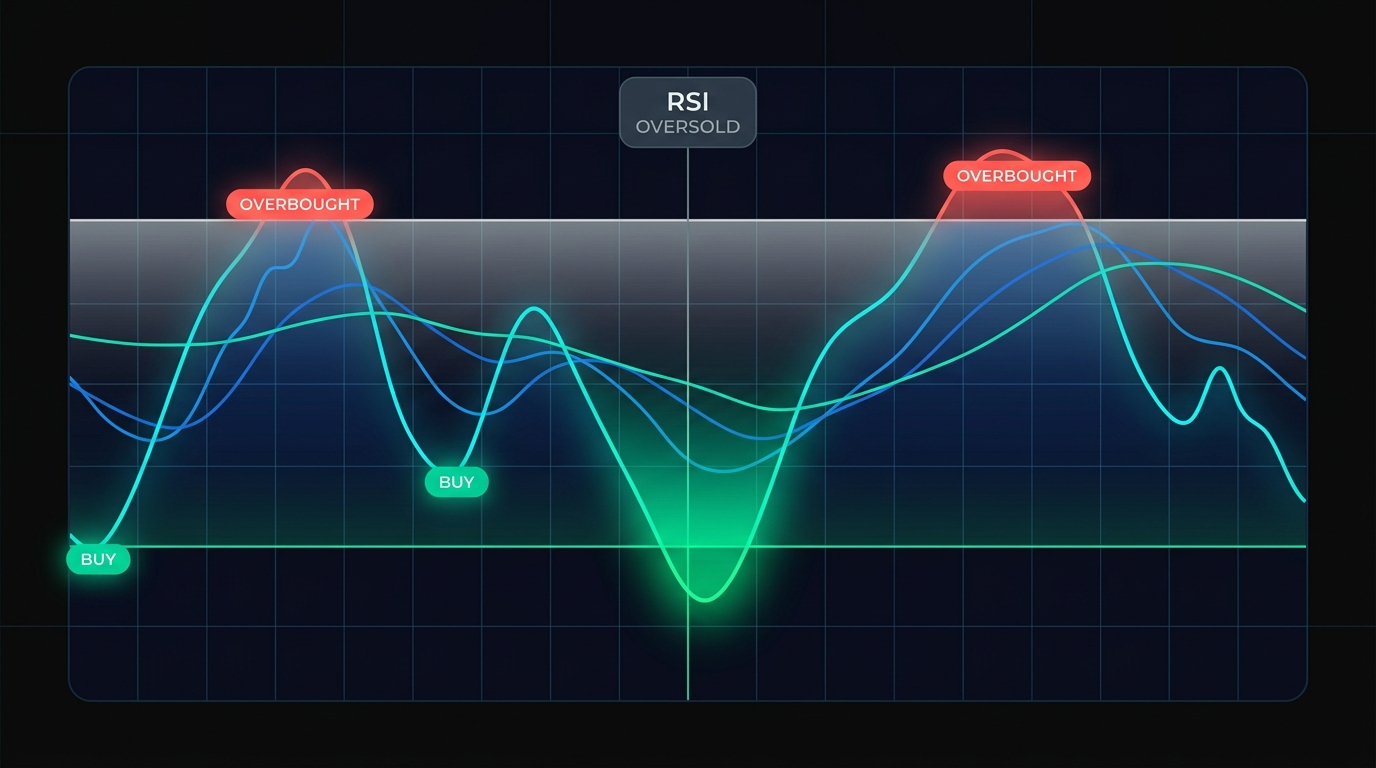
- RSI(14) below 30 — when Bitcoin's 14-day Relative Strength Index drops below 30, the asset is statistically oversold. Markets don't stay oversold indefinitely. Many DCA investors increase their weekly contribution by 50–100% when this condition appears.
- Fear & Greed Index below 25 — this composite sentiment indicator measures market panic. Readings below 25 ("Extreme Fear") have historically preceded significant recoveries.
These are enhancements, not replacements for the base schedule. The schedule runs regardless; these signals simply adjust the amount on specific weeks.
Popular Long-Term Strategies That Pair with DCA
HODL + DCA is the lowest-effort combination and appropriate for most investors reading this guide. Staking adds a yield layer but varies significantly by protocol — research specific staking mechanics before committing assets. The DCA + Swing Trading overlay is territory for experienced traders only.
DCA Risk Management — Protecting Your Capital
📊 DCA Risk Management Checklist
- Investment amount is 5–20% of monthly disposable income — money you can hold for 3–5 years
- Maximum 2–3 assets in your DCA rotation (BTC + ETH is the most common viable combination)
- Stablecoin reserve of 10–20% of your crypto portfolio maintained for opportunistic dip purchases
- Investment amount reviewed quarterly — adjust if your financial circumstances change materially
- Total crypto allocation does not exceed your defined risk tolerance percentage of overall net worth

DCA Alternatives — Other Strategies Worth Knowing
DCA isn't the only systematic approach to crypto investing. Understanding the alternatives helps you confirm whether DCA genuinely fits your goals.
- Lump-Sum Investing — Deploy all available capital at once. Highest potential return in a sustained bull market; highest potential short-term drawdown risk if timing is off. Best suited to experienced investors with genuine conviction about entry conditions. Complexity: High.
- Value Averaging — Adjust investment amounts to hit a predetermined portfolio growth target. If your portfolio grew 3% when you targeted 2%, invest less this period. More sophisticated than standard DCA — but requires ongoing calculation. Complexity: Intermediate.
- Technical Analysis-Based Entry — Time purchases using chart patterns and indicators: MACD crossovers for momentum confirmation, Bollinger Band squeezes for volatility setups, RSI for oversold/overbought conditions. Requires significant chart-reading expertise and active monitoring. Complexity: Advanced.
- Spot Grid Trading — Set up automated buy orders at defined price intervals below the current market price. Creates a natural averaging effect similar to DCA but responds to price levels rather than time intervals. Best suited to sideways or range-bound markets. Complexity: Intermediate.
Understanding these alternatives confirms rather than undermines the case for DCA for most long-term investors: the strategies above require more time, more skill, or more risk tolerance. DCA's power is precisely that it demands none of those things.
Conclusion — Is DCA the Right Strategy for You?
Dollar-cost averaging won't make you rich overnight — but it removes the single biggest obstacle most crypto investors face: themselves. Panic at the wrong moment, FOMO into the wrong peak, freeze up when the charts turn red — DCA eliminates each of those failure modes by replacing judgment with a schedule. As one of the most cited strategies for building long-term crypto exposure, what is DCA in crypto comes down to one thing: systematic discipline over emotional reaction.
Platforms built on self-custody and on-chain verifiability — where you control your own funds and all outcomes are transparently verifiable — represent the direction the industry is moving regardless of strategy. Zipmex's self-custodial model is one example of how DeFi infrastructure is making this kind of trustless, user-controlled approach the standard rather than the exception.
Crypto trading and investing involve substantial risk of loss. DCA reduces timing risk but does not eliminate market risk. Past performance of any strategy is not indicative of future results. This article is for informational purposes only and does not constitute financial advice.
Last updated: April 2026.
Frequently Asked Questions
What is DCA in crypto?
DCA — dollar-cost averaging — is an investment strategy where you invest a fixed amount of money into a cryptocurrency on a regular schedule, regardless of current price. Instead of trying to identify the perfect entry point, you buy consistently — weekly, bi-weekly, or monthly — and let your purchase price reflect an average across multiple market conditions. When prices fall, your fixed amount buys more coins. When prices rise, it buys fewer. Over time, this smooths out your cost basis and removes the pressure of market timing entirely.
Does DCA guarantee profits in crypto?
No investment strategy guarantees profits in crypto. DCA reduces timing risk and behavioral risk — it doesn't eliminate market risk. If the asset you're DCA-ing into declines permanently over your investment horizon, you'll still lose money, though potentially less than a single lump-sum purchase made at a peak. DCA's track record in Bitcoin specifically has been strong because Bitcoin has recovered from every major drawdown to date — but that historical pattern is not a guarantee of future performance. The strategy works when applied to assets with genuine long-term value.
How much money do I need to start DCA in crypto?
Most major exchanges support recurring buys starting at $10–25 per purchase. A more useful question is: what amount can you genuinely commit to without needing access to it for 1–5 years? Standard guidance is 5–20% of monthly disposable income — money that isn't earmarked for rent, emergency funds, or planned purchases within the next year. Starting smaller and staying consistent is far more valuable than starting large and quitting during the first significant correction.
How often should I DCA into crypto — daily, weekly, or monthly?
Weekly is the optimal balance for most investors. It provides enough price averaging points to meaningfully smooth volatility, while keeping transaction fees lower than daily purchases. Monthly DCA is psychologically easier and incurs the fewest fees — but provides only 12 averaging points per year, which limits the smoothing effect in a fast-moving market. Daily DCA maximizes averaging mathematically but compounds fees quickly. Unless you're on a zero-fee platform, weekly is the practical sweet spot.
What is the best crypto to DCA into?
Bitcoin (BTC) and Ethereum (ETH) are the most appropriate assets for long-term DCA for most investors. Both have multi-cycle track records, deep daily liquidity, and are available for automated recurring purchase on every major exchange. Outside the top 10 by market cap, DCA becomes significantly riskier — you're systematically increasing exposure to projects with less-established value propositions over multi-year timeframes. The core selection criteria: would you be comfortable holding this asset through a 70–80% drawdown over 18 months?
Can I combine DCA with staking?
Yes — and it's one of the more compelling compound growth setups for long-term DCA investors. Once your DCA schedule accumulates sufficient assets, you can deploy those accumulated assets into staking protocols to earn yield on top of price appreciation. This creates a two-layer return: price gains from your DCA'd position plus staking yield. The staking yield compounds automatically in most liquid staking implementations, reinvesting without manual intervention — similar in spirit to DCA itself. Research specific staking mechanics and protocol risks before committing assets, as yields and risk profiles vary significantly.
What are the biggest mistakes to avoid with DCA in crypto?
Five mistakes account for the majority of DCA failures: first, applying DCA to speculative tokens without fundamental conviction — the averaging mechanic amplifies losses as readily as it amplifies gains; second, ignoring cumulative fees, which silently erode returns on high-fee platforms; third, stopping during a bear market, which is precisely when DCA accumulates the most valuable units; fourth, investing money needed within 12 months, which forces selling at potentially disadvantageous prices; fifth, running DCA amounts that create psychological stress during drawdowns — if the amount causes you to panic during a correction, it's sized too large for your current risk tolerance. For a complete look at position sizing and risk controls, see our crypto risk management guide.