Fantom is a high-speed, low-fee blockchain platform built to solve the scalability problems that plagued earlier networks - using a Directed Acyclic Graph (DAG) architecture and a custom consensus mechanism called Lachesis to deliver near-instant transaction finality. Powered by its native FTM token, the network supports smart contracts, a growing decentralized finance (DeFi) ecosystem, and real-world enterprise applications. If you want to understand what Fantom actually is, how its technology works under the hood, and why it matters in a crowded Layer 1 market, this guide covers all of it.
⚡ Key Takeaways
- Fantom uses a DAG (Directed Acyclic Graph) structure - not a traditional linear blockchain
- The Lachesis consensus mechanism achieves transaction finality in 1-2 seconds
- Fully EVM-compatible via its Opera Chain, letting Ethereum developers deploy with minimal code changes
- Transaction fees typically run under $0.01 - a fraction of Ethereum's variable gas costs
- FTM is the native utility token used for transaction fees, staking, and on-chain governance
What Is Fantom? Origins, Vision, and the Team Behind FTM
Fantom is an open-source, permissionless blockchain platform founded in 2018 by Dr. Ahn Byung Ik, a South Korean computer scientist who earned his PhD from Yonsei University and previously built Siksin - a restaurant review platform that became widely used in South Korea. His goal with Fantom was direct: overcome the blockchain trilemma, the longstanding tension between security, decentralization, and scalability that forces most networks to compromise on at least one dimension.
Software developer Michael Kong stepped in as CEO after Ahn's departure in 2019, guiding the platform's technical roadmap through its critical growth phase. The team also brought in Andre Cronje - the DeFi builder behind yearn.finance - as an advisor, and his deep knowledge of decentralized finance protocols shaped how Fantom's ecosystem developed before his departure in March 2022.
The Fantom Opera mainnet launched in December 2019, marking the transition from an ERC-20 token to a fully independent, smart contract-capable blockchain. Fantom secured institutional backing from HyperChain Capital in 2021 alongside strategic integrations with Chainlink, The Graph, and Ren. By January 2022, Fantom reportedly surpassed Ethereum in daily transaction volume - a milestone driven by its growing DeFi ecosystem and the cost advantages of its network.
FANTOM KEY MILESTONES
2018
Founded by Dr. Ahn Byung Ik; initial venture capital raise to fund development
2019
Opera mainnet launch (December); Michael Kong becomes CEO; transition from ERC-20 to native chain
2021
HyperChain Capital institutional raise; integrations with Chainlink, The Graph, and Ren
2022 - Key Inflection Point
Reportedly surpasses Ethereum in daily transaction volume; DeFi TVL peaks; Andre Cronje departs
2023-2026
Sonic upgrade roadmap initiated; FTM-to-S token transition begins (1:1 swap ratio)
Fantom's reputation rests less on its backstory and more on the technology underneath it.

How Fantom Works: DAG Architecture and Lachesis Explained
Fantom's performance advantage comes from two architectural decisions that set it apart from conventional blockchains: replacing the traditional linear block structure with a Directed Acyclic Graph (DAG), and replacing standard Byzantine Fault Tolerance consensus with an asynchronous variant called Lachesis. Those two systems work in tandem - the DAG manages transaction flow, Lachesis ensures everything is confirmed quickly and securely. Understanding both is the key to understanding why Fantom can deliver the throughput numbers it claims, as confirmed by CoinMarketCap.
Directed Acyclic Graph (DAG): How Fantom Processes Transactions in Parallel
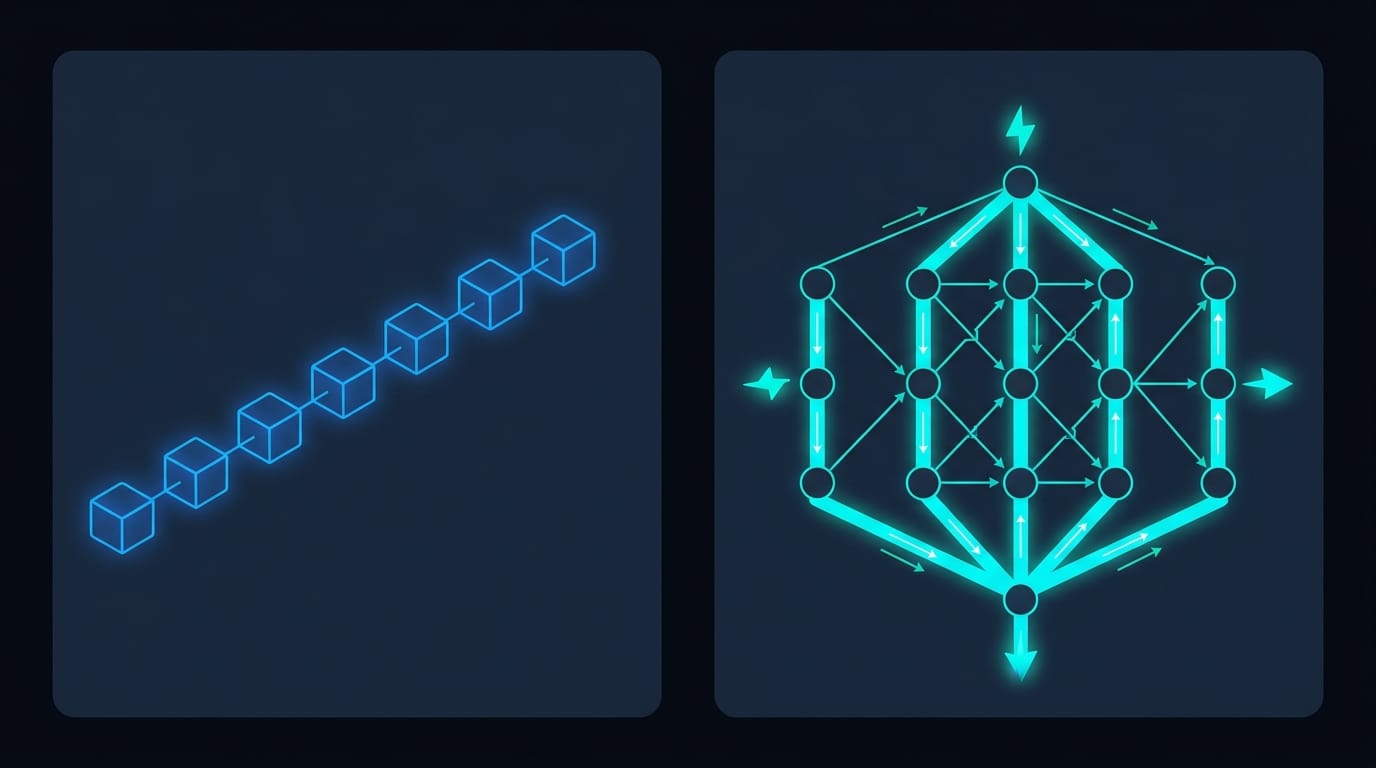
A traditional blockchain is essentially a single-lane road. One node leads the production of each new block, and every transaction must join a queue and wait its turn. Fantom's DAG architecture is more like a multi-lane highway - multiple nodes process and validate transactions simultaneously, in parallel, rather than sequentially.
In a DAG structure, transactions are organized as interconnected "events" rather than blocks. Each event references previous events, creating a web of connections that flows in one direction (the "directed" part) and never loops back on itself (the "acyclic" part). Nodes process events independently, then share their findings with random sets of neighboring nodes for confirmation.
The practical result: no single node bottlenecks the network. Transaction throughput scales with the number of participating nodes, not against it. This architecture - formalized as the Fantom Opera Chain - is what makes Fantom's speed claims credible rather than theoretical.
Lachesis Consensus Mechanism: Speed, aBFT, and Sub-2-Second Finality
Lachesis is Fantom's proprietary Proof of Stake consensus protocol, built on Asynchronous Byzantine Fault Tolerance (aBFT). Breaking that down: nodes reach consensus independently and at different times (asynchronous), and the network continues operating correctly even if up to one-third of validators malfunction or act maliciously (Byzantine Fault-Tolerant). Only two-thirds of validators need to agree for consensus to be reached - which is what enables the speed advantage.
Lachesis is applied directly to the Opera Chain's DAG structure - not bolted on as a separate layer. That tight integration is what allows Fantom to hit finality times that compare more favorably to payment networks than to traditional blockchains.
Fantom vs. Ethereum: Technical Comparison at a Glance
Fantom was explicitly designed to be an EVM-compatible alternative to Ethereum, meaning developers can port Ethereum smart contracts to Fantom with minimal code changes, and users familiar with MetaMask can interact with Fantom without any new tooling. Here's how the two networks compare on the metrics that matter most:
The fee differential is the most practical advantage for everyday users. On Ethereum, gas fees for a simple DeFi interaction can exceed the value being transacted during network congestion. On Fantom, sub-cent fees make frequent, small transactions economically viable.
The FTM Token: Utility, Staking, and Tokenomics
FTM isn't just a speculative asset - it's the operational layer that keeps the entire Fantom network running. Every core function of the protocol requires FTM: paying for compute, securing the network through staking, and shaping its future through on-chain governance. Understanding how FTM works makes the network's economics much clearer.
FTM Token Use Cases: Transaction Fees, Governance, and Network Security
FTM serves three essential functions on the Fantom network.
Transaction fees. Every smart contract interaction, transfer, or dApp call on the Opera Chain requires a small FTM payment. Because fees are near-zero, this creates demand without friction - the network can support high transaction volumes without pricing out smaller participants.
Staking and network security. FTM holders stake their tokens to help validate transactions under the Lachesis PoS model. Staking rewards are paid in FTM, creating a direct incentive for holders to secure the network rather than simply hold passively.
Governance. FTM holders vote on protocol proposals through a mechanism more nuanced than a standard yes/no vote. Holders express their position on a five-point scale (1 through 5), signalling the strength of their agreement or disagreement - not just the direction. That granularity gets factored into the final community tally, producing a more representative outcome than binary governance systems allow.
Beyond these core functions, FTM powers fUSD - Fantom's native stablecoin pegged 1:1 to the US dollar - used across Fantom's lending, borrowing, and decentralized exchange protocols. Ecosystem growth directly increases demand for FTM, since every dApp built on Opera uses it as gas.
Staking FTM and Tokenomics: Rewards, Validator Requirements, and Supply
Fantom uses a delegation model that makes staking accessible at almost any investment level. Here's how the three participation tiers compare:
For most holders, delegation is the practical entry point. One FTM is enough to start - you select a validator, delegate your stake, and earn a proportional share of that validator's rewards. Historically, annualized staking yields have ranged from approximately 4% to 14%, varying based on lock-up duration and network participation levels. Always verify current rates on the Fantom staking portal before allocating capital, as reward rates shift with total network stake.
On the supply side, FTM has a fixed total supply of 3,175,000,000 tokens, per CoinGecko, distributed as follows:
- ~40% - Seed and private token sales (prior to 2019 mainnet)
- ~33% - Validator staking rewards reserve
- ~20% - Team and project advisors
- ~6% - Token reserve
- ~1.5% - Public ICO
FTM earned through staking can be re-deployed into Fantom's DeFi ecosystem - which is where the next layer of yield opportunities lives.
Fantom's DeFi Ecosystem: Opera Chain, Smart Contracts, and Real-World Applications
The Opera Chain's EVM compatibility wasn't just a technical decision - it was a growth strategy. By building a blockchain that Ethereum developers could deploy to with minimal friction, Fantom attracted established protocols like Curve, Aave, and yearn.finance to expand onto its network. Users familiar with MetaMask needed only to add a custom RPC endpoint to start interacting with Fantom-native dApps.
That rapid portability helped Fantom accumulate significant total value locked across DeFi protocols, peaking in early 2022. Current TVL fluctuates with market conditions - check DeFiLlama for live figures before drawing conclusions from historical data.
Fantom's applications extend beyond DeFi. On the enterprise side, the network has been deployed for supply chain management, healthcare data infrastructure, and government pilot programmes - each on-chain and publicly verifiable rather than dependent on a central authority's attestation.
Getting involved in Fantom's ecosystem starts with acquiring FTM.
How to Buy, Store, and Get Started with Fantom (FTM)
Getting exposure to FTM and the Fantom ecosystem is a straightforward process, but the path you choose should match your goals - trading, staking, DeFi, or long-term holding each require slightly different setups.
- Choose a cryptocurrency exchange. FTM is listed on most major centralized and decentralized exchanges. Verify availability in your jurisdiction before selecting a platform.
- Purchase FTM. Buy FTM using fiat or by swapping from another cryptocurrency. Confirm network fees and withdrawal options before transacting.
- Set up a compatible wallet. MetaMask works natively with Fantom - add the Opera network manually using Fantom's official RPC settings. For long-term cold storage, Ledger and Trezor both support FTM.
- Connect to the Fantom Opera network. Add the custom RPC endpoint in MetaMask (available on Fantom's official documentation). Your wallet address is identical on both Ethereum and Fantom once connected.
- Start staking, trading, or using DeFi. Delegate FTM to a validator through the Fantom staking portal (minimum: 1 FTM), or connect to a DeFi protocol via the Opera network.
As with any permissionless network, knowing what to watch out for protects your capital.
Staying Safe: Red Flags, Scam Warnings, and FTM Security Tips
Fantom's open DeFi ecosystem is powerful - but like any permissionless network, it attracts bad actors. Knowing the warning signs is your first line of defense.
⚠ 5 Red Flags When Using Fantom DeFi
- Unaudited smart contracts → Fantom's EVM compatibility means malicious contracts can be deployed in minutes. Always verify a protocol has been audited before depositing funds.
- Fake FTM token contract addresses → Scammers deploy copycat tokens with identical names. Cross-reference every contract address against Fantom's official block explorer before transacting.
- Inflated APY promises → Yields in the hundreds or thousands of percent from obscure protocols almost always signal an unsustainable emission model or an outright rug pull.
- Phishing RPC endpoints → Only use Fantom's official Opera network RPC settings. Third-party links claiming to offer "faster" connections are a common phishing vector.
- Impersonation on Telegram and Discord → The Fantom Foundation will never message you first to offer exclusive staking opportunities. Governance proposals come through official channels only.
Self-custody means you - not a platform - bear responsibility for the security of your keys. That accountability removes counterparty risk and puts full control in your hands, but it also means there's no recovery path if you sign a malicious transaction or send to the wrong address.
Conclusion: Is Fantom Still Relevant in 2026?
Fantom made a genuine technical contribution to the blockchain space. The DAG architecture and Lachesis consensus mechanism solved real problems - slow finality, high fees, and throughput bottlenecks - without simply copying Ethereum's design. Whether that's enough to sustain long-term relevance in a market crowded with fast, cheap Layer 1 and Layer 2 networks is a more open question.
Here's how Fantom's value proposition maps to different user types in 2026:
The Sonic upgrade - Fantom Foundation's next-generation overhaul designed to increase throughput and introduce a new token standard - represents the most significant inflection point on the roadmap. FTM is upgradeable to Sonic (S) at a 1:1 ratio; check the official Fantom Foundation channels for the latest on launch status and what any transition means for current holders.
The broader direction the industry is moving - toward on-chain verifiability, self-custody, and transparent protocol mechanics - aligns with Fantom's foundational design principles. Platforms that hard-coded those values from the start, rather than retrofitting them, tend to retain developer communities even through volatile market cycles.
Do your own research. Assess your risk tolerance independently. Crypto trading involves substantial risk of loss, and nothing in this article constitutes financial advice.
Last updated: March 2026.
Frequently Asked Questions
What is Fantom (FTM)?
Fantom is an open-source, permissionless blockchain platform designed for fast, scalable smart contract execution. Unlike traditional blockchains that process transactions sequentially in linear blocks, Fantom uses a Directed Acyclic Graph (DAG) architecture combined with its Lachesis consensus mechanism to achieve transaction finality in 1-2 seconds with fees typically under $0.01. The FTM token powers the entire network - used for transaction fees, staking, and governance. Fantom's Opera Chain is fully EVM-compatible, enabling deployment of Ethereum-based decentralized applications with minimal code changes.
Who created Fantom and when did it launch?
Fantom was founded in 2018 by Dr. Ahn Byung Ik, a South Korean computer scientist with a PhD from Yonsei University. Software developer Michael Kong took over as CEO in 2019, guiding the platform's technical roadmap. The Fantom Opera mainnet launched in December 2019, transitioning from an ERC-20 token to a standalone blockchain. DeFi pioneer Andre Cronje served as an early advisor, contributing deep knowledge of decentralized finance protocols before departing in March 2022. The project secured institutional backing from HyperChain Capital in 2021 alongside integrations with Chainlink and The Graph.
How does Fantom differ from Ethereum?
Fantom and Ethereum both support smart contracts and DeFi applications, but their underlying architectures are fundamentally different. Ethereum uses a linear blockchain where blocks are produced sequentially; Fantom uses a DAG structure enabling parallel transaction processing. Practically, this means transaction finality of 1-2 seconds on Fantom versus roughly 12-15 seconds on Ethereum, and fees below $0.01 on Fantom compared to Ethereum's variable gas model that frequently reaches tens of dollars during congestion. Both networks are EVM-compatible, meaning developers can deploy the same smart contracts on either chain.
What is a Directed Acyclic Graph (DAG) in blockchain?
A Directed Acyclic Graph (DAG) is an alternative distributed ledger structure in which transactions are organized as interconnected "events" rather than sequential blocks. "Directed" means transactions flow in one direction; "acyclic" means they never loop back to create cycles. In a DAG, multiple nodes validate transactions simultaneously in parallel, rather than one node leading block production at a time. Fantom's Opera Chain uses DAG architecture to eliminate the throughput bottleneck inherent in linear blockchains, enabling much higher transaction capacity without sacrificing decentralization or security.
What is the Lachesis consensus mechanism?
Lachesis is Fantom's proprietary Proof of Stake consensus protocol built on Asynchronous Byzantine Fault Tolerance (aBFT). It has four key properties: leaderless (no single node controls validation), asynchronous (nodes reach consensus independently without synchronization delays), Byzantine Fault-Tolerant (consensus holds even if up to one-third of nodes act maliciously), and final (transactions confirmed in 1-2 seconds). Lachesis requires only two-thirds of validators to agree for consensus - prioritizing speed while maintaining security. It operates directly within Fantom's DAG structure rather than as a separate layer, which is the source of its performance advantage.
What can you do with FTM tokens?
FTM serves multiple functions within the Fantom ecosystem. It pays transaction fees on the Opera Chain, is staked to secure the network and earn rewards, and is used to vote on governance proposals through a unique five-point voting scale that lets holders express the strength of their agreement - not just yes or no. FTM also backs fUSD, Fantom's native stablecoin pegged 1:1 to the US dollar, powering lending and decentralized exchange activity. Every dApp deployed on Fantom uses FTM as gas, tying token demand directly to ecosystem growth and usage.
How does staking FTM work?
Fantom staking uses a delegation model accessible from as little as 1 FTM. You delegate your tokens to a chosen validator, who uses them to secure the network and shares the resulting rewards proportionally with you. Running a full validator node yourself requires 500,000 FTM plus server infrastructure. Historical annualized yields have ranged from approximately 4% to 14%, varying by lock-up duration and total network stake. Longer lock-up periods generally earn higher yields. Always verify current rates on Fantom's official staking portal before committing capital, as reward rates shift continuously with network participation levels.