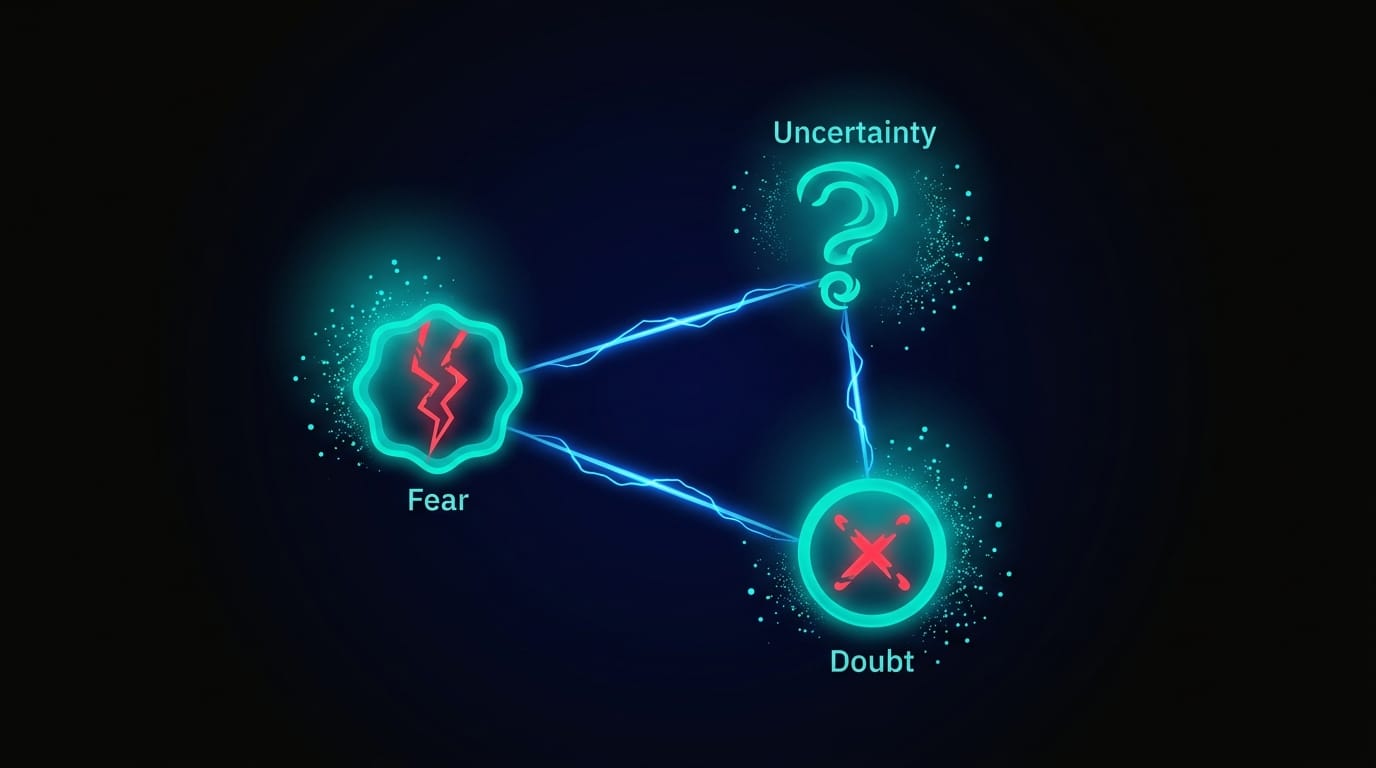
If you've spent five minutes in a crypto community, you've seen the word FUD. What is FUD, exactly - and why does it move markets? FUD stands for Fear, Uncertainty, and Doubt: a tactic that exploits negative emotion to destabilize investor confidence in crypto assets. Understanding where it comes from, how it spreads, and how to defend against it is one of the most practical skills any crypto investor can develop. To protect your portfolio - and potentially profit - from FUD events, start with the fundamentals.
⚡ Key Takeaways
- FUD = Fear, Uncertainty, Doubt - a coordinated or opportunistic tactic designed to spread negative sentiment around a crypto asset or the market as a whole
- FUD can trigger panic selling and sharp price drops, sometimes wiping double-digit percentages off major assets within hours
- Not all FUD is false - some originates from real but heavily exaggerated concerns, which makes it harder to dismiss and more dangerous
- DYOR and the Crypto Fear & Greed Index are your two primary countermeasures against fear-driven decision-making
What Is FUD? Full Definition, Origins, and Core Mechanics
FUD - short for Fear, Uncertainty, and Doubt - describes both an acronym and a behavioral phenomenon: the deliberate or opportunistic spread of negative narratives designed to shake investor confidence and trigger reactive selling. What is FUD at its core? It's an information weapon. The goal is to make holders doubt their positions and react emotionally rather than rationally. In crypto, where markets never close and news travels at the speed of a tweet, the mechanics of fear uncertainty and doubt are extraordinarily effective.
📊 FUD at a Glance
F = Fear - triggers panic selling and impulsive position exits
U = Uncertainty - exploits information gaps, regulatory ambiguity, and technical complexity
D = Doubt - erodes conviction in even well-researched positions, often without outright false claims
The Historical Origins of FUD
The phrase predates crypto by nearly a century. Negative sentiment campaigns designed to undermine competitor confidence entered business vocabulary in the 1920s, used by established players to discourage customers from adopting rival products. By 1975, the FUD acronym was in widespread use across the technology sector - and the canonical example is IBM.
When Gene Amdahl left IBM to found his own competing hardware company, IBM responded with a sustained campaign of FUD: seeding doubt about Amdahl's long-term viability, reliability, and support. Customers with no technical basis to evaluate the claims defaulted to the incumbent out of fear. The tactic worked. Decades later, the same strategy found a far more volatile home: the cryptocurrency market.
FUD: A BRIEF TIMELINE
1920s
Negative sentiment tactics enter business competitive playbooks as an established market manipulation strategy
1975
"FUD" acronym widely adopted across the tech industry - IBM's campaign against Gene Amdahl becomes the canonical example
1990s
IBM-era FUD campaigns formalized in academic and business literature as a recognized competitive tactic
2010s
Crypto community adopts the term; Bitcoin becomes its primary target as digital asset markets scale globally
Breaking Down the Three Components - Fear, Uncertainty, and Doubt
Each component of FUD hits differently in the crypto context - and understanding the psychological mechanism behind each one makes them far easier to recognize in the moment.
Fear functions as crypto's fastest accelerant. A single alarming headline triggers a fight-or-flight response in holders, especially those who entered positions recently at higher prices. Unlike traditional equities markets, crypto has no regulatory circuit breakers or trading halts - a 10% intraday drop can cascade globally before any correction mechanism kicks in.
Uncertainty exploits the genuine complexity of blockchain projects. Regulatory ambiguity - "Will this government ban crypto trading?" - is particularly effective because it's impossible to fully disprove. Anonymous sources on Telegram amplify this uncertainty before any official information is available.
Doubt is the most insidious component because it doesn't require lies. A legitimate concern - a protocol's energy usage, a token's inflation schedule - gets amplified far beyond its actual significance, corroding conviction in even well-researched positions over time.
How FUD Spreads in Crypto Markets
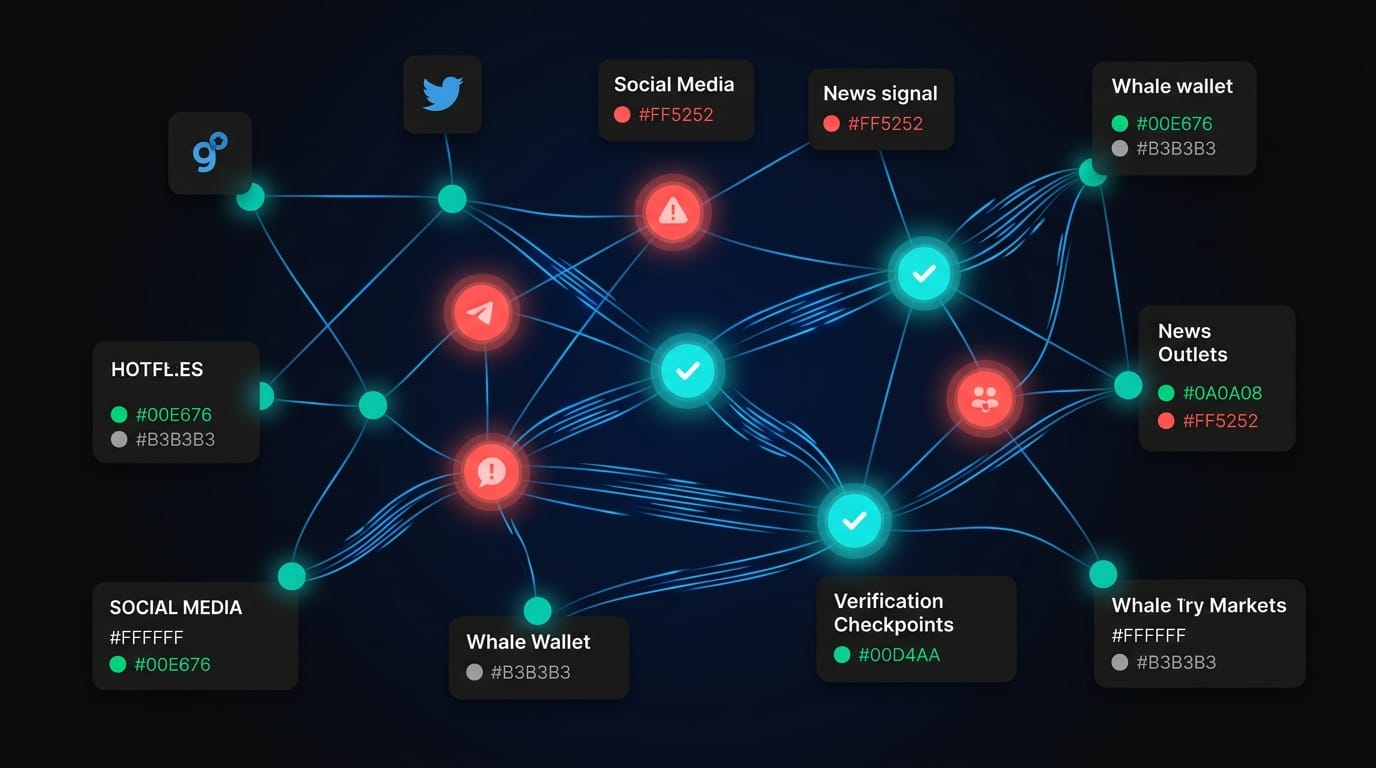
FUD doesn't originate from a single source - it propagates through multiple channels simultaneously, which is what makes it so difficult to contain. Crypto's 24/7 global trading cycle eliminates the overnight correction window that traditional markets rely on. A FUD narrative that breaks at 2 AM in one timezone is already circulating on three continents by the time major institutional traders arrive at their desks. Critically, a significant portion of FUD originates from actors with direct financial incentives to suppress prices: short-sellers, competing projects, and coordinated bot networks.
FUD Source Categories:
- Individuals - influencers, executives, celebrities (e.g., Elon Musk's May 2021 Bitcoin energy tweet sent BTC down 12% within hours, with intraday losses reaching 17% according to CoinMarketCap data)
- Institutions - governments announcing crackdowns, exchanges halting withdrawals, financial media publishing panic-inducing headlines
- Coordinated actors - competing projects, short-sellers with open positions, and automated bot networks amplifying minor negative news
Traditional FUD vs. Crypto FUD - Why Digital Assets Are More Vulnerable
FUD exists in traditional financial markets too - but four structural differences make crypto uniquely susceptible.
The 5 Biggest FUD Triggers in Crypto History
One critical distinction: most FUD-driven price drops eventually recover when the underlying fundamentals remain intact. The FTX collapse is the important counter-example - that wasn't manufactured sentiment, it was genuine fraud. The recovery thesis only holds when FUD exaggerates reality, not when reality is catastrophic.
Knowing what triggers FUD is only half the skill - recognizing it in real time is where most investors struggle.
How to Identify FUD - Separating Manufactured Noise from Legitimate Risk
The danger is that FUD sometimes starts from a real concern - it's the exaggeration and timing, not always the core fact, that makes it FUD. A regulatory announcement in one jurisdiction gets framed as a global ban. A temporary protocol bug becomes "crypto is dead." Separating signal from noise requires a systematic approach, not just healthy skepticism.
6 Red Flags That Signal FUD - Not Facts
Once you recognize what triggers FUD, the next skill is evaluating it in real time. Apply this checklist whenever alarming news hits your feed:
6 FUD RED FLAGS TO WATCH FOR
No credible primary source cited - the claim circulates on social media without linking to an official announcement, court document, or named institutional source
Emotionally charged language - phrases like "total collapse," "emergency sell," or "final warning" are designed to provoke fear, not inform
Vague predictions without verifiable data - "experts say Bitcoin could drop 90%" with no named expert, no methodology, no timeframe
Unconfirmed government ban claims - no official government press release, legislation text, or regulatory filing to verify
Anonymous sources on Telegram, Twitter/X, or Discord - a FUDster operating pseudonymously faces zero accountability for false claims
Suspiciously timed with a short position or competitor launch - check whether major short positions were opened in the 24-48 hours before the narrative went viral
When in doubt, apply the core do your own research (DYOR) rule: cross-reference any alarming claim against three independent credible sources before taking any portfolio action.
Tools to Measure FUD - The Crypto Fear & Greed Index and Key Sentiment Indicators
Qualitative red flags get you halfway there. Three tools provide quantitative confirmation:
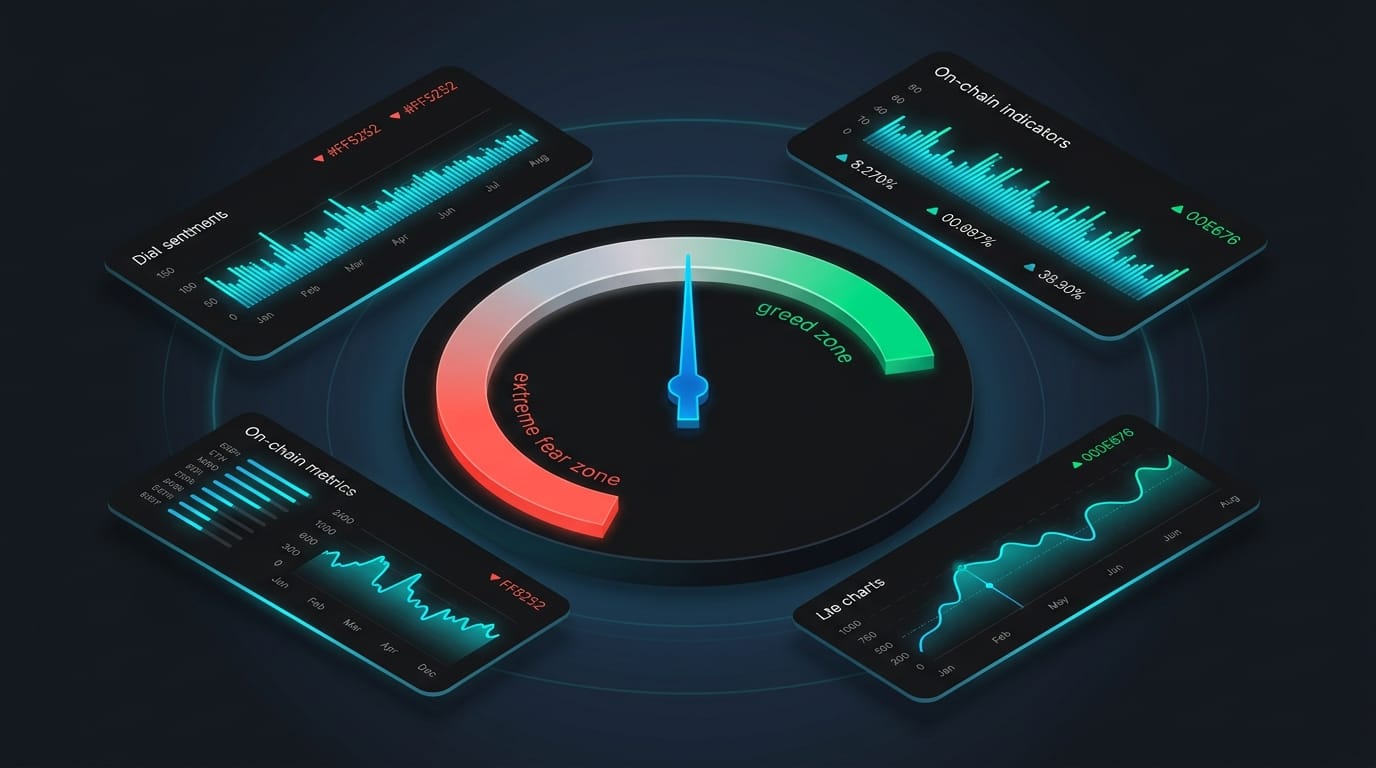
1. Crypto Fear & Greed Index (Alternative.me) - the industry-standard sentiment gauge, scored 0-100. As Zipmex's own explainer notes, the index aggregates data from volatility, momentum, social media volume, Bitcoin dominance, and search trends. Extreme Fear (0-24) means FUD is dominating the market; historically, these readings have aligned with medium-term buying opportunities.
2. Bitcoin Dominance - when BTC dominance rises sharply during a market-wide downturn, investors are rotating out of altcoins into the perceived safety of Bitcoin. A rising dominance metric often signals altcoin-specific FUD reaching critical mass.
3. On-chain Exchange Inflows - large wallet deposits to centralized exchanges signal that holders are preparing to sell. On-chain data from blockchain explorers provides an objective early-warning signal that exists nowhere in traditional finance.
Understanding FUD is only half the job - knowing how to respond to it separates experienced investors from the crowd.
How to Protect Yourself from FUD - and Turn It Into Opportunity
FUD is a permanent feature of crypto markets - the real question is not how to avoid it, but how to respond when it hits. The good news: there's both a defensive and an offensive playbook, and neither requires predicting the future. For a deeper dive into building a complete risk management framework around market volatility, it's worth reading Zipmex's dedicated guide.
Defensive Strategies - DYOR, Diversification, and Staying Rational
Apply this framework before touching your portfolio during any FUD event:
✓ 5-STEP FUD RESPONSE CHECKLIST
Do your own research (DYOR) first - cross-reference the claim across three independent credible sources, including on-chain data via a blockchain explorer. Blockchain's inherent transparency gives crypto investors a verification layer traditional market participants don't have
Check your diversification - if a single asset represents more than 20-30% of your portfolio, one targeted FUD event can do disproportionate damage
Pre-set stop-losses before volatility hits - emotional decision-making during a market drop is almost always worse than systematic pre-set exit rules. Define your maximum acceptable loss per position in advance
Limit social media consumption during high-volatility periods - Telegram, Twitter/X, and Discord are the fastest FUD amplification channels. Stepping away during acute volatility reduces emotional contamination
Maintain a written investment thesis - document why you hold each position before FUD hits. During a fear event, refer back to your thesis. If the FUD invalidates a core assumption, that's a signal to re-evaluate. If it doesn't, it's noise
Offensive Strategies - Using FUD as a Buy Signal (For Prepared Investors)
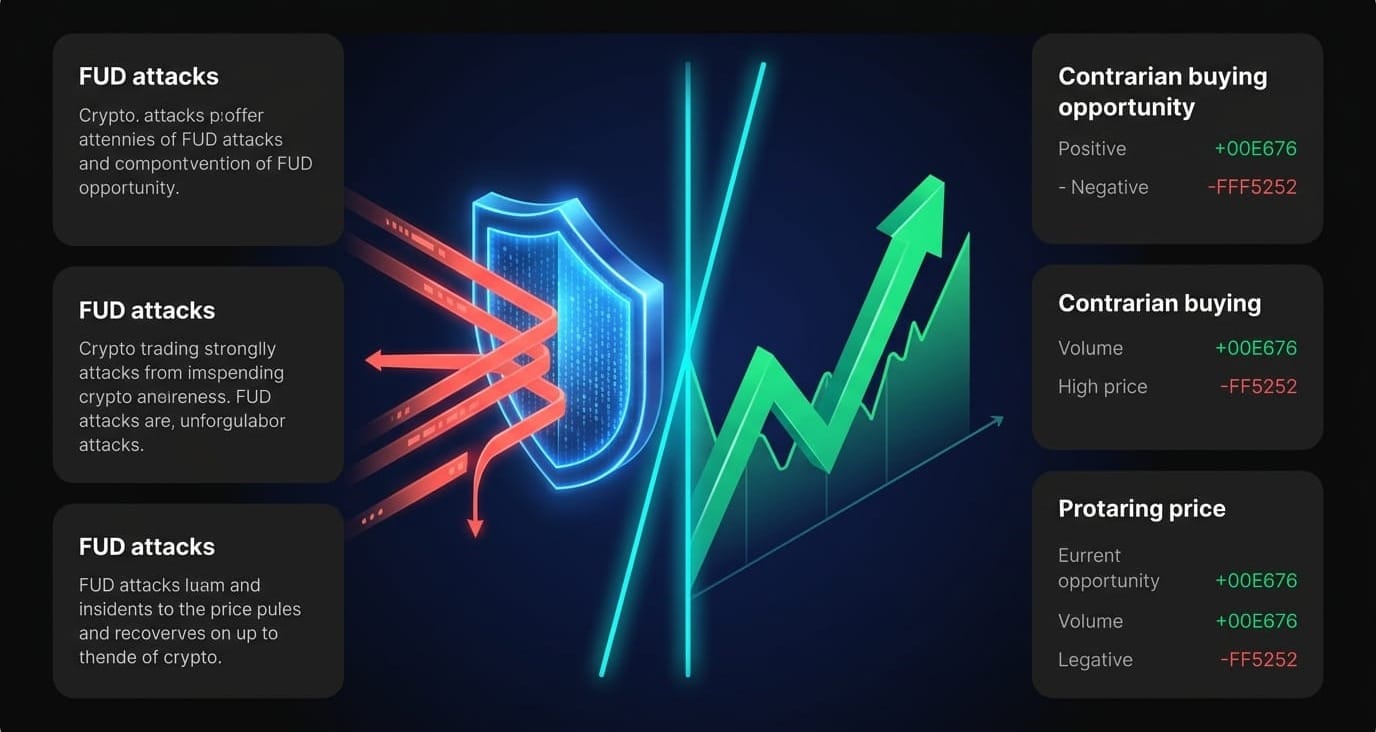
The logic is straightforward: fear-driven selling creates discounted prices that have nothing to do with project fundamentals. Panic selling is irrational by definition - it's driven by emotion, not analysis - and irrational selling creates irrational prices.
Bitcoin has recovered from every major FUD-driven price correction in its history: the 2017 China exchange ban, the 2020 COVID crash, the May 2021 Elon Musk energy tweet, and the post-FTX bear market bottom. Each event produced Extreme Fear readings on the Fear & Greed Index. Each subsequently presented accumulation opportunities for investors with the conviction and risk discipline to act.
📊 FUD as an Opportunity: The Contrarian View
- Extreme Fear readings on the Crypto Fear & Greed Index have historically aligned with medium-term buying opportunities across multiple market cycles
- Bitcoin has recovered from every major FUD-driven crash - regulatory, influencer-driven, and macro-driven alike
- This strategy requires strict risk management and strong conviction in project fundamentals - it is not a universal rule
The critical caveat: this only applies when the FUD is manufactured or exaggerated. Never average down into genuine fraud or insolvency events. The FTX collapse is the definitive counter-example - holders who bought that dip lost significant capital because the underlying concern was real, not amplified. Verify fundamentals before treating any dip as an opportunity.
⚠ Risk Disclaimer
Crypto trading involves substantial risk of loss. The offensive FUD strategy described above is not suitable for all investors and should not be construed as financial advice. Always conduct independent research and consider your personal risk tolerance before making any investment decision.
FUD vs. FOMO - The Two Emotional Forces Driving Crypto Markets
FUD and FOMO are two sides of crypto's emotional coin - and understanding both is essential for any serious investor. FUD (Fear, Uncertainty, Doubt) drives fear-based selling that pushes prices down; FOMO (Fear of Missing Out) drives excitement-fueled buying that inflates prices beyond fundamentals. Together they create the boom-bust cycles crypto markets are known for.
What makes this particularly important is that sophisticated market participants deliberately sequence both. The playbook: coordinate a FUD narrative to crash prices → accumulate discounted assets → release bullish announcements or let market sentiment recover → ride the FOMO-driven price recovery → exit into the retail enthusiasm. Together, FUD and FOMO create the volatility that defines crypto - but they are patterns you can learn to navigate.
Conclusion - Navigating FUD with Confidence
FUD has existed since the first competitive market and will continue as long as money is at stake. The crypto market didn't invent it - but it gave it a uniquely powerful environment: 24/7 trading, global pseudonymous actors, thin altcoin liquidity, and retail investors operating without the institutional risk infrastructure that traditional finance provides.
Your response to FUD should match your experience level:
- Beginners - DYOR is your primary weapon. Before any alarming news changes your portfolio, cross-reference three independent credible sources and verify claims against on-chain data where possible. Patience and independent verification beat reactive selling almost every time.
- Intermediate investors - add the Crypto Fear & Greed Index to your toolkit as a quantitative FUD sensor. When the index hits Extreme Fear, that's a data point worth factoring into your analysis - not a buy signal in isolation, but meaningful context.
- Experienced traders - integrate FUD recognition into your risk management framework as a formal component. Pre-defined stop-losses, written investment theses, and on-chain verification skills turn FUD from a threat into actionable information.
Platforms built on on-chain verifiability and transparency - where market mechanics, outcomes, and fee flows are all publicly auditable - reflect the trajectory the industry is moving toward: trustless systems where FUD claims can be tested against objective data rather than managed through institutional authority. That shift won't eliminate FUD, but it changes what investors can do with it.
FUD is permanent. Understanding it converts a market threat into a navigable - and sometimes profitable - dynamic.
Last updated: March 2026.
Frequently Asked Questions
What does FUD stand for in crypto?
FUD stands for Fear, Uncertainty, and Doubt. In crypto, the term describes any narrative - true, false, or exaggerated - that spreads negative sentiment and triggers reactive selling among investors. The acronym predates crypto by decades, originating in competitive business and technology marketing during the 1970s, but it found its most powerful application in 24/7 digital asset markets where information travels instantly and there are no regulatory circuit breakers to halt a panic-driven price cascade. Recognizing FUD as a category of market event is the first step toward responding to it rationally rather than emotionally.
Is FUD always based on false information, or can it be partly true?
FUD is not always false - that's what makes it genuinely dangerous. The most effective FUD starts with a real concern: a legitimate regulatory risk, a real technical vulnerability, a genuine market development. The FUD layer adds exaggeration, emotionally charged framing, and strategic timing to amplify that concern beyond its actual significance. A regulatory announcement affecting one jurisdiction becomes "governments are banning crypto worldwide." A minor protocol bug becomes "the project is over." The skill isn't dismissing all negative news - it's calibrating how much the exaggeration exceeds the underlying reality.
How does FUD affect cryptocurrency prices in practice?
FUD triggers panic selling, which reduces buy pressure while increasing sell volume simultaneously - a combination that can produce sharp, rapid price declines. In thin-liquidity altcoin markets, even relatively small sell volumes can cascade into double-digit percentage drops within hours. The 24/7 nature of crypto trading means a FUD event that breaks overnight in Asia is already circulating globally before North American markets become active. Bitcoin has historically recovered from every major FUD-driven price correction, though recovery timelines range from days to over a year depending on the severity of the underlying event.
What is the difference between FUD and FOMO in crypto?
FUD and FOMO are crypto's two dominant emotional market drivers operating in opposite directions. FUD (Fear, Uncertainty, Doubt) generates negative sentiment that triggers selling and price declines. FOMO (Fear of Missing Out) generates excitement and urgency that triggers buying and price inflation. Experienced market participants often deliberately sequence both: manufacture FUD to crash prices and accumulate at a discount, then release bullish narratives that trigger FOMO-driven buying as prices recover. Understanding that FUD and FOMO are sometimes engineered - not spontaneous - is a significant step toward more disciplined investment decision-making.
What are the most famous real-world examples of FUD in crypto history?
Five events stand out across crypto history. Elon Musk's May 2021 tweet about Bitcoin's energy usage sent Bitcoin down 12% within hours, with intraday losses reaching 17% according to CoinMarketCap data. China's 2017 exchange ban triggered significant single-day BTC declines. The FTX collapse in November 2022 pushed Bitcoin to 2-year lows around $15,500 - though that event involved genuine fraud. Whale wallet movements into exchanges consistently generate community panic. Security exploit announcements regularly get amplified well beyond the actual scope of damage, causing disproportionate drops on affected assets.
Who typically spreads FUD in crypto markets, and why?
FUD originates from three main actor categories, each with distinct motivations. Individuals - influencers, executives, celebrities - spread FUD for attention, personal financial incentives such as undisclosed short positions, or genuine but exaggerated concern. Institutions - governments, exchanges, mainstream financial media - spread FUD through regulatory announcements, withdrawal halts, and panic-framing coverage, often unintentionally. Coordinated actors - competing projects, short-sellers, and bot networks - spread FUD deliberately with direct financial incentives: suppressing a competitor's price, profiting from an open short position, or accumulating assets at a discount before a bullish reversal.
How can I tell if a news story is FUD or a legitimate warning?
Apply a six-point checklist when alarming news hits your feed: Does it cite a credible primary source - an official document, named analyst, or verified announcement? Is the language emotionally charged rather than factual? Does it include specific, verifiable data or only vague predictions? Are government ban claims backed by actual legislation or regulatory filings? Is the source anonymous - an unnamed Telegram contact or pseudonymous account? Did major short positions open in the 24-48 hours before this narrative went viral? If several of these red flags apply simultaneously, treat the information as unverified until independently confirmed against multiple sources.
What is the Crypto Fear & Greed Index and how does it relate to FUD?
The Crypto Fear & Greed Index, published by Alternative.me, measures real-time market sentiment on a scale of 0-100. As explained in Zipmex's dedicated explainer, the index aggregates volatility, market momentum, social media volume, Bitcoin dominance, and search trend data. Scores of 0-24 represent Extreme Fear - the zone where FUD is dominating market psychology. Scores of 75-100 represent Extreme Greed - the FOMO zone. Historically, Extreme Fear readings have aligned with medium-term buying opportunities across multiple market cycles, though the index is a sentiment measurement tool, not investment advice.
Can FUD events actually be a buying opportunity for crypto investors?
Yes - when the underlying fundamentals of the asset remain intact. Fear-driven selling is irrational by definition: it's driven by emotion, not analysis of project value. Bitcoin's recovery from the 2017 China ban, the 2020 COVID crash, and the 2021 Musk tweet all demonstrate that FUD-driven drops can precede significant recoveries. The Crypto Fear & Greed Index Extreme Fear zone has historically corresponded to medium-term accumulation opportunities. The critical exception: genuine fraud or insolvency events like FTX represent real catastrophic risk, not temporary sentiment. Only apply the contrarian thesis when FUD exaggerates reality, not when reality itself is the problem. This is not financial advice; all investment decisions carry risk.
What does DYOR mean and how does it help protect against FUD?
DYOR stands for "do your own research" - crypto's shorthand for independent verification before taking any portfolio action. In a FUD context, DYOR means cross-referencing any alarming claim against at least three credible, independent sources before selling or reacting. Practically, this includes checking official project announcements, reading regulatory filings directly rather than media summaries, and using blockchain explorers to verify on-chain data - wallet movements, treasury balances, smart contract activity. Blockchain's inherent transparency gives crypto investors a verification layer that doesn't exist in traditional finance: you can often check the facts of a FUD claim directly on-chain.
Is FUD unique to crypto, or does it also exist in traditional stock markets?
FUD exists across all financial markets - it predates crypto by decades, with roots in competitive business tactics from the 1920s and formalization during IBM-era technology competition in the 1970s. Traditional equity markets experience FUD through analyst downgrades with undisclosed conflicts of interest and short-seller campaigns. However, crypto is uniquely vulnerable for four structural reasons: no regulatory trading halts or circuit breakers, 24/7 global trading with no cooling-off periods, pseudonymous actors who face zero accountability for false claims, and thin altcoin liquidity that amplifies the price impact of even moderate sell volumes. The same FUD narrative that might move a large-cap stock 2-3% can move a mid-cap altcoin 20-30%.