Stablecoins are supposed to be boring - that's the whole point. But one category of stablecoin has generated more chaos, billion-dollar collapses, and regulatory scrutiny than almost anything else in crypto. Algorithmic stablecoins promised to solve the hardest problem in decentralized finance: stable money without a central custodian. The results have been spectacular - and, in the most high-profile case, catastrophically bad.
⚡ Quick Answer
An algorithmic stablecoin is a cryptocurrency designed to hold a stable value - typically $1 USD - using smart contracts and supply-adjustment algorithms instead of dollar reserves locked in a bank. When the price rises above $1, the protocol mints new tokens to push it back down. When it falls below $1, it burns tokens to reduce supply and restore the peg. The mechanism is elegant in theory; in practice, it has proven extremely difficult to sustain during market stress.

What is an algorithmic stablecoin?
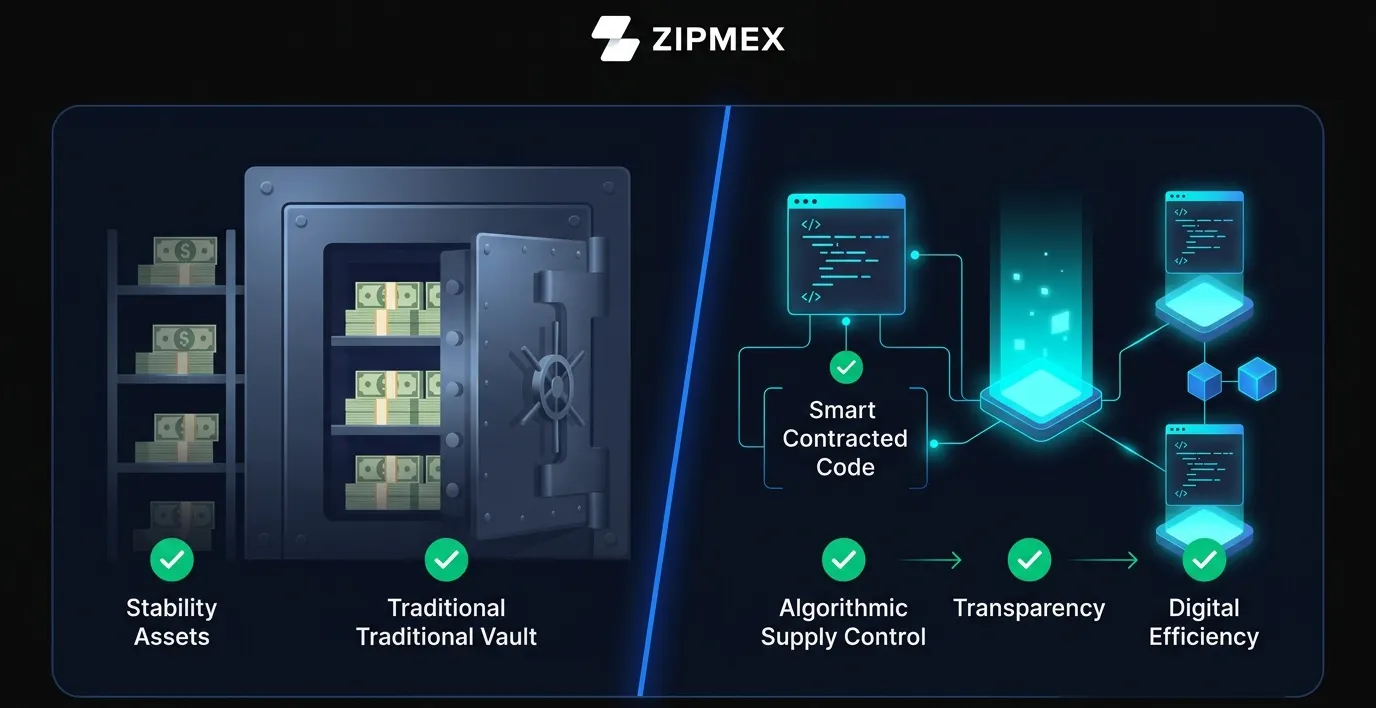
An algorithmic stablecoin is a digital asset designed to maintain price stability through onchain algorithms and smart contracts rather than by holding dollar reserves in a bank account. Where fiat-backed stablecoins like USDT or USDC work by keeping $1 in reserve for every token issued, algorithmic stablecoins rely entirely on code-driven supply adjustments to keep their price at $1.
The idea draws direct inspiration from central banking. When a central bank wants to defend a currency peg, it buys or sells that currency on the open market to adjust supply. An algorithmic stablecoin protocol does the same thing - but autonomously, on-chain, 24 hours a day, without any human intervention.
This makes algorithmic stablecoins potentially the most decentralized form of stable money in crypto. They don't require a custodian you have to trust, they can't be frozen by a regulator, and they can theoretically scale without proportional increases in backing capital. That capital efficiency is the core appeal.
Algorithmic vs. fiat-backed stablecoins
The tradeoff is stark. Fiat-backed stablecoins work reliably, but they reintroduce the centralization crypto was designed to escape. Algorithmic stablecoins are more aligned with DeFi's values - but their peg depends entirely on market confidence, and that confidence can evaporate fast.
How do algorithmic stablecoins work?
The core mechanism is supply elasticity. When the stablecoin's market price moves away from $1, the protocol automatically triggers a rebalancing event:
- Price above $1: Supply is too low relative to demand. The protocol mints new tokens and distributes them - typically to governance token holders or liquidity providers - adding selling pressure until the price returns to $1.
- Price below $1: Supply exceeds demand. The protocol must reduce the number of tokens in circulation. It does this through burning mechanisms, bond incentives, or rebase adjustments that shrink the supply until the price recovers.
The exact implementation varies by model. There are three main types, each with meaningfully different risk profiles.
🔄 Rebase model (Ampleforth / AMPL)
In a rebase model, the protocol doesn't move tokens between wallets - it changes how many tokens every wallet contains. If AMPL trades at $1.10, the protocol increases every holder's balance proportionally. If it trades at $0.90, every holder's balance shrinks.
The token supply adjusts globally, typically once per day. The USD value of your position may stay roughly stable even as your token count changes - the individual tokens are worth less or more, but there are more or fewer of them.
Ampleforth (AMPL) has operated since 2019, making it the longest-running algorithmic stablecoin in continuous operation. Its sustained existence is notable, though it has never captured significant mainstream DeFi adoption.
For algorithmic stablecoins to function smoothly, they rely heavily on deep external liquidity layers where automated market makers can absorb sudden shifts in supply and demand. Without highly efficient trading environments to clear arbitrage orders, variance in the peg can widen during periods of high selling pressure. To understand how specialized platforms design these low-slippage environments specifically for pegged assets, explore our guide on how Curve Finance works and its role in ecosystem liquidity.
🏦 Seigniorage / dual-token model (Terra UST)
The seigniorage model uses two tokens: the stablecoin itself (e.g., UST) and a companion volatile token (e.g., LUNA). The volatile token absorbs price fluctuations to keep the stablecoin pegged.
- When UST trades above $1, users can mint new UST by burning $1 worth of LUNA - profiting from the arbitrage and expanding UST supply.
- When UST trades below $1, users can redeem UST for $1 worth of LUNA - profiting again while contracting UST supply.
The mechanism works as long as there is demand for LUNA. When that demand disappears - particularly if it disappears rapidly - the system becomes reflexively self-destructive. More LUNA gets minted to defend the peg, hyperinflating LUNA's supply, destroying its value, which further undermines UST's peg, which triggers more LUNA minting. A death spiral.
This is exactly what happened to Terra in May 2022.
🔀 Fractional-algorithmic model (FRAX)
The fractional-algorithmic model attempts to solve the fragility of pure algorithmic designs by combining partial collateralization with algorithmic supply management. A portion of the stablecoin's value is backed by real assets (typically USDC), while the remaining portion is maintained algorithmically.
Frax Finance (FRAX) launched in 2020 and pioneered this approach. Following the Terra collapse in 2022, Frax's governance moved progressively toward higher collateralization ratios - effectively acknowledging that the market no longer trusted fully uncollateralized designs. As of 2026, FRAX operates as a primarily collateral-backed stablecoin with algorithmic components retained for efficiency.

Algorithmic stablecoin examples
Understanding the theory becomes much clearer when you look at the real projects - both the ones that failed and the ones still operating today.
🎯 Key Examples: Algorithmic Stablecoins
- TerraUSD (UST) - FAILED: The largest algorithmic stablecoin ever. Peaked at $18.7B market cap before collapsing in May 2022, wiping over $40 billion in combined UST + LUNA value within days.
- FRAX (Frax Finance) - SURVIVING: Fractional-algorithmic hybrid. Market cap above $130M as of 2025. Survived by progressively increasing collateralization ratios after the Terra crash.
- Ampleforth (AMPL) - SURVIVING: Oldest continuously operating algorithmic stablecoin (since 2019). Uses daily rebasing. Never gained mainstream DeFi traction but remains operational.
- Basis Cash (BAC) - FAILED: Seigniorage model launched in 2020. Lost its peg and never recovered. Now largely inactive.
- Empty Set Dollar (ESD) - FAILED: Another seigniorage experiment from 2020. Also lost its peg and activity declined to near zero.
- USDD (Tron) - ACTIVE: Tron's algorithmic stablecoin, launched 2022. Uses a hybrid reserve model influenced by Terra's original design. Maintained its peg but with significantly lower adoption.
The pattern is clear: pure seigniorage models (UST, BAC, ESD) have a near-perfect failure rate. Hybrid models with real collateral (FRAX) have proven more durable. Rebase models (AMPL) survive but don't scale.
Are algorithmic stablecoins safe?
This is the question most crypto newcomers ask when they encounter these assets for the first time - and the honest answer is: they carry unique risks that fiat-backed stablecoins don't.
The Federal Reserve's own research on the IRON stablecoin collapse (June 2021) concluded that design flaws in no-arbitrage mechanisms contributed to the failure, and noted that "the speed of IRON's failure serves as a useful reminder that some stablecoins are not stable at all."
The core safety problem with algorithmic stablecoins is circular dependency. The peg is maintained by market participants who believe the peg will be maintained. If that belief falters, the mechanism that was supposed to restore the peg can instead accelerate the collapse. This is distinct from fiat-backed stablecoins, which have a hard floor: you can always redeem for actual dollars.
Because algorithmic stablecoins lack direct 1:1 fiat backing in a traditional vault, their survival is ultimately tied to collective market sentiment and consumer confidence. When macro-level panic triggers capital flight across major digital assets, tracking the emotional momentum of retail investors becomes essential for assessing asset risk. Before navigating highly volatile market structures, we recommend keeping an eye on the crypto fear and greed index explained to properly time your market exposure.
For anyone using DeFi protocols or automated market makers that involve algorithmic stablecoins as collateral or liquidity, the depeg risk of those assets cascades through the entire position.

Algorithmic stablecoin risks
Anyone evaluating these assets needs to understand the full risk landscape - not just the headline de-peg risk.
📉 Core Risks
- Death spiral risk: In seigniorage models, falling confidence triggers a reflexive loop - more minting of the companion token collapses both assets simultaneously.
- Oracle manipulation: Algorithmic stablecoins rely on price oracles to know when to expand or contract supply. Flash loan attacks can manipulate these oracles, triggering incorrect supply responses.
- Smart contract bugs: The minting, burning, and collateral management code is a high-value attack target. Even audited contracts have been exploited in DeFi.
- Demand dependency: Unlike fiat-backed stablecoins, algorithmic models require continuous external demand to function. If DeFi activity declines, the peg support mechanism weakens.
- Regulatory risk: The [GENIUS Act](https://www.jpmorgan.com/insights/global-research/currencies/stablecoins), signed into US law in July 2025, provides a regulatory framework for fiat-backed stablecoins. Algorithmic models fall into a legal grey area in multiple jurisdictions - including being classified as derivatives in Australia.
Understanding impermanent loss becomes especially important when providing liquidity to pools containing algorithmic stablecoins - a de-peg event creates extreme price divergence that dramatically amplifies impermanent loss for liquidity providers.
The core stability of an algorithmic mechanism depends on active arbitrageurs who burn or mint tokens whenever the price deviates from one dollar. However, during systemic market liquidations, extreme block space demand can drive execution costs to prohibitive levels, leaving key peg-correcting smart contracts too expensive to execute in time. To see how these critical computational costs fluctuate during sudden network events, read our explanation of what blockchain gas fees are and how they affect transaction speed.
Algorithmic stablecoins in 2026
The algorithmic stablecoin landscape looks very different in 2026 than it did at the height of Terra's dominance in early 2022.
The total stablecoin market now exceeds $255 billion, with algorithmic models accounting for less than 2% of that total. Fiat-backed stablecoins (USDT, USDC) have consolidated their dominance, and the GENIUS Act has accelerated institutional preference for regulated, collateral-backed options.
What remains of the algorithmic stablecoin space has evolved in one of two directions:
- Towards hybrid collateralization: FRAX represents this trajectory - retaining algorithmic efficiency mechanisms while maintaining a hard collateral floor that provides redemption backstop. This was the direct lesson learned from Terra.
- Towards niche, research-oriented designs: AMPL and similar rebase models continue operating as interesting monetary experiments, but they haven't found product-market fit at scale.
Pure seigniorage models - the Terra design - appear to be effectively dead as a credible design category. No major new pure algorithmic stablecoin has launched and gained traction since the UST collapse.
📅 Algorithmic Stablecoin Timeline
2013-2019
Earliest experiments on BitShares (2013). Ampleforth (AMPL) launches as the first rebase model (2019).
2020
Frax Finance launches fractional-algorithmic model. Basis Cash and Empty Set Dollar attempt seigniorage designs - both eventually fail to maintain peg.
2021
Terra UST reaches $18.7B market cap. IRON stablecoin collapses on Polygon in June (Federal Reserve research paper documents the failure). Anchor Protocol offers 20% APY on UST - a yield that was structurally unsustainable.
MAY 2022 - THE COLLAPSE
TerraUSD depegs. LUNA hyperinflation begins. Over $40 billion in combined value destroyed within days. The event permanently reshapes DeFi's approach to algorithmic stability.
2022-2024
FRAX progressively increases collateralization. Regulatory attention intensifies globally. Algorithmic stablecoins' share of total stablecoin market falls to under 2%.
JULY 2025
GENIUS Act signed into US law, providing a regulatory framework for fiat-backed stablecoins. Algorithmic models remain in a legal grey area.
2026
Stablecoin market exceeds $255B. Algorithmic models account for less than 2%. Hybrid models (FRAX) represent the only durable design category.
Frequently Asked Questions
What is the difference between an algorithmic stablecoin and a regular stablecoin?
Regular stablecoins like USDT or USDC are backed by actual dollars held in reserve - for every token issued, $1 sits in a bank account. Algorithmic stablecoins use code-driven supply adjustments to maintain their peg, with no (or minimal) real-world collateral. This makes them more decentralized but significantly more fragile, especially during market stress.
Are algorithmic stablecoins still a thing in 2026?
Yes, but at a dramatically reduced scale. Following the Terra UST collapse in May 2022, the total market share of algorithmic stablecoins fell to under 2% of the $255 billion stablecoin market. Surviving projects like FRAX have moved toward greater collateralization. Pure seigniorage models have effectively disappeared as a credible design category.
Why did TerraUSD (UST) collapse?
UST was a pure seigniorage stablecoin backed only by LUNA, a volatile companion token. When large sell-offs triggered the depeg in May 2022, the protocol needed to mint more LUNA to defend the peg. This hyperinflated LUNA's supply, crashed LUNA's price, which further undermined UST's peg - a reflexive death spiral. The Anchor Protocol's unsustainable 20% yield had also artificially inflated demand for UST, masking the structural instability. Over $40 billion in combined value was destroyed within days.
What is a rebasing stablecoin?
A rebasing stablecoin adjusts every holder's balance proportionally to bring the price back to its target. If the price is too high, all wallets receive more tokens. If the price is too low, all wallets have tokens removed. The individual token count changes, but the protocol aims to keep the USD value of each position stable. Ampleforth (AMPL) is the primary example, operating since 2019.
Can algorithmic stablecoins be safe to use?
Hybrid models with hard collateral floors (like FRAX) are meaningfully safer than pure seigniorage designs, but they still carry risks that fiat-backed stablecoins don't. For any DeFi activity involving algorithmic stablecoins - liquidity provision, lending, yield farming - evaluate the depeg risk of the underlying asset and how it would cascade through your position before entering.
What does the GENIUS Act mean for algorithmic stablecoins?
The GENIUS Act, signed into US law in July 2025, creates a regulatory framework specifically for payment stablecoins - and requires them to be fully backed by qualifying liquid assets. This framework effectively covers fiat-backed stablecoins like USDC and USDT. Algorithmic stablecoins, which lack full backing by definition, fall outside this framework and into a legal grey area that continues to evolve.
What is a seigniorage stablecoin?
A seigniorage stablecoin uses two tokens: the stablecoin itself and a companion volatile token. Users can arbitrage between the two to keep the stablecoin at $1 - burning the companion token to mint the stablecoin when demand is high, and redeeming the stablecoin for the companion token when it trades below peg. TerraUSD (UST) and LUNA were the largest example. The model works during growth phases but becomes catastrophically unstable when the companion token loses value.
Conclusion
Algorithmic stablecoins represent one of crypto's most ambitious ideas: stable money through code rather than custody. The theory is elegant. The execution has proven extremely difficult.
The Terra UST collapse in May 2022 remains the defining event - a $40+ billion destruction of value that demonstrated what happens when algorithmic confidence evaporates at speed. The lesson the market took from that event was clear: without a hard collateral floor, a stablecoin is not a stablecoin. It's a confidence game.
The algorithmic stablecoin space in 2026 is smaller, more cautious, and increasingly hybrid. Survivors like FRAX have moved toward greater collateralization. Pure seigniorage models have effectively exited the conversation. What remains is a research-oriented fringe and a set of hybrid designs that borrow algorithmic mechanisms for efficiency while maintaining the hard-asset backstop the market has demanded since 2022.
If you're evaluating DeFi protocols that involve algorithmic stablecoins, the key questions are: what is the collateral floor, what triggers a depeg, and how does that cascade through your position? Those questions didn't get asked enough about Anchor and UST in 2021.
⚠ Disclaimer: The information provided in this article is not intended to provide investment or financial advice. Investment decisions should be based on the individual's financial needs, objectives, and risk profile. We encourage readers to understand the assets and risks before making any investment entirely. Cryptocurrency investments are subject to high market risk. Past performance does not guarantee future results.
ZIPMEX promotes trading on trade.zipmex.com. Promotions are labelled and kept separate from news coverage, which is selected and checked without regard to them. Perpetual futures are leveraged derivatives. Prices can move fast and you can lose all of your margin. Not available in every jurisdiction. Not investment advice.