
CryptoKitties is a game on the Ethereum blockchain where players buy, collect, breed and sell digital cats. Each cat is a non-fungible token: a unique on-chain item whose owner is recorded by a smart contract, not by the game company's database. Axiom Zen released it publicly on Nov. 28, 2017. Within about a week it was one of the busiest applications on Ethereum, and its traffic slowed the whole network.

How CryptoKitties worked
Cats as non-fungible tokens
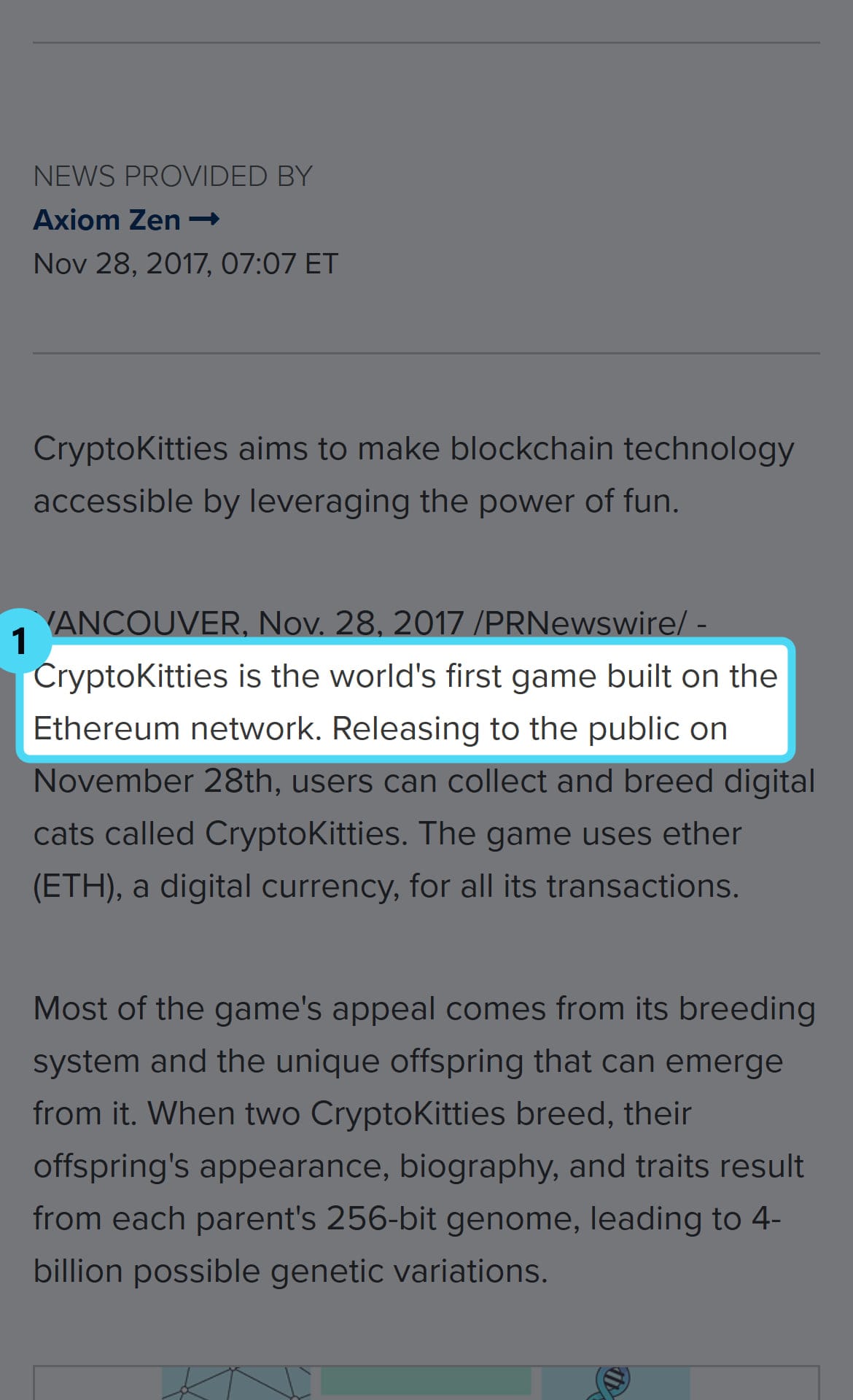
The launch announcement says every CryptoKitty lives in a smart contract on Ethereum and every in-game payment is made in ether (ETH). Each cat has its own ID, its own genes and its own owner, so one cat cannot be swapped one-for-one with another the way two units of ETH can. That is what "non-fungible" means.
The game's contracts became the model for a standard. On Sept. 22, 2017, Dieter Shirley, an Axiom Zen developer named as author in the CryptoKitties contract code, opened a proposal titled "ERC: Non-fungible Token Standard #721" on the Ethereum proposals tracker. The formal version, EIP-721 ("ERC-721: Non-Fungible Token Standard"), was created on Jan. 24, 2018, with Shirley as one of four authors, and now has Final status. The standard itself lists CryptoKitties as "compatible with an earlier version of this standard." In other words, CryptoKitties launched on a draft of ERC-721, before the final text existed.
Breeding
Two cats can be bred to produce a kitten. The game's published contract code sets out these rules:
- Genes. Each cat carries a 256-bit genetic code that never changes. A kitten's appearance and traits are derived from both parents' genes.
- Matron and sire. Cats have no fixed sex. In each breeding, one cat acts as the matron (it becomes pregnant) and the other as the sire.
- Generations. Cats created by the contract itself are Generation 0 ("gen0"). A kitten's generation is the higher of its parents' generations plus one.
- Cooldowns. After every successful breeding, a cat must wait before breeding again. The code comments say the wait "roughly doubles each time a cat is bred" and caps at seven days. Higher-generation cats start with longer waits.
The contract sold gen0 cats through auctions. Players could also auction their own cats or offer them as sires to other players.
The launch announcement says the 256-bit genome allows "4 billion possible genetic variations." The contract code uses the same 4 billion figure for something else: the maximum number of cat IDs that fit in a 32-bit number. Treat the 4 billion variations figure as the company's own marketing claim.
The 2017 craze
Axiom Zen ran a closed beta from Nov. 23, 2017, with 200 early-access users, after an alpha at the ETHWaterloo hackathon in October. The company said that within three hours of the beta, CryptoKitties was the third most active smart contract on Ethereum and accounted for about 2% of ether transactions.
After the public release, demand rose fast:
- Dec. 3, 2017. TechCrunch reported that about $1.3 million had been spent on cats. The most expensive sale up to then was the "genesis" kitten, at about 246 ETH (around $113,000 at the time).
- Dec. 4, 2017. MIT Technology Review reported that CryptoKitties accounted for 12% of all Ethereum transactions. It put the median sale price at $11.44 in ether.
How CryptoKitties went from beta to backlog
Follow the dated steps from the first ERC-721 proposal to the congestion crisis and the later Flow plans.
- Sept. 22, 2017ERC-721 proposal openeddone
Dieter Shirley, an Axiom Zen developer, opened "ERC: Non-fungible Token Standard #721" on the Ethereum proposals tracker. CryptoKitties later launched on this draft.
- Nov. 23, 2017Closed beta with 200 usersdone
Within three hours of the beta, Axiom Zen said CryptoKitties was the third most active smart contract on Ethereum, with about 2% of ether transactions.
- Nov. 28, 2017Public releasedone
Axiom Zen released the game publicly. Every cat lives in a smart contract and every in-game payment is made in ETH.
- Dec. 3, 2017About $1.3 million spent on catsdone
TechCrunch reported the total. The top sale so far was the genesis kitten, at about 246 ETH (around $113,000 at the time).
- Dec. 4, 201712% of Ethereum transactionsdone
MIT Technology Review put CryptoKitties at 12% of all Ethereum transactions and the median sale price at $11.44 in ether.
- Dec. 6, 2017Pending transactions spikedone
Bloomberg, citing ETH Gas Station, reported 11% of all Ethereum transactions, up from 4% the previous Friday. The team doubled its birthing fee from 0.001 ETH to 0.002 ETH so births would still attract miners.
- Jan. 24, 2018Formal EIP-721 createddone
The formal ERC-721 standard was created with Shirley as one of four authors. It now has Final status.
- Feb. 20, 2018Consensys retrospectivedone
Fees to buy a kitty were sometimes more than its price, and Infura requests roughly doubled from 2 billion to over 4 billion a day.
- March 20, 2018Spin-out and $12 million rounddone
CryptoKitties became a separate company and raised $12 million in a round led by Andreessen Horowitz and Union Square Ventures.
- July 2021Move to Flow announcedannounced
Decrypt reported that the 2017 congestion led Dapper Labs to build Flow, and that CryptoKitties would soon migrate there.
- April 22, 2025Meowcoins planned on Flowannounced
Decrypt reported plans for six CryptoKitties-themed tokens, with a seventh about a week later, tied to the Telegram idle game CryptoKitties: All The Zen.
This shows only the dated steps the article reports: it does not confirm whether the Flow migration or the Meowcoin launch went ahead, and it gives no view on the value of any token or cat.
How it congested Ethereum
Each Ethereum block can hold only a limited amount of work. When demand rises, transactions queue up and users bid higher fees (gas prices) to get included.
- Dec. 6, 2017. Bloomberg, citing the tracker ETH Gas Station, reported that CryptoKitties made up 11% of all Ethereum transactions, up from 4% the previous Friday. A CoinDesk research director said pending transactions had "spiked in the last 24 hours, mostly from CryptoKitties traffic."
- Early December 2017. TechCrunch reported that buying and selling cats was taking longer than usual and often needed several attempts. The CryptoKitties team doubled its birthing fee from 0.001 ETH to 0.002 ETH so that birth transactions would still attract miners.
- Feb. 20, 2018. A retrospective from the Ethereum software company Consensys described what followed. Gas prices rose so far that the fee to buy a kitty was sometimes more than the kitty's price. Users who set low fees waited days for confirmation. Requests to Infura, a widely used Ethereum access service owned by Consensys, roughly doubled from 2 billion to over 4 billion a day.
The team added a network-status display and a transaction queue to its site. A popular browser wallet added a button for resending stuck transactions with a higher fee. The episode became a common example of Ethereum's scaling limits.
What happened next
- March 20, 2018. CryptoKitties was spun out of Axiom Zen as a separate company and raised $12 million in a round led by Andreessen Horowitz and Union Square Ventures (TechCrunch). Decrypt later described Dapper Labs as the creator of CryptoKitties.
- Flow. Dapper Labs went on to build its own blockchain, Flow. Decrypt reported in July 2021 that the 2017 congestion was the reason, and that CryptoKitties would "soon migrate to Flow."
- April 22, 2025. Decrypt reported that Dapper Labs planned to launch six CryptoKitties-themed tokens, called Meowcoins, on Flow, with a seventh about a week later. The tokens were tied to CryptoKitties: All The Zen, an idle game played through Telegram. Players of its two previous seasons were due to receive an airdrop.
