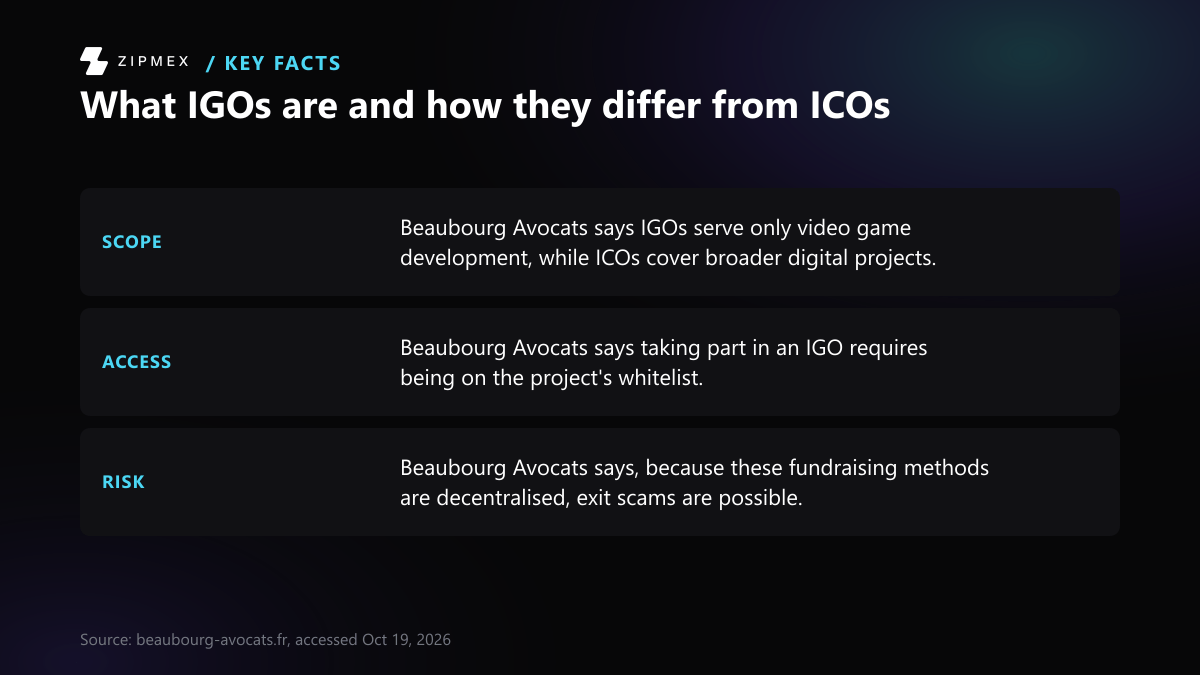
An initial game offering (IGO) is a pre-sale in which a blockchain game raises crypto funds before it launches. Buyers pay for the game's tokens or NFTs while the game is still being built. The sale usually runs through a launchpad platform, and only buyers on the project's whitelist can take part. Beaubourg Avocats, a Paris law firm, describes it as a way to "pre-purchase NFTs or tokens of a blockchain game at the start of its development." The firm also says IGOs carry real risk: no central body oversees them, exit scams are possible, and the game may never be finished.
How an IGO works
The steps below are taken from Beaubourg Avocats' explainer, published April 4, 2022.
- The venue. IGOs are run through launchpad platforms, and the terms can differ from one platform to another.
- The whitelist. Only investors on the project's whitelist can buy. The firm says the list is usually published a few hours before the sale opens.
- Getting on the list. There are two routes: win a place in a lottery, or hold a set number of the launchpad's own tokens.
- What you receive. Buyers get tokens or NFTs. The firm says that "most of the time" they are NFTs.
TokenMinds, a firm that sells launch services to blockchain game projects, gives a similar description. In a March 26, 2024 post, it says buyers receive in-game assets, often NFTs, game-specific tokens or exclusive access. The post is marketing material for its own services.
Each launchpad sets its own lottery rules, token-holding thresholds, lock-up periods and unlock schedules. None of the sources here gives figures that apply across platforms. The terms of the specific sale are the only reliable guide.
IGO vs ICO
Tangem's glossary (updated Feb. 4, 2025) calls IGOs "similar in concept" to initial coin offerings (ICOs) and initial exchange offerings (IEOs). The difference is that IGOs are specialised for gaming projects. They often include in-game items such as characters, skins, weapons or land.
Beaubourg Avocats puts the difference in terms of scope. IGOs fund only video game development. ICOs can fund digital-technology projects of any kind.
Does MiCA's white-paper rule cover this IGO?
Answer up to four questions about an IGO offered in the EU to see which MiCA rules the article says would apply.
What does the sale give buyers?
- A unique NFT that is not part of a large series and not a fraction of one → Likely outside MiCA
- NFTs from a large series or collection, or fractions of a unique NFT → next question
- A game token or other fungible crypto-asset → next question
- Tokens given away for free → Title II does not apply
Is the offer made only to qualified investors, or to fewer than 150 persons per Member State?
- Yes → Exempt from the white paper
- No → next question
Is the total consideration for the offer no more than EUR 1,000,000 over 12 months?
- Yes → Exempt from the white paper
- No → next question
Did you buy as a retail buyer directly from the offeror, before the token was admitted to trading?
Article 2(3) says MiCA does not apply to crypto-assets that are unique and not fungible with other crypto-assets. Regulators look at what the asset actually is, not what the issuer calls it.
Under Article 4(3), MiCA's offer rules in Title II do not apply to tokens given away for free.
Article 4(2) means no white paper is needed for this kind of offer, so the sale may have none. Ask which exemption it claims. The utility-token exemption does not help a game that has not launched yet.
Under Article 4(1), the offeror must be a legal person and must draw up, notify and publish a white paper. Under Article 13, you have 14 calendar days to withdraw.
Under Article 4(1), the offeror must be a legal person and must publish a white paper. The 14-day right in Article 13 covers only retail buyers who buy directly from the offeror, and not tokens already admitted to trading.
This covers only the EU MiCA rules described in the article. It is not legal advice, leaves out the US and other countries, and does not check any launchpad's terms, lock-ups or whether the game gets finished.
An Initial Game Offering (IGO) is a crowdfunding method used by game developers at an early stage to secure funding.
How regulators treat IGO assets
No regulator has a separate category for IGOs. The rules depend on what is being sold and where the buyer is.
European Union: MiCA
The Markets in Crypto-Assets Regulation (Regulation (EU) 2023/1114, MiCA) has applied in full since December 30, 2024. ESMA says a transitional period ran for up to 18 months after that date.
- Unique NFTs are excluded. Article 2(3) says the regulation "does not apply to crypto-assets that are unique and not fungible with other crypto-assets."
- The NFT label alone does not decide it. Recital 11 says fractional parts of a unique NFT are not unique. It also says issuing NFTs "in a large series or collection" is a sign that they are fungible. Regulators are to look at what the asset actually is, not what the issuer calls it. Many IGO sales sell large batches of NFTs, so they may fall inside MiCA.
- Game tokens follow Title II. Under Article 4(1), someone offering other crypto-assets to the public must be a legal person. They must draw up, notify and publish a crypto-asset white paper and follow MiCA's marketing rules.
- Exemptions. No white paper is needed for an offer to fewer than 150 persons per Member State, for an offer whose total consideration is no more than EUR 1,000,000 over 12 months, or for an offer only to qualified investors (Article 4(2)). Title II does not apply at all to tokens given away for free, or to a utility token for a good or service that already exists or is in operation (Article 4(3)). A game that has not launched yet does not meet that last condition.
- Right of withdrawal. Article 13 gives retail buyers who buy directly from the offeror 14 calendar days to withdraw. The right does not apply if the token was already admitted to trading before the purchase.
France
When Beaubourg Avocats wrote its article in April 2022, IGOs had no specific French rules. ICOs fell under the PACTE law of May 22, 2019. That position is now out of date. On July 6, 2026, the AMF (France's markets regulator) said the transition from the PACTE regime to MiCA ended on July 2, 2026. The European framework now applies to all market participants.
United States
On March 17, 2026, the SEC and CFTC issued interpretive release 33-11412. It became effective March 23, 2026. According to the law firm Gibson Dunn's summary, the release defines "digital collectibles" as crypto assets "designed to be collected and/or used," and its examples include in-game items. It classes them as non-securities, with two exceptions:
- A collectible sold as part of an investment contract is a security. The test is the Howey test: an investment of money in a common enterprise, with a reasonable expectation of profits from the efforts of others.
- Fractionalised collectibles "could constitute securities" if buyers expect profits from essential managerial efforts.
An IGO sold mainly on the promise that the team will build the game and the asset will gain value is the kind of sale the investment-contract test looks at. The release is an interpretation, not a statute, and the SEC can revise it. It replaces the SEC staff's 2019 digital-asset framework, which sec.gov now marks as withdrawn.
Risks for buyers
Beaubourg Avocats lists four risks:
- No oversight. No central body regulates or controls the sale.
- Exit scams. Because the fundraising is decentralised, exit scams are possible.
- No guaranteed return. Returns are not guaranteed, and prices can be very volatile.
- Unfinished games. The project is at an early stage, so it may never be completed.
The buyer pays first, while the game is still a plan. All four risks fall on the buyer. In the EU, the 14-day withdrawal right covers only some purchases. Exemptions for small offers also mean a sale may have no white paper at all.
Questions to check before a sale
These questions come from the rules above. They are not a recommendation to buy.
- Who is the offeror, and are they a legal entity you can identify?
- Is there a white paper? If an EU offer has none, which MiCA exemption does it claim?
- What exactly do you receive: a unique NFT, an NFT from a large series, or a fungible token?
- How did you get on the whitelist, and does the launchpad require you to hold or lock its own token? For how long?
- When do purchased tokens unlock, and can you withdraw from the purchase?
- Does the game exist yet, or does the sale fund its development?
Limitations: how IGOs work comes from one law firm's 2022 explainer and two industry glossaries, and the US section relies on a law firm's summary of the SEC release; launchpad terms vary and none were checked.