With crypto ETFs surpassing $115 billion in assets and 76% of institutional investors planning to expand their digital asset exposure in 2026, the question isn't whether to invest in crypto-it's how to spread that risk intelligently across multiple assets.
⚡ Quick Answer
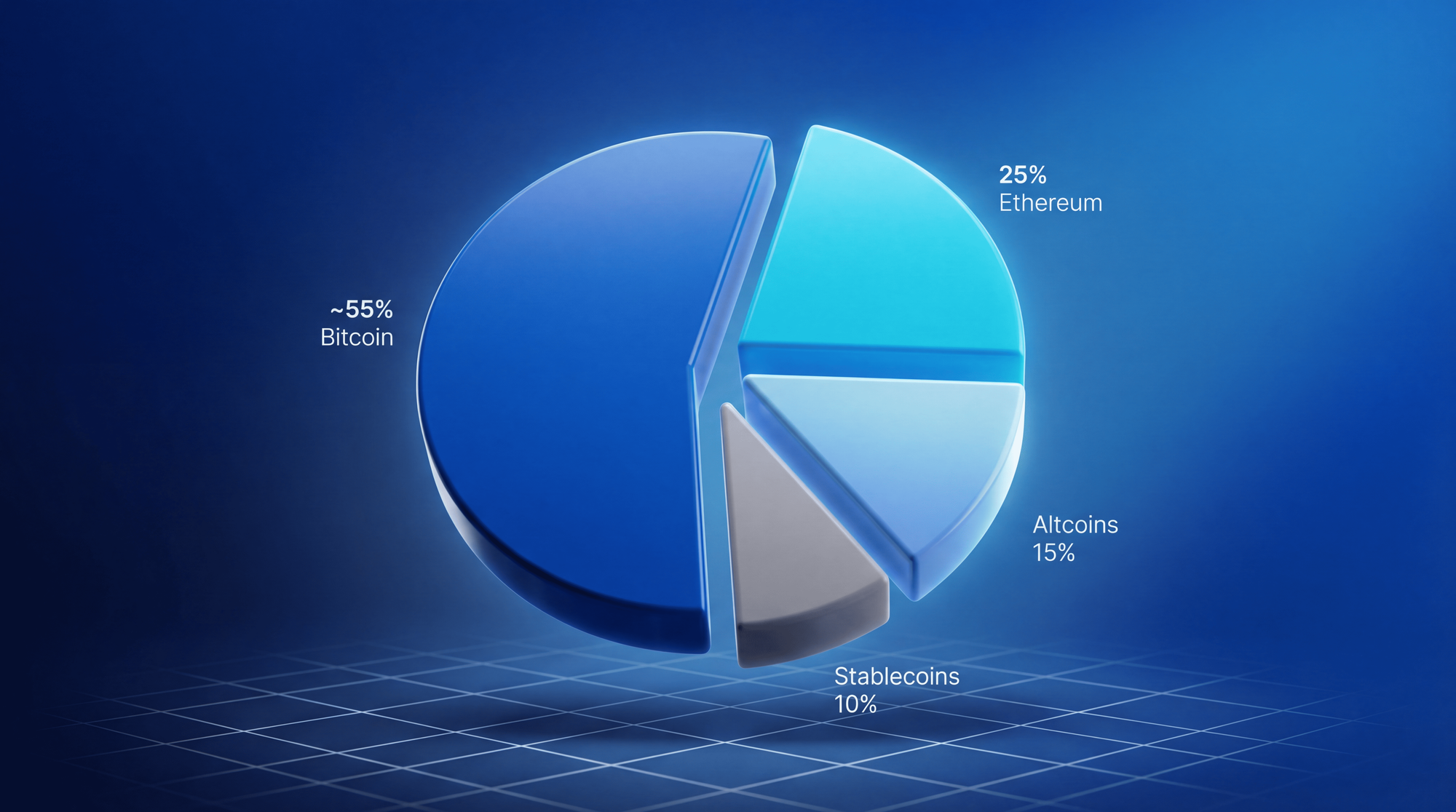
A well-diversified crypto portfolio in 2026 typically allocates 40-60% to Bitcoin and Ethereum (large-cap), 25-35% to established altcoins (mid-cap like Solana, XRP, Cardano), and 10-20% to emerging projects (small-cap, DeFi, RWAs). Always maintain 5-10% in stablecoins for liquidity and rebalancing opportunities.
Crypto portfolio diversification isn't about owning 50 different tokens-it's about strategically spreading risk across assets that don't move in perfect lockstep while maintaining exposure to growth opportunities. In a market where Bitcoin can swing 15% in a week and altcoins can drop 50% in a month, proper diversification is the difference between surviving volatility and being wiped out by it.
As of mid-January 2026, Bitcoin trades near $95,000-$96,000, with the total crypto market capitalization hovering above $3.0 trillion. Institutional adoption continues accelerating, with Grayscale reporting less than 0.5% of U.S. advised wealth currently allocated to crypto-leaving massive room for growth.

Why Crypto Portfolio Diversification Matters in 2026
The crypto market has matured dramatically. According to Coinbase's institutional research, 76% of global institutional investors plan to expand their digital asset exposure in 2026, with nearly 60% allocating over 5% of their assets under management to crypto. But this institutional money isn't flowing into random memecoins-it's targeting structured, diversified portfolios anchored by Bitcoin and Ethereum.
Here's why diversification is more critical than ever:
Market Correlation Shifts Constantly. During 2025's late-year correction, Bitcoin and Ethereum experienced 25-30% drawdowns from their peaks. However, certain sectors like Real World Assets (RWAs) surged 245%, surpassing $22.5 billion onchain. Investors concentrated in a single asset missed these rotation opportunities entirely.
Bitcoin Dominance Creates Cyclical Opportunities. Bitcoin's market dominance has fluctuated between 40% and 70% throughout market cycles. When dominance rises above 60%, capital typically shifts toward safety. When it drops into the 40s, altcoin seasons emerge-with 75% of top 50 altcoins historically outperforming Bitcoin over 90-day periods during these phases.
Regulatory Clarity Is Creating New Asset Classes. With Europe's MiCA framework setting standardized crypto rules and U.S. Bitcoin and Ethereum ETF approvals unlocking institutional capital, new categories like tokenized assets and stablecoins are becoming legitimate portfolio components. Understanding how to diversify your crypto portfolio now includes assets that didn't exist three years ago.
How Much of Your Portfolio Should Be Crypto?
Before diving into crypto diversification, you need to address a fundamental question: what percentage of your total wealth should be in cryptocurrency?
Morgan Stanley's Global Investment Committee and most financial advisors recommend limiting crypto to 5-10% of your overall investment portfolio-and many suggest even less for conservative investors. Here's why:
📊 The 5% Rule Explained
According to Grayscale Research, adding Bitcoin to a traditional 60/40 portfolio improves risk-adjusted returns (Sharpe Ratio) up to approximately 5% allocation. Beyond that point, additional crypto allocation no longer improves risk-adjusted returns-it simply adds more volatility.
Even a small 6% crypto allocation can nearly double overall portfolio volatility, according to Morgan Stanley simulations. If your crypto investment rises rapidly, rebalance to prevent your portfolio from becoming dangerously crypto-heavy.
The key insight: A little goes a long way. Because crypto is so volatile, even modest allocations can meaningfully impact both returns and risk.
Understanding Crypto Market Capitalization Tiers
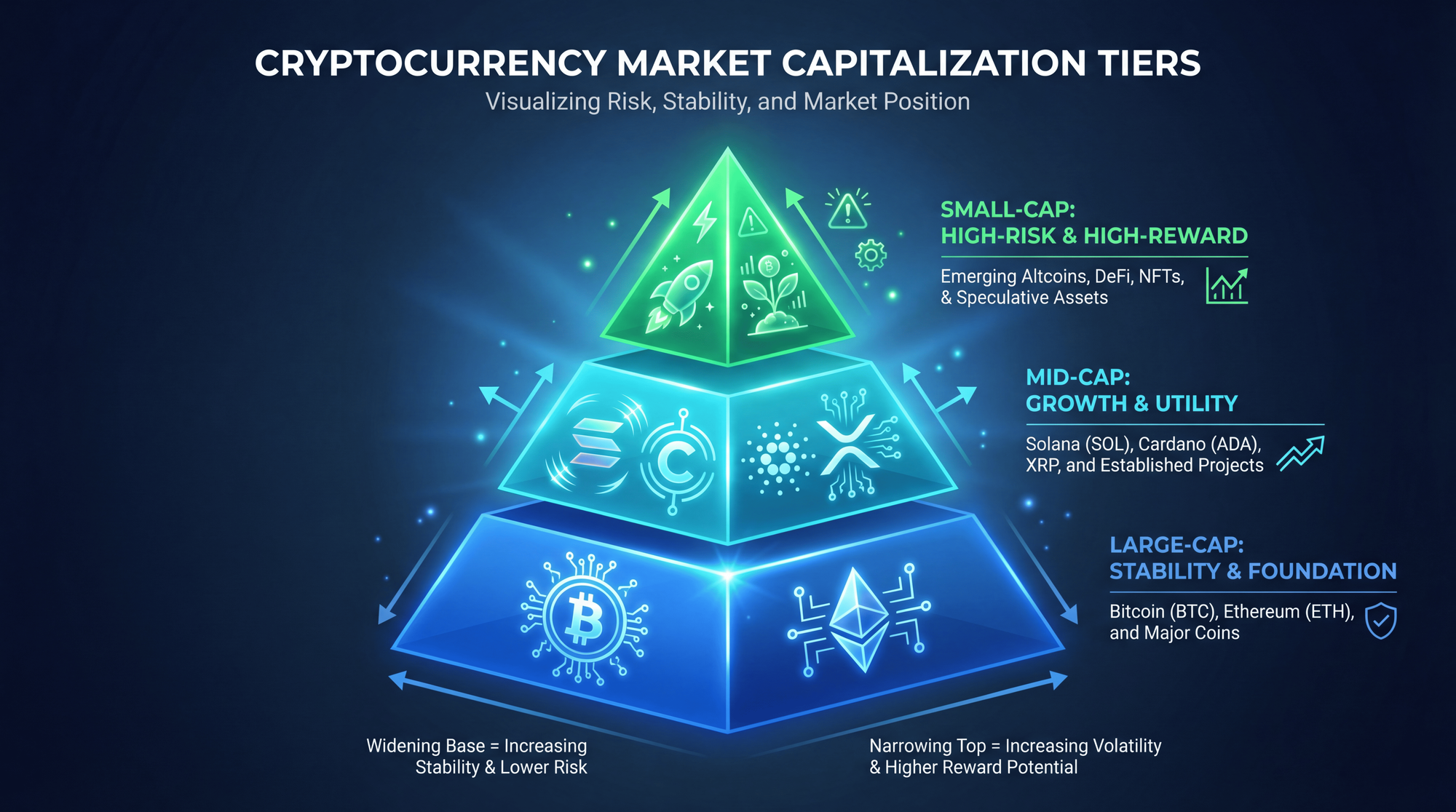
Before building your diversified portfolio, you need to understand how crypto assets are categorized by market capitalization. This hierarchy directly impacts risk, volatility, and potential returns.
Large-Cap Cryptocurrencies (The Foundation)
Large-cap cryptocurrencies typically have market capitalizations exceeding $10 billion. These are the blue-chip assets of the crypto world-Bitcoin and Ethereum-along with established altcoins like BNB and XRP.
Bitcoin (BTC) currently trades around $95,000-$96,000 as of mid-January 2026, with institutional investors holding over $115 billion in global crypto ETPs. Bitcoin's volatility is high compared to traditional assets but comparatively lower than most altcoins. This makes it the anchor in most diversified crypto portfolios. Bitcoin reached an all-time high above $126,000 in October 2025, demonstrating both its upside potential and its resilience as a store of value.
According to WisdomTree research, Bitcoin is typically uncorrelated with any major asset class-neither positively nor negatively correlated with the stock market. This makes it valuable for portfolio diversification, as it can "zig when other assets zag."
Ethereum (ETH) hovers near $3,300-$3,400 and represents exposure to smart contracts, decentralized applications, and the broader DeFi ecosystem. While some view Bitcoin as "digital gold," Ethereum functions more like a tech investment-volatile but tied to actual network utility and developer activity. If you're learning about blockchain fundamentals, Ethereum is essential to understand.
Mid-Cap Cryptocurrencies (Growth Engine)
Mid-cap cryptocurrencies range from approximately $1 billion to $10 billion in market capitalization. These offer higher growth potential than large-caps but with increased volatility and risk.
Current mid-cap leaders include:
Solana (SOL) trades near $140-$145 and has emerged as Ethereum's primary competitor for speed and low transaction costs. Solana's ecosystem includes NFT marketplaces, DeFi protocols, and emerging applications. The planned Alpenglow upgrade could finalize blocks in 100-150 milliseconds, potentially increasing demand for the SOL token. Pending ETF applications for SOL signal growing institutional interest.
XRP trades around $2.15-$2.40, with CNBC calling it the "hottest trade" of early 2026. Institutional demand through U.S.-listed spot XRP ETFs remains strong. Its focus on cross-border payments gives it a distinct use case from other cryptocurrencies.
Cardano (ADA) at approximately $0.39-$0.43 represents a methodical, research-driven approach to blockchain development. While slower to market with features, its academic foundation attracts certain institutional investors.
📈 January 2026 Market Snapshot
BTC
$95,000+
ETH
$3,300+
SOL
$142+
Small-Cap Cryptocurrencies (High Risk, High Reward)
Small-cap cryptocurrencies have market capitalizations below $1 billion. These assets carry the highest risk but also offer the greatest potential returns during bull markets.
This tier includes emerging DeFi protocols, AI-focused tokens, new Layer-2 solutions, and sector-specific projects. However, small-caps also include projects that may never recover or could be outright scams.
⚠ Risk Warning
In 2025, memecoins lost $40 billion in market cap, and AI tokens dropped roughly $35 billion despite early hype. Small-cap allocations should never exceed 10-20% of your total crypto portfolio, and you should be prepared to lose 100% of these investments.
Understanding Correlation: The Science of Diversification
True diversification isn't just about owning many tokens-it's about owning assets that don't move in lockstep. This is where correlation becomes crucial.
🔬 The Correlation Principle
Correlation measures how two assets move relative to each other, on a scale from -1 to +1:
- +1.0 = Perfect positive correlation (move identically)
- 0 = No correlation (move independently)
- -1.0 = Perfect negative correlation (move opposite)
According to CME Group research, many altcoins have high correlation to Bitcoin (often above 0.7), meaning when Bitcoin's price falls, they tend to fall too. However, XRP has notably lower correlation to Bitcoin, Ethereum, and Solana-making it potentially valuable for diversification within crypto.
Key insight from Coinbase institutional research: During market stress, correlations between crypto and other risk assets (like tech stocks) tend to increase. This means crypto may not provide the diversification you expect precisely when you need it most. That's why most advisors suggest limiting crypto to 5-10% of total portfolio allocation.
Crypto Diversification Strategies by Risk Profile
Not every investor should use the same allocation. Your diversification strategy should match your risk tolerance, investment timeline, and financial goals.
Conservative Portfolio (Lower Risk)
Best for: New investors, those nearing financial goals, or anyone who can't afford significant losses.
🔢 Conservative Portfolio Allocation
Bitcoin (BTC)
50-60%
Ethereum (ETH)
20-25%
Large-Cap Alts (SOL, XRP)
10-15%
Stablecoins (USDC, USDT)
10%
This allocation mirrors the institutional "60/40" approach adapted for crypto that XBTO and other professional asset managers recommend. With 70-85% in established large-caps, you're positioned to capture Bitcoin's store-of-value narrative while maintaining growth exposure through Ethereum.
Balanced Portfolio (Moderate Risk)
Best for: Investors with 3-5 year horizons who can handle moderate volatility for better growth potential.
🔢 Balanced Portfolio Allocation
Bitcoin (BTC)
35-45%
Ethereum (ETH)
20-25%
Mid-Cap Alts (SOL, XRP, ADA)
20-25%
Small-Cap / Emerging
5-10%
Stablecoins
5-10%
This allocation balances the stability of Bitcoin with meaningful exposure to mid-cap growth opportunities. The small-cap component allows for speculative upside without betting the portfolio on unproven projects.
Aggressive Portfolio (Higher Risk)
Best for: Experienced investors with long time horizons and high risk tolerance who can afford to lose significant capital.
🔢 Aggressive Portfolio Allocation
Bitcoin (BTC)
25-35%
Ethereum (ETH)
15-20%
Mid-Cap Alts
25-30%
Small-Cap / Emerging
15-20%
Stablecoins
5%
This portfolio reduces Bitcoin dominance to capture more altcoin volatility during growth phases. During Altcoin Seasons, 75% of top 50 altcoins historically outperform Bitcoin over 90-day periods. However, this same structure can lead to devastating drawdowns during Bitcoin Seasons.
How to Rebalance Your Crypto Portfolio
Diversification isn't a one-time event. Markets move constantly, and your carefully planned allocation will drift over time. Rebalancing restores your original allocation and locks in profits from outperformers.
When to Rebalance
Time-Based Rebalancing: Set a schedule-quarterly or monthly-to review and adjust allocations. This removes emotion from the process and creates discipline.
Threshold-Based Rebalancing: Rebalance when any asset deviates more than 5-10% from its target allocation. If Bitcoin rises from 40% to 50% of your portfolio, trim it back to target.
Volatility-Based Triggers: Some institutional investors use volatility targeting, scaling down altcoin exposure when realized volatility exceeds target bands. This is more sophisticated but can protect against sudden drawdowns.
Rebalancing Example
Suppose you started with a balanced portfolio:
| Asset | Target | After 6 Months | Action |
|---|---|---|---|
| BTC | 40% | 52% | Sell 12%, reallocate |
| ETH | 25% | 22% | Buy 3% |
| SOL | 15% | 8% | Buy 7% |
| Small-caps | 10% | 13% | Sell 3% |
| Stablecoins | 10% | 5% | Buy 5% |
This process forces you to sell high (trimming BTC and small-caps that outperformed) and buy low (adding to ETH and SOL that underperformed). Over time, this discipline tends to improve risk-adjusted returns.
⚠ Tax Consideration
Rebalancing triggers taxable events in most jurisdictions. In some regions, you cannot offset losses on one crypto against gains on another. Rebalancing too frequently can significantly reduce after-tax returns. Consider consulting a tax professional before implementing aggressive rebalancing strategies.
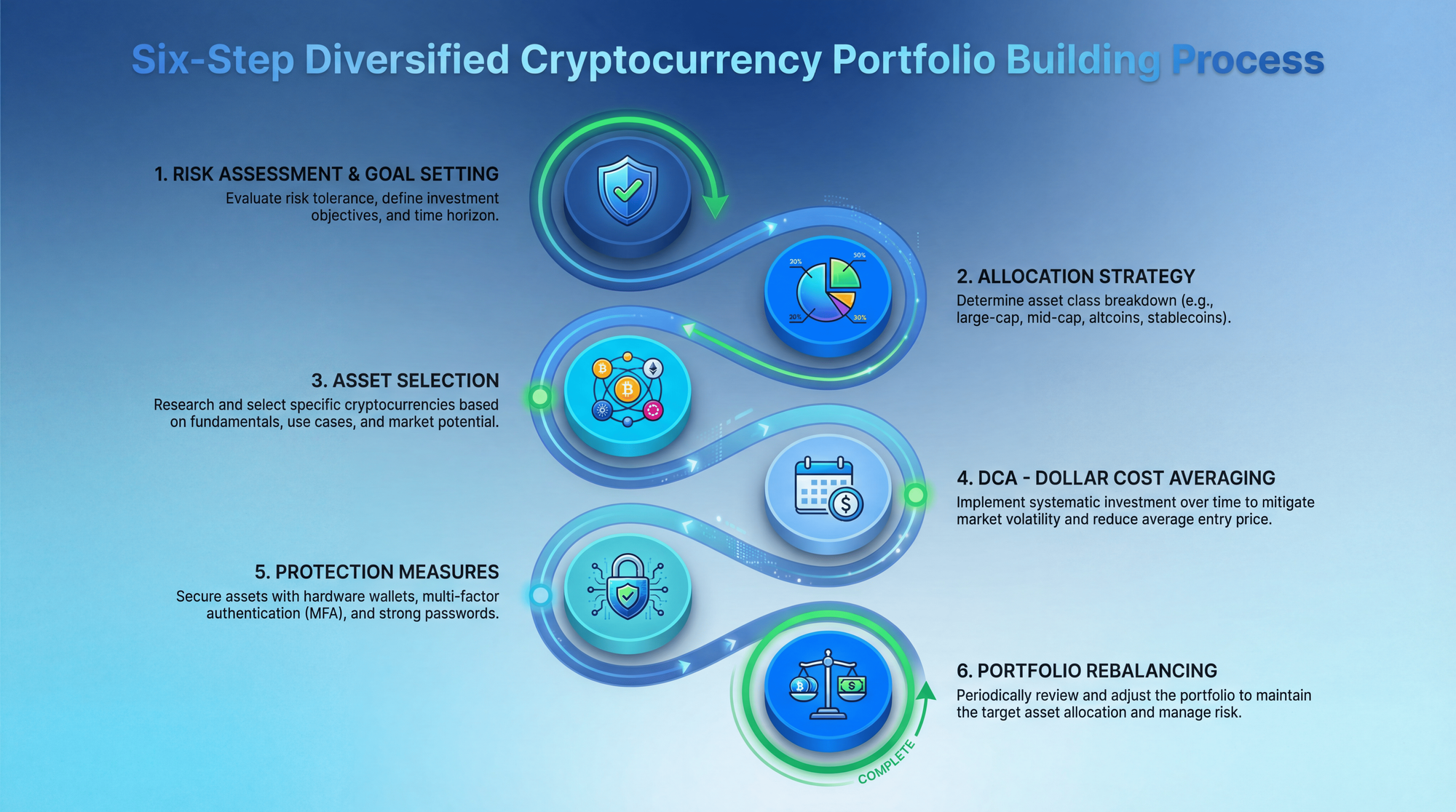
Bullish vs Bearish Factors for Crypto in 2026
Understanding both sides helps you maintain realistic expectations and adjust your diversification strategy accordingly.
📈 Bullish Factors
- Institutional Adoption Accelerating: 67% of institutional firms increasing crypto allocations, with Bitcoin ETFs holding $27.4B+ in assets.
- Regulatory Clarity Improving: MiCA in Europe and evolving U.S. frameworks removing uncertainty for large investors.
- Bitcoin's Historical Patterns: BTC has never posted back-to-back losing years; 2025's 6% loss may set up 2026 recovery.
- New ETF Filings: Pending ETF applications for Solana, XRP, Litecoin, Cardano, and Chainlink could unlock billions in new capital.
- RWA and Stablecoin Growth: Real-world assets surpassed $22.5B onchain, stablecoins projected to reach $1.2T by 2028.
📉 Bearish Factors
- Volatility Persists: Bitcoin swung from $126K ATH to $88K in late 2025-a 30% drawdown in weeks.
- Memecoin and AI Token Losses: These sectors lost $40B and $35B respectively in 2025, showing speculative excess remains dangerous.
- Macro Uncertainty: Interest rate policies, dollar strength, and geopolitical events continue affecting crypto as a risk asset.
- Low Liquidity Periods: Holiday and year-end trading shows thin liquidity can amplify price swings in either direction.
- Quantum Computing Concerns: While unlikely before 2030, research on quantum risk is accelerating.
Diversifying by Sector: Beyond Market Cap
Smart diversification extends beyond market cap tiers. Spreading investments across different blockchain use cases reduces correlation risk and captures emerging narratives.
Key Crypto Sectors for 2026
Store of Value / Digital Gold: Bitcoin remains the dominant play. Strategy (formerly MicroStrategy) and other corporate treasuries continue accumulating, creating steady institutional demand.
Smart Contract Platforms: Ethereum leads, but Solana and Cardano offer exposure to competing architectures. Each handles transactions differently and attracts different developer communities.
DeFi (Decentralized Finance): Lending protocols like Compound and Aave allow users to earn yield on deposited crypto. Understanding staking and DeFi fundamentals is essential before allocating to this sector.
Real World Assets (RWAs): This emerging sector surged 245% in 2025, surpassing $22.5 billion onchain. It includes tokenized treasuries, real estate, and commodities. Grayscale and other institutions predict RWAs will be a dominant theme through 2026.
Stablecoins: USDC and USDT aren't just for parking cash. The stablecoin market could reach $1.2 trillion by 2028 according to Coinbase projections. Learn more about USDT and how stablecoins function in diversified portfolios.
Gold-Backed Stablecoins: A new 2025-2026 trend. These stablecoins are pegged to gold prices rather than USD. When gold rose nearly 70% in 2025, gold stablecoins became some of the top-performing cryptocurrencies.
Privacy Coins: Zcash (ZEC) and Monero (XMR) soared in 2025, driven by concerns over online privacy and blockchain surveillance. These assets often move independently from Bitcoin, offering potential diversification benefits.
Crypto ETFs: A Diversification Shortcut
The crypto ETF landscape has dramatically expanded since 2024. By late 2025, Bitcoin and Ethereum ETFs had amassed over $115 billion in assets, with BlackRock's IBIT managing $75 billion and Fidelity's FBTC surpassing $20 billion.
Why Consider Crypto ETFs?
Regulated access: ETFs provide SEC-sanctioned exposure without needing to manage wallets or private keys.
Diversification within crypto: Expect 50+ new spot altcoin ETFs in 2026, including Solana, XRP, Litecoin, and Cardano products. This allows index-style diversification across crypto.
Portfolio integration: ETFs fit seamlessly into traditional brokerage accounts, IRAs, and institutional portfolios.
No custody concerns: The ETF provider handles secure storage, eliminating self-custody risk.
✅ ETF Consideration
For investors who want crypto exposure without the complexity of managing digital wallets, crypto ETFs offer a compelling alternative. However, you don't actually own the underlying crypto-you own shares in a fund that holds crypto. This means you can't use it in DeFi protocols or transfer it to other wallets.
Dollar-Cost Averaging vs. Lump Sum Investing
How you enter the market matters as much as what you buy.
Dollar-Cost Averaging (DCA)
With DCA, you invest a fixed amount at regular intervals-say, $200 every week-regardless of price. This approach:
- Reduces timing risk: You don't need to predict market bottoms
- Smooths entry price: You buy more when prices are low, less when high
- Creates discipline: Removes emotion from investment decisions
- Works well in volatile markets: Particularly suited to crypto's wild swings
Lump Sum Investing
Investing your entire allocation at once can work if:
- You believe the market is at a favorable entry point
- You have a very long time horizon (5+ years)
- You can psychologically handle potential immediate losses
- Historical data shows lump sum beats DCA about 2/3 of the time in rising markets
How to Rebalance Your Crypto Portfolio
Diversification isn't a one-time event. Markets move constantly, and your carefully planned allocation will drift over time. Rebalancing restores your original allocation and locks in profits from outperformers.
When to Rebalance
Time-Based Rebalancing: Set a schedule-quarterly or monthly-to review and adjust allocations. This removes emotion from the process and creates discipline.
Threshold-Based Rebalancing: Rebalance when any asset deviates more than 5-10% from its target allocation. If Bitcoin rises from 40% to 50% of your portfolio, trim it back to target.
Volatility-Based Triggers: Some institutional investors use volatility targeting, scaling down altcoin exposure when realized volatility exceeds target bands. This is more sophisticated but can protect against sudden drawdowns.
Rebalancing Example
Suppose you started with a balanced portfolio:
| Asset | Target | After 6 Months | Action |
|---|---|---|---|
| BTC | 40% | 52% | Sell 12%, reallocate |
| ETH | 25% | 22% | Buy 3% |
| SOL | 15% | 8% | Buy 7% |
| Small-caps | 10% | 13% | Sell 3% |
| Stablecoins | 10% | 5% | Buy 5% |
This process forces you to sell high (trimming BTC and small-caps that outperformed) and buy low (adding to ETH and SOL that underperformed). Over time, this discipline tends to improve risk-adjusted returns.
⚠ Tax Consideration
Rebalancing triggers taxable events in most jurisdictions. In some regions, you cannot offset losses on one crypto against gains on another. Rebalancing too frequently can significantly reduce after-tax returns. Consider consulting a tax professional before implementing aggressive rebalancing strategies.
Common Crypto Diversification Mistakes to Avoid
Even experienced investors make diversification errors. Here are the most common pitfalls:
1. Over-Diversification
Holding 50+ different tokens isn't diversification-it's chaos. Many small-cap tokens are highly correlated and will all crash together during bear markets. 5-15 carefully selected assets typically provides optimal diversification without diluting returns.
2. False Diversification
Owning 10 different memecoins doesn't diversify your risk-they'll all crash together. True diversification means owning assets with different use cases, risk profiles, and correlation patterns.
3. Ignoring Correlation During Market Stress
During panic events, correlations spike across all crypto assets. Even "diversified" portfolios can drop 40-60% in weeks. Stablecoins are the only true hedge during extreme downturns.
4. Chasing Narratives
Buying every hyped narrative (AI tokens, memecoins, whatever is trending) leads to buying high and selling low. Stick to your allocation plan rather than chasing the latest social media trend.
5. Never Rebalancing
Without rebalancing, one outperformer can dominate your portfolio and dramatically increase risk. Regular rebalancing locks in profits and maintains your intended risk level.
6. Ignoring the 5% Rule
Allocating 25% or 50% of your total wealth to crypto is extremely risky. Most financial advisors recommend 5-10% maximum of total portfolio in crypto assets.

Portfolio Tracking Tools and Platforms
Managing a diversified crypto portfolio requires the right tools. Here are the most effective options:
Portfolio Trackers
CoinStats: Supports multiple blockchains and wallets with detailed analytics and real-time performance tracking.
Delta: User-friendly interface with performance tracking, price alerts, and portfolio analysis across exchanges.
Zerion: Excellent for DeFi-focused investors, tracking on-chain positions directly from your wallet.
CoinGecko/CoinMarketCap: Free portfolio tracking with comprehensive market data and price alerts.
Exchange Platforms
Choose exchanges that offer the assets you need with strong security:
- Wide selection of tokens including DeFi, AI, and RWA projects
- Strong security standards and regulatory compliance
- Low fees for frequent rebalancing
- Good liquidity for larger trades
2026 Outlook: Bullish and Bearish Factors
Understanding both sides helps you maintain realistic expectations and adjust your diversification strategy accordingly.
📈 BULLISH FACTORS
- 76% of institutions increasing crypto allocations
- Crypto ETFs surpass $115B in assets
- Grayscale expects BTC to exceed ATH in H1 2026
- Less than 0.5% of advised wealth in crypto (room to grow)
- Regulatory clarity (MiCA, GENIUS Act)
- 50+ new altcoin ETFs expected in 2026
- RWAs surpassed $22.5B onchain
- Bitcoin never posted back-to-back losing years
📉 BEARISH FACTORS
- Bitcoin dropped 30% from $126K ATH to $88K
- Memecoins lost $40B in 2025
- AI tokens dropped $35B despite hype
- ETF flows can reverse quickly
- Correlations spike during market stress
- Small 6% allocation can double portfolio volatility
- Global macro uncertainty persists
- Regulatory surprises still possible
Step-by-Step: Building Your Diversified Crypto Portfolio
Follow this actionable guide to implement your diversification strategy:
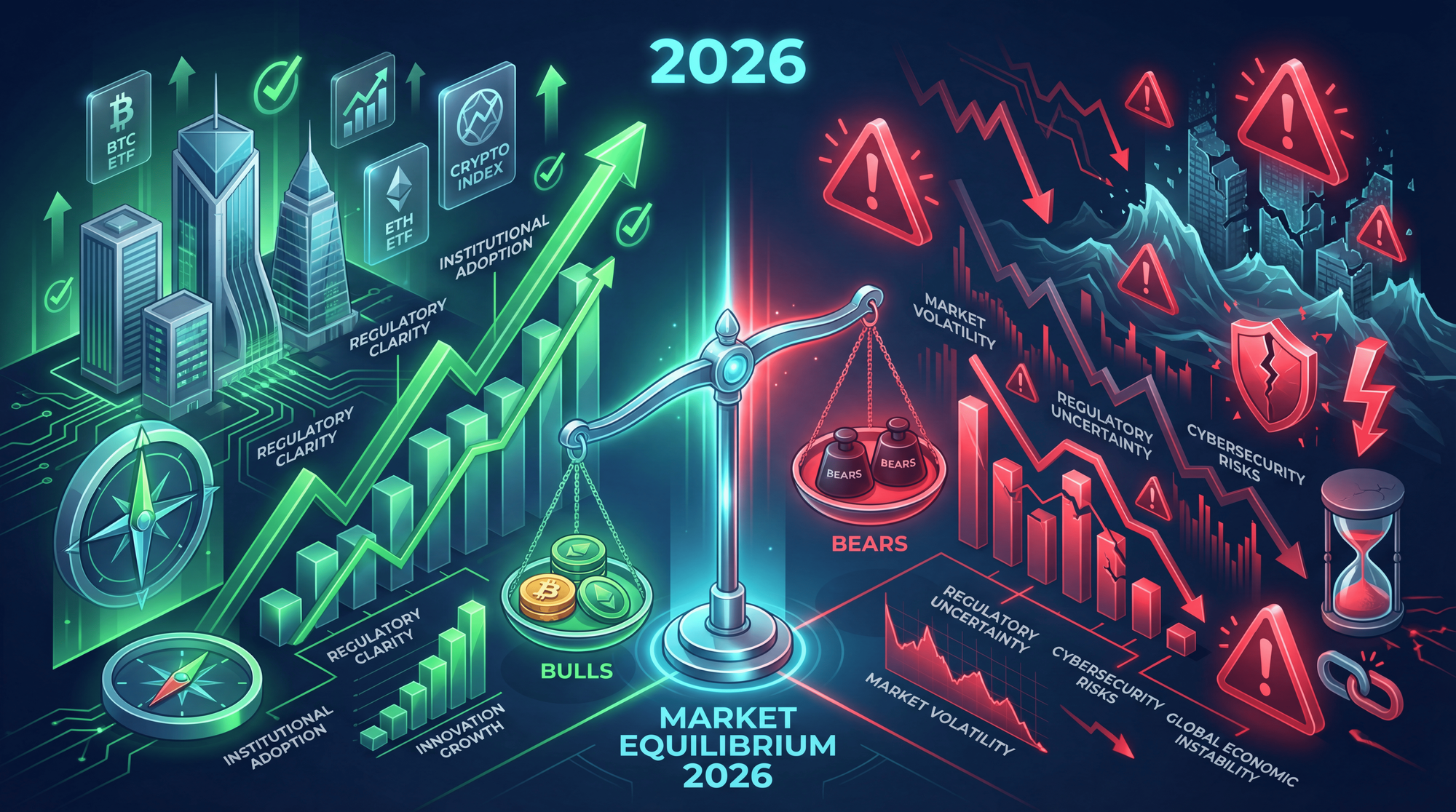
📋 Your 6-Step Action Plan
Step 1: Determine Total Crypto Allocation
Limit crypto to 5-10% of your total investment portfolio. Calculate your dollar amount based on what you can afford to lose entirely.
Step 2: Choose Your Risk Profile
Select conservative (70%+ BTC/ETH), balanced (55-65% BTC/ETH), or aggressive (40-55% BTC/ETH) based on your timeline and risk tolerance.
Step 3: Select Specific Assets
Research and choose 5-15 assets across different sectors: store of value (BTC), smart contracts (ETH, SOL), DeFi, RWAs, and stablecoins.
Step 4: Choose Entry Strategy
Decide between DCA (safer for beginners), lump sum (if confident in timing), or hybrid (50% now, 50% over 3-6 months).
Step 5: Set Up Secure Storage
Use exchanges for active trading, cold wallets for long-term holdings (anything you plan to hold 6+ months), and consider ETFs for simplicity.
Step 6: Schedule Rebalancing
Set quarterly calendar reminders to review allocations. Rebalance when any asset drifts 5-10% from target. Consider tax implications before trading.
Frequently Asked Questions
How many cryptocurrencies should I hold in my portfolio?
Most experts recommend 5-15 carefully selected assets for optimal diversification. Holding fewer than 5 concentrates too much risk, while holding more than 15-20 dilutes returns and becomes difficult to manage. Focus on quality over quantity-5 well-researched assets across different sectors beats 50 random tokens.
What percentage of my total portfolio should be in crypto?
Financial advisors typically recommend 5-10% maximum. According to Grayscale Research, risk-adjusted returns (Sharpe Ratio) improve up to about 5% allocation, then plateau. Morgan Stanley simulations show even a 6% crypto allocation can nearly double overall portfolio volatility.
Should I just buy Bitcoin, or do I need to diversify within crypto?
Bitcoin alone provides meaningful crypto exposure and is the safest single-asset approach. However, adding Ethereum and select altcoins can improve returns during certain market cycles. A common starting point: 60-70% Bitcoin, 20-25% Ethereum, 10-15% carefully selected altcoins.
Is it better to buy crypto directly or use ETFs?
ETFs offer simplicity, regulatory protection, and easy portfolio integration without custody concerns. Direct ownership provides more flexibility (DeFi access, transfers, staking) but requires managing security yourself. Many investors use both: ETFs in retirement accounts, direct ownership for active management.
How often should I rebalance my crypto portfolio?
Quarterly rebalancing works well for most investors. More frequent rebalancing (monthly) can improve risk management but increases tax events and transaction costs. Threshold-based rebalancing (when any asset drifts 5-10% from target) is another effective approach.
What's the best crypto allocation for beginners with $500?
Start simple: 50% Bitcoin, 30% Ethereum, 20% stablecoins. This provides core exposure while maintaining flexibility. Use dollar-cost averaging-invest $100/week over 5 weeks rather than all at once. Avoid small-cap tokens until you understand the market better.
Are memecoins worth including for diversification?
Generally no. Memecoins lost $40 billion in 2025 and offer no fundamental value or utility. They're highly correlated with each other and crash together. If you must speculate, limit memecoins to less than 5% of your crypto allocation and expect to lose 100% of that position.
How do I diversify crypto if I'm risk-averse?
Focus on 70-80% Bitcoin, 15-20% Ethereum, and 5-10% stablecoins. Avoid small-caps entirely. Consider crypto ETFs for regulated exposure without custody risk. Use dollar-cost averaging over 6-12 months rather than lump sum investing. Keep crypto to 3-5% of total portfolio.
What are the risks of over-diversification?
Holding too many assets dilutes returns, increases complexity, and doesn't actually reduce risk if assets are correlated. Many altcoins have 0.7+ correlation with Bitcoin-they'll all crash together anyway. Better to own 8-10 carefully researched, uncorrelated assets than 50 random tokens.
Should I hold stablecoins as part of my diversification strategy?
Yes. Stablecoins provide liquidity for rebalancing, protection during market crashes, and earning opportunities through DeFi yields. Most professional portfolios maintain 5-10% in stablecoins, increasing to 20-30% during extreme uncertainty. They're the only true "safe haven" within crypto during panic events.
Key Takeaways
🎯 Summary: How to Diversify Your Crypto Portfolio in 2026
- Limit crypto to 5-10% of your total investment portfolio
- Core allocation: 40-60% Bitcoin + Ethereum (large-cap foundation)
- Growth allocation: 25-35% mid-cap altcoins (SOL, XRP, ADA)
- Speculative allocation: 10-20% small-caps and emerging sectors
- Always maintain 5-10% stablecoins for liquidity and rebalancing
- Diversify by sector, not just market cap (DeFi, RWAs, smart contracts)
- Understand correlation-many altcoins move in lockstep with Bitcoin
- Use DCA to reduce timing risk, especially in volatile markets
- Rebalance quarterly or when allocations drift 5-10% from targets
- Consider crypto ETFs for simplified, regulated exposure
Ready to build your diversified crypto portfolio? Start with proven strategies, stick to your allocation plan, and remember that proper diversification is a marathon-not a sprint. For more cryptocurrency investing tips, explore our education resources.
Start Building Your Crypto Portfolio Today
Access 100+ cryptocurrencies with competitive fees and advanced trading tools.
Trade on Zipmex →Disclaimer: This article is for educational purposes only and does not constitute financial advice. Cryptocurrency investments are highly volatile and can result in significant losses. Never invest more than you can afford to lose. Past performance does not guarantee future results. Always conduct your own research and consider consulting a financial advisor before making investment decisions.