
Yes. As of October 2026, it is legal for individuals in the United States to own, buy, sell and use bitcoin, and no federal statute bans it. The federal government treats it as several things at once. For tax purposes, the IRS treats it as property. The SEC and CFTC classified it as a "digital commodity" in a joint interpretation dated March 17, 2026. FinCEN says an individual user is not a money transmitter, but a business that exchanges or administers it for others is. Bitcoin is not legal tender. The duties that come with it depend on what you do: holding and selling brings tax reporting, while running a bitcoin business brings registration and licensing.
The newest development: the market structure bill stalled
On September 15, 2026, the Senate voted on cloture on the motion to proceed to H.R. 3633, the Digital Asset Market Clarity Act (CLARITY Act). The Senate's own roll call record (vote 234) lists the result as "Cloture on the Motion to Proceed Rejected." Orrick's October 2, 2026 summary gives the tally as 49–50, short of the 60 votes needed. The House had passed the bill 294–134 on July 17, 2025.
The vote does not change whether bitcoin is legal. The bill would have written a federal market structure for digital commodities into statute. Without it, the current framework comes from agency actions and older laws, described below. Orrick reports that Senator Tillis voted no so he could enter a motion to reconsider, which keeps a path open to revive the bill. The firm adds that passage this Congress is "widely viewed as unlikely."
Who regulates what
SEC and CFTC: bitcoin as a digital commodity
On March 17, 2026, the SEC and CFTC issued a joint interpretation titled "Application of the Federal Securities Laws to Certain Types of Crypto Assets and Certain Transactions Involving Crypto Assets" (Release No. 33-11412). Law firm summaries by Norton Rose Fulbright and Pillsbury report that it names bitcoin among the assets the agencies treat as digital commodities, which are not themselves securities. The same summaries add one caveat: an asset that is not a security can still be offered as part of an investment contract, depending on the promises made to buyers.
The SEC has already allowed bitcoin products on US securities exchanges. On January 10, 2024, it approved the listing and trading of a number of spot bitcoin exchange-traded product (ETP) shares.
On August 18, 2026, the SEC proposed "Regulation Crypto Assets" (Release No. 33-11434). It would create Securities Act exemptions for crypto investment contracts. It is a proposal, not a final rule.
FinCEN: users versus businesses
FinCEN's guidance FIN-2013-G001, issued March 18, 2013, says: "A user of virtual currency is not an MSB under FinCEN's regulations." It also says that "an administrator or exchanger is an MSB under FinCEN's regulations, specifically, a money transmitter." A money services business (MSB) carries registration, anti-money-laundering and recordkeeping duties under the Bank Secrecy Act. FinCEN updated how this applies to specific business models in guidance FIN-2019-G001, issued May 9, 2019.
In practice, buying bitcoin and holding it for yourself creates no FinCEN registration duty. Exchanging it for other people as a business does.
States: New York as the example
States license crypto businesses separately from federal rules. New York's Department of Financial Services says that "a person (whether an individual or a company) that engages in Virtual Currency Business Activity requires a BitLicense." That activity includes holding virtual currency for others and offering exchange services. DFS also says consumers who buy crypto only as an investment, and merchants who use it only to buy or sell goods and services, do not need one. A New York limited purpose trust company can do this business without a BitLicense if the Superintendent approves. Other states set their own rules. Check your state regulator's page before you start any business activity.
The federal government holds bitcoin itself
Executive Order 14233, signed March 6, 2025, created a Strategic Bitcoin Reserve. Its bitcoin comes from coins the Treasury has "finally forfeited as part of criminal or civil asset forfeiture proceedings." The order says bitcoin deposited in the reserve "shall not be sold," with limited exceptions such as returning assets to crime victims.
Stablecoins have their own law
The GENIUS Act (S. 1582, the Guiding and Establishing National Innovation for U.S. Stablecoins Act) was signed on July 18, 2025. It regulates payment stablecoins, not bitcoin. It is the first federal statute written specifically for a class of crypto assets.
What duties does your bitcoin activity bring?
Answer a few questions about what you do with bitcoin to see the main federal duty the article describes, plus New York's licensing rule.
Do you exchange or administer bitcoin for other people as a business?
- Yes, as a business → next question
- No, only for myself → next question
Does that business engage in virtual currency business activity in New York, such as holding bitcoin for others or offering exchange services?
During the year, did you sell, exchange or spend bitcoin?
- Yes → next question
- No, I only bought and held it → Answer the Form 1040 question
Did you sell through a custodial platform, meaning a broker that takes possession of the bitcoin being sold?
- Yes, through a custodial platform → Report it on Form 8949 and expect a Form 1099-DA
- No, without a broker → Report it on Form 8949 and keep your own records
Buying and holding bitcoin for yourself is legal and creates no FinCEN registration duty. Your individual return still asks whether you received, sold, exchanged or otherwise disposed of a digital asset during the year, and you answer Yes or No.
The IRS treats bitcoin as property, so selling, exchanging or spending it can create a capital gain or loss. Report it on Form 8949 and answer the Form 1040 question. Without a broker, no Form 1099-DA arrives, but you still owe the tax.
Report the gain or loss on Form 8949 and answer the Form 1040 question. A broker that takes possession of the bitcoin must report gross proceeds for transactions on or after January 1, 2025, and basis on certain transactions on or after January 1, 2026.
Under FinCEN guidance FIN-2013-G001, an exchanger or administrator is a money transmitter. That brings registration, anti-money-laundering and recordkeeping duties under the Bank Secrecy Act. Your state's own licensing rules apply on top of the federal ones.
The FinCEN money transmitter duties apply. New York's Department of Financial Services also requires a BitLicense for virtual currency business activity. A New York limited purpose trust company can do this business without one if the Superintendent approves.
This covers only the federal duties and New York's rule described in the article. It leaves out other states' licensing, income from receiving bitcoin as payment or a reward, and token offerings that securities law may cover. It is not legal, tax or investment advice.
How the IRS taxes bitcoin
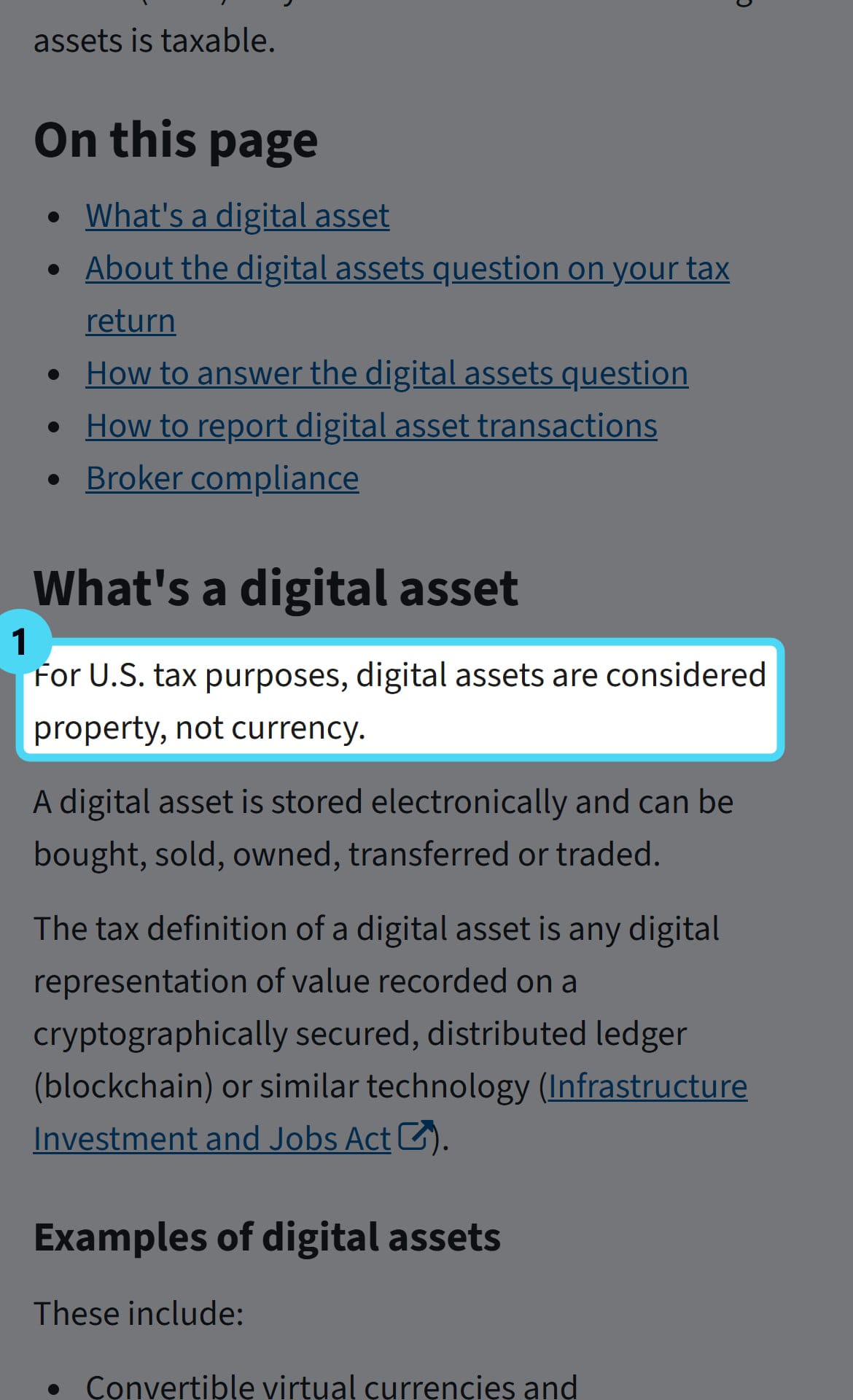
The IRS digital assets page, last reviewed September 2, 2026, says: "For U.S. tax purposes, digital assets are considered property, not currency." Selling bitcoin, exchanging it or spending it can create a capital gain or loss. Receiving it as payment or a reward is income. IRS Notice 2014-21 says virtual currency "does not have legal tender status in any jurisdiction."
What this means at filing time:
- The Form 1040 question. Every individual return asks whether, during the year, you received a digital asset as a reward, award or payment, or sold, exchanged or otherwise disposed of one. You answer Yes or No.
- Form 8949. The IRS says to report sales and other dispositions of capital assets, including digital assets, on Form 8949.
- Form 1099-DA. Brokers must report gross proceeds for transactions on or after January 1, 2025. They must also report basis on certain transactions on or after January 1, 2026.
Which brokers report
The IRS says the final regulations apply to brokers that take possession of the digital assets being sold. Examples include operators of custodial trading platforms and certain hosted wallet providers, digital asset kiosks and payment processors. A separate rule for decentralized, non-custodial brokers was overturned under the Congressional Review Act. The President signed that resolution, H.J.Res.25, on April 10, 2025, according to the House Ways and Means Committee. If you sell through a custodial platform, expect a Form 1099-DA. If you transact without a broker, you still owe the tax and must keep your own records.
Who needs to do what
| Activity | Main federal duty | Where the rule comes from |
|---|---|---|
| Buying and holding bitcoin | Answer the Form 1040 digital asset question | IRS |
| Selling, exchanging or spending bitcoin | Report the gain or loss on Form 8949 | IRS |
| Selling through a custodial platform | The broker files Form 1099-DA (proceeds from 2025, basis from 2026) | IRS |
| Exchanging or administering bitcoin for others as a business | Register as an MSB (money transmitter) and meet AML duties | FinCEN FIN-2013-G001 |
| Running a virtual currency business in New York | BitLicense or limited purpose trust charter | NY DFS |
| Offering a token as an investment contract | Securities law applies | SEC |
This article covers federal law and New York's licensing rule. If your business operates in another state, that state's licensing rules apply on top of the federal ones. Nothing here is legal, tax or investment advice.
