
A negative balance warning means your imported records show you selling or withdrawing more of a coin than the software can see you holding at that moment. The cause is almost always a gap or error in your data, not borrowing. Waltio says the most common cause is a duplicate transaction, such as the same platform added both by file and by API. Coinpanda says the most common cause is missing history, such as coins bought on a platform you never imported. Fix the records, because an unresolved warning usually makes your reported gain larger than it really is.

What the warning means in each tool
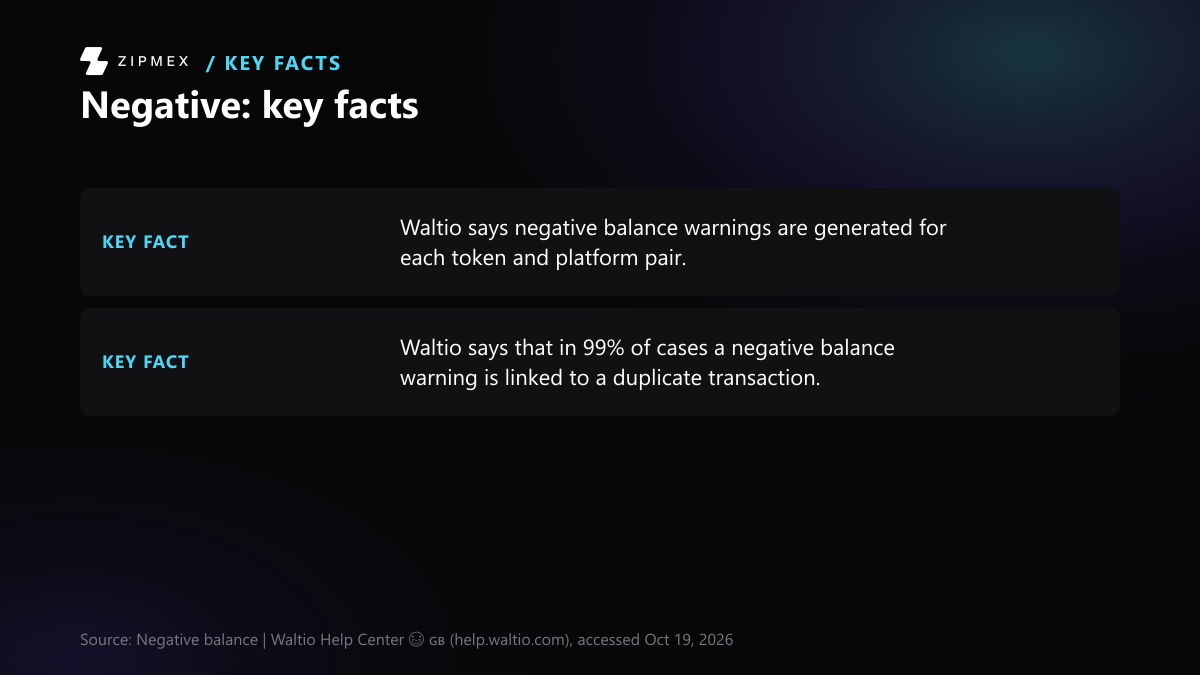
Waltio (help article last updated July 31, 2026) says a warning "is generated when a transaction seems impossible based on the information provided", for example a withdrawal larger than your recorded stock. It lists warnings per token and per platform. Waltio does not display a negative balance smaller than -10 €.
Coinpanda (help article dated November 18, 2023) shows the warning on the Transactions page when you appear to sell more of a coin than you held at the time. Its example: you buy a coin on one platform and move it to a second platform. If you import only the second platform's history, the coin looks as if it appeared from nowhere.
The usual causes
Waltio names three:
- One or more deposits are missing.
- One or more withdrawals are recorded more than once.
- Transactions are in the wrong order, for example a withdrawal recorded before the deposit that funded it.
Coinpanda's list centres on missing incoming transactions:
- incomplete trade history from one or more platforms
- transactions missed because of a platform's API limits
- untracked airdrops, rewards, bonuses, interest or distributions
- mining or staking income that was never imported
- gifted crypto that was never recorded
- rounding errors, which are harmless when the balance is very small
Waltio adds several patterns:
- Many warnings on one platform probably share one cause.
- Warnings on a wallet are "very likely due to bridge transactions not being read".
- A badly formatted import file can cause warnings.
- API keys older than six months can miss transactions. Waltio advises renewing them.
How to fix it in Waltio
Waltio's help centre gives this order:
- Filter the warnings. Open the corrections page, filter for negative balances, select a transaction and click "Correct". The stock sheet helps you see which cause applies.
- Look for duplicates first. Waltio says that "in 99% of cases" a warning is linked to a duplicate transaction, often because both a file and an API were added for the same platform. Two transactions with the same amount, the same tokens and the same time are likely duplicates. If you are unsure, check the platform's own records.
- Check manual entries. Look for typos such as a wrong platform name or a wrong amount.
- Check for missing transactions and accounts. Confirm Waltio reads every transaction type for the platform. Add missing file types, such as a full statement. Create unsupported transactions by hand or by file, and make sure every platform and blockchain is added. If a transaction is in your file or API data but Waltio does not read it, contact support.
- Fix the order. Waltio says that "in 99% of cases" an ordering problem is a withdrawal appearing before a deposit. Move the deposit earlier so it is recorded first.
If the balance is still negative, Waltio "will by default consider in your report that your balance was 0", and you can move on to the next correction. Waltio also offers paid Expert review and Full service options for a more accurate calculation.
Match your warning to a likely fix
Answer each question to reach the likely cause and the step to take.
Is the balance very small?
Source: "Negative balance" warnings | Coinpanda Help Center (help.coinpanda.io), accessed Oct 19, 2026Are there two transactions with the same amount, tokens and time?
- Yes → Check for a duplicate
- No → next question
Does a withdrawal appear before a deposit?
- Yes → Move the deposit earlier
- No → next question
Are deposits missing, or were transactions entered by hand?
- Yes → Check manual entries
- No → next question
Is a platform or blockchain missing from the account?
- Yes → Add the missing platform
- No → Still open
Coinpanda says a very small missing amount has a negligible impact on final capital gains. You can most likely ignore it.
Source: "Negative balance" warnings | Coinpanda Help Center (help.coinpanda.io), accessed Oct 19, 2026Waltio says a pair of transactions with the same amount, tokens and timing is very likely a duplicate. Check whether the two entries are the same transaction.
Source: Negative balance | Waltio Help Center 😃 🇬🇧 (help.waltio.com), accessed Oct 19, 2026Waltio says to move the deposit earlier, so it is recorded before the withdrawal.
Source: Negative balance | Waltio Help Center 😃 🇬🇧 (help.waltio.com), accessed Oct 19, 2026Waltio says manually entered transactions can often be a source of errors. Review those entries and any missing deposits.
Source: Negative balance | Waltio Help Center 😃 🇬🇧 (help.waltio.com), accessed Oct 19, 2026Waltio's example says a wallet added without a blockchain could also cause negative balances and an incorrect tax report. Add the missing platform or blockchain.
Source: Negative balance | Waltio Help Center 😃 🇬🇧 (help.waltio.com), accessed Oct 19, 2026If the balance is not corrected, Waltio counts it as 0 in the report by default.
Source: Negative balance | Waltio Help Center 😃 🇬🇧 (help.waltio.com), accessed Oct 19, 2026The branches cover only the causes and fixes both help centres describe; they do not check your own transactions.
Having a negative balance means that your stock of a cryptocurrency on a platform is less than 0 at a given moment.
How to fix it in Coinpanda
For a large negative balance, Coinpanda's fix is to complete your history: import every transaction, from every platform and wallet, for every year you have held crypto.
For many small warnings, such as rounding leftovers, Coinpanda describes a cleanup:
- Total the missing amount for each coin.
- Using the generic Excel template, add one Receive transaction per coin for that total, dated before the first warning.
- Import the file into a custom wallet with a clear name, such as "Adjustments".
The warnings should then clear.
What an unresolved warning does to your tax figures
When a coin you sold has no purchase history, Coinpanda says it "assumes a cost basis equal to zero". The whole sale amount then counts as gain, so you will most likely pay more tax than you owe. Coinpanda calls this conservative and says it should not get you into trouble with a tax authority. That is the vendor's view, not tax advice.
In the US, the IRS treats virtual currency as property. Its FAQ (Q46) says the Internal Revenue Code and regulations require taxpayers to keep records documenting "receipts, sales, exchanges, or other dispositions of virtual currency" and their fair market value. A complete import is how you rebuild that record and the real cost basis. The IRS FAQs generally cover transactions completed before January 1, 2025, and apply to people who hold virtual currency as a capital asset.
Quick checklist
- Is the amount tiny? It is probably rounding. Waltio hides warnings under -10 €, and Coinpanda says tiny shortfalls can usually be ignored.
- Is the same platform connected by both file and API? Remove the duplicate.
- Is a withdrawal recorded before its deposit? Move the deposit earlier.
- Is a platform, blockchain, bridge or income type missing? Import it.
- Are your API keys more than six months old? Renew them and re-sync.
Limitations: this guide relies on each vendor's own help article. The 99% figures are Waltio's and have not been checked independently.
