The NFT space has its own language - and if you don't speak it, you're at a serious disadvantage. This nft vocab guide covers everything from foundational concepts like minting and floor price to advanced terms like ordinals and soulbound tokens. Whether you're stumbling across WAGMI in a Discord channel or trying to understand gas fees before your first purchase, this reference has you covered.
⚡ Key Takeaways
- NFT (Non-Fungible Token): A unique digital asset recorded on a blockchain that proves ownership and authenticity of a specific item.
- Floor Price: The lowest listed price for any NFT in a given collection - the entry point for buyers.
- Minting: The act of creating and issuing a new NFT by recording it permanently on the blockchain via a smart contract.
- WAGMI: "We're All Gonna Make It" - community shorthand for collective optimism about a project's future.
Last updated: March 2026.
What Is NFT Vocab? The Foundation of Non-Fungible Token Language
A non-fungible token is a unique digital record of ownership stored on a blockchain. "Fungible" means interchangeable - a dollar bill is fungible because any dollar bill equals any other. A signed concert ticket is non-fungible: it's specific, irreplaceable, and the signature makes it yours alone. NFTs bring that logic to the digital world, where a token on Ethereum (or another blockchain) certifies that a specific digital asset belongs to a specific wallet address.
Why does a specialized vocabulary exist at all? NFTs pulled together four very different communities - fine art collectors, crypto traders, gamers, and internet culture - each with their own terminology. The result is a lexicon that spans three distinct registers: technical/protocol terms (smart contracts, ERC-721, metadata), financial/market terms (floor price, royalties, Dutch auction), and community slang (WAGMI, degen, diamond hands). Miss any register and you'll miss critical signals about what's happening in a project.
To navigate nft vocab confidently, it helps to organize terms by category - which is exactly how this guide is structured.
Core Technical Terms: Blockchain, Smart Contracts & Token Standards
Before spending a dollar on any NFT, these six terms are non-negotiable:
- Blockchain - A distributed ledger where every transaction is recorded permanently across thousands of nodes simultaneously. No single entity controls it, and no record can be erased. For NFT collectors, the blockchain is the source of truth for ownership history.
- Smart Contract - Self-executing code deployed on a blockchain that automatically handles NFT creation, transfer, and royalty distribution when pre-set conditions are met. The smart contract is the NFT's rulebook - every interaction with your token goes through it.
- ERC-721 - Ethereum's original token standard for unique digital assets, introduced in 2018. Each ERC-721 token has an individual ID, making every NFT within a collection distinguishable from the others. CryptoPunks and BAYC both use ERC-721.
- ERC-1155 - An evolution of ERC-721 that enables a single smart contract to manage both fungible and non-fungible tokens simultaneously, and allows batch transfers. If a game needs to send 50 swords and 1 unique weapon to a player in one transaction, ERC-1155 handles it efficiently.
- Contract Address - The unique on-chain identifier for the smart contract governing an NFT collection. Before minting or buying, always verify the contract address on a blockchain explorer like Etherscan against the project's official communications - fake collections copy artwork but not contract addresses.
- Metadata - The data package attached to an NFT describing its attributes: name, image URL, traits, rarity scores, and provenance. If metadata is stored off-chain on a centralized server, that server going offline could make your NFT's image disappear permanently. On-chain or IPFS-stored metadata is significantly more durable.
NFT Types & Formats: From 1:1 Art to 10K Collections
Not all NFTs are the same kind of thing. Format determines which vocabulary applies and how value is calculated.
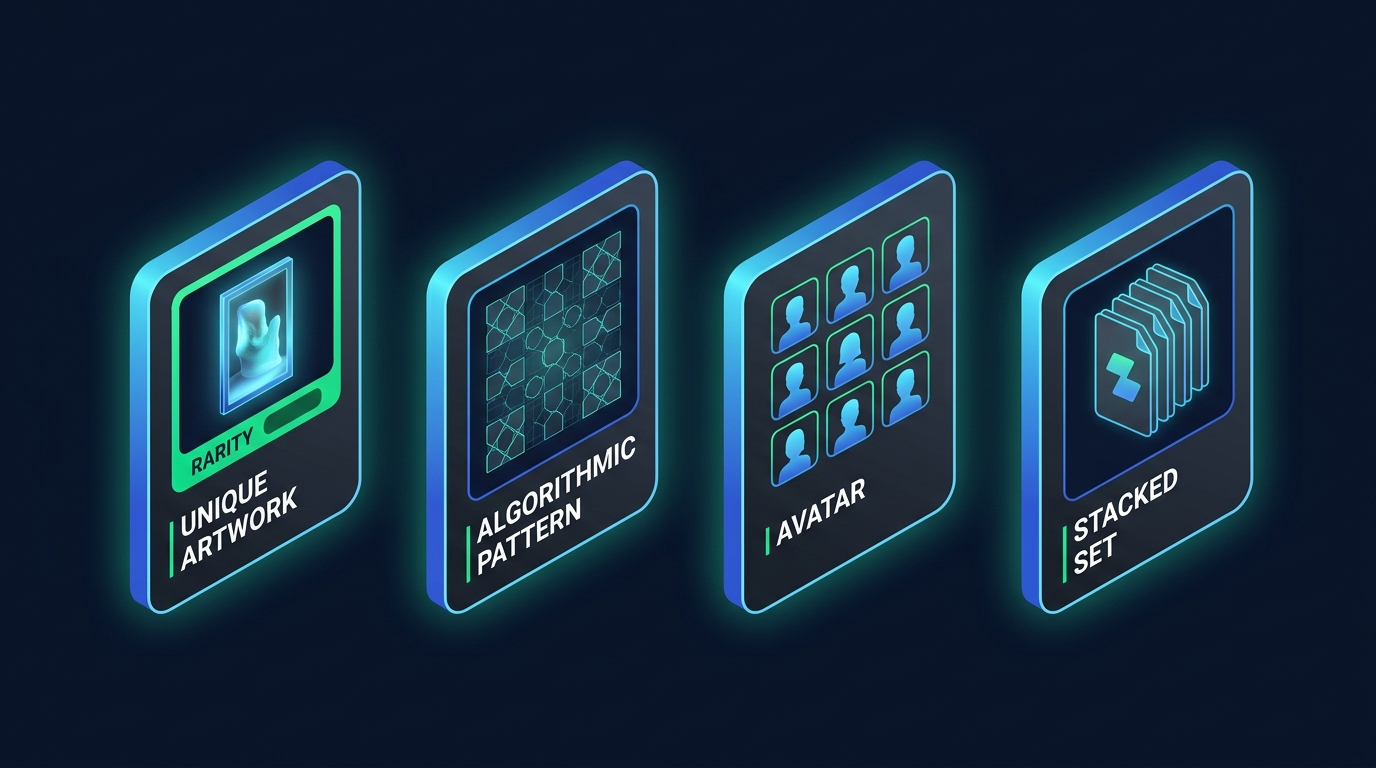
1:1 art is the closest analog to traditional fine art - a single unique work with no copies. Generative art is produced algorithmically: the artist sets parameters, and each piece is generated uniquely at mint - Fidenza #479 sold for $622,300 because its specific algorithm output was exceptionally rare within the collection's ruleset. PFP projects are 10,000-piece collections where rarity comes from trait combinations. Editions work like print runs in traditional art: multiple copies exist, but edition size is fixed.
Why does format matter for vocabulary? Floor price is a PFP concept - it has no meaningful equivalent for 1:1 pieces. Dutch auctions are almost exclusively used for 1:1 art and generative drops. Learning the vocab without knowing the format context is like learning poker rules but not knowing which game you're playing.
NFT Marketplace Vocabulary: Terms Every Buyer and Seller Must Know
Every interaction with an NFT marketplace - whether you're minting, listing, or bidding - involves a specific set of terms. These are the ones that show up the moment you connect your wallet.
Minting is where every NFT begins. When a creator mints an NFT, they're invoking a smart contract to generate a new token on-chain, linking it to a digital asset (typically an image URL) and recording it in the blockchain's ledger. From that moment, the token exists permanently - it can be sold, transferred, or burned, but it can never be unminted. The cost to mint varies by blockchain and network congestion, which brings us to gas fees.
Gas fees are the transaction costs paid to blockchain validators for processing your on-chain activity. On Ethereum, gas is priced in gwei (a fraction of ETH) and fluctuates based on network demand. During a hyped mint, gas fees can spike dramatically - a phenomenon called a gas war, where hundreds of buyers compete to get their transactions processed first by offering higher fees. Checking gas prices on Etherscan before any on-chain action is basic hygiene.
Floor price is the lowest listed price for any NFT within a given collection on secondary markets. It's the most-watched metric in NFT culture - a rising floor signals healthy demand, a collapsing floor signals panic selling or project failure. Floor price is relevant primarily to PFP and generative art collections where multiple tokens exist.
Airdrops distribute NFTs (or tokens) directly to wallet addresses, usually to reward early adopters, holders of a specific collection, or community members who completed certain actions. They're marketing tools, loyalty mechanisms, and occasionally the source of unexpected value.
Allowlists (formerly called whitelists) are pre-approved wallet address lists that grant access to mint before general public opens. Getting on an allowlist usually requires completing community tasks - Discord activity, Twitter engagement, or early community participation.
Pricing & Auction Terms: Dutch Auctions, English Auctions & Secondary Markets
In a Dutch auction, the price starts at a maximum and drops incrementally until it hits a floor or a buyer accepts. This format distributes collection ownership more equitably - buyers who want lower prices simply wait, rather than competing to bid highest. English auctions are the traditional fine art format: bids increase until the last bidder wins.
Secondary markets are where NFTs trade after their initial mint. Marketplaces like OpenSea, Blur, and Magic Eden provide the liquidity layer - collectors can list, bid, and buy without any involvement from the original creator. This is where royalties kick in: the percentage of every secondary sale automatically routed to the original creator via the smart contract. Royalties typically range from 5-10%, but a significant controversy exists in the market - some platforms have made royalties optional, bypassing creator revenue entirely.
ATH (all-time high) and ATL (all-time low) track the historical price range of a collection. Blue chip NFTs are collections with established track records of maintaining or increasing floor price over sustained periods - typically projects 2+ years old with significant trading history and cultural recognition.
Wallet & Storage Terms: Hot Wallets, Cold Wallets & Custody
Your crypto wallet doesn't actually store your NFTs - it stores your private key, the cryptographic string that proves you control a specific blockchain address. The NFTs live on the blockchain; the wallet is your access credential. Lose the private key with no backup, and that access is gone permanently - no recovery, no customer support, no exceptions.
MetaMask is the dominant browser extension hot wallet for Ethereum-based NFT activity. For high-value NFTs, cold wallet storage on a Ledger or Trezor device keeps the private key air-gapped from internet threats. Many collectors maintain both: a hot wallet for active trading with limited funds, and cold storage for long-term high-value holdings.
IPFS (InterPlanetary File System) is a decentralized peer-to-peer storage protocol used to host NFT media files. When an NFT's image URL points to an IPFS hash rather than a centralized server, the file is replicated across the IPFS network. NFTs with centralized image hosting are dependent on the creator's infrastructure staying live indefinitely - a risk most collectors underestimate.
NFT Culture & Community Slang: The Unofficial Vocab Dictionary
Much of nft vocab isn't found in any technical document - it lives on X (formerly Twitter), Discord servers, and Telegram chats. These terms carry real behavioral and social meaning within communities.
WAGMI and its opposite NGMI function as social evaluation signals - calling something NGMI is a form of community criticism, while WAGMI is collective encouragement. HODL originated in a 2013 Bitcoin forum typo and evolved into a philosophy: hold through volatility rather than panic-sell. FUD is the countermove to WAGMI - deliberately negative sentiment circulated to drive prices down, sometimes by those looking to accumulate at lower prices.
DYOR carries ethical weight beyond its surface meaning. In a market saturated with shilling (enthusiastic project promotion, sometimes paid or self-interested), DYOR is the reminder that no one's research should substitute for your own. This principle applies equally when evaluating DeFi protocols and NFT projects.
Project & Collector Archetypes: Degens, Whales, OGs & Diamond Hands
Degens aren't necessarily losing money - the term carries a hint of self-aware irony. Someone who "apes into" a project and profits becomes a celebrated degen. Whales exert outsized market influence: when a whale decides to sell a significant position in a collection, floor price often drops as the market absorbs supply. Watching on-chain whale wallet activity is a legitimate intelligence tool for active collectors.
Diamond hands vs. paper hands describes the psychological split between holders who maintain positions through drawdowns and those who sell at first sign of pressure. Neither is inherently correct - it depends entirely on whether the underlying project has genuine long-term value.
Shilling warrants special attention: it ranges from authentic community enthusiasm to coordinated paid promotion by team members or influencers with undisclosed financial interests. Heavy shilling without on-chain substance is a warning sign worth investigating before any purchase.
Getting Started with NFT Vocab: A Step-by-Step Onboarding Glossary
No other guide organizes vocabulary by the actual sequence a new collector encounters it - so here it is. Each step introduces the terms you'll meet at that specific stage. For a deeper look at how to mint your first NFT, see this step-by-step minting guide.
Step 1: Wallet Setup
Terms introduced: hot wallet, cold wallet, private key, seed phrase
Install MetaMask (or equivalent) and generate your wallet. Write your 12-word seed phrase on paper and store it physically - never digitally, never in cloud storage. This phrase IS your wallet. Anyone who has it has full access to your assets.
Step 2: Getting ETH for Gas
Terms introduced: gas fees, gwei, gas wars
Before minting or buying anything, you need ETH to pay transaction fees. Check current gas prices on Etherscan - high traffic periods can make simple transactions expensive. Budget for gas separately from the cost of the NFT itself.
Step 3: Finding a Marketplace
Terms introduced: primary market, secondary market, curated marketplace, open marketplace
Primary markets are where initial mints happen. Secondary markets handle all post-mint trading (OpenSea, Blur, Magic Eden). Curated marketplaces pre-screen artists; open marketplaces list anything. Curated platforms typically signal higher artistic quality; open platforms have more volume and liquidity.
Step 4: Evaluating a Project
Terms introduced: floor price, traits, rarity, blue chip, roadmap, utility
Before buying, check: What's the floor price and how has it moved? What's the total supply? Are traits verifiably distributed on-chain? Does the roadmap have delivered milestones or only promises?
Step 5: Buying - Auction Mechanics
Terms introduced: Dutch auction, English auction, allowlist, fixed price
Know which format you're entering before the mint. Dutch auctions reward patience - waiting for price to drop can save significant ETH. Always verify the contract address matches the official project announcement before sending any transaction.
Step 6: Post-Purchase - Custody & Royalties
Terms introduced: cold wallet, IPFS, royalties, metadata
Once you own an NFT with real value, consider moving it to cold storage. Check where the metadata and media are hosted. Understand that any resale will trigger royalties to the creator - typically 5-10%, depending on the platform you sell through.
How to Evaluate an NFT Project: Vocab for Due Diligence
Understanding nft vocab for due diligence is what separates informed collectors from impulsive buyers. These are the terms to know when assessing whether a project deserves your capital.
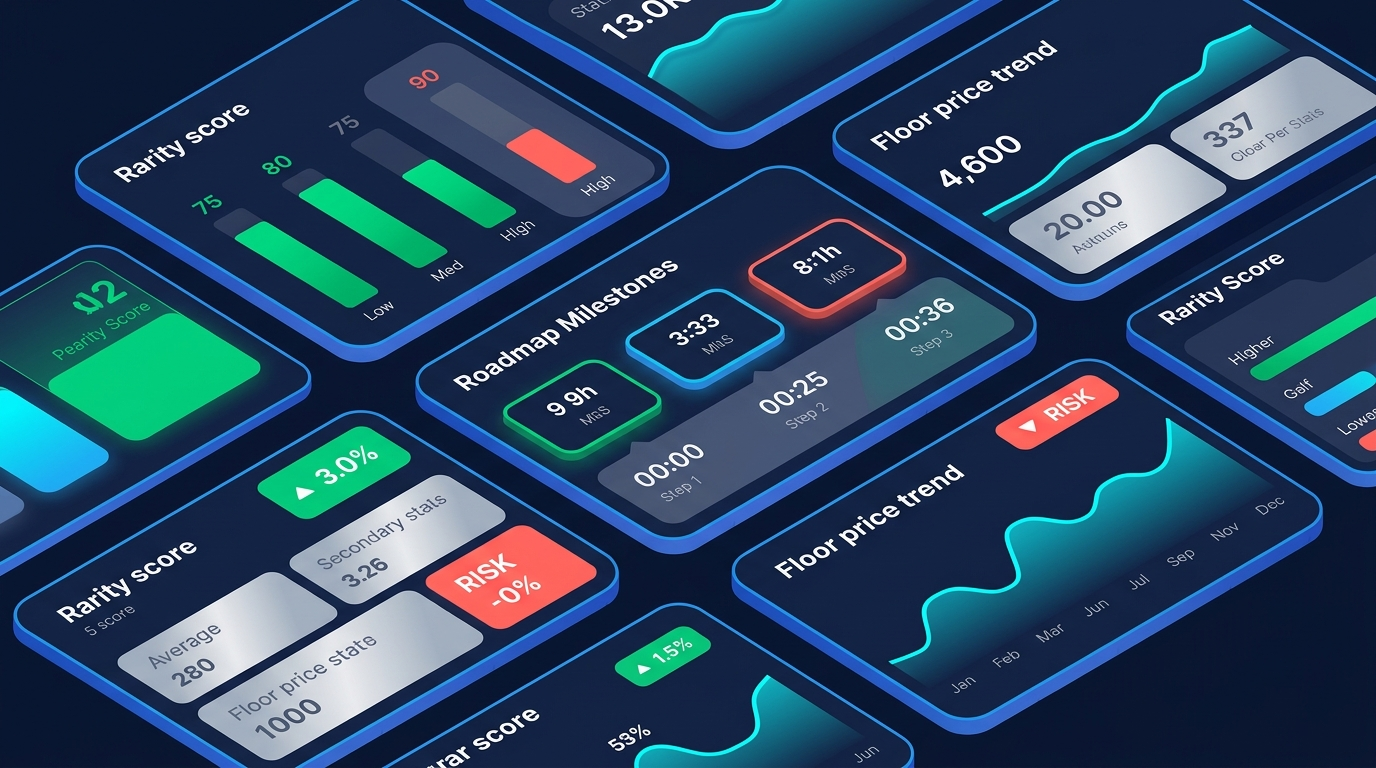
Rarity is determined by traits - the individual attributes within a generative collection that define each token's appearance. A CryptoPunk with an alien skin type (9 exist out of 10,000) is dramatically rarer than one with standard skin. Rarity tools like Rarity Sniper and on-chain metadata explorers quantify this precisely. Higher trait rarity typically commands a floor premium, but rarity alone doesn't guarantee value - the project itself must generate demand for rarity to matter.
Roadmap vocabulary matters more than most newcomers realize. An unfulfilled roadmap is frequently a precursor to a rugpull or project abandonment. When evaluating a roadmap, check not what it promises but what it has already delivered. Promises are marketing; completed milestones are evidence.
Utility expands an NFT's value proposition beyond speculative resale: staking rewards, event access, merchandise, governance rights, or integration into games and metaverse environments. NFTs with proven utility have a value floor beyond pure speculation. DAOs give NFT holders voting rights over project decisions - treasury allocation, roadmap priorities, licensing agreements. Provenance is the verifiable ownership history recorded on-chain, especially relevant for high-value 1:1 pieces.
📊 Before You Buy: 7 Vocabulary-Based Due Diligence Questions
- What is the contract address and does it match the official project announcement?
- Where is the metadata hosted - on-chain, IPFS, or a centralized server?
- What does the roadmap show as completed (not just promised)?
- What is the floor price trend over 30/60/90 days?
- Is there a genuine utility layer, or is the project purely speculative?
- Does the project have a DAO or community governance structure?
- What is the rarity distribution of traits - is it verifiable on-chain?
Free vs. Paid vs. AI-Generated NFT Projects: Understanding Business Models
Free mints charge no mint price - you pay only gas fees. They democratize access and build large holder communities rapidly, but they also lower commitment barriers significantly. Many rugpulls in 2022 were free mints: the creators had nothing financial at stake, so abandonment cost them nothing.
Paid mints create alignment between creator and collector. When a team raises significant ETH at mint, there's an expectation - though never a certainty - that they'll deploy that capital toward project development.
Lazy minting is a technical mechanism where the NFT isn't recorded on-chain until it's first sold or transferred - the creator defers gas costs until the buyer triggers the mint. It's common on OpenSea and is transparent in how it works, but collectors should understand they're buying a token that doesn't fully exist on-chain until the transaction completes.
NFT Scam Vocabulary: Red Flags Every Collector Must Recognize
Nft vocab isn't just about profits - understanding the language of scams could save your portfolio. These terms are non-negotiable knowledge for anyone putting real money into the space.
Rugpull is the most common and most costly NFT scam. Creators build hype, collect mint revenue, and then abandon the project - often deleting Discord servers and social accounts simultaneously. The tokens remain on-chain but become worthless when team support evaporates. Key red flags: anonymous teams with no verifiable identities, roadmaps with no completed milestones, and aggressive FOMO-driven marketing.
Phishing targets wallet credentials directly. Fake marketplace URLs, fake Discord mint announcements, and fake "wallet verification" requests are all designed to get you to connect your wallet or enter your seed phrase somewhere malicious. The rule is simple: your seed phrase goes nowhere, ever.
Wash trading artificially inflates trading volume and floor price by having the same entity buy and sell tokens between controlled wallets. On blockchain explorers, wash trading often appears as high transaction volume involving a small number of interconnected wallet addresses cycling assets back and forth. Blockchain analytics platforms have developed wash trading detection algorithms - basic on-chain analysis of buyer/seller wallet diversity provides a reasonable first filter.
Honeypot contracts are among the most technically sophisticated scams: the smart contract allows buying but contains code that blocks selling. Collectors can acquire the token but cannot transfer or list it. Auditing a smart contract or checking verified audit reports before minting is the defense.
Pump and dump follows the classic market manipulation playbook: coordinated buyers drive up floor price through bulk purchases, attract FOMO-driven retail buyers, then coordinate a mass exit.
⚠ Scam Terms Warning - 5 Red Flags to Know Before You Buy
- Rugpull risk → No doxxed team, promises without completed milestones, no locked liquidity
- Phishing → Any request to "verify" your wallet or enter your seed phrase online
- Wash trading → High volume but few unique wallet addresses in transaction history
- Honeypot contract → Many buys, near-zero sells in secondary market - check on Etherscan
- Pump and dump → Sudden floor spike from dormant collection + coordinated social media push
Deceptive Tactics in NFT Projects
A honeypot contract exploits buyers' inability to read smart contract code. The buy function works normally; a hidden conditional in the transfer function blocks any outbound movement unless the caller is a whitelisted address (the scammer's wallet). Defense: check that smart contracts are verified on Etherscan and look for third-party audit reports before interacting.
Fake allowlists harvest wallet data and create false hype without delivering actual access. Always verify allowlist announcements through the project's official website directly - never through links shared in Discord or Twitter DMs.
Pump and dump exploits FOMO at a mechanical level. The coordinated buy phase is designed to trigger algorithmic and psychological responses: rising floor prices on tracking sites, increasing social media mentions, and genuine FOMO in latecomers who see a "mooning" collection. The exit phase happens after maximum retail participation.
📊 Deceptive Tactic Detection Checklist
- ✅ Verify contract address on Etherscan before minting - copy from official site, not Discord
- ✅ Check transaction history on Etherscan for wallet diversity - concentrated ownership = risk
- ✅ Confirm smart contract has a verified audit from a recognized security firm
- ✅ Never click allowlist or mint links from DMs - only official website announcements
- ✅ Look for sell activity in recent sales - a collection with only buys and no sells is a honeypot signal
Advanced NFT Vocabulary: Emerging Terms for 2026
Ordinals fundamentally expand what "NFT" means. While Ethereum-based NFTs link tokens to external files, Ordinals inscribe data directly onto individual satoshis - the smallest Bitcoin denomination. Every Ordinal is stored entirely on Bitcoin's blockchain, making it arguably more permanent than standard Ethereum NFTs.
Layer-2 blockchains like Polygon, Base, and Immutable X solve Ethereum's gas fee problem by processing transactions off the main chain and settling them in batches. Gas on L2 can be a fraction of Ethereum mainchain - sometimes under $0.01 per transaction.
Proof-of-Stake replaced Ethereum's energy-intensive Proof-of-Work consensus in September 2022 (the Merge). Ethereum's energy consumption dropped approximately 99.95% post-Merge, neutralizing the environmental criticism that had dogged Ethereum-based NFT activity.
Tokenization is where NFT vocabulary bleeds into traditional finance: real estate deeds, private equity stakes, and intellectual property licenses are being converted into on-chain tokens. Soulbound tokens are non-transferable NFTs permanently tied to a single wallet - their purpose is identity and credential representation: proof of education, community contribution, or professional achievement.
Conclusion - Your NFT Vocab Reference for 2026
Mastering nft vocab isn't a one-time exercise - it's an ongoing practice that evolves with the market. New protocols introduce new terms; new scam vectors require new defensive vocabulary; new asset classes like ordinals, tokenized real estate, and soulbound identity tokens expand the lexicon in directions that weren't on anyone's radar in 2021.
Your starting point depends entirely on where you are in your journey. DYOR isn't just a slogan - it's the foundational practice that all the vocabulary above serves.
The through-line across all three tracks is the same: on-chain verifiability over claimed performance. Every piece of nft vocab worth knowing either helps you verify something independently or helps you recognize when someone is asking you to take their word for it instead. Blockchain-based ownership exists precisely because trust-based systems can fail. Understanding vocabulary like contract address, metadata hosting, and wash trading puts verification power directly in your hands - exactly where it belongs.
For collectors looking to explore the broader NFT ecosystem, see our guide to top NFT projects to follow and the best NFT games to earn from.
Crypto and NFT trading involves substantial risk of loss. NFTs are speculative digital assets whose values can decline to zero. Nothing in this article constitutes financial advice or a recommendation to buy or sell any specific asset. Always conduct your own research before making investment decisions.
Last updated: March 2026.
Frequently Asked Questions
What does NFT stand for?
NFT stands for Non-Fungible Token. "Non-fungible" means the token is unique and cannot be replaced by an identical copy - unlike ETH or USD, where every unit is interchangeable with any other. An NFT is a cryptographic record on a blockchain that certifies ownership of a specific digital asset. Each NFT has a unique token ID within its smart contract, distinguishing it from every other token in the same collection. The blockchain record is permanent, publicly verifiable, and not controlled by any single entity, making on-chain ownership provably trustless.
What is minting an NFT?
Minting is the process of creating a new NFT by invoking a smart contract on a blockchain, which generates a unique token ID and permanently records it in the ledger. When you mint an NFT, you're publishing a digital asset on-chain for the first time - the token links to metadata (an image or file URL) and records your wallet as the original owner. Minting requires paying gas fees in addition to any mint price the creator sets. Once minted, the token exists permanently on-chain - it cannot be unminted, though it can be transferred, sold, or burned to a null address.
What does floor price mean in NFT?
Floor price is the lowest listed price for any NFT within a specific collection on secondary marketplaces. It represents the minimum cost to enter a collection without going through auction. Floor price is widely watched as a collection health indicator: rising floors signal increasing demand or supply tightening; falling floors may indicate selling pressure or reduced project interest. Floor price is most relevant for PFP and generative art collections with multiple tokens. For 1:1 art pieces, there is no floor price - each work is individually priced based on its own provenance and rarity within the collector market.
What is a rugpull in NFT?
A rugpull is a scam where NFT project creators abandon the project after collecting mint revenue - typically by shutting down Discord servers, deleting social media accounts, and disappearing with funds. The tokens remain on the blockchain but become worthless when team support vanishes. Rugpulls range from obvious fraud to soft rugs (gradual abandonment without explicit theft). Key red flags include anonymous teams with no verifiable identities, roadmaps with no completed milestones, and aggressive FOMO-driven marketing that discourages independent verification. DYOR discipline and checking on-chain data before minting is the primary defense.
What are gas fees in NFT transactions?
Gas fees are transaction costs paid to blockchain validators for processing on-chain activity, including NFT mints, transfers, and sales. On Ethereum, gas is denominated in gwei (fractions of ETH) and fluctuates based on network demand - the more activity competing for block space, the higher the fee. During hyped mints, gas wars can erupt where buyers outbid each other on fees to ensure their transactions process first, sometimes driving gas costs above the mint price itself. Gas fees are paid even on failed transactions on Ethereum, so checking current gas prices on Etherscan before initiating any transaction is standard practice for active collectors.
What is DYOR and why does it matter?
DYOR stands for "Do Your Own Research" - a widely used phrase reminding participants to conduct independent due diligence rather than acting on others' advice or social media hype. In a market saturated with shilling and coordinated promotions, DYOR is both an ethical reminder and a practical directive. Genuine DYOR in the NFT context means verifying contract addresses on Etherscan, checking team identities, reviewing completed roadmap deliverables, analyzing on-chain trading data for wash trading signals, and confirming metadata hosting permanence. Trusting community sentiment alone without on-chain verification consistently leads to losses in both bull and bear market conditions.
What is wash trading in NFTs?
Wash trading is a market manipulation technique where the same entity - or a coordinated network - buys and sells NFTs between controlled wallets to create artificial trading volume and inflate apparent floor prices. On blockchain explorers, wash trading appears as high transaction volume involving a small number of interconnected wallet addresses cycling assets. It artificially signals demand to outside observers, attracting genuine buyers who provide exit liquidity to the manipulators. Basic on-chain analysis - checking whether a collection's top buyers and sellers are distinct, unrelated wallets - provides a reasonable first filter against wash trading exposure before committing capital.